Almost any metal-band watch is built around one of a small handful of bracelet families that have shaped wristwatch design for nearly a century. The Jubilee, the Oyster, and mesh (sometimes called Milanese) bracelets all do the same basic job of holding a watch to the wrist, yet they look, move, and feel completely different once placed side by side. Knowing what separates them isn’t just trivia for watch collectors — it changes how a watch sits on the arm every single day, how dressy or rugged it looks, and even how it ages over the years.
What Is an Oyster Bracelet?
The Oyster bracelet is a sturdy, three-link metal band with a wide, flat center link flanked by two narrower outer links, best known for its no-nonsense, tool-watch look. It’s the bracelet most people picture when they think of a classic steel sports watch, and it was built from the start to feel solid and take a beating.
Rolex is the brand most closely tied to the Oyster name, and the design has quite a specific backstory. According to Rolex itself, the bracelet was developed in the late 1930s, growing out of founder Hans Wilsdorf’s idea of the wristwatch as a rugged tool built for a modern, demanding world. It didn’t reach the wider public right away, though — the design was formally patented in 1947 and started appearing in catalogs in 1948, and its early links were made by an outside bracelet manufacturer before Rolex eventually bought that company outright decades later.
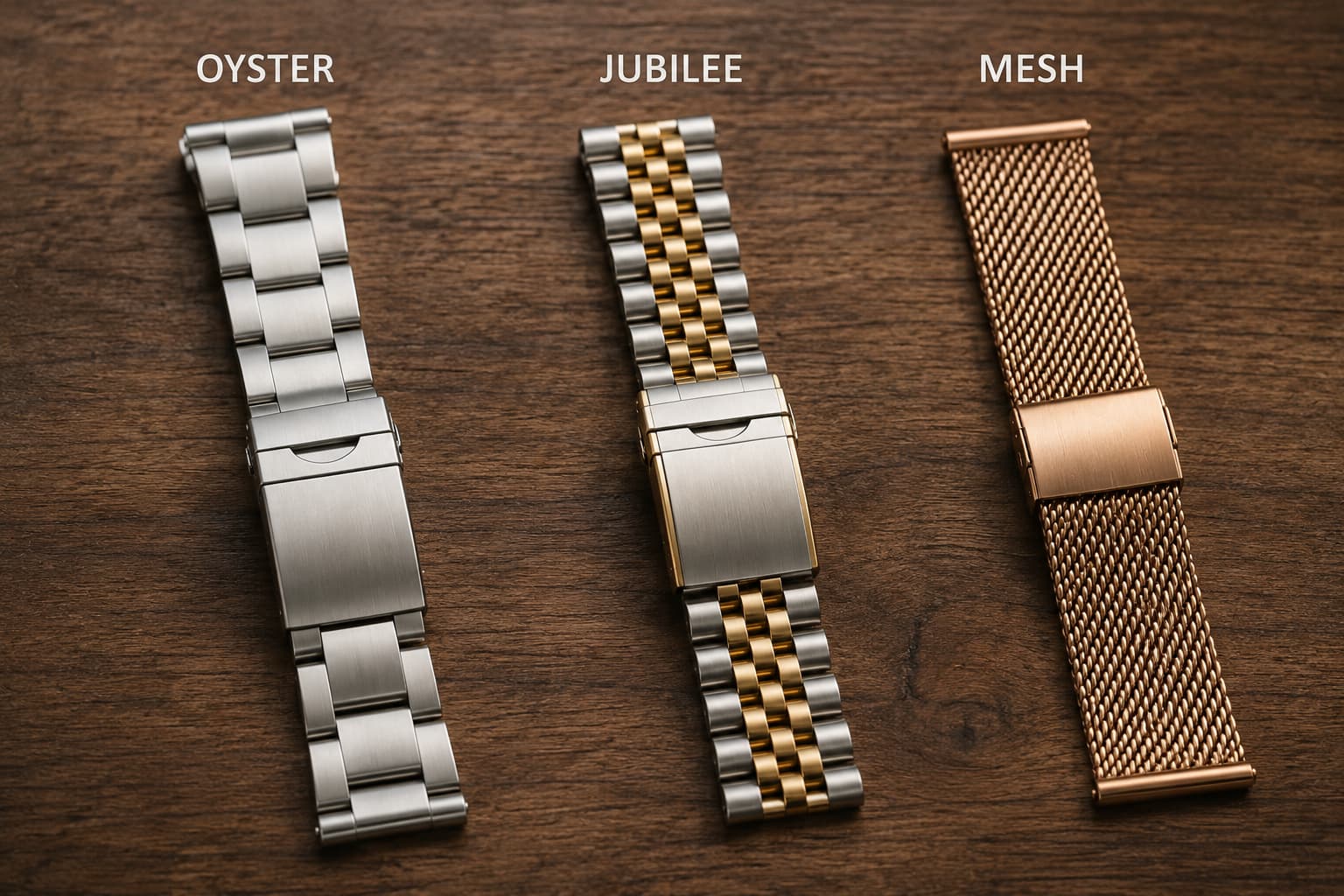
Structurally, the Oyster has stayed remarkably consistent. Three flat pieces link together — a raised center link running down the middle, flanked by a narrower link on each side — creating a band that feels chunky, substantial, and resistant to stretching. Because it doesn’t flex as much as bracelets with smaller links, it tends to sit more rigidly on the wrist rather than draping over it. That’s exactly why it became the standard choice on dive watches, pilot watches, and other “professional” tool watches, where durability matters more than delicate looks.
The Oyster bracelet works much like a bike chain built for heavy use — thick, simple, and made to survive rough conditions without falling apart.
The bracelet has also gone through real engineering upgrades over the decades, not just cosmetic ones. The earliest versions used hollow links held together with visible rivets, which looked great but stretched and loosened with years of wear. By the late 1960s these were replaced with a folded-link design that was noticeably sturdier, and by the mid-1970s manufacturers moved to the fully solid links still used today, which is why vintage rivet-style Oysters feel so much lighter and thinner in the hand than a modern one. The clasp has evolved alongside the links, too — most current Oyster-style bracelets use either a simple folding clasp or a locking version that adds a hidden safety catch so it can’t pop open by accident, a small but reassuring detail on a watch worn while swimming or working with the hands.
What Is a Jubilee Bracelet?
The Jubilee bracelet is a five-link metal band with smaller, more intricate links that create a softer, more elegant drape than the Oyster. It was designed to look closer to fine jewelry than to sturdy tool equipment, and that distinction still defines it today.
The name comes from its debut occasion. It was created in 1945 to mark Rolex’s 40th anniversary, launching alongside the original Datejust — the brand’s first self-winding watch with a date window. Each row uses five pieces total: two larger links on the outside carry a brushed finish, while three smaller links running between them are polished to a mirror shine, so the whole bracelet flickers between matte and shiny surfaces as it catches light.
Because it uses more, smaller links than the Oyster’s three-piece setup, the Jubilee has more points where it can bend. That extra articulation is the whole secret behind its reputation for comfort — it doesn’t just sit on the wrist, it wraps around it, following the curve of the arm during movement. This is also why it’s traditionally been paired with dressier watches meant for formal occasions rather than diving or fieldwork, though it has since found its way onto some sportier references too.
The Jubilee has also picked up a few small technical touches since 1945. On dressier watches it’s typically fitted with a simple, low-profile folding clasp, while on the sportier watches that later adopted it, it sometimes gets a more secure, safety-catch clasp instead — the same underlying idea as the Oyster’s clasp options, just dressed up to match the bracelet’s finer proportions. Interestingly, the “hollow center link” construction that once made older Jubilee bracelets prone to stretching over time has now been replaced with solid links on modern production, closing the durability gap that used to separate it from the tougher Oyster.
Neither the Oyster nor the Jubilee is objectively “better” — they were built with different goals in mind, and the choice between them really comes down to whether a watch should feel like sturdy gear or like a polished accessory.
What Is a Mesh (Milanese) Bracelet?
A mesh bracelet, often called a Milanese bracelet, is made from hundreds of thin metal wires woven together into a flexible fabric-like sheet rather than a chain of solid links. Instead of individual pieces connected by pins, the whole band behaves like a single continuous surface that bends and folds almost like cloth.
The weaving technique behind it is genuinely old. Some sources trace the weaving method itself back to chain-mail work as early as the 13th century, while the specific jewelry version most associated with watches took shape later, when metalworkers in Milan spent the Renaissance and baroque periods coiling fine wire by hand and weaving it into necklaces and bracelets — a slow, skilled process that gave the style its name, since “Milanaise” is simply Italian for “of Milan.” That craft stayed a jewelry specialty for centuries before it crossed over into watchmaking. A turning point came around the turn of the 20th century, when a handful of German workshops — Staib among the best known — worked out how to weave the mesh by machine instead of by hand, cutting the cost dramatically and putting it within reach of ordinary watch buyers for the first time.
Because it’s woven rather than jointed, mesh has no rigid links to catch on hair or skin, and it distributes tension across the whole band instead of concentrating it at a few pivot points. That’s what gives mesh its trademark silky, almost weightless feel — it conforms to the exact shape of the wrist rather than approximating it with a handful of fixed segments. Most mesh bands also use a sliding clasp instead of fixed sizing holes, allowing the fit to be adjusted in tiny increments rather than locked into set positions.
Not all mesh is identical, either. Milanese mesh uses very fine wire in a tight, smooth diagonal weave, while a heavier variant built from thicker wire — often called “shark mesh” — gives a chunkier, more textured surface and has shown up on rugged dive watches over the years. There’s also a “Polonaise” weave with a visibly different alternating pattern, so the word “mesh” alone doesn’t guarantee a specific look or feel.
Mesh has had a couple of real moments in the spotlight since it entered mainstream watchmaking. It became especially fashionable in the 1960s and 1970s, when it was frequently paired with the very thin, elegant gold watches that defined that era’s dress-watch style, giving off a similar shine and slink as the case itself. It then spent a few decades playing more of a supporting role behind bulkier, integrated bracelet designs, before smartwatches brought it roaring back — the woven “Milanese Loop” band introduced for the Apple Watch reintroduced the style to a huge new audience and sparked fresh interest in traditional mesh straps for mechanical watches too.
Oyster vs. Jubilee vs. Mesh: Which One Fits Best
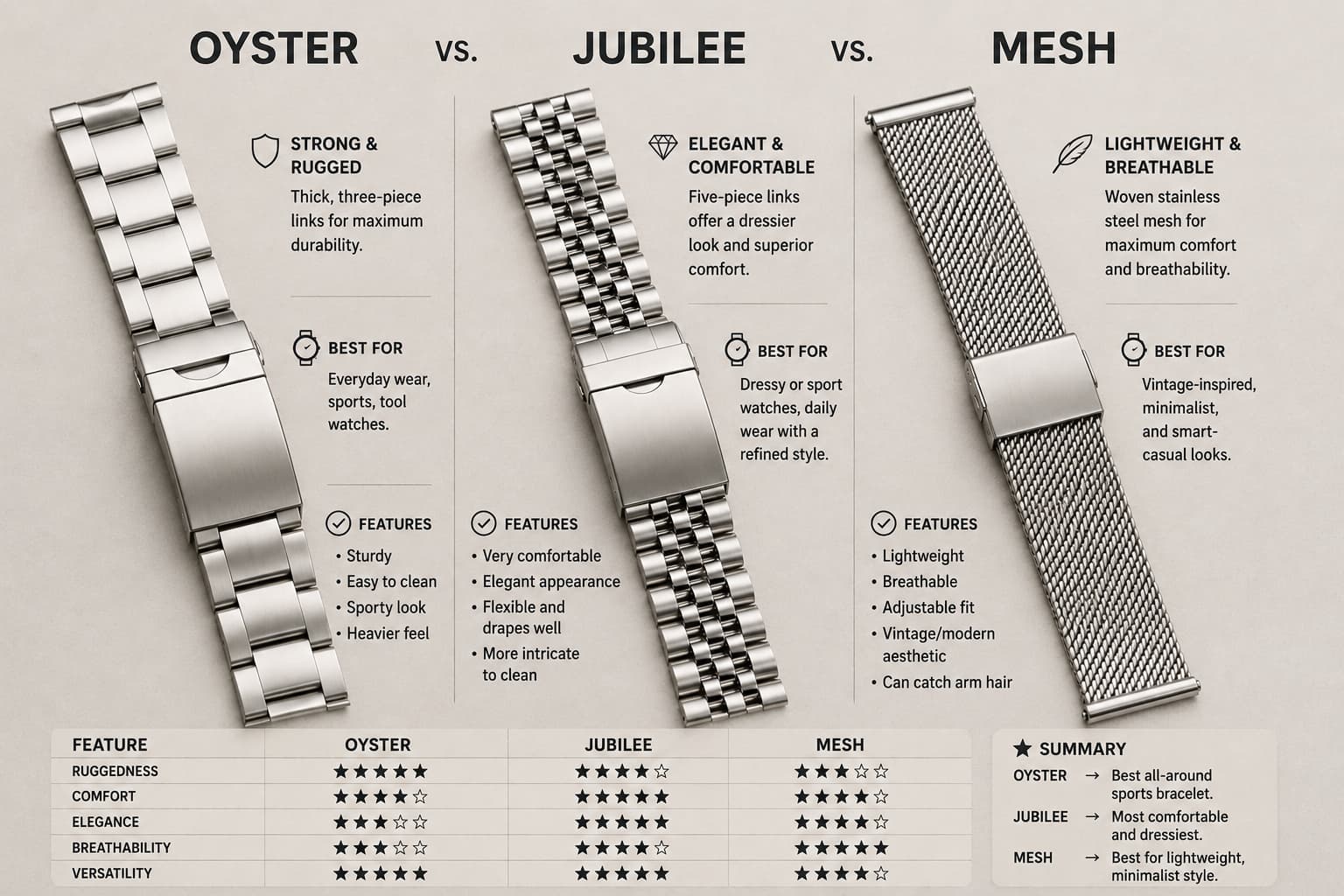
Each bracelet type was built to solve a different problem, so the ideal choice depends on daily habits and personal style more than on any single “correct” answer.
| Feature | Oyster | Jubilee | Mesh |
|---|---|---|---|
| Construction | Three-piece links | Five-piece links | Woven wire, no fixed links |
| Debut | Late 1930s (patented 1947) | 1945 | 1800s (Milan); popularized in watches by the early 1900s |
| Look | Bold, simple, sporty | Layered, refined, dressy | Smooth, fabric-like, shimmering |
| Feel on wrist | Solid, more rigid | Supple, drapes well | Very flexible, silky against skin |
| Adjustability | Fixed holes, sometimes a micro-adjust extension | Fixed holes, sometimes a micro-adjust extension | Sliding clasp, fine-tuned in small increments |
| Typical pairing | Tool and sport watches | Dress watches, some GMT models | Dress watches, divers, and modern smartwatches alike |
Oyster suits an active lifestyle or a work environment where the watch needs to feel tough and low-maintenance without much thought. Jubilee leans closer to jewelry, offering a comfortable drape with a bit more visual sparkle for dressier settings. Mesh stands out in warm climates or for smaller wrists, where a close, cool fit against the skin and fine adjustability matter most.
None of these choices is permanent in the way it might seem. Many watch brands offer the same case on multiple bracelet options, and aftermarket straps allow plenty of watches to switch styles without a full replacement.
How to Identify Each Bracelet Type
The fastest way to identify a bracelet is to count the rows of links across its width and check whether it bends in one direction or moves like fabric. A few seconds of looking usually settles the question before anything else needs checking.
Three flat pieces across each row — a wide one in the middle flanked by two slightly narrower ones — point to an Oyster-style bracelet, which feels stiff and substantial and only bends up and down at each joint rather than side to side. Five smaller pieces across each row, with the outer two brushed and the inner three shinier, mark the Jubilee pattern, noticeably lighter and more flexible than the Oyster and prone to draping rather than sitting. A band with no individual links visible at all, resembling a woven metal sheet, is mesh — it moves like tightly woven cloth rather than clicking link by link.
Frequently Asked Questions
Is the Jubilee bracelet more comfortable than the Oyster?
Most wearers do find the Jubilee more comfortable because its five smaller links create more flex points, letting it curve naturally around the wrist rather than sitting more rigidly like the three-link Oyster. That said, both are considered comfortable for all-day wear, and the difference tends to be a matter of degree rather than one being uncomfortable.
Does a mesh bracelet stretch or loosen over time?
Because mesh is woven rather than pinned link by link, it’s generally quite resistant to the kind of stretching that can eventually affect older jointed bracelets, though heavy long-term wear can still cause gradual wear at the weave. Quality varies a lot between manufacturers, so a well-made mesh band from a reputable maker tends to hold its shape for years.
Can mesh bracelets get caught on arm hair?
It’s less common than expected. Because the weave is tight and smooth rather than made of gapped links, mesh bands generally cause less hair-pulling than some jointed bracelets, though this can still depend on the tightness of the weave and how the clasp sits against the skin.
Are Oyster and Jubilee bracelets exclusive to Rolex?
The names Oyster and Jubilee are specifically Rolex’s own bracelet designs and terminology, though other brands make bracelets with a similar three-link or five-link structure under different names. Mesh, by contrast, is used across the watch industry by many different brands and isn’t tied to one company.
Which bracelet type is best for hot or humid weather?
Mesh tends to perform especially well in heat and humidity because its fine, breathable weave allows more airflow against the skin than a solid jointed bracelet, and it doesn’t trap moisture the way a leather strap can. Oyster and Jubilee bracelets are also fine in warm weather since they’re solid metal, but they won’t have quite the same airy feel as mesh.
Conclusion
Choosing between Jubilee, Oyster, and mesh really comes down to matching the bracelet’s original purpose to the wearer’s own life: the Oyster was built for durability and daily toughness, the Jubilee for a dressier, more fluid feel with a touch of sparkle, and mesh for a lightweight, closely conforming fit rooted in centuries-old weaving craft. All three have earned their staying power for good reason, and understanding what makes each one tick makes it far easier to identify the bracelet that will actually feel right on the wrist, not just look right in a photo.