Marc Jacobs built his name in clothing, not clocks, but his watches have earned a loyal following anyway. They mix bold color, clean shapes, and a bit of New York attitude into pieces meant for daily wear. The manufacturing history, materials, and pricing behind the name tell a fuller story than the logo on the dial ever could.
The Company Behind Marc Jacobs Watches
Marc Jacobs does not build its own watches in-house. Like most fashion brands, it licenses its name to a watchmaking company that designs, manufactures, and sells the timepieces on its behalf.
From 2004 to 2018, that partner was Fossil. Fossil expanded heavily into fashion-brand licensing in the early 2000s, and it added Marc Jacobs to its roster in 2004, around the same time it picked up Michael Kors. This is why older Marc Jacobs watches often share build quality and case style with Fossil, Michael Kors, and DKNY watches from the same era. They came out of the same factories and suppliers, and sometimes even the same case designs.
That changed in 2019. Bedrock Manufacturing, the parent company of Shinola and Filson, took over the Marc Jacobs watch license that fall, ending the long run with Fossil. Bedrock is based in Detroit and also runs Shinola, a brand known for assembling watches in the United States. Marc Jacobs watches today are handled by this Bedrock-run operation, sometimes listed as “Bedrock Watch Company” on official warranty paperwork.
Bedrock’s founder, Tom Kartsotis, is also the person who started Fossil back in 1984, making him the entrepreneur behind two separate chapters of Marc Jacobs watch history.
The very first Marc Jacobs watches debuted in fall 2005, a year after the Fossil license was signed. Fossil described them at launch as Swiss-made, sold at first through the brand’s own stores and a limited number of department store partners before broader retail distribution followed. A second, more playful line called Marc by Marc Jacobs arrived in 2006, aimed at a younger and more casual customer than the main collection. The Marc by Marc Jacobs clothing label itself was discontinued in 2015, and Marc Jacobs watches have carried the single Marc Jacobs name in the years since.
What Materials Do Marc Jacobs Watches Use
Marc Jacobs watches use a mix of global components rather than being built entirely in one country. According to the brand’s own warranty page, movements come from Japan or from Swiss parts assembled in Thailand, while the watches themselves are put together in China. Officially, a watch’s country of origin follows the origin of its movement, not the final assembly location.
Every current Marc Jacobs watch uses what the brand calls a K1 Hardened Mineral Crystal for the lens covering the dial. This is a treated glass that resists scratches better than plain mineral glass, but it is still softer than sapphire crystal, which is the toughest option used on higher-end watches. It holds up fine under normal daily wear, but it is not built to survive rough treatment the way a sapphire crystal would.
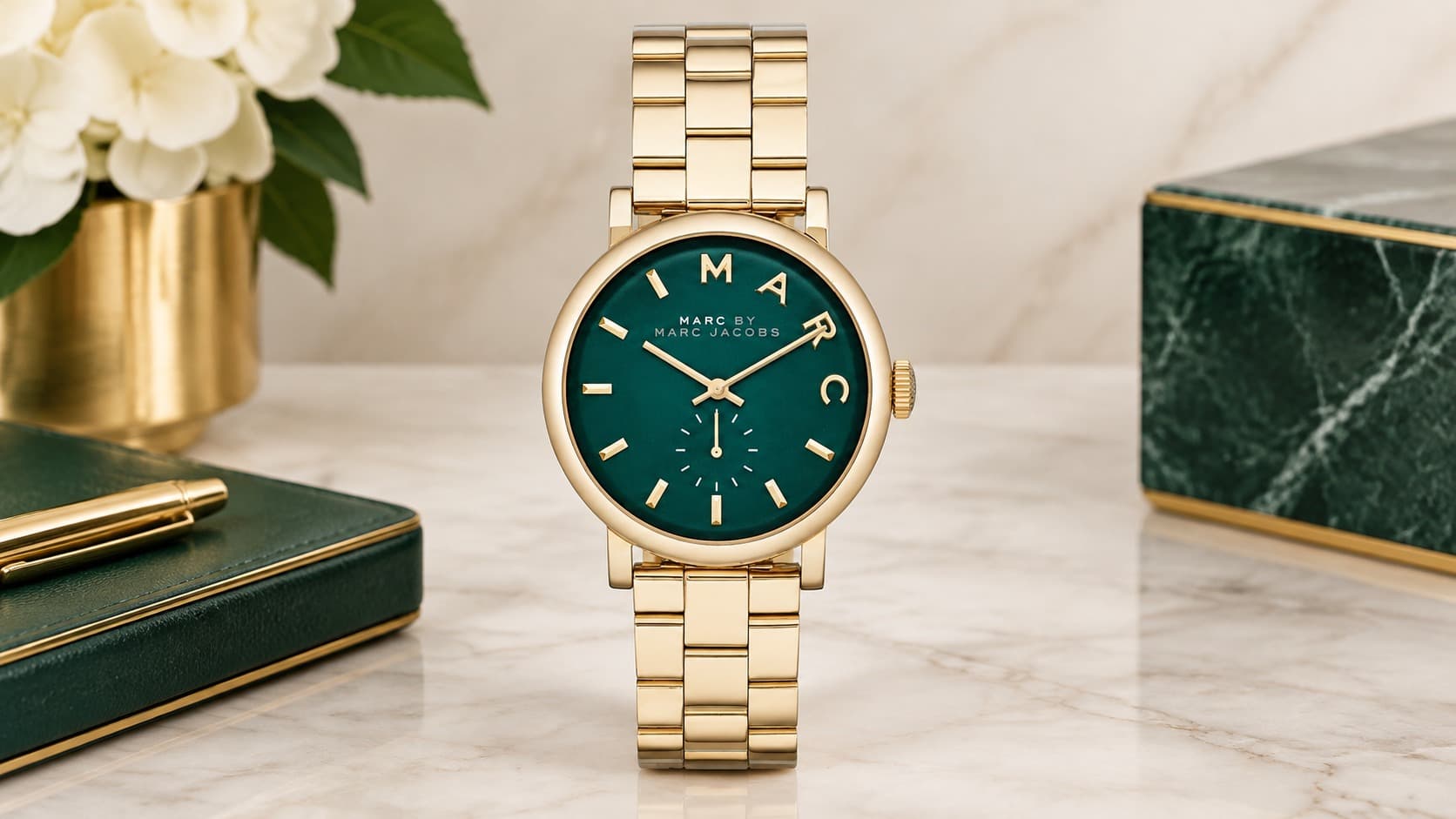
Cases are typically stainless steel, sometimes finished in rose gold or gold tone, paired with either a matching metal bracelet or a leather strap. The combination keeps the watches lightweight and affordable compared to Swiss luxury brands, while still looking polished enough for an office or a night out.
Best-Known Marc Jacobs Watch Models
During the Fossil years, a handful of Marc Jacobs watch families became especially popular, and secondhand or discounted versions of these still turn up often today. The names refer to case shape and dial style rather than a single fixed product, which explains why so many colorways and material combinations exist under each one.
- Baker – A rounder, classic case shape, often available with either a leather strap or matching metal bracelet. This was one of the brand’s longest-running families.
- Amy – A smaller, more delicate case built for everyday wear, usually shown with pastel or metallic dial colors.
- Roxy – Known for pairing leather straps with contrast-tone dials for a slightly dressier look.
- Vic – A slim, minimal design with a simple round face and rose gold accents.
- Riley – A sportier option built around a round case face with bold, oversized numerals on the dial.
- Classic Mini – A compact case built for a subtle, understated look.
- Pelly, Henry, and Blade – Additional lines from the same era, each offering slightly different case shapes and strap combinations.
Fossil released many colorways and material combinations under each name, which is why “Baker” watches exist in silver, gold, and rose gold while sharing the same core design. The Riley name later became the base for the brand’s smartwatch line as well.
Marc Jacobs Also Made Smartwatches
Between 2017 and 2018, Marc Jacobs briefly entered wearable tech with two versions of the Riley smartwatch, both manufactured by Fossil Group. The first, the Riley Hybrid, launched in 2017 at $165. It looked like a normal analog watch but added smartphone notifications, activity tracking, and sleep monitoring, all controlled through three customizable side buttons rather than a touchscreen. A coin-cell battery powered it for around six months at a time, avoiding the nightly charging typical of most smartwatches.
A second version, the Riley Touchscreen, followed in 2018 at $295 and ran on Google’s Wear OS software. This model added a 1.19-inch touchscreen display, a Snapdragon processor, and standard smartwatch features like Google Assistant, along with the daily charging that touchscreen smartwatches of that era generally required. Both Riley smartwatches were discontinued once Marc Jacobs ended its licensing agreement with Fossil in 2018, and the current Bedrock-made collection does not include any smart or connected models. Secondhand units today function better as pieces of tech history than as daily drivers, since app support for older Wear OS and hybrid smartwatch models tends to fade over time.
Men’s vs. Women’s Marc Jacobs Watches
Marc Jacobs has always designed watches for both men and women, though the brand’s identity leans more heavily toward womenswear overall. Women’s models tend to run smaller, often in the 28mm to 36mm case range, and lean into crystal accents, pastel dials, and slimmer bracelets.
Men’s models, when available, use larger cases, usually 40mm and up, with simpler dials and darker color schemes like black, gunmetal, or brown leather. Because the brand’s accessories business is built mostly around fashion-forward women’s pieces, men’s watch options have historically made up a smaller part of the lineup compared to competitors like Fossil or Michael Kors.
How Much Do Marc Jacobs Watches Cost
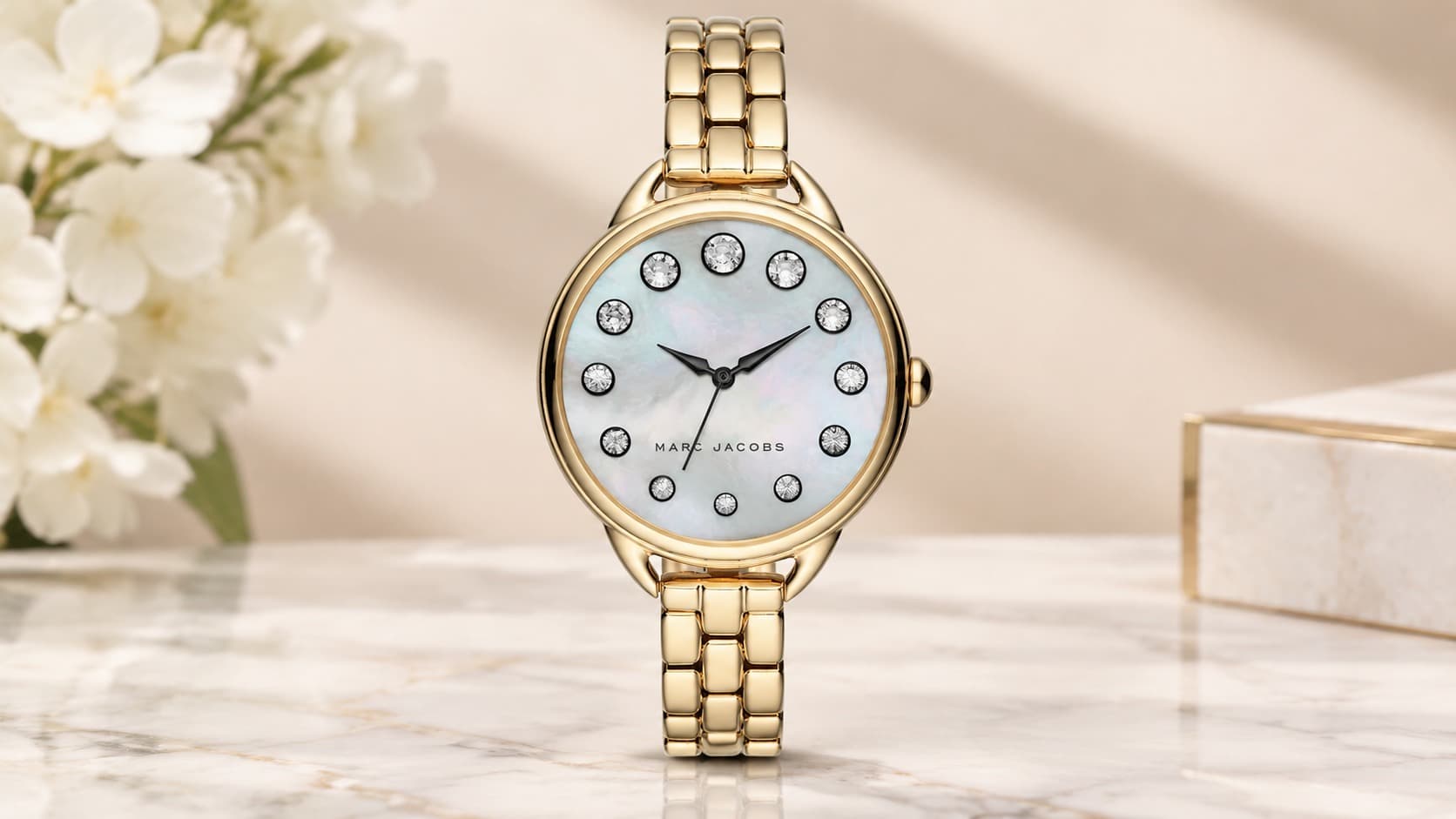
When Marc Jacobs watches launched in 2005 and 2006, industry reporting placed retail prices between $125 and $300, positioning the collection above basic quartz brands but well under Swiss watchmaking. By the later Fossil years, list prices for many models climbed higher, commonly landing between $319 and $367 before markdowns, based on prices currently listed across multiple retailers. Discounted or outlet versions of those same models often sell for $128 to $152, well over half off the original list price.
| Category | Typical Price |
|---|---|
| Original 2005–2006 launch retail | $125–$300 |
| Later-era list price (pre-discount) | $319–$367 |
| Common outlet or discount price | $128–$152 |
| Riley smartwatches (Hybrid / Touchscreen, discontinued) | $165–$295 |
An unusually low price for a “brand new” listing is generally a sign to confirm the seller is authorized, since counterfeit fashion watches are common in this price bracket.
Resale value is another factor worth weighing. Fashion watches as a category, including Marc Jacobs, generally do not hold or gain value the way Swiss mechanical watches from brands like Rolex or Omega can. They run on mass-produced quartz movements rather than in-house mechanics, and the appeal rests on design and branding rather than horological craftsmanship. The watches function best as stylish accessories meant for regular wear rather than long-term investment pieces.
How to Take Care of a Marc Jacobs Watch
The K1 crystal needs gentle treatment, since it scratches more easily than sapphire. Setting the watch face-down on hard surfaces like countertops or wooden desks raises the risk of scratches, as does storing it loose near keys or other metal objects in a bag or pocket.
Water exposure is another risk area, since most fashion watches in this category are only splash resistant rather than built for swimming or diving unless specifically rated otherwise. A soft pouch or watch box protects the case between wears, and wiping the case and strap with a dry cloth afterward removes sweat and oils that can wear down leather straps or dull metal finishes over time.
Marc Jacobs directs repair requests to the Bedrock Watch Company Service Center in Detroit rather than a local jeweler, making it worth checking the current warranty terms before attempting a fix independently.
Care for the discontinued Riley smartwatches looks a little different. The Hybrid model runs on a replaceable coin-cell battery, so a jeweler or watch repair shop can swap it in a few minutes once it dies. The Touchscreen version depends on a working wireless charger and, since it relies on Wear OS software, functionality may fade over time as Google updates the platform and moves away from older devices.
How to Authenticate a Marc Jacobs Watch
The caseback is the first place to check. Genuine watches carry a model number stamped there, usually starting with letters like MJ or MBM, which can be cross-referenced online. A missing or blank caseback is a warning sign.
The logo engraving on the dial or bezel is another indicator worth close inspection. Authentic pieces show crisp, evenly spaced lettering, while counterfeits often show blurry or uneven text under close inspection. Weight matters too: genuine stainless steel cases feel solid, while fakes often feel unusually light because they use cheaper alloys.
A “brand new” Marc Jacobs watch priced far below every other listing for the same model number is a signal to verify the seller before buying, rather than a genuine bargain.
Frequently Asked Questions
Are Marc Jacobs watches considered luxury?
No. Marc Jacobs watches sit in the fashion watch category, similar to Fossil or Michael Kors, rather than the luxury or fine watchmaking category occupied by Swiss brands. The focus rests on style and affordability rather than in-house mechanical movements or premium materials like sapphire crystal.
Does Marc Jacobs still make watches?
Yes. Bedrock Manufacturing, the company behind Shinola, has produced and distributed Marc Jacobs watches since 2019, taking over from Fossil, which held the license from 2004 to 2018.
What movement do Marc Jacobs watches use?
Current Marc Jacobs watches use quartz movements sourced from Japan or Swiss components assembled in Thailand, according to the brand’s official warranty information. Quartz movements run on a battery and are known for accurate, low-maintenance timekeeping.
Are Marc Jacobs watches waterproof?
Most Marc Jacobs fashion watches are only water resistant to a light degree, capable of handling rain or hand washing but not built for swimming or diving. The specific water resistance rating printed on the caseback determines what any individual watch can safely handle.
How can replacement parts like straps or links be found?
For extra bracelet links or repairs, Marc Jacobs directs customers to contact the Bedrock Watch Company customer service line directly, since local jewelers may not stock brand-specific parts for this style of fashion watch.
Did Marc Jacobs ever make a smartwatch?
Yes. The brand released the Riley Hybrid Smartwatch in 2017 and the Riley Touchscreen with Wear OS in 2018, both made by Fossil Group. Both were discontinued once Marc Jacobs ended its watch license with Fossil in 2018, and the current Bedrock-made collection is entirely analog.
The Bottom Line
Marc Jacobs watches were never meant to compete with Swiss horology, and that was always the point. They deliver a strong dose of the brand’s design personality, built around accessible materials, quartz reliability, and prices that stayed in the low hundreds rather than the thousands. Whether the appeal is a vintage Baker or Roxy from the Fossil years or a newer piece from the Bedrock era, the manufacturing history and materials behind the name explain what the watch actually is and how well it holds up over time.