A mother’s ring is one of the few pieces of jewelry designed to tell a story instead of just complete an outfit. Each stone set into the band stands for a real person, usually one of the wearer’s children, which turns a simple ring into something closer to a wearable family tree. It has become a go-to gift for Mother’s Day, milestone birthdays, and the arrival of a new baby, precisely because it says something specific rather than something generic.
What Is a Mother’s Ring?
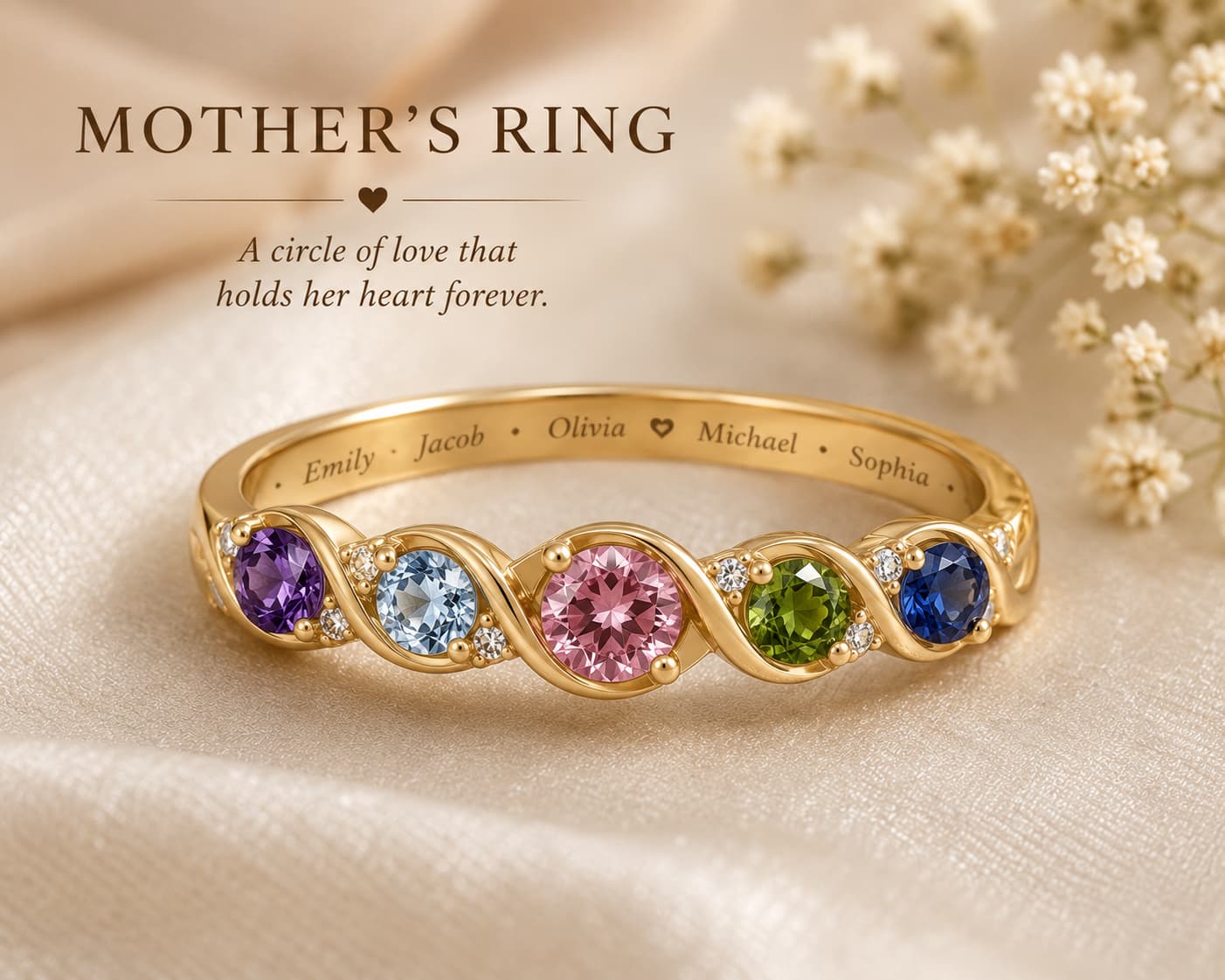
A mother’s ring is a ring set with one birthstone for each of a mother’s children, arranged together in a single piece of jewelry. The stones are usually chosen based on each child’s birth month, so a mother with kids born in March, July, and October might end up with a ring featuring an aquamarine, a ruby, and an opal side by side. Because the arrangement is built entirely around the wearer’s own family, no two mother’s rings are ever quite the same.
The concept exists to solve a specific problem: how to represent more than one loved one in a single piece rather than buying separate items for each. Some families extend the idea further and add stones for a spouse, grandchildren, or a child who has passed away, which is why these designs are sometimes marketed as family rings rather than strictly mother’s rings. Engravings are common too, with names or birthdates added to the inside or outside of the band as a detail that only becomes visible on closer look.
The ring’s meaning has also expanded past its original scope. Grandmothers frequently wear a version with a stone for each grandchild, spouses sometimes gift a piece that includes their own birthstone alongside the children’s, and some women commission one for themselves rather than waiting to receive it as a gift. What ties all of these variations together is not a particular look, but the fact that each stone stands for a specific, named person in the wearer’s life.
A mother’s ring doesn’t have a fixed look. What makes it a “mother’s ring” is the meaning behind the stones, not any particular band style, metal, or setting.
The Origin of the Mother’s Ring
Mother’s rings became popular in the United States during the 1950s, developing alongside the broader growth of Mother’s Day as a national holiday. There is no single confirmed inventor, but jewelry industry accounts consistently trace the design back to a jeweler who fused two wedding bands together and set a birthstone for each of his children into the join, originally as a personal gift for his wife. That story has been repeated by enough independent jewelers over the decades that it is generally accepted as the closest thing the piece has to an origin story, even without formal documentation.
The timeline lines up with how Mother’s Day itself developed in America. Anna Jarvis organized the first Mother’s Day observance in 1908, and President Woodrow Wilson made it an official national holiday in 1914. It took several more decades for jewelers to connect that holiday specifically with a design built around a mother’s children, but once the link was made in the 1950s and 1960s, it spread quickly. Jewelers at the time also began releasing ring styles that literally joined two wedding bands with birthstones between them, reinforcing the connection between marriage, motherhood, and the ring’s symbolism.
The design has changed considerably since those early versions. The earliest mother’s rings typically used a straight row of stones sandwiched between two narrow metal bands, a very literal lineup of the family. Modern versions range from cluster and halo settings that resemble cocktail rings to slim bands with stones set flush against the metal, meaning the style has kept pace with broader jewelry trends while holding onto its original purpose.
Mother’s Ring Birthstones by Month
The birthstones on a mother’s ring are almost always selected according to each child’s birth month, using the standard modern birthstone list that the National Association of Jewelers formalized in 1912. Because birth months differ from family to family, the resulting combination of colors and stone types is effectively unique to each ring, even though the underlying list is standardized across the American jewelry industry.
| Month | Birthstone |
|---|---|
| January | Garnet |
| February | Amethyst |
| March | Aquamarine |
| April | Diamond |
| May | Emerald |
| June | Pearl, Alexandrite, or Moonstone |
| July | Ruby |
| August | Peridot |
| September | Sapphire |
| October | Opal or Tourmaline |
| November | Topaz or Citrine |
| December | Turquoise, Tanzanite, or Zircon |
Families are not required to follow this list exactly. A parent might prefer a favorite color over the assigned birthstone, substitute a stone with personal significance such as one matched to an engagement ring, or choose a synthetic version of a stone for practical reasons covered further below. Grandmothers commonly wear a variation of the same design, with a stone representing each grandchild rather than each child, which is why these pieces are sometimes labeled grandmother’s rings in stores and catalogs. Some designs also leave an open setting or extra space along the band specifically so a stone can be added later if the family grows.
Mother’s Ring Metals and Styles
Mother’s rings are produced in the same range of metals used across fine jewelry generally, including sterling silver, yellow gold, white gold, rose gold, and platinum. The choice of metal affects both appearance and durability: silver and gold-filled pieces are the most budget-friendly and lightest options, while solid gold and platinum cost more upfront but resist wear better over years of daily use and are less likely to need re-plating.
The setting style changes how the ring wears day to day as much as it changes how it looks. A row of small stones set flush into the band sits low against the skin and is less likely to snag on clothing or hair, which makes it a practical choice for a mother who is active or works with her hands. A raised cluster, halo, or crown-style setting turns the stones into more of a visual centerpiece, closer in appearance to a cocktail or statement ring, though it sits higher and can be more prone to catching on fabric. Neither approach is objectively better, since the right choice depends on how often the ring will be worn and in what kind of daily activity.
Personalization is a major part of how these rings are designed, and most jewelers offer several ways to add detail beyond the stones themselves:
- Engraving each child’s name, initials, or birthdate inside or outside the band
- Mixing genuine gemstones with lab-created versions to balance cost and appearance
- Using a durable simulant, such as created sapphire, in place of a naturally soft birthstone like opal or pearl
- Choosing a design that can be resized or expanded with an additional stone later
- Combining birthstones with small diamond accents for extra sparkle around the colored stones
What Affects the Cost of a Mother’s Ring?
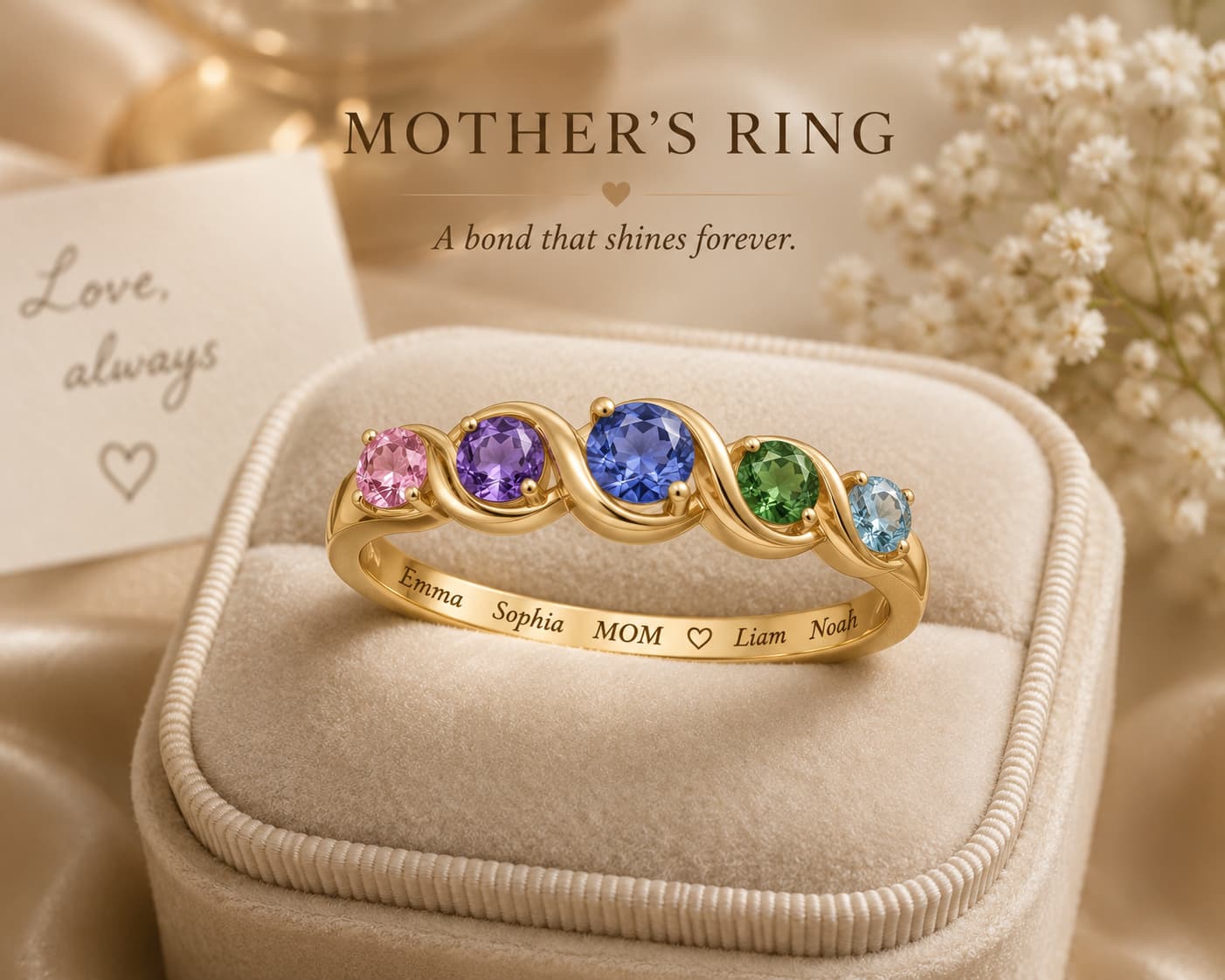
Mother’s ring prices vary widely based on metal, stone quality, and the number of birthstones included, with most pieces falling somewhere between roughly 100 and 500 dollars for a mid-range design. Sterling silver rings set with synthetic or semi-precious stones tend to sit at the lower end of that range, while gold rings with natural birthstones typically run higher, often into the several-hundred-dollar range depending on the jeweler and the number of stones.
At the upper end, designs in platinum or solid gold that use precious gemstones such as diamonds, rubies, sapphires, or emeralds in place of standard birthstones can exceed a couple thousand dollars, particularly as the number of stones and their carat weight increases. The number of stones has a direct effect on price too, since a ring built for five or six children naturally costs more in materials and labor than one built for one or two. Engraving, custom settings, and the choice between natural and lab-created stones all shift the final price as well, which is why two mother’s rings that look similar from a distance can differ significantly in cost.
Taking Care of a Mother’s Ring
Because a mother’s ring is typically worn daily and holds significant sentimental value, routine care matters more for this piece than for jewelry worn only occasionally. Cleaning it regularly with warm water, a small amount of mild dish soap, and a soft-bristled brush removes the buildup of lotion, soap residue, and everyday grime that dulls both the metal and the stones over time. Harsh chemicals, including chlorine and standard household cleaners, should be avoided, since they can damage softer birthstones such as pearl, opal, or turquoise and can also wear down certain metal finishes.
Because the stones in a mother’s ring often differ in hardness, from durable options like diamond and sapphire to much softer ones like pearl and opal, the ring should generally be cared for based on its softest stone rather than its hardest. That usually means removing the ring before activities like swimming, cleaning, gardening, or exercise, where impact or chemical exposure is more likely. An annual check by a jeweler is also worth doing, since daily wear can gradually loosen prongs or settings, and catching that early prevents a stone from being lost.
Mothers who want the sentiment without wearing a ring daily often choose alternative formats for the same idea. Pendants and necklaces are the most common substitute, followed by bracelets and charm pieces, all of which can carry the same birthstone arrangement without the wear concerns that come with a ring worn on the hand.
Mother’s Ring Wearing Traditions
Mother’s rings are traditionally worn on the right hand, following an older convention that reserves the left hand for wedding and engagement rings. This is a custom rather than a strict rule, and there is no formal etiquette that prevents a mother’s ring from being worn on the left hand, stacked with other rings, or moved between fingers over time.
In practice, many women choose the hand and finger based on comfort and visibility rather than tradition, since the ring’s value comes from what it represents rather than its placement. Some choose to wear it on a chain instead of a finger if they do not wear rings often, or if they want to avoid resizing issues as their hand size changes over the years. Because ring size can shift with weather, weight changes, or time of day, comfort is generally treated as more important than following the traditional right-hand placement exactly.
Frequently Asked Questions
Do you need a stone for every child, or can you leave one out?
The number of stones is entirely up to the person wearing the ring. Most mother’s rings include one stone per living child, but there is no rule against adding a stone for a stepchild, a child who has passed away, or leaving space to add a stone later if the family grows.
Can a mother’s ring include stones for grandchildren too?
Yes, and this is common enough that these designs are sometimes marketed separately as grandmother’s rings or family rings. In these versions, each stone represents a grandchild instead of, or in addition to, a child.
Is a mother’s ring the same as a birthstone ring?
Not quite. A birthstone ring typically features a single stone, usually for the wearer’s own birth month, while a mother’s ring is built around multiple stones representing multiple family members. A mother’s ring is really a specific application of birthstone jewelry rather than a separate stone category.
Do the birthstones have to be real gemstones?
No. Because natural birthstones vary widely in price and durability, many mother’s rings use lab-created or simulated stones instead, particularly for softer natural stones like opal or pearl that wear less well with daily use. This keeps the ring both affordable and practical without changing what the design represents.
What’s the best time to give someone a mother’s ring?
Mother’s Day is the most common occasion, but these rings are also popular gifts after the birth of a new baby, for milestone birthdays, or with no occasion attached at all. Because the design can often be updated later with an additional stone, it also works well as a gift that grows alongside the family.
Conclusion
A mother’s ring earns its popularity by doing something most jewelry doesn’t: representing specific, named people rather than marking an occasion alone. Whether it’s set with traditional birthstones or a mix of personal favorites, cast in silver or platinum, and worn on the hand or as a pendant, the ring’s real value comes from what each stone stands for rather than its price or placement. That combination of a simple concept and deeply personal execution is exactly why the style has lasted since the 1950s and still shows up on Mother’s Day wish lists today.