Few birds have made their way into jewelry boxes quite like the peacock. Its feathers are shaped into brooches, its blue-green colors show up in enamel and gemstones, and its “eye” pattern has been carved, painted, and engraved for thousands of years. But the peacock isn’t just a pretty design choice. It carries a long list of meanings that shift depending on the culture and era behind the piece, from divine protection in ancient temples to royal power on emperors’ robes, and those layers are exactly what make a piece of peacock jewelry more interesting than its colors alone.
What Does a Peacock Symbolize in Jewelry?
A peacock in jewelry usually stands for beauty, protection, renewal, and confidence, though the exact meaning depends on the culture behind the design. Most peacock jewelry borrows from one or more of these four big ideas, and they show up again and again across continents and centuries, which is part of why the bird has stayed so popular in design for thousands of years.
The beauty angle is the easiest to spot. A male peacock’s train can carry up to 200 elongated feathers in electric blues and greens, and no other bird quite matches that kind of natural color show. Jewelers have been trying to capture that shimmer in metal, enamel, and stone for a very long time, which is exactly why peacock pieces tend to lean colorful rather than plain.
The renewal meaning comes from real peacock biology. Once breeding season ends, a male peacock loses his entire train through a natural shedding cycle known as molting, and a fresh set grows back in, usually looking even brighter than what came before, well ahead of the following year’s mating season. That pattern of losing something spectacular and having it return even better is why peacocks became linked to rebirth and transformation, meanings that carry directly into jewelry given as encouragement during a big life change.
Confidence rounds out the picture. A peacock only fans its train when it wants to be seen, so the bird has come to represent showing one’s true colors without apology. Depending on the culture, that same trait gets read either as healthy self-assurance or as vanity, which is part of why peacock symbolism carries slightly different weight from one design tradition to the next.
Why Do Peacock Feathers Have “Eyes” on Them?
The eye-shaped spots on a peacock’s tail feathers are called ocelli, and across many cultures people believed they could see and ward off evil. Ancient civilizations looked at that shimmering, eye-covered fan and treated it as something closer to a guardian than a decoration, believing the peacock could actually spot and drive off evil the moment it opened its tail.
This idea traveled into jewelry as a kind of built-in protection charm. In Hindu and Buddhist traditions, the eye markings are tied to spiritual sight and the power to guard against negative energy, which is one reason peacock feather motifs still show up in protective jewelry today. Buddhist tradition adds another layer to this: the peacock is said to be able to eat poisonous plants without being harmed, so the bird also came to represent the ability to transform something dangerous into something useful, a kind of spiritual resilience that pairs naturally with the eye’s protective meaning.
In Greek mythology, the story goes a step further. The goddess Hera turned the hundred eyes of a giant named Argus into the pattern on the peacock’s tail, so the “eyes” represent constant watchfulness stretched across the night sky, with each spot standing in for one of the stars. That same eye motif shows up today in feng shui and other folk traditions, where peacock feathers are kept in homes specifically because the “eyes” are believed to watch over a space and catch bad energy before it settles in.
The eye-shaped pattern isn’t random decoration. In story after story, from Greece to India to China, it’s described as a symbol of vigilance, something that watches over the wearer rather than just decorating them.
HWhat the Peacock Means in Different Cultures
The peacock means something a little different everywhere it appears, and that variety is part of what makes it such a rich symbol for jewelry designers to work with. Its meaning has been shaped by several major traditions across history, each one adding its own layer to how the bird is read in jewelry today.
Peacock Symbolism in India
In India, the peacock isn’t just a myth, it’s the national bird, and its spiritual meaning runs deep. The bird is closely tied to Saraswati, the goddess of wisdom, and to Krishna, who is often depicted wearing a peacock feather in his crown. Because Krishna and Saraswati are both linked to the peacock, the bird ends up carrying connections to both playful love and deep wisdom at the same time, a combination that shows up often in Indian jewelry design, from bridal sets to temple jewelry.
Peacock Symbolism in China
In Chinese culture, the peacock has long stood for rank, dignity, and good fortune rather than vanity. It was even included among the 12 Symbols of Sovereignty that appeared on an emperor’s ceremonial robes starting during the Western Zhou Dynasty, placing it alongside the sun, moon, and dragon as a mark of imperial authority. Interestingly, the “showing off” meaning that Western culture often attaches to peacocks doesn’t really carry over into Chinese tradition, where the bird is seen far more positively.
Peacock Symbolism in Ancient Greece and Rome
In Greek mythology, the peacock belonged to Hera, queen of the gods, and the Romans carried the same association over to her equivalent, Juno. Peacocks were believed to embody the all-seeing knowledge of the heavens, with the eye-spotted feathers standing in for the stars themselves. Roman mosaics and frescoes featured peacock imagery often, using the bird to signal beauty, wealth, and a connection to the divine all at once.
Peacock Symbolism in Christianity
Early Christians held onto an old belief that a peacock’s flesh never rotted after death, and they treated that as evidence the bird couldn’t be corrupted or destroyed, which is how it ended up standing for resurrection and life after death in Christian art. That’s why peacock imagery still turns up in older church art and religious jewelry, standing in for the promise of life continuing after death rather than for anything about beauty or vanity.
Peacock Symbolism in Persia
Ancient Persia held a similar view, treating the peacock as a mark of immortality for the same reason: a lasting belief that its flesh resisted decay. The bird’s status ran high enough in Persian culture that peacock imagery was worked into palace and temple architecture under the Achaemenid Empire, putting it on par with other emblems of royal power.
Peacock Symbolism in Hungary
In Hungarian folk tradition, the peacock represents eternal love, freedom, purity, and light, and it shows up constantly in decorative arts, folk music, and poetry. Bride’s trousseaus, meaning the decorated boxes, linens, and clothing a bride collected before marriage, often featured peacock designs, most likely as a symbol of enduring love between the couple.
Why Is the Peacock a Symbol of Pride?
The link between peacocks and pride mostly comes from Western culture, where “to peacock” literally means to show off. Watching a male peacock fan out his tail to attract a mate does look a lot like showing off, and that visual stuck in Western language and storytelling for centuries, eventually turning into the old saying “proud as a peacock” to describe someone who’s a little too pleased with themselves.
But that reading has always been a bit one-sided. Many people now push back on the “vanity” label and point out that a peacock displaying its feathers isn’t arrogance, it’s closer to healthy self-expression, showing one’s best self without hiding it. The vanity meaning does shape how some Western jewelry marketing frames the bird, but it’s really only one thread among several, and it’s largely absent from the Eastern and ancient traditions, where the peacock is treated with far more reverence than suspicion.
Peacock Motifs in Art Nouveau Jewelry
Peacocks became one of the signature motifs of the Art Nouveau movement in the late 1800s and early 1900s, a period defined by flowing lines and nature-inspired jewelry. French jeweler René Lalique was a true pioneer of Art Nouveau jewelry, known for blending sculpture, nature, and mythology elements into his work, and peacocks appeared throughout his brooches, pendants, and corsage ornaments. One of his most famous pieces is a peacock corsage ornament worked in blue and green enamel with opal cabochons set into the design, acquired straight from Lalique’s own hands by a private collector in 1900 and now regarded as one of the standout pieces of the entire era.
Lalique wasn’t working alone, either. Other Art Nouveau jewelers of the period, such as Philippe Wolfers, also turned to the peacock as a subject, using its curved feathers to fit the sinuous, whiplash-style lines the movement was known for. The American designer Louis Comfort Tiffany brought the same motif into a different medium, using his signature iridescent Favrile glass to mimic peacock feathers in vases and stained glass, which shows how far the bird’s popularity reached beyond jewelry alone during this period.
The bird fit the Art Nouveau spirit perfectly: dramatic, colorful, drawn from nature, and layered with symbolic meaning rather than being purely decorative. Lalique in particular kept returning to the peacock even after Art Nouveau gave way to Art Deco in the 1920s, later reworking the same motif into decorative glass objects, which shows how strongly the design stuck with him personally, not just with the trend of the moment.
Peacock Jewelry: Styles and Pieces
Peacock symbolism shows up in a wide range of jewelry styles, and each format tends to highlight a different part of the bird’s design, from the full fanned tail to a single glimmering feather.
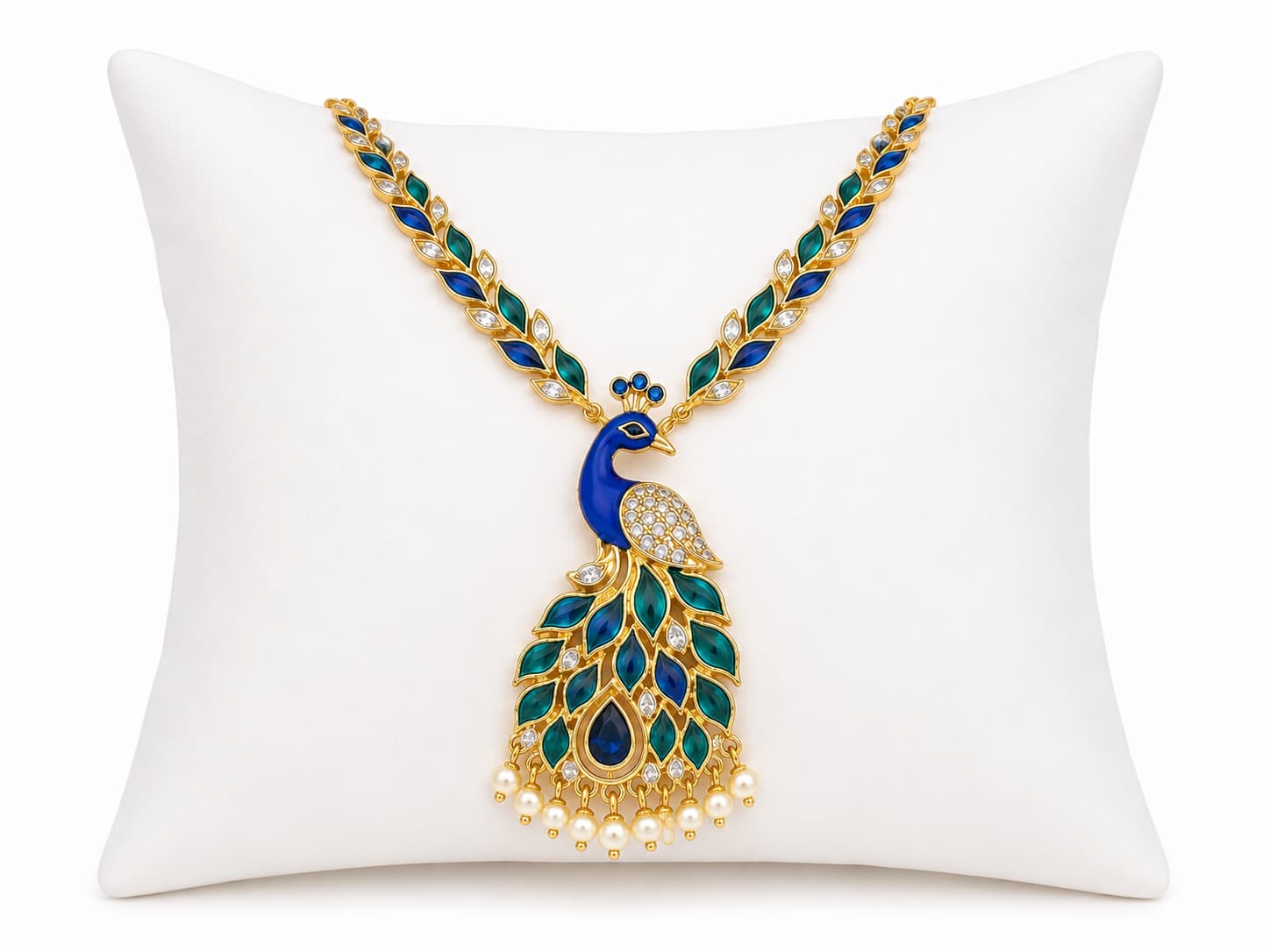
- Brooches: This is where the peacock shows up most dramatically, usually as a full-bodied bird with its tail fanned open, often worked in enamel to capture the color shift between the feathers.
- Pendants and necklaces: These tend to focus on a single feather or just the eye motif by itself, which keeps the symbolism intact while staying easy to wear day to day.
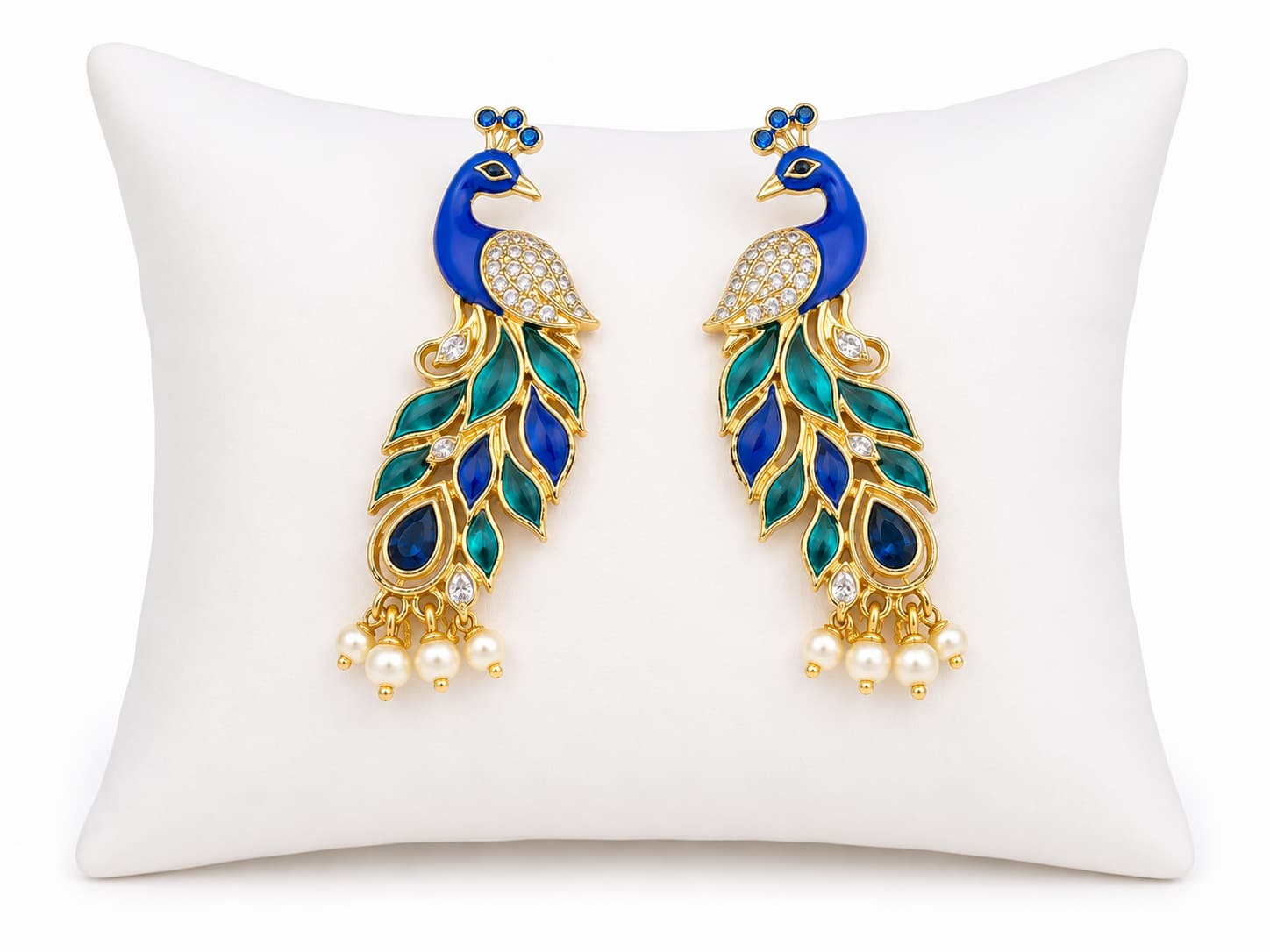
- Earrings: Small feather shapes or teardrop “eye” designs are common here, giving a subtle nod to the motif without overwhelming the face.
- Rings: Peacock feathers often wrap around the band itself, or the eye shape becomes the setting for a single gemstone.
- Bracelets: Repeated feather patterns or small peacock charms are typical, letting the design read as a pattern rather than one large image.
Feather-only designs are especially common across all of these categories because a single feather can carry the full symbolism, protection, beauty, renewal, without needing the whole bird shape, which makes it easier to wear in everyday pieces like small pendants or stud earrings.
Peacock Jewelry Colors and Gemstones
Peacock jewelry almost always leans into blues, greens, and sometimes purples, because those are the colors found in the bird’s actual feathers. Designers commonly reach for gemstones and materials that echo that iridescent look:
- Peacock ore (chalcopyrite): A mineral prized for its rainbow, oil-slick-like sheen, which shifts color depending on the angle it’s viewed from, much like a real feather.
- Blue and green sapphires: These sit at the richer, more formal end of peacock-inspired jewelry, giving a deep, saturated version of the bird’s coloring.
- Tourmaline: This stone naturally occurs in the exact blue-green range peacocks are known for, making it a popular and more affordable alternative to sapphire.
- Opal: Used historically by Lalique because of its shifting, iridescent color play, opal remains one of the closest natural matches to the way peacock feathers catch light.
- Peridot: A brighter, warmer green option that’s often paired with blue accents to widen the color range in a single piece.
- Enamel: Not a gemstone, but essential to the look, since enamel can be layered and shaded in a way that mimics how light bounces off real feathers, something a single gemstone alone usually can’t do as well.
Frequently Asked Questions
Is peacock jewelry only for women?
No. While peacock jewelry is often marketed toward women, the bird’s symbolism, protection, wisdom, and confidence, isn’t tied to any one gender, and peacock motifs have appeared in men’s cufflinks, tie pins, and rings as well.
What does it mean to give someone peacock jewelry as a gift?
Giving peacock jewelry generally sends a message tied to admiration, protection, or celebrating someone’s individuality, since those are the themes the bird carries most consistently across cultures. It can also be a meaningful gift for someone with ties to Indian, Chinese, or Hungarian heritage, given how central the peacock is to those traditions.
Why do some people think peacocks are bad luck?
This belief is mostly a Western superstition, often linked to theater and stage folklore, where peacock feathers were considered unlucky props because the “eye” pattern was thought to resemble the evil eye staring back rather than protecting against it. This is a much newer and more limited belief compared to the thousands of years of positive peacock symbolism found in Greek, Indian, Chinese, and Christian traditions.
What’s the difference between peacock and peafowl in jewelry terms?
Peafowl is the correct name for the whole species, while “peacock” technically refers only to the male bird, which is the one with the dramatic tail feathers. Jewelry almost always draws from the male peacock’s appearance, since the female peahen has much duller coloring and doesn’t have the long tail at all.
Does peacock jewelry work for everyday wear?
Yes, especially in smaller formats like feather pendants or stud earrings, which carry the symbolism without the bold visual size of a full peacock brooch. Choosing simpler peacock pieces in single gemstones or subtle enamel work makes the motif easy to fit into a daily jewelry rotation rather than saving it only for statement occasions.
Conclusion
Across every culture that has adopted it, the peacock keeps circling back to the same core ideas: a beauty striking enough to stop people in their tracks, and a watchfulness meant to protect what matters. Whether it’s showing up as a single feather on a delicate pendant or a full enamel bird on an Art Nouveau brooch, peacock jewelry carries thousands of years of meaning behind its colors, and that history is what turns a simple accessory into something worth a second look.