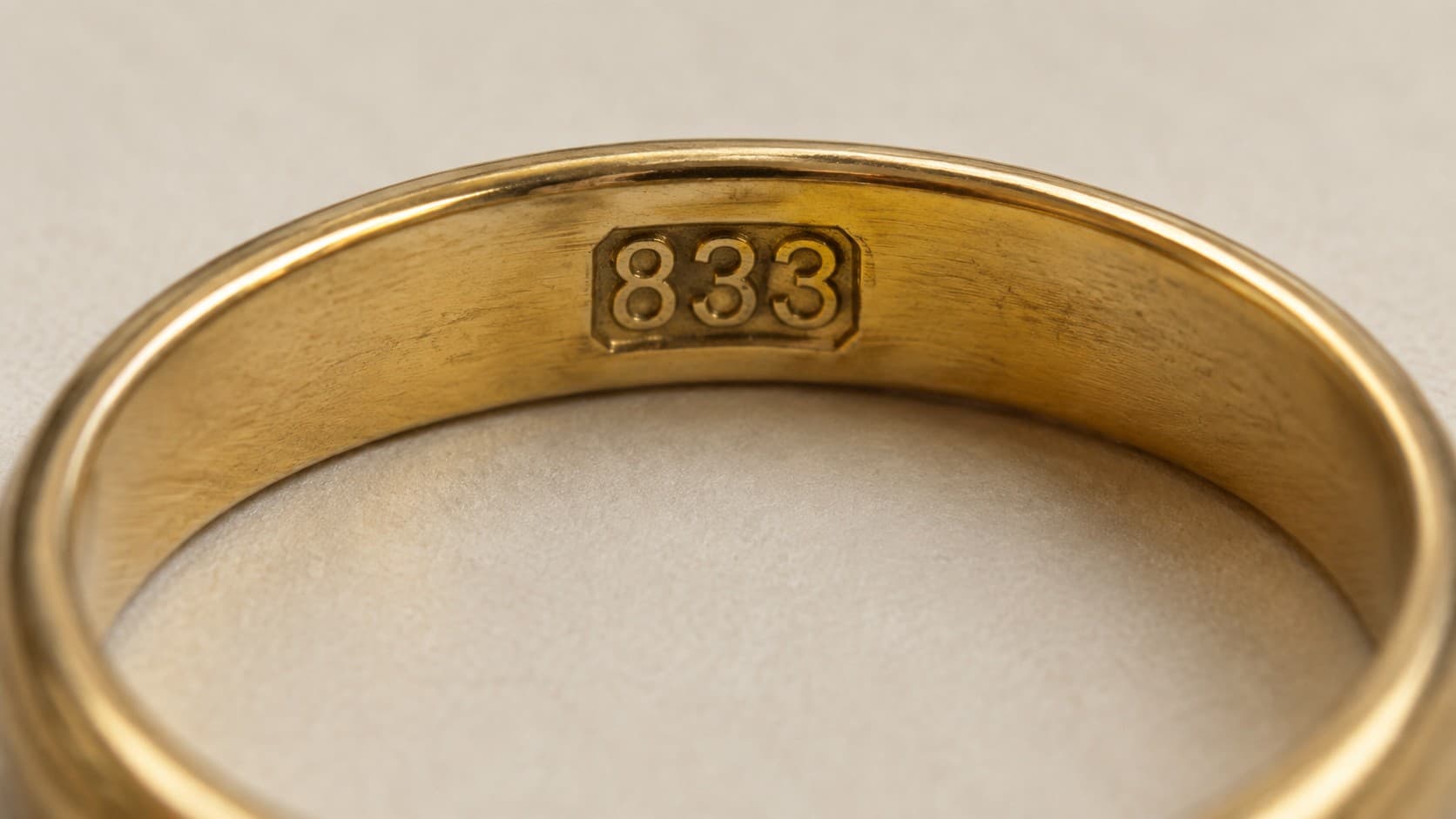
A tiny number stamped inside a ring band or along a bracelet clasp can look like a secret code, but it is one of the most useful clues a piece of jewelry can carry. That number tells exactly how much real gold sits inside the metal, which affects its value, its durability, and sometimes even where the piece was originally made. Understanding what 833 means turns a small, easy-to-miss mark into real, usable information.
What Does 833 Mean on Jewelry?
An 833 stamp means the piece is 20 karat gold, or 83.3% pure gold. The remaining 16.7% is made up of other metals such as copper, silver, or zinc, mixed in to make the gold stronger.
Gold on its own is very soft. Jewelry made from pure gold would bend and scratch almost immediately, so metalworkers blend gold with tougher metals to create an alloy, a mixture that keeps most of the gold’s shine while adding enough strength to survive daily wear. The stamped number, known as a fineness mark, states the exact ratio of gold to other metals out of a possible 1,000 parts. Twenty karats out of a maximum of 24 works out to 83.3%, which jewelers round down and stamp as 833 directly onto the metal.
This mark typically sits in small, discreet spots: inside a ring band, near a bracelet’s clasp, on the back of a pendant, or along an earring post. The stamp stays small on purpose, visible enough for an expert to find but not distracting on a finished piece.
Why Some Countries Use 833 Instead of 20K
Numbers like 833 measure purity out of 1,000 parts rather than out of 24 karats, and many countries rely on this system for hallmarking. A stamp reading “833” communicates the same purity as “20K,” just through a different numbering format.
This system, called millesimal fineness, is the standard hallmarking method across much of Europe, India, and the Middle East. A jeweler in Mumbai and a jeweler in Berlin might both sell 20-karat gold, one stamping it “20K” and the other stamping it “833,” with both numbers describing identical gold content. In India, the Bureau of Indian Standards requires hallmarked gold to carry a purity number alongside a certification mark and the jeweler’s ID, giving buyers a way to confirm authenticity. The United States never built a government-run assay and hallmarking system comparable to Europe’s. A 1906 law, the National Gold and Silver Stamping Act, requires that purity claims be accurate and paired with a maker’s mark, but no independent lab checks every piece before it reaches a store shelf.
Twenty-karat gold also carries deep regional roots. Ottoman and Levantine workshops produced jewelry to this standard, as did goldsmiths in parts of the old Austro-Hungarian Empire and the Balkans, where local traditions differed from the 18-karat standard favored in France and Britain. A piece stamped 833 that has been passed down through a family often traces back to the eastern Mediterranean, Central Europe, South Asia, or the Middle East.
833 Gold vs Other Karat Stamps
An 833 stamp sits in the middle of the gold purity scale, less pure than 22K or 24K gold but richer in gold content than the 18K or 14K pieces most common in Western jewelry stores. The most common purity stamps, from lowest to highest gold content:
| Stamp | Karat | Gold Purity |
|---|---|---|
| 375 | 9K | 37.5% |
| 417 | 10K | 41.7% |
| 585 | 14K | 58.5% |
| 750 | 18K | 75.0% |
| 833 | 20K | 83.3% |
| 875 | 21K | 87.5% |
| 916 | 22K | 91.6% |
| 999 | 24K | 99.9% |
Because it holds more gold than 18K, jewelry stamped 833 tends to have a deeper, warmer yellow color, though the exact shade depends on which alloy metals were used. A higher share of copper in the mix creates a warmer, more reddish-yellow tone, while more silver produces a paler, cooler yellow, which explains why two pieces stamped 833 can look slightly different despite containing identical amounts of gold. In terms of toughness, 20K is not as soft as 22K or 24K gold, making it a practical choice for pieces meant for regular wear, such as everyday bangles or wedding bands. That balance of rich color and workable strength is exactly why 20K gold became popular for detailed craftsmanship like filigree and complex chain designs, where both durability and a strong gold tone matter.
Is 20K Gold a Good Choice?
Yes, 833 gold is a solid, honest choice for anyone who wants strong color and decent durability in one piece. It carries more value than lower-karat gold because it contains more actual gold, while standing up better to daily wear than higher-karat pieces.
Quality still depends on the intended use. A ring meant for daily wear might hold up better long-term in the 14K to 18K range, since that alloy mix resists scratches and dents more effectively. For buyers focused on maximum gold content, whether for investment or cultural reasons, 22K or 24K pieces sit closer to pure gold. Twenty-karat gold lands between those two goals, a middle ground that has made it a lasting choice in regions where both durability and rich color carry weight.
Gold purity works like a recipe. More gold means more shine and more value, but also more softness. Jewelers choose the ratio that fits how a piece will actually be worn.
How to Tell if an 833 Stamp Is Real
A stamp can be checked by examining its clarity and, for certainty, having the metal tested by a jeweler. A crisp, evenly pressed “833” mark is a good sign, though the stamp alone does not guarantee authenticity.
Counterfeiters sometimes fake purity stamps on gold-plated or brass jewelry to inflate its apparent value. Genuine 833 gold is almost always stamped alongside a maker’s mark, initials, or an assay office symbol identifying who produced or certified it; a purity number with no accompanying mark is a warning sign. A magnet test offers another quick check, since real gold is not magnetic, while a piece that sticks strongly to a magnet likely contains a steel or iron core. Weight matters too, as gold is dense and a piece that feels unusually light for its size may be plated rather than solid. None of these checks are foolproof on their own, so a professional appraisal using acid testing or an electronic gold tester remains the most reliable option for a significant purchase.
Does 833 Gold Need Extra Care?
833 gold does not require drastically different care than other gold jewelry, but its alloy content affects how it reacts to chemicals and everyday wear. Gentle handling keeps its color and shine intact for decades.
Chlorine, harsh cleaning products, and prolonged exposure to sweat or lotion are the main threats, since the copper and silver mixed into the alloy can oxidize or react with these substances over time. That reaction is what causes some gold jewelry to look dull or slightly discolored, even though pure gold itself never actually tarnishes. Storing pieces separately in a soft pouch or lined box prevents scratches from harder jewelry and gemstones. A soft cloth wipe after wearing, along with an occasional wash in mild soap and warm water, keeps an 833 piece looking its best over the long run.
Frequently Asked Questions
Is 833 gold the same as 20K gold?
Yes. The number 833 and the label “20K” describe the same gold purity, 83.3% pure gold, differing only in which hallmarking system is being used.
Is 833 gold real gold?
Yes. 833 gold contains 83.3% actual gold mixed with other metals for added strength, a standard and accepted method of producing durable gold jewelry.
Why isn’t 833 gold common in the United States?
American jewelers mostly stamp gold using the karat system, such as 14K or 18K, rather than the three-digit millesimal system. Twenty-karat gold itself is also less common in the US market compared with the Middle East and South Asia, where higher-purity gold carries stronger cultural preference.
Can 833 gold turn colors or tarnish?
Pure gold does not tarnish, but the alloy metals mixed into 833 gold can react with chemicals, sweat, or humidity over time, leading to slight dulling. Regular cleaning and proper storage prevent most of this effect.
How much is 833 gold worth compared to 18K gold?
Gram for gram, 833 gold carries more value than 18K gold because it contains a higher percentage of actual gold. The exact value shifts with the current market price of gold and the total weight of the piece.
Conclusion
An 833 stamp communicates exactly what a piece of jewelry is made of: 20-karat gold, 83.3% pure, strong enough for daily wear and rich enough in color to stand out. That understanding turns a tiny stamped number into practical information, whether the context is a new purchase, an inherited piece, or simple curiosity about a jewelry box’s contents. A three-digit stamp on gold is not a mystery at all, just the metal recording its own composition in numbers.