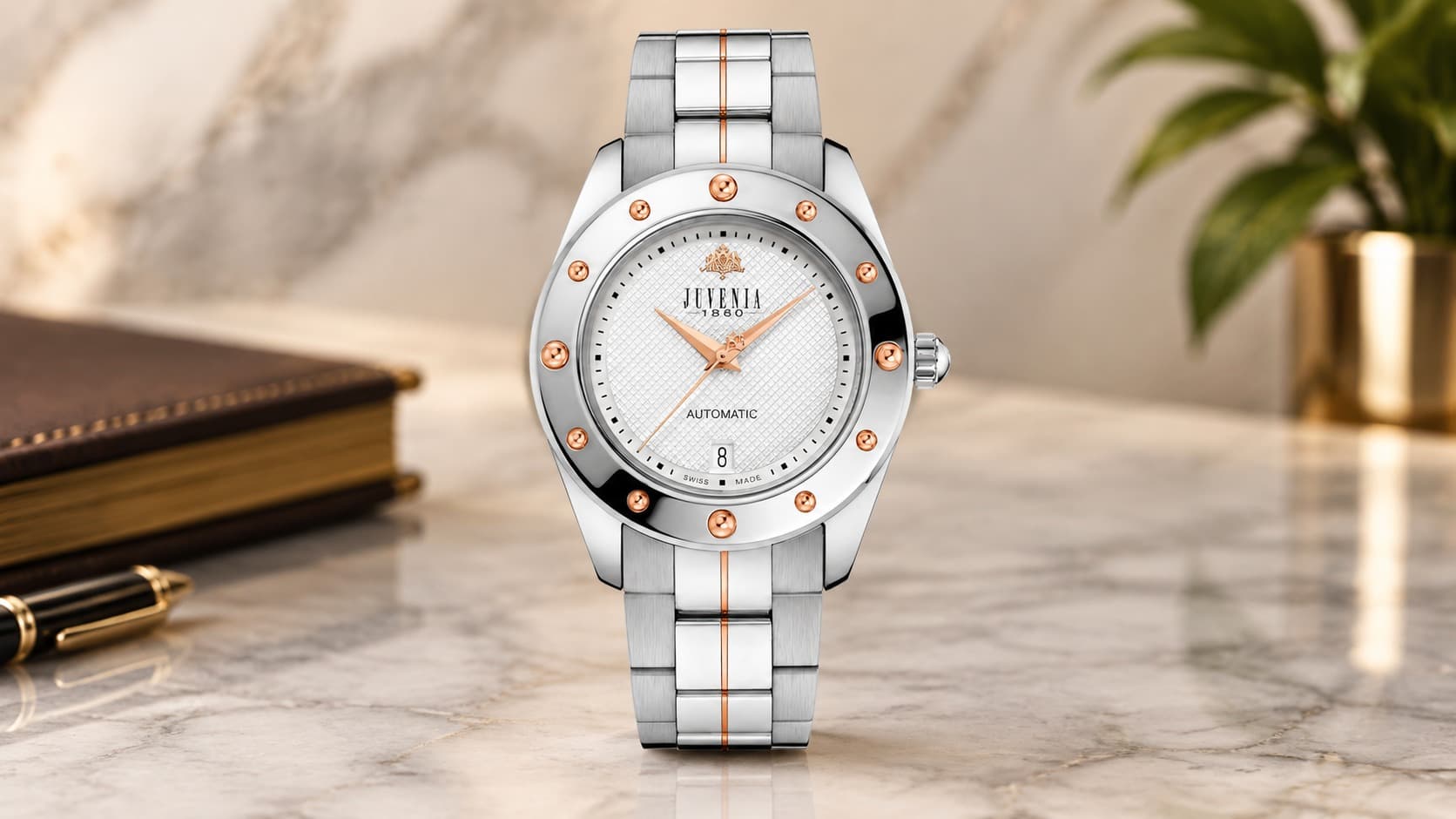
Juvenia is one of the oldest watch companies in Switzerland, and it has kept making watches nonstop since 1860. That is a rare thing. Most brands from that era either closed down, got swallowed by bigger names, or stopped and restarted years later. Juvenia bent and changed hands more than once, but it never fully stopped, even through wars, the quartz crisis, and several changes in ownership. Along the way, it built a reputation for two things: dressy, elegant watches and clever mechanical tricks, especially its famous “mystery dial” where the hands seem to float with no visible connection to the movement. That mix of longevity and playful design work is what separates Juvenia from most of its Swiss contemporaries, from the twentieth-century models that built its name to the watches it still produces today.
The Juvenia Watch Company History
Juvenia was started in 1860 by Jacques Didisheim-Goldschmidt in Saint-Imier, Switzerland, and the company moved soon after to La Chaux-de-Fonds, a town that became one of the beating hearts of Swiss watchmaking. His son Bernard took over later and merged the family’s two small workshops into one, which let the company make its own parts instead of buying them from outside suppliers. That shift, from assembling bought-in parts to building calibers in-house, is what turned Juvenia into a true manufacture rather than just a watch retailer with its name on the dial.
That decision to build things in-house paid off early. By 1914, Juvenia had developed the smallest single-plate watch movement in the world at the time, just 9.5mm across and 2.5mm tall, and it showed the piece off at the Swiss National Exhibition. The brand also leaned hard into thin, elegant pocket watches, a specialty it carried into the wristwatch age. During this period, Juvenia sold watches under a handful of smaller brand names too, including Fiat, Polar, Fiducia, and Nautilus, which was common practice for Swiss watchmakers selling into different countries at the time, since a name that worked in one market didn’t always translate well elsewhere.
The family stayed in charge for generations. Bernard Didisheim died in 1960, and his descendants kept running the company through the 1960s under the name Fabrique Juvenia, even as competition from cheaper foreign watchmakers pushed the brand to lean even further into gold and other precious-metal pieces rather than trying to compete on volume. That pivot toward luxury materials over mass production is a big part of why so many surviving vintage Juvenia watches today are gold rather than plain steel.
Why Juvenia Watches Are Unique
Most Swiss watchmakers from Juvenia’s era built their reputation around case shapes, materials, or movement precision. Juvenia did something different: it kept rethinking the dial itself, changing how a watch actually shows the time rather than just how it looks on the outside.
That habit produced a string of genuinely unusual designs across the 20th century, from the Mystère’s floating hands to the Trigone’s triangular pointers and the Planète’s rotating discs. None of these tricks were purely decorative gimmicks, either. Each one still had to keep accurate time underneath the novelty, which meant Juvenia’s watchmakers had to solve the engineering problem first and the visual puzzle second. That combination, of real horological work hiding behind a playful dial, is what separates Juvenia from most of its Swiss contemporaries and is the reason collectors still search the brand out today.
Juvenia’s Most Famous Watches
These are the models that shaped Juvenia’s reputation. Most of them are only available today on the vintage and pre-owned market, but they explain why collectors still search out the brand.
Juvenia Mystère
The Mystère is Juvenia’s signature watch and the reason serious collectors know the brand at all. Its floating-hands design was patented in the mid-1940s and released to the public in 1947, and it stuck around in Juvenia’s catalog for close to four decades in several different shapes and formats.
Part of what made the Mystère special is how the dial itself was designed. The numbers and hour markers were built into the bezel rather than a flat dial face, so once the hands appeared to float above it, the whole watch looked less like a normal timepiece and more like a piece of kinetic art. Juvenia later revived the Mystère name more than once, including during a 1990s relaunch that reworked the design for a new generation of buyers.
Juvenia Trigone and Planète
Juvenia followed the Mystère with two more unusual dial designs in the 1950s: the Trigone and the Planète. The Trigone, launched in 1955, replaced standard hands with large overlapping triangular pointers, so telling the time meant reading angles instead of a typical hour and minute hand.
The Planète, launched in 1956 alongside the Sextant, took things even further. Instead of hands at all, it used small rotating discs set into a rectangular case with a sphere at each corner. Through the course of the day the discs turned and lined up into recognizable shapes, star patterns at some hours and pyramid-like arrangements at others, turning the simple act of checking the time into something closer to a visual puzzle. Both the Trigone and the Planète show that Juvenia’s obsession with unconventional dials went well beyond the Mystère alone.
Juvenia Arithmo
Launched in 1945 from a patent originally filed a year earlier for a calculating table clock, the Arithmo was built for professionals who worked with numbers, including pilots, architects, and engineers. It used a rotating bezel with a logarithmic slide rule, which let the wearer perform calculations right on the wrist, decades before pocket calculators existed.
The watch also used a specially patented crystal, called the “Refrascope,” which separated the flat portion covering the main dial from the curved portion covering the rotating slide-rule bezel. That two-part crystal design meant the slide rule stayed sharp and readable even though it curved around the edge of the case. The Arithmo came in wristwatch, pocket watch, and desk clock formats, which shows how seriously Juvenia treated it as a genuine tool rather than a novelty.
Juvenia Ephemeris
Released in 1950, the Ephemeris was a triple-calendar watch that displayed the day, date, and month alongside a moon phase indicator, powered by a self-winding movement. It measured 36mm across, a fairly large case for the time, and came in both steel and gold versions.
The watch stood out for two practical design touches: the calendar-correction buttons sat higher up on the case sides than most watches of the era, making them easier to reach, and the case back screwed down tightly to protect the complicated movement inside from dust and moisture. Despite its high price at the time, the Ephemeris reportedly sold well, part of a wider wave of new post-war models Juvenia released as the public grew eager for fresh designs after years of wartime shortages.
Juvenia Sextant
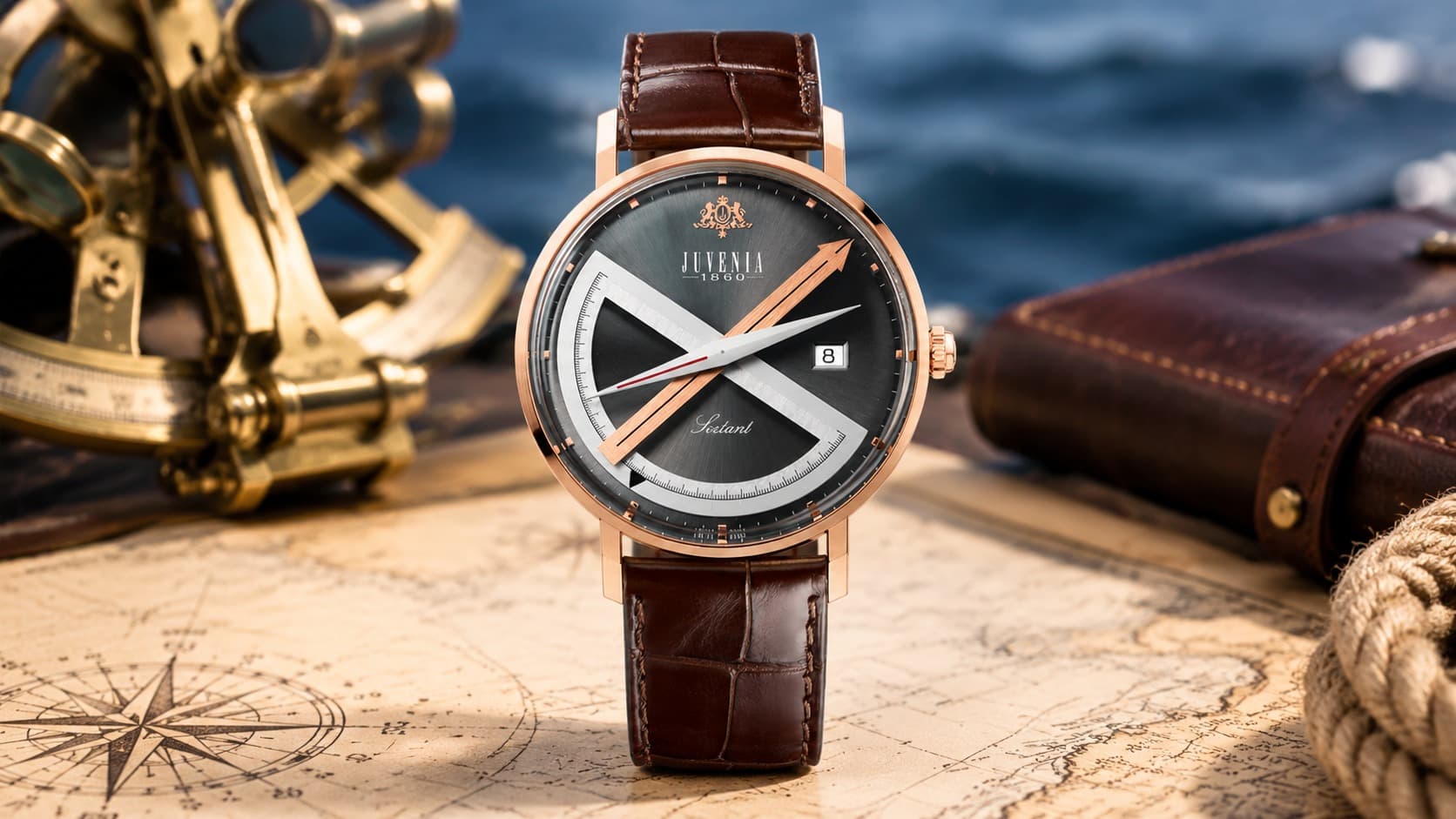
The Sextant project actually began in the late 1940s but wasn’t shown publicly until the 1956 Baselworld fair, making it one of Juvenia’s slower-developed designs. Its name and inspiration came directly from the sextant, the navigation tool sailors used for centuries to measure the angle between the horizon and a star or the sun.
True to that inspiration, the original Sextant used a semi-circular hour hand rather than a standard pointer, echoing the arc shape of the actual instrument. The name has stuck around longer than almost any other Juvenia model, and it still exists in the current lineup today under names like Sextant III, making it one of the few threads connecting the brand’s 1950s design experiments to its modern catalog.
Juvenia Slim
Introduced in 1957, the Slim line built on Juvenia’s long-running obsession with extra-thin cases, an obsession that started decades earlier with the brand’s pocket watches. Fitting a full watch movement into a slim case was a genuine engineering challenge at the time, since every component had to be made thinner without sacrificing accuracy or durability.
The Slim watches leaned into clean, understated dress-watch styling rather than the playful dial tricks of the Mystère or Planète, giving Juvenia a second identity as a maker of quietly elegant, wearable everyday pieces. The name was later revived during the brand’s 2000 relaunch, showing that this simpler side of Juvenia’s design language still had appeal decades later.
Juvenia Navette
Introduced in 1962, the Navette brought an almond-shaped case with faceted, cut-crystal detailing aimed at women’s fashion watches. It reflects how much of Juvenia’s mid-century output was designed specifically for female customers, at a time when many competing brands focused mainly on men’s tool watches, and it fit alongside the brand’s decades-long habit of unusual, sculptural case shapes.
Juvenia’s Key Models by Year
| Model | Launched | Signature Feature |
|---|---|---|
| Mystère | 1947 | Hands appear to float with no visible connection to the movement |
| Trigone | 1955 | Large overlapping triangular hands instead of standard pointers |
| Planète | 1956 | Rotating discs that form shapes like a star or pyramid over the day |
| Arithmo | 1945 | Built-in rotating slide-rule bezel for on-wrist calculations |
| Ephemeris | 1950 | Triple calendar (day, date, month) with moon phase |
| Sextant | 1956 | Semi-circular hour hand inspired by the navigation instrument |
| Slim | 1957 | Extra-thin case built for clean, everyday dress wear |
| Navette | 1962 | Almond-shaped case with faceted, cut-crystal detailing for women |
Best Juvenia Watches You Can Buy Today
Juvenia still exists as an active brand, based in La Chaux-de-Fonds and owned by the Hong Kong-based Asia Commercial Holdings Ltd, which has held the company since 1988. The current catalog is much smaller than in Juvenia’s mid-century heyday, but it keeps a few historically important names alive while focusing heavily on markets in Asia.
Juvenia Sextant III
The Sextant name traces back to 1956, and the modern Sextant III keeps that heritage while updating the case and movement for today. It is aimed at buyers who want a classic three-hand dress or sport-casual watch with a genuine link to the brand’s history, rather than a flashy modern complication, and it comes in several dial and case-finish variations, including an “Architect” version.
Juvenia J Collection Dual Time
The J Collection Dual Time is built for tracking two time zones at once, showing a second time reading alongside the main dial. This kind of complication is genuinely useful for anyone who travels often or keeps in touch with people in a different part of the world, and it continues Juvenia’s long history of practical, calendar- and time-focused complications going back to models like the Ephemeris.
Juvenia J Collection Moon Phase
The J Collection Moon Phase adds a small window showing the current phase of the moon, a complication that has been popular in dress watches for centuries and one Juvenia itself first explored back with the Ephemeris in 1950. It does not add practical timekeeping value, but it is one of the more visually appealing complications a watch can have, and it fits Juvenia’s long history of decorative, elegant dial work.
How Much Is a Juvenia Watch Worth
Juvenia prices vary enormously depending on age, materials, and condition, more than with most modern brands. That is because most of the watches changing hands are vintage pieces from the 1940s through 1970s rather than new production.
On the resale market, plain steel or gold-capped pieces from the mid-20th century, including basic automatic models, have sold for as little as a few hundred dollars. Solid gold dress watches from the 1950s, like rose gold “tank” style pieces, tend to land in the low thousands. Rarer, more complicated models, or documented gold pieces tied to a notable event, have been known to sell well past that, into five figures, though pricing on a specific complicated piece like the Ephemeris depends heavily on condition and documentation and can vary widely.
As a rough guide: expect low hundreds of dollars for a common steel vintage piece in working condition, low-to-mid thousands for solid gold dress watches or complications like the Ephemeris, and higher prices for rare, documented, or historically notable examples.
New Juvenia watches, including current gold models, are priced more in line with mid-tier Swiss watchmakers, though the brand keeps a low profile compared to well-known Swiss houses, so pricing information for the current lineup is not always easy to find in one place.
Juvenia’s Ownership History
Juvenia’s ownership has changed hands and names several times, which is normal for a brand this old. In 1972, the company was restructured as Juvenia Horlogerie de Précision SA as the Didisheim family’s direct involvement wound down and the wider Swiss watch industry entered a rough period brought on by cheap quartz competition from Asia.
In 1981, Ebel’s head, Pierre-Alain Blum, bought Juvenia outright while his own company was growing quickly. The brand kept the Juvenia Horlogerie de Précision name under Ebel’s ownership, but it was never a real priority alongside Ebel’s own line, and only a handful of quartz models came out during this period before Juvenia was largely set aside.
In 1988, Hong Kong’s Asia Commercial Holdings bought the company, adding it to a group that already included the Leonard jewelry brand. The new owners relaunched Juvenia with a stronger focus on luxury, introducing a skeleton perpetual calendar in 1991 and reviving the Planète and Mystère names with fresh designs. The company was renamed Juvenia Montres in 1994, but growth didn’t come easily, and the brand was put on hold entirely for about three years starting in 1997.
Juvenia came back in 2000 under new direction, reintroducing updated versions of the Slim, Sextant, and Planète lines alongside genuinely new ideas like the Contresens, a watch with hands that run counterclockwise instead of the usual direction. Asia Commercial Holdings still owns Juvenia today, along with the Ball Watch Company and the Wakman brand, and the current business leans heavily on demand from Asian markets rather than trying to compete head-on with the biggest Swiss names in Europe and North America.
Things to Check Before Buying a Vintage Juvenia
Vintage watches always need extra care before a purchase, and Juvenia is no exception.
- Check the mechanism, not just the dial. A Mystère’s floating-hands trick depends on a rotating glass disc, which can wear out or need service after decades, and a Trigone or Planète’s unusual hand system can be even harder to find parts for if something breaks.
- Ask about service history. A vintage watch that has never been opened and cleaned in 50-plus years is more likely to need work soon.
- Compare the case metal against the listing. Gold-cased Juvenia watches are worth significantly more than gold-plated or gold-capped ones, and the two can look nearly identical in photos.
- Look for matching serial numbers and hallmarks. These help confirm the watch has not been assembled from mismatched parts over the years, sometimes called a “franken-watch.”
- Factor in restoration cost. A cheap vintage watch that needs a full movement service may end up costing more than a pricier watch that is already in good working order.
Best Juvenia Watch for Each Type of Buyer
The right Juvenia depends on what someone actually wants from it: a piece of horological history to collect, a daily watch with a story behind it, or a modern piece that still nods to the brand’s past.
Collectors chasing a genuine conversation piece, and willing to hunt the vintage market, tend to look for a Mystère or Planète. Both turn checking the time into something closer to a magic trick, and both are rare enough now that finding one in good working condition is part of the appeal.
Buyers who want something wearable day to day that still carries real brand history tend to land on the Sextant III instead. It keeps the semi-circular hour hand and navigation-inspired design language from the 1956 original, but in a currently produced watch that doesn’t come with a vintage watch’s servicing risks.
Buyers after a genuinely useful modern complication rather than a design curiosity gravitate toward the J Collection Dual Time, especially frequent travelers who track a second time zone. Those who care more about looks than function tend to prefer the J Collection Moon Phase instead, since it offers the same dressy appeal as the vintage Ephemeris without needing to track down and service a 70-year-old movement.
Frequently Asked Questions
Is Juvenia a luxury watch brand?
Juvenia sits in the upper-middle tier of Swiss watchmaking. It has real horological history and has made genuinely innovative watches, but it does not carry the same brand recognition or resale value as the most famous Swiss luxury names.
What is special about the Juvenia Mystère?
The Mystère uses hands that appear to float freely over the dial with no visible connection to the movement. Mystery-dial watches like this typically achieve the illusion by attaching the hands to clear, rotating glass discs hidden inside the case. Juvenia registered its version of the idea in 1945 and launched it commercially in 1947.
Is Juvenia still in business?
Yes. Juvenia is still an active watchmaker based in La Chaux-de-Fonds, Switzerland, and it is owned by Asia Commercial Holdings Ltd, a Hong Kong company that also owns Ball Watch and Wakman. The brand has been paused and relaunched more than once over the decades, most recently returning in 2000.
Are old Juvenia watches worth money?
Some are. Gold-cased vintage pieces and watches with complicated mechanisms, like the Mystère’s floating hands or the Ephemeris’s calendar and moon phase, tend to hold more value than plain steel dress watches from the same era. Condition and working order matter as much as the model itself.
What is the Juvenia Sextant?
The Sextant is one of Juvenia’s longest-running model names, first shown publicly at Baselworld in 1956 and inspired by the navigation instrument of the same name. A modern version, the Sextant III, is still part of the brand’s current lineup.
Conclusion
Juvenia’s story is really the story of a small, independent Swiss workshop that kept adapting instead of disappearing, even through ownership changes, a full three-year shutdown in the late 1990s, and a shift toward Asian markets under its current owner. It built its name on genuine mechanical cleverness, from the Mystère’s floating hands to the Arithmo’s built-in slide rule and the Ephemeris’s calendar and moon phase, while also producing solid, elegant dress watches like the Slim and Sextant lines. From a decades-old Mystère to a new Sextant III, the through-line stays the same: understated design backed by a company that has never actually stopped making watches since 1860.