D1 Milano has become one of the most recognizable names in affordable design-led watches, and it got there fast. Founded in Milan in 2013 by Dario Spallone, the brand built its identity around a bold octagonal case, bright colorways, and ultra-lightweight materials rather than centuries of Swiss tradition. That approach has made it popular with buyers who want a watch that looks striking on the wrist without the price tag of a heritage brand, but it also means the lineup is large and split across several very different collections, each built around its own material, movement, and price point.
D1 Milano’s Design Explained
D1 Milano watches stand out because of their octagonal case shape and use of unusual materials like polycarbonate instead of traditional metal. The brand calls itself a design house first and a watchmaker second, and that shows in how the watches are built and marketed. Instead of chasing mechanical complications, D1 Milano focuses on silhouette, color, and how a watch feels on the wrist day to day. Even the brand’s name carries that idea: “D1” is short for “day one,” meant to signal a fresh, rule-breaking start rather than a link to any old watchmaking house.
The company debuted during Milan Fashion Week in 2013 and joined Bocconi University’s business incubator the following year, a path that explains why the watches lean more toward fashion accessory than tool watch. It later moved its headquarters to Dubai, with an additional hub in Hong Kong, and now sells through hundreds of retail points across dozens of countries. That growth happened because the brand kept its prices accessible while still offering a design that looks more expensive than it costs, and by the brand’s own account it now produces well over 100,000 watches a year.
Because the lineup spans so many collections, from featherlight quartz pieces to proper self-winding mechanical watches, the right choice comes down to price, material, and how the watch is meant to be worn day to day.
Best D1 Milano Ultra Thin Watches
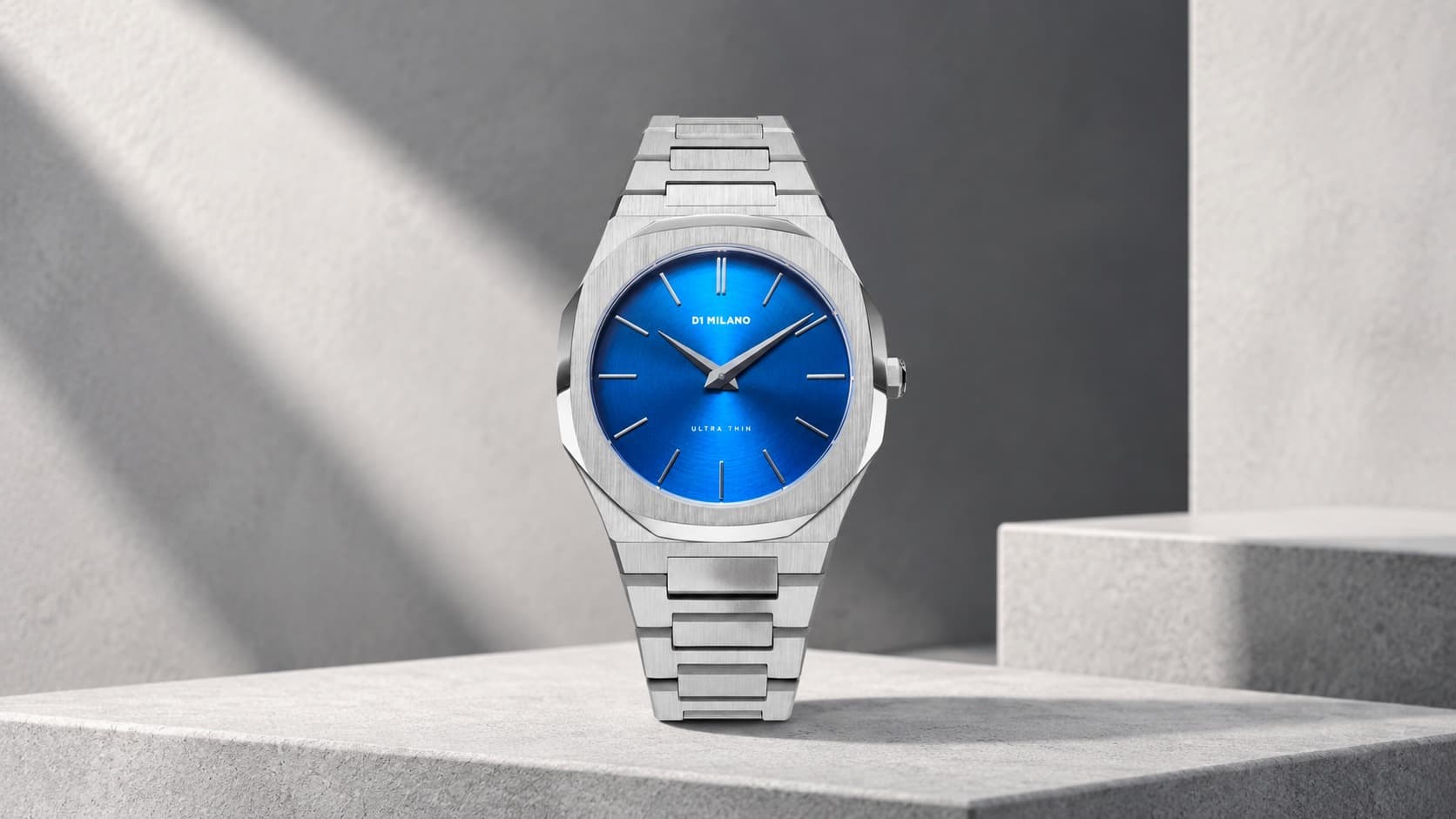
The Ultra Thin collection is D1 Milano’s slimmest line, built for anyone who wants a dressy, low-profile watch that sits flat under a shirt cuff. These models use precise Japanese quartz movements, which keep the case thickness down while staying accurate without needing to be wound. The line launched in 2017 and quickly became the brand’s most recognized series, which is why it still anchors most of the current catalog.
Ultra Thin watches come in steel cases ranging from around 34mm to 40mm, which makes the collection one of the most versatile for both men and women. Popular finishes include the mirrored “Mirror” dial, the textured “Groovy” dial, and the monochrome “Shadow” versions that use dark PVD coating across the whole case and bracelet. Most Ultra Thin models retail somewhere in the $375 to $465 range, depending on the finish and bracelet material.
For a single D1 Milano watch that works equally well with a casual outfit and a slightly dressed-up occasion, Ultra Thin is usually the safest starting point.
The integrated bracelet is part of what makes this line feel more expensive than its price suggests. Because the bracelet links flow directly into the case rather than attaching through separate lugs, the whole watch reads as one continuous design rather than a case with a strap bolted on.
Best D1 Milano Polycarbon Watches
The Polycarbon collection is D1 Milano’s lightest and most affordable line, built around a case made from polycarbonate instead of metal. It was also the brand’s very first watch series back in 2013, so in a sense it is where the whole company started. Most Polycarbon cases weigh somewhere between 44 and 65 grams, compared to roughly 150 grams for a typical steel watch of a similar size, which is why they feel almost unnoticeable on the wrist.
Prices for Polycarbon models usually sit between $125 and $250, making this the entry point into the brand. The material also allows for far bolder colors than steel ever could, since polycarbonate can be dyed and finished in almost any shade without the plating or coating process a metal case would need. That is why this line includes some of D1 Milano’s brightest and most playful colorways, including camouflage prints, translucent “sketch” finishes, and the diver-styled Subacqueo models that push water resistance up to 10 ATM.
Because the case is plastic rather than metal, Polycarbon watches are a sensible choice for the gym, poolside wear, or as a first D1 Milano piece before committing to a pricier collection. They are not meant to compete with steel watches on perceived luxury, but they do exactly what they are designed to do: look fun and cost very little to try.
For something even lighter and a little more technical-looking, D1 Milano also makes a small Nylon/Carbonlite line. These watches swap the solid polycarbonate case for a carbon-nylon composite shell around 47 grams, often paired with a carbon-fiber dial and a silicone strap. It remains a niche option compared to the main Polycarbon range, aimed at buyers drawn to a matte, sporty look rather than the brand’s usual glossy colorways.
Best D1 Milano Automatico Watches
The Automatico collection is D1 Milano’s self-winding mechanical line, built for people who want a real watch movement rather than a battery-powered one. These watches use a Japanese automatic movement, commonly a Miyota 9015 or similar caliber, which winds itself through the natural motion of the wearer’s wrist.
Every Automatico model includes a sapphire crystal case-back, which reveals the rotor and gear train spinning when the watch is off the wrist. Case sizes run mostly between 36mm and 41.5mm in 316L stainless steel, with power reserves around 40 hours and a day-to-day accuracy of roughly -10 to +30 seconds. Prices for Automatico models typically land between $400 and $775, though exact pricing depends on the dial finish and bracelet choice.
This collection suits buyers drawn to the idea of a battery-free watch, or simply to the ritual of winding and wearing a mechanical piece. It is also the clearest signal that D1 Milano, despite its fashion-forward reputation, is capable of building watches with genuine mechanical substance.
Best D1 Milano Skeleton Watches
The Skeleton collection takes the same self-winding movement as Automatico but exposes it from the front of the dial instead of hiding it behind a traditional face. The gear train, balance wheel, and mainspring are all visible as the watch runs, which turns the movement itself into the design.
Skeleton models typically use Japanese Miyota automatic calibers, often with 21 jewels and around a 40-hour power reserve. Case sizes run close to 41.5mm, finished in steel with options like rose gold plating, gunmetal, or jet black coatings, and most pair with either a steel bracelet or a rubber strap. Retail prices for current Skeleton models generally run from around $650 to $900, with rarer finishes and collaboration pieces pushing toward the higher end, while well-kept pre-owned examples often resell for noticeably less, sometimes closer to $500.
Skeleton watches are the most visually dramatic pieces in the D1 Milano catalog, and they tend to draw the most attention on the wrist simply because there is so much happening on the dial. They suit anyone who wants a mechanical watch that makes its engineering the main talking point rather than something tucked out of sight.
Best D1 Milano Chronograph Watches
The Chronograph collection, sometimes labeled Polychrono, adds stopwatch functions on top of D1 Milano’s signature case design. A chronograph watch allows timing of events separately from the regular time display, using sub-dials for things like elapsed minutes, running seconds, and a 24-hour indicator.
These watches run on quartz movements, which keeps the extra chronograph functions accurate without the cost of a mechanical chronograph caliber. Case sizes range from 36mm up to 41.5mm, available in both steel and the brand’s lightweight Polycarbon material, and all models carry 5 ATM water resistance, enough for rain and hand-washing but not swimming laps. Prices usually sit between $400 and $700 depending on case material and strap type, with Polycarbon chronograph versions landing toward the lower end of that range.
This collection makes sense for anyone who actually wants to use the stopwatch function, whether for sports, cooking, or simply because the extra sub-dials add visual detail to the watch face. It also tends to appeal to buyers who like the busier, more technical look a chronograph gives a dial compared to a simple three-hand watch.
Best D1 Milano Watches for Women
D1 Milano does not split its design language much by gender, but several collections lean toward smaller case sizes that are marketed specifically for women. The Square collection, with its angular case shape, and smaller-diameter Ultra Thin and Polycarbon models in the 28mm to 34mm range are the most common picks.
The Aura line is built specifically with a women’s audience in mind, pairing a smaller case with softer color palettes and finer bracelet links, often finished in rose gold or pastel tones. Ceramica models, made with ceramic case components, offer a scratch-resistant alternative with a smoother, glossier finish than steel, which also makes them a touch more resistant to everyday scuffs than a polished metal case. Pricing across these smaller models tracks closely with their equivalent men’s sizes in the same collection, so a 32mm Polycarbon watch costs about the same as a 40.5mm version in the same finish.
D1 Milano also makes a Drop collection aimed at a softer, more feminine look than the rest of the catalog. Its 23mm stainless steel case takes its rounded, fluid shape from a water droplet rather than the brand’s usual octagon, paired with a Miyota GL22 quartz movement, a bracelet with a butterfly clasp, and 5 ATM water resistance. Priced around $375 to $395, it suits someone who wants a smaller, dressier D1 Milano watch rather than one built around the brand’s sportier signature silhouette.
How Much Do D1 Milano Watches Cost
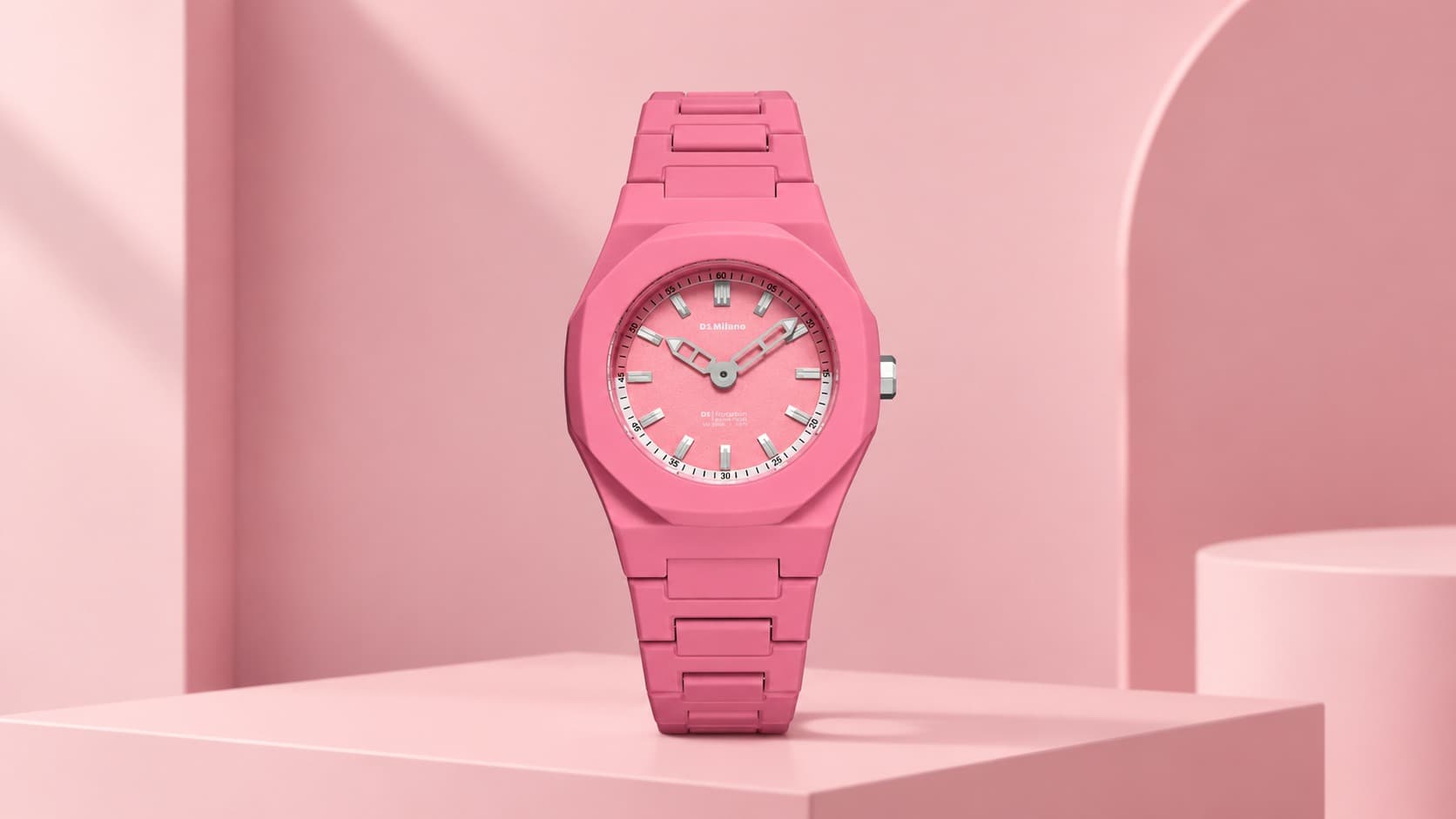
D1 Milano watches generally cost between $125 and $900, depending on the collection and materials used. Polycarbon sits at the entry level, Ultra Thin and Chronograph models occupy the middle of the range, and mechanical Automatico and Skeleton watches sit at the top because of their movement and finishing.
| Collection | Movement | Typical Price Range | Case Material |
|---|---|---|---|
| Polycarbon | Quartz | $125–$250 | Polycarbonate |
| Ultra Thin | Quartz | $375–$465 | Stainless steel |
| Chronograph | Quartz | $400–$700 | Steel or polycarbon |
| Automatico | Automatic | $400–$775 | Stainless steel |
| Skeleton | Automatic | $650–$900 | Stainless steel |
These figures are general retail ranges and can shift based on region, currency, and whether a watch is a limited colorway or collaboration piece. Second-hand and outlet pricing can also run noticeably lower than the figures above, since fashion-watch resale values tend to drop faster than those of heritage mechanical brands.
Frequently Asked Questions
Are D1 Milano watches real Swiss watches?
No. D1 Milano is an Italian design brand founded in Milan, and its watches are assembled using Japanese quartz or automatic movements rather than Swiss ones. The brand does not market itself as Swiss-made and instead focuses on design and materials as its main selling points.
Is D1 Milano a luxury watch brand?
D1 Milano sits in the accessible fashion-watch category rather than the luxury segment. Prices typically range from around $125 to $900, which is far below what traditional luxury watch brands charge, and the watches rely on design appeal rather than in-house mechanical complications.
How long does a D1 Milano watch battery last?
Most D1 Milano quartz models use standard watch batteries that last roughly one to two years under normal use, similar to other quartz watches on the market. Automatico and Skeleton models do not use a battery at all since they run on a self-winding mechanical movement.
Are D1 Milano watches water resistant?
Most D1 Milano watches carry a water resistance rating of 5 ATM, which is roughly 50 meters, enough to handle rain, splashes, and hand washing. A few Polycarbon diver-styled models go up to 10 ATM, but none of them are built for serious swimming or diving.
What is the difference between D1 Milano Automatico and Skeleton watches?
Both collections use the same type of self-winding Japanese automatic movement, so the mechanical performance is similar. The difference is visual: Automatico watches keep a solid dial and only show the movement through a see-through case-back, while Skeleton watches open up the dial itself so the gear train is visible from the front.
Where are D1 Milano watches made?
D1 Milano’s design work is based in Italy, and the movements inside its watches are Japanese. Final assembly, however, takes place in China, with individual parts sourced from a mix of countries along the way. Splitting design, movement production, and assembly across different countries like this is standard practice for fashion-watch brands trying to keep retail prices low.
The Bottom Line
D1 Milano built its reputation on being a design brand that happens to make watches, and that shows clearly across its collections. Polycarbon and Ultra Thin cover the lightweight, everyday, budget-friendly side of the brand, while Automatico and Skeleton prove it can build genuine mechanical pieces when it wants to. Chronograph and the women’s-focused Square and Aura lines fill in the rest, giving the lineup enough range that most people can find a case size, material, and price point that fits what they actually want from a watch.