A skeleton watch strips away the solid dial that normally hides a watch’s inner workings, revealing tiny gears, springs, and wheels in motion. It turns a mechanism that most people never see into the main event. Because every gear and screw sits in plain sight, a skeleton watch also leaves nowhere for sloppy work to hide, which is exactly why watchmakers have used the style for over 250 years to show off their best craftsmanship.
What Is a Skeleton Watch?
A skeleton watch is a mechanical watch with most of its dial and movement plates cut away so the gears working underneath remain visible. Instead of a solid front covering the mechanism, there are windows, cutouts, or in some cases a nearly transparent view straight through to the other side. This isn’t just about looks. It shows the actual machine that keeps time, piece by moving piece.
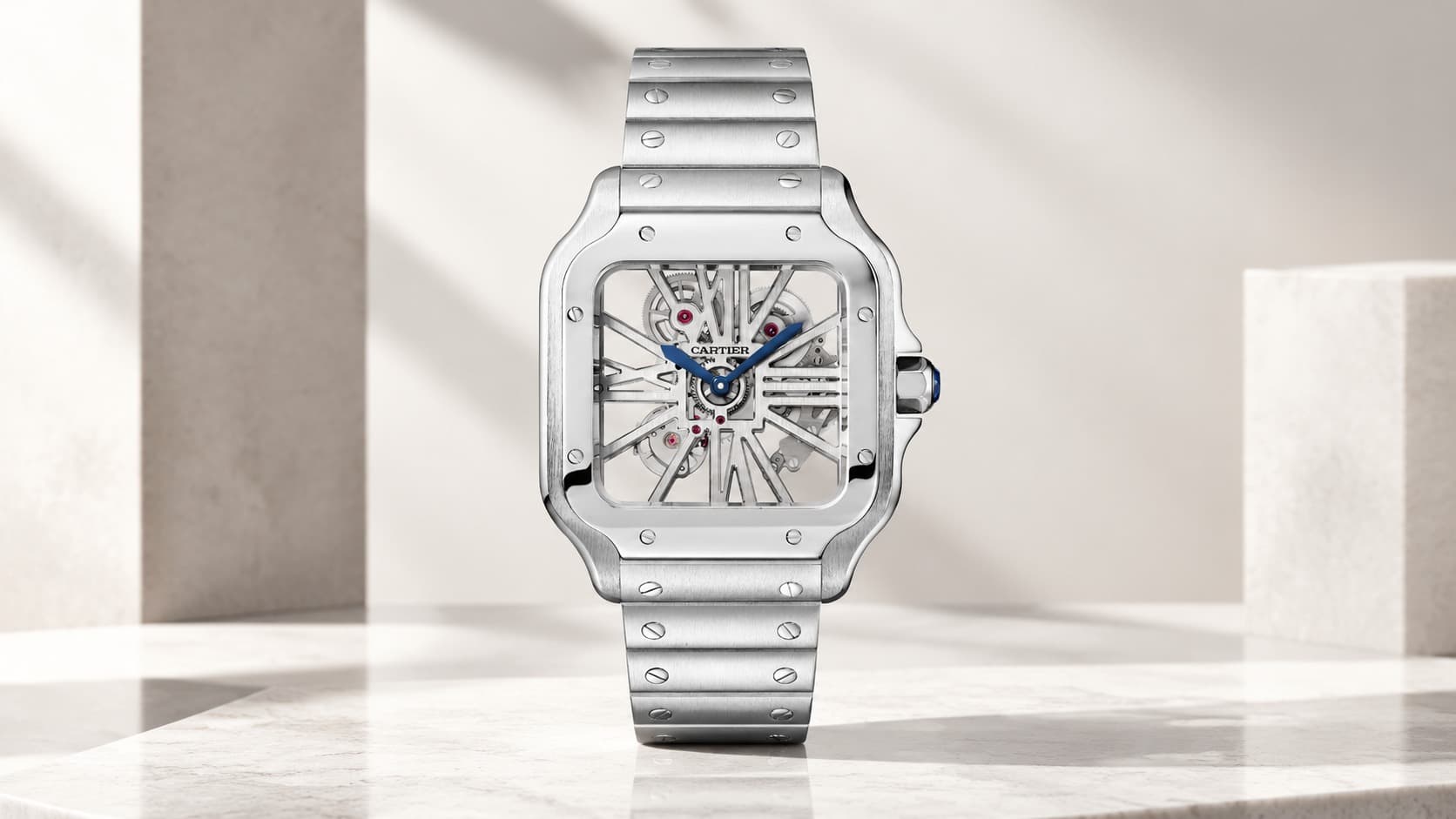
The visible gears aren’t decorations. They are the real wheels, springs, and levers that make the watch tick, quite literally. Watchmakers remove metal from the plates and bridges (the parts that hold the movement together) wherever it can safely go, then often decorate the remaining metal with hand-engraved patterns. The result looks a bit like an X-ray of a watch, except instead of bones, there’s brass, steel, and tiny jewels catching the light.
Because this only works with gears that can actually be watched in motion, skeleton watches almost always use mechanical movements — either hand-wound or automatic. A quartz watch, which ticks using a battery and a vibrating crystal, doesn’t have the same visual drama, so true skeleton quartz watches are rare.
Small red or clear dots are scattered around the gears on most skeleton watches. Those are jewel bearings, usually made from synthetic ruby, and they aren’t there just to look nice. Gears spin on tiny metal pivots that would quickly wear down through metal-on-metal contact, so watchmakers set these ultra-hard, low-friction jewels wherever a pivot needs support, keeping the movement running smoothly for decades. On a solid-dial watch these jewels stay hidden, but on a skeleton watch they become part of the display.
How Are Skeleton Watches Made?
Skeleton watches are made by carefully cutting away metal from a watch’s plates and bridges until only the parts needed to keep it running remain. The goal is to expose the moving gears without weakening the mechanism underneath. A watchmaker has to know exactly how much metal can go before the whole thing loses its structural strength and stops keeping accurate time.
Think of it like carving a wooden chair down to its thinnest possible frame. Cut too little, and it still looks bulky. Cut too much, and the chair collapses the moment someone sits down.
The process typically unfolds in five stages:
- Start with a working movement. The watchmaker begins with a complete, tested mechanical movement rather than designing blind.
- Map out what can be removed. Every gear needs support, so the maker plans cuts around the parts that actually do work — the mainspring, gear train, and balance wheel.
- Cut and file the metal. Traditionally this was done entirely by hand with fine saws and files. Many high-end brands still finish skeleton pieces by hand today, even when machines make the first rough cuts.
- Polish and decorate. The edges of every cutout are smoothed and often engraved, since a rough or unfinished edge would be obvious on a see-through watch.
- Reassemble and test. The watch goes back together and is checked for accuracy, since removing material can throw off the balance and timing if it isn’t done with care.
This is a large part of why skeleton watches tend to cost more than a solid-dial version of the same movement. A skeletonized caliber can take many more hours of skilled hand labor to finish properly.
Some of that labor goes into decorative finishing that only matters because the movement is on display. Techniques like Geneva stripes (fine parallel lines polished into a bridge) or perlage (small overlapping circular patterns) exist purely to make the metal look better up close, and beveled, hand-polished edges around each cutout catch the light instead of looking like raw, sawn metal. On a hidden movement, none of this would ever be seen, which makes a skeleton watch one of the few places where a watchmaker’s finishing skills get put fully on display.
The History of Skeleton Watches
Skeleton watches were first made in the 1760s by André-Charles Caron, a French clockmaker who worked for King Louis XV. Caron’s idea was to let owners watch the actual gears at work rather than hide them behind a solid dial, so he cut away the metal that normally sat over the movement. His pocket watches were expensive, hand-finished pieces made for wealthy 18th-century clients, not everyday timekeepers.
From Pocket Watches to Near Extinction
For most of the 19th century, skeleton watches stayed rare. They took enormous skill and time to make by hand, so only a small number of watchmakers bothered, and only wealthy buyers could afford them. Caron’s approach did inspire other watchmakers to start experimenting with removing non-essential material from their own movements over the following decades, but the style would not become widely popular for another two centuries.
A few standout pieces kept the idea alive along the way. In the early 1800s, Samuel Ravené, a court watchmaker in Prussia, built a chiming pocket watch whose engraved, hollowed-out movement could be seen through an opening cut into the middle of the dial. Later, in the 1860s, Patek Philippe hand-built a handful of skeletonized pocket watches for display at trade exhibitions rather than for regular sale, using them to demonstrate the brand’s watchmaking skill. Pieces like these stayed one-off showcase items rather than a standard product, which is exactly why skeleton watches stayed so rare for so long.
The Quartz Crisis Brought Skeleton Watches Back
Skeleton watches made their big comeback in the 1970s, during a period called the quartz crisis. Cheap, battery-powered quartz watches from Japan were more accurate and far less expensive than traditional mechanical watches, and they nearly wiped out the Swiss watch industry. To prove that hand-built mechanical watches were still worth their price, Swiss watchmakers leaned into skeleton designs, since nothing shows off human craftsmanship better than a movement working in full view.
Interestingly, one major brand had actually gotten there decades earlier. Audemars Piguet released a skeletonized pocket watch in 1934, long before the quartz crisis forced the rest of the industry to catch up, and it later followed that up with the world’s thinnest wristwatch movement in 1946. When the 1970s crisis hit, this earlier skeleton work gave Audemars Piguet and a handful of other Swiss houses a head start in convincing buyers that a visible, hand-finished movement was worth paying for.
Skeleton Watches in the Modern Era
Today, skeleton watches sit at every price point, from affordable fashion watches to pieces from brands like Audemars Piguet, Patek Philippe, and Vacheron Constantin that can cost tens of thousands of dollars or more. The style went from a rare curiosity for French aristocrats to one of the clearest ways a brand can show off its engineering skill.
Modern skeleton watches also keep pushing the idea in new directions. Chronoswiss’s Opus Chronograph, introduced in 1995, took the concept further than most by opening up the movement on both sides of the case, exposing even the automatic rotor that most brands leave solid. More recently, Bvlgari’s Octo Finissimo Skeleton Ceramic, released in 2019, combined a fully skeletonized movement with a ceramic case, one of the first in that collection to use the material, showing that the style keeps evolving alongside new case materials rather than staying frozen in the 1760s.
Notable Skeleton Watches Worth Knowing
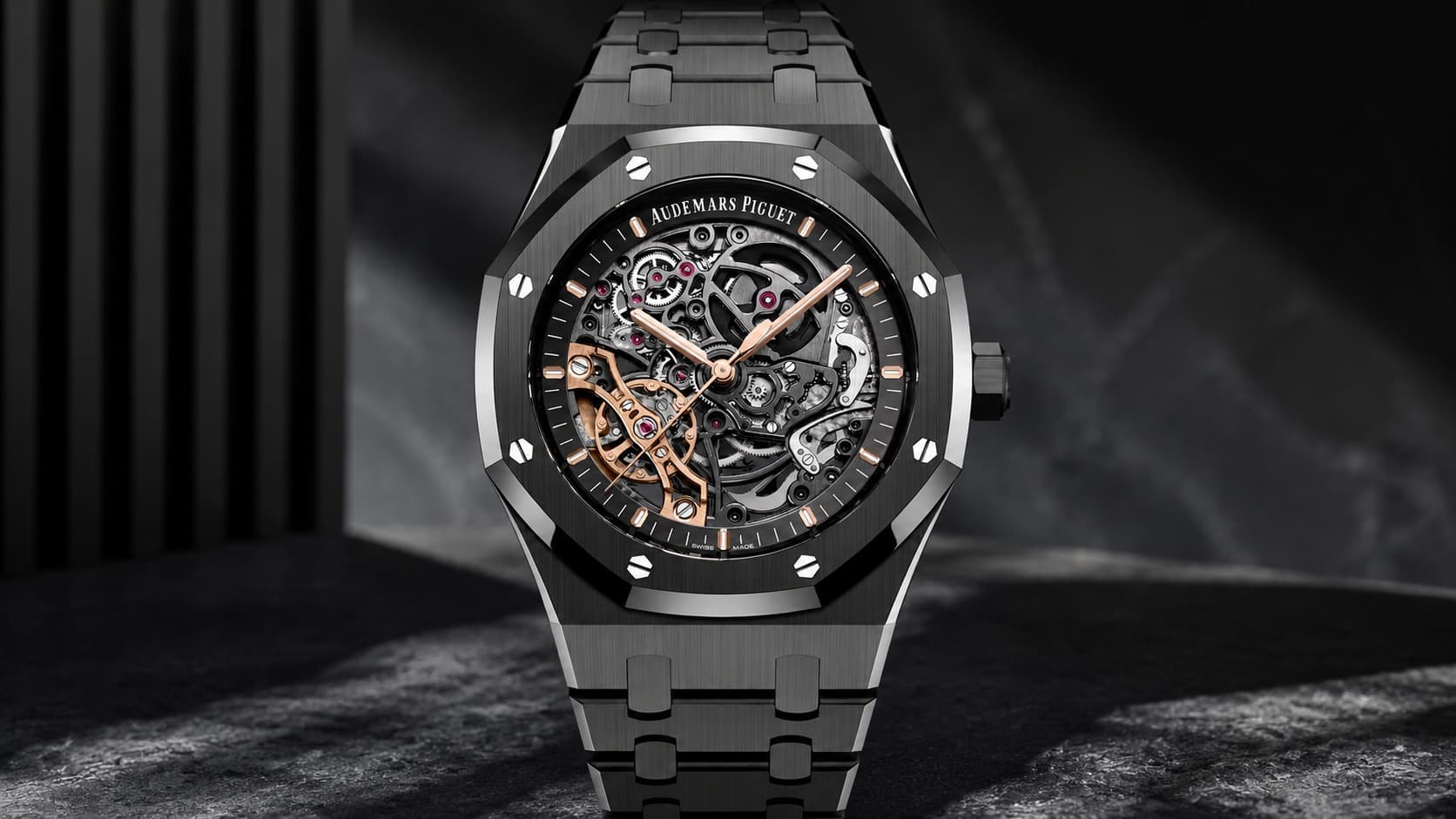
A handful of specific watches come up again and again whenever skeleton watches get mentioned, and each one earned that reputation for a different reason.
- Corum Golden Bridge — Introduced in 1980, this watch stretched its movement into a single straight line and mounted it inside a fully transparent case, becoming one of the earliest watches where the entire mechanism, not just parts of it, sat in plain view from every angle.
- Cartier Santos Skeleton — Built around Cartier’s aviation-inspired Santos design from 1904, this version shapes the movement’s own bridges into large Roman numerals, turning the skeleton structure itself into the hour markers instead of hiding it behind them.
- Audemars Piguet Royal Oak Openworked — Pairing the brand’s famous 1972 octagonal-bezel design with a fully hollowed-out movement, this model has become one of the most recognized modern skeleton watches, since the shape alone identifies it before anyone notices the see-through dial.
- Hublot Big Bang Unico Sapphire — Released in 2016, it went beyond skeletonizing the movement by making the entire case, bezel, and crystal out of sapphire, so the whole watch reads as see-through rather than just the dial.
- Jacob & Co. Astronomia — First unveiled in 2014, this watch replaces the traditional dial with a rotating structure of arms that carry a skeletonized time display, a tourbillon, and moving decorative elements, turning the entire mechanism into an orbiting display rather than a fixed one.
These five span very different price points and design philosophies, but they share the same core idea running through this whole guide: letting the mechanism itself become the design, instead of hiding it behind a dial.
What’s the Difference Between Skeleton, Openworked, and Open Heart Watches?
These three terms get mixed up constantly, but they describe different amounts of “see-through” on a watch.
| Style | What’s Visible | Typical Look |
|---|---|---|
| Open heart | A single small window, usually showing just the balance wheel | Mostly solid dial with one small cutout |
| Openworked | Several parts of the movement visible through cutouts in the dial | Partially see-through, some structure still hidden |
| Skeleton | Most or all of the movement, often visible from both front and back | Fully see-through, minimal solid material left |
An open heart watch shows only the balance wheel, the small part that swings back and forth to regulate timekeeping. It’s a small peek, not a full view. An openworked watch shows more, cutting into the dial to reveal gears and springs, but it usually keeps some structure in place. A true skeleton watch takes things further, removing material from the actual movement plates so the watch can often be seen clear through, front to back.
Many people, including some retailers, use “skeleton” loosely to describe all three styles. Anyone looking for the fully see-through look does well to check whether a watch is genuinely skeletonized or just has a partial cutout, since the terms are often used interchangeably in casual descriptions even when watch enthusiasts draw a sharper line.
The word “openworked” gets used almost as often as “skeleton” for the same fully see-through look, and that’s largely thanks to Audemars Piguet, which has marketed its own see-through movements using that term for decades. Some collectors draw a finer line and say a true skeleton watch also has its remaining metal engraved and decorated by hand, while a plainer openworked watch might skip that extra step. In everyday shopping, though, both words are typically used to mean the same thing, so the actual dial matters more than which label a listing uses.
Skeleton Watch Pros and Cons
A skeleton watch suits anyone who values mechanical craftsmanship and doesn’t mind a slightly harder-to-read dial. It’s a less practical choice for situations that call for checking the time at a glance in low light or from a distance.
Reasons people love skeleton watches:
- They show off real, moving mechanical engineering, not just a printed dial.
- Each piece often has hand-finished details best appreciated up close.
- They stand out from the sea of plain, solid-dial watches.
- Many models offer a second view of the movement from the case back as well.
Things to consider before buying one:
- Reading the time can take an extra second or two, since the hands blend into the busy background of gears.
- Fully skeletonized movements can be more delicate than solid ones, so they may need gentler handling.
- Prices climb quickly with hand-finished or Swiss-made pieces.
- Servicing can cost more, since a technician has to work carefully around exposed, decorative parts.
How Much Do Skeleton Watches Cost?
Skeleton watches range from under $100 for mass-produced fashion pieces to well over six figures for hand-finished luxury watches. The price mostly comes down to how the skeletonizing was done and by whom.
Machine-cut skeleton watches from budget and mid-range brands can look impressive while staying affordable, because computer-controlled cutting tools can shape a movement quickly and consistently. Hand-finished skeleton watches from high-end Swiss or independent watchmakers cost far more, since a skilled worker might spend days or weeks cutting, filing, and engraving a single movement by hand. Comparing two skeleton watches at very different prices usually comes down to how much human hand-work went into the piece, not just the brand name on the dial.
Roughly speaking, skeleton watches fall into three price tiers. Entry-level skeleton watches, often selling for under $300, typically use simple, machine-cut automatic movements and focus on the visual effect rather than fine hand-finishing. Mid-range pieces, generally somewhere between $300 and a few thousand dollars, tend to come from established watchmakers using in-house or Swiss-made movements with a bit more decoration on the visible parts. Luxury skeleton watches from names like Audemars Piguet, Vacheron Constantin, and Patek Philippe can run from several thousand dollars into six figures, largely because so much of the work is still done by hand by watchmakers trained for years in that one specific skill.
Skeleton Watch Maintenance Basics
Skeleton watches need the same basic care as any mechanical watch, plus a little extra attention because their exposed structure can be more delicate. Strong magnets should be kept away, since magnetized parts can throw off accuracy in any mechanical movement, skeletonized or not. Drops and knocks against hard surfaces are also riskier than usual, since removed metal leaves less material behind to absorb an impact.
Manual movements need regular winding, and automatic ones need frequent enough wear, since mechanical watches rely on consistent motion or winding to stay accurate. Servicing is best left to someone experienced with skeleton or open movements specifically, since a general repair shop may not be used to handling the thinner, more exposed bridges and plates.
Everyday cleaning should stay gentle. A soft, dry brush or a slightly damp microfiber cloth is usually enough to clear dust from the visible gaps, and ultrasonic cleaners are best left to a professional, since the vibrations that work fine on a sealed movement can be too aggressive for the thinner, more exposed bridges in a skeleton watch.
Frequently Asked Questions
Are skeleton watches less accurate than regular watches?
Not necessarily. A well-made skeleton watch keeps time just as accurately as its solid-dial counterpart, because the same gears and springs are doing the work. The main risk is if too much metal was removed without proper reinforcement, which is why buying from a reputable maker matters.
Can a skeleton watch be waterproof?
Some can, but many skeleton watches have lower water resistance than solid watches. The gaps and cutouts that reveal the movement can also make it harder to fully seal the case, so checking the specific water resistance rating before swimming or showering with one is worthwhile.
Do skeleton watches cost more to repair?
Usually, yes. Technicians need extra care and time to work around exposed, decorative parts without damaging them, and replacement components for a skeletonized movement can be harder to source than standard parts.
Is a skeleton watch harder to read?
A little. Because the hands sit on top of a busy background of gears instead of a plain dial, it can take a moment longer to spot the time, especially in dim lighting. Many brands address this with contrasting hands or a partial dial ring to keep the hour markers visible.
What’s the difference between a skeleton watch and a see-through case back?
A see-through case back reveals the movement from behind the watch, while the front dial stays solid. A true skeleton watch removes material from the front as well, so the entire watch is often visible straight through, not just from the back.
Conclusion
Skeleton watches turn a hidden mechanism into the whole point of the watch, and that idea has barely changed since André-Charles Caron first cut away metal for his French clients in the 1760s. What has changed is who can own one: what started as a rare luxury for aristocrats is now available at almost any budget, thanks to modern cutting tools alongside the hand-finishing techniques traditional watchmakers still use. Whether the piece is an affordable machine-cut model or a hand-engraved luxury watch, the appeal stays the same: the chance to watch, quite literally, how a mechanical watch does its job.