Fiyta is not a household name in most of the world, but it holds a title that even Rolex and Omega cannot claim: it is the only watch brand that has outfitted every single Chinese astronaut, called a taikonaut, on every crewed mission since China first put a person in orbit in 2003. That alone makes Fiyta worth a second look. The brand sells everything from thirty-dollar quartz watches with date windows to twenty-thousand-dollar limited-edition tourbillons built with its own movement, and most people outside China have never heard of either end of that range. A watch company from Shenzhen ended up tied to rockets largely by accident of corporate ownership, and that accident shaped nearly everything Fiyta has built since.
What You Should Know About Fiyta
Fiyta is a Chinese watch company founded in 1987 in Shenzhen, and today it is the country’s best-known domestic watch brand. It started as Shenzhen Feida Watch Company and grew into Fiyta Precision Technology Co., Ltd., a subsidiary of AVIC International Shenzhen, which itself sits under the Aviation Industry Corporation of China, a massive state-owned aerospace group. The brand went public on the Shenzhen Stock Exchange in 1993, and it has since grown into a wider group that also owns smaller labels, including the fashion-leaning Jonas & Verus, the heritage-focused Beijing brand, and a line of Jeep-branded smartwatches built for fitness tracking rather than mechanical watchmaking.
That aerospace connection is not just a marketing line. Fiyta’s parent company builds airplanes, so when China needed a reliable watch supplier for its space program, Fiyta already had the right corporate relatives in the room. In 2019, Fiyta was named the only watch brand included on a government-curated list of “70 brands” celebrating the 70th anniversary of modern China, a recognition that speaks to how closely the brand is tied to national identity there. As recently as December 2025, Fiyta publicly confirmed that its watches are carried at Pang Donglai, one of China’s most talked-about retail chains, a sign the brand still keeps close tabs on where and how it reaches shoppers at home.
Anyone shopping for a Fiyta today is dealing with one of China’s largest and most established watch manufacturers, not a small boutique brand experimenting with its first collection.
Fiyta’s Space Watch History
Fiyta has supplied the official watches for China’s manned spaceflight program since 2003, and this is the single thing that sets the brand apart from every other budget or mid-range watchmaker. When Yang Liwei became the first Chinese astronaut in space aboard Shenzhou 5 in October 2003, he wore a Fiyta watch on his wrist. Two years later, in 2005, the same Space Watch collection flew the full length of the Shenzhou 6 mission, just under five days in orbit covering more than three million kilometers.
That relationship got far more demanding in 2008. During the Shenzhou VII mission, taikonaut Zhai Zhigang performed China’s first spacewalk wearing a Fiyta watch strapped to the outside of his spacesuit sleeve, not underneath it. That watch, later sold to the public as the Fiyta Spacemaster, had to survive conditions no ordinary watch ever faces.
Fiyta engineered a special lubricant so the watch’s movement kept running across a temperature range of -80°C to +80°C, something the brand says had not been achieved before.
A few details make this watch genuinely unusual among space-flown instruments:
- The rotating bezel is marked in 8-hour segments, matching the life-support duration of the Feitian spacesuit, so the bezel doubled as a safety countdown.
- The crown locks counter-clockwise, a design choice meant to stop it from accidentally popping open during the spacewalk.
- The real flight watch is extremely rare: Fiyta made just 53 of the 54mm titanium version, and only three of those ever left Earth’s surface, worn by the three-man Shenzhou VII crew. Collectors who wanted something closer to the original could instead buy a smaller, 44mm stainless steel edition, limited to 699 pieces.
Fiyta kept building on this heritage. When Liu Yang became China’s first female taikonaut on the Shenzhou 9 mission in 2012, her watch carried hand-applied cloisonné enamelwork, a traditional Chinese decorative technique, running along the side of the case. The design work paid off beyond China’s own borders too: in 2010, the Shenzhou VII spacewalk watch took home a Red Dot Design Award, a well-regarded international product design prize and one of the few times Fiyta earned recognition independent of its government ties.
Best Fiyta Aeronautics Watches
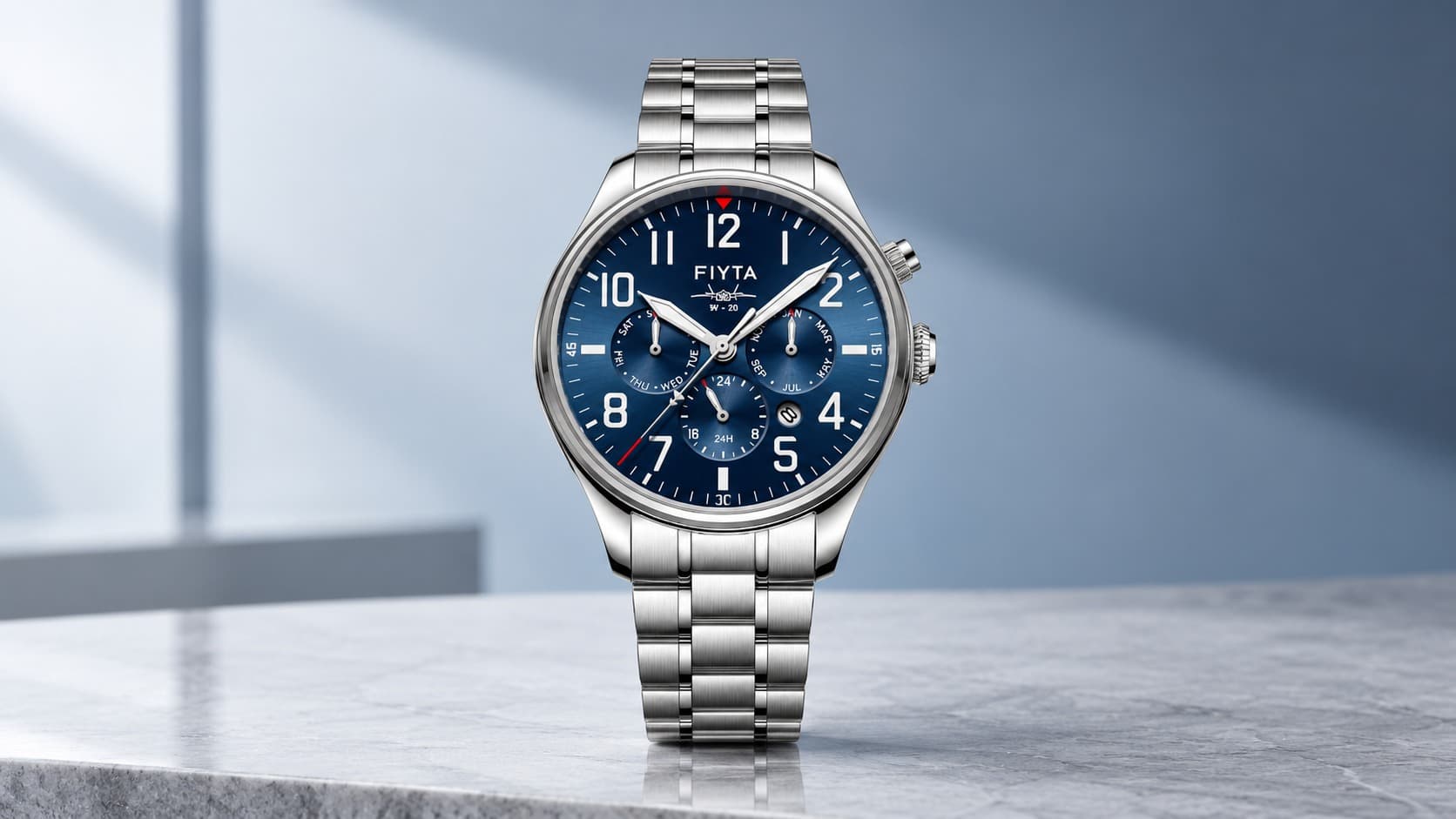
The Aeronautics line is where Fiyta channels its space program work into watches regular people can actually buy. These models borrow design cues, materials, and sometimes movement technology directly from the spacecraft-tested watches. Collectors tend to rate the EVA-linked commemorative chronographs especially highly, and the mechanics back that up: those particular watches ran on the Swiss-made ETA 7750, a well-regarded automatic chronograph movement used across the watch industry, rather than a cheaper quartz engine.
A standout current model is the Taikonaut Tourbillon, built around Fiyta’s own tourbillon caliber, the F192. A tourbillon is a small rotating cage inside the movement, originally invented to fight gravity’s effect on accuracy in pocket watches; today it is mostly valued as a sign of serious watchmaking skill, since it is difficult and expensive to build well. The Taikonaut version has a case made from Grade 5 titanium, the same type of lightweight, corrosion-resistant alloy used in aerospace parts, and even its winding rotor is styled after the shape of a Shenzhou re-entry capsule, a small detail most owners would only notice once they flip the watch over.
Another model worth knowing is the Big Dipper Tourbillon, which places a star constellation pattern on the dial and uses a titanium bracelet. It runs on the same family of in-house tourbillon movement and carries an 80-hour power reserve, meaning it can sit unworn for over three days and still be keeping accurate time when you pick it back up. Fiyta has also experimented with more playful Aeronautics-adjacent designs over the years, including a Photographer-themed chronograph with interchangeable bezels, showing the collection is not limited to pure space replicas.
For buyers who want the aerospace styling without the cost of a tourbillon, Fiyta also sells automatic Aeronautics watches without that complication, at a noticeably lower price.
Best Fiyta Tourbillon Watches
Fiyta’s Roadster series, sometimes marketed under the brand’s “Extreme” collection naming, takes a different inspiration, drawing from car dashboards instead of spacecraft, but it houses some of the brand’s most technically interesting watches. The Roadster High-Frequency Tourbillon uses an in-house movement running at 28,800 vibrations per hour with an 80-hour power reserve, and its power reserve indicator is styled to look like a fuel gauge, a small design touch that ties the whole watch back to its automotive theme.
What makes this watch notable in the wider watch world is price. A Western Swiss tourbillon from a major maison often costs well into five or six figures. Fiyta’s in-house tourbillons, including Roadster and Aeronautics models, have historically sold in the roughly $1,600 to $4,500 range, with a small number of ultra-limited pieces, like the 20-piece Turnover Tourbillon, priced far higher, around $20,000. For buyers curious about tourbillon watchmaking without a Swiss-sized budget, this is one of the more accessible entry points anywhere in the industry.
Best Fiyta Classic Watches
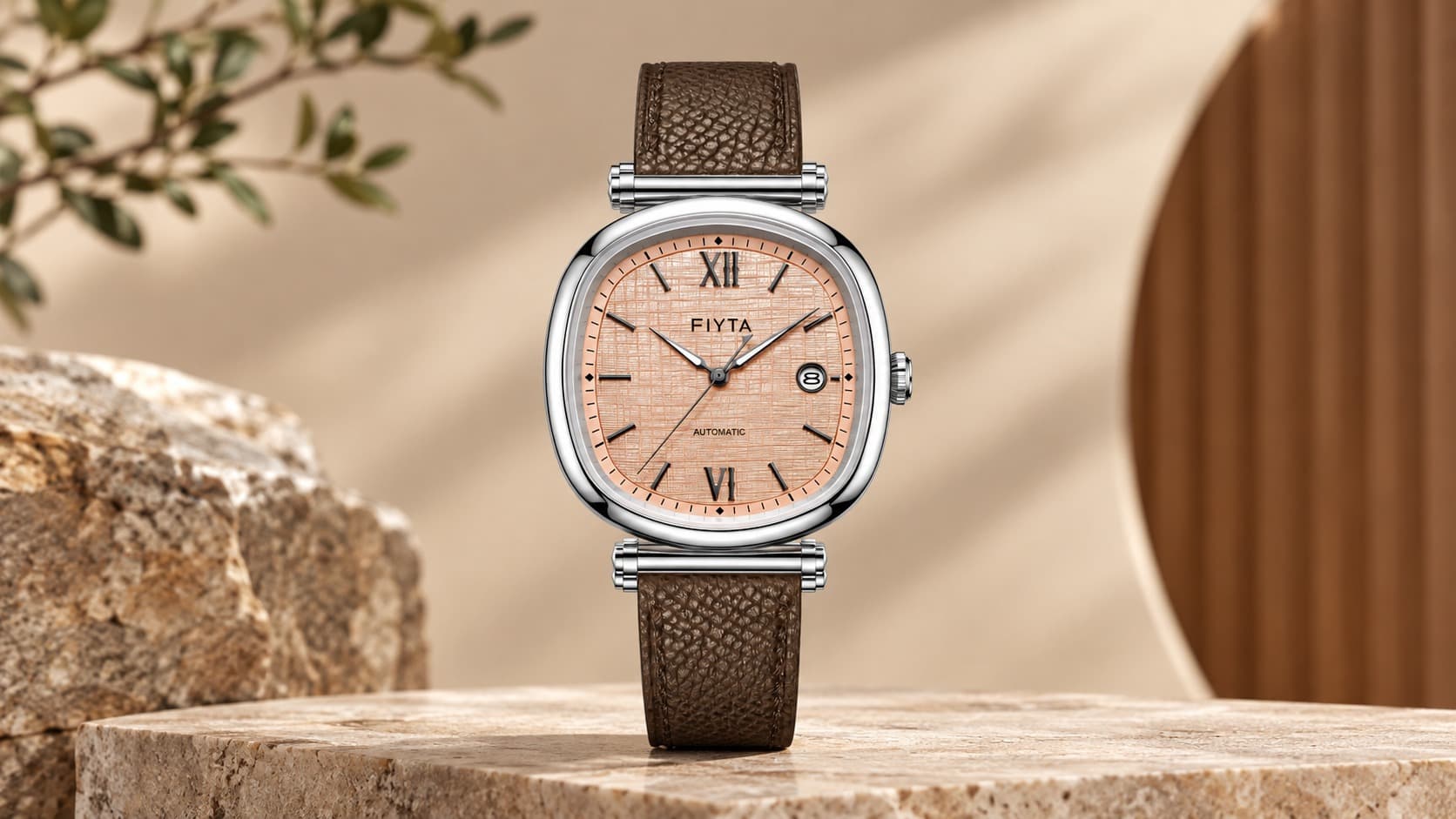
Not everyone wants a tourbillon, and this is where Fiyta’s Classic line comes in. These are simple, affordable watches meant for daily wear rather than collecting, typically priced from under $100 up to around $300, and the lineup covers both men’s and women’s sizing.
Classic models commonly feature:
- A sapphire crystal, which resists scratches far better than the plastic or mineral crystals found on many watches in this price range
- Either a Japanese quartz movement or an automatic movement sourced from suppliers like Miyota, giving buyers a choice between battery-free mechanical motion and low-maintenance quartz accuracy
- Water resistance generally between 30 and 50 meters, enough for daily wear, hand-washing, and rain, though not for swimming or diving
- Clean dials with Roman numeral or bar-style hour markers and a date window, aimed at an office-appropriate, dressy look
Owner reviews of Fiyta’s Classic and Aeronautics lines consistently point to strong value for money as the brand’s biggest strength, with buyers often comparing the build quality favorably against other watches at similar prices.
Fiyta Watch Collections Compared
| Collection | Typical Price Range | Movement Type | Best For |
|---|---|---|---|
| Classic | $75–$300 | Quartz or automatic (Miyota) | Everyday, budget-friendly wear |
| Aeronautics | $2,500–$4,500+ | Automatic, some in-house tourbillon | Space heritage, aviation styling |
| Roadster | $1,600–$4,500 | In-house tourbillon | Mechanical complexity at a lower cost |
| Limited Editions | $4,500–$20,000+ | In-house tourbillon | Collectors, rare pieces |
Fiyta Watches: Movements and Manufacturing
Fiyta watches are designed and assembled in China, mostly through facilities connected to its Shenzhen headquarters. The brand does not rely on a single movement source. Entry-level and mid-range Fiyta watches commonly use Japanese quartz or automatic movements from Miyota, while some models, particularly chronographs built for commemorative space editions, have used Swiss ETA movements.
For its higher-end mechanical watches, Fiyta has invested in developing movements in-house, including its own tourbillon calibers. This shift became more serious after October 2016, when Fiyta took ownership of the Beijing Watch Factory, a historic Chinese movement maker, giving it direct access to more advanced movement technology instead of depending entirely on outside suppliers. It is worth noting that some watch enthusiasts have questioned how much of Fiyta’s tourbillon movement was truly engineered from scratch in-house versus adapted from existing Chinese movement architecture, though there is no dispute that the finished caliber is exclusive to Fiyta and not sold to other brands.
Long before most Chinese competitors caught on, Fiyta was already experimenting with case materials such as tungsten and ceramic, which helped build its reputation as a technically ambitious domestic brand. It also moved into sports marketing early, backing China’s gymnastics team at the 2000 Sydney Olympics. That track record of firsts culminated in 2011, when Fiyta became the first watch brand from China ever invited to show in Hall 1 at Baselworld, the part of the Swiss fair historically occupied by the industry’s longest-established names. For a company only 24 years old at the time, that invitation was a clear sign the international watch trade had started paying attention.
Frequently Asked Questions
Is Fiyta a good watch brand?
Fiyta is a legitimate, well-established watch brand with a genuine track record, including decades of supplying watches for China’s manned space program and an in-house tourbillon movement. It is not a luxury Swiss brand, but within its price range it offers solid build quality, sapphire crystals, and real mechanical engineering, which makes it a reasonable option for buyers who want more than a basic fashion watch without spending thousands of dollars.
What movements does Fiyta use?
Fiyta uses a mix of movements depending on the watch. Budget and mid-range models commonly use Japanese Miyota quartz or automatic movements, some chronographs have used Swiss ETA movements, and the brand’s higher-end pieces, especially its tourbillons, use movements developed in-house, a capability that grew after Fiyta acquired the Beijing Watch Factory in 2016.
Why does Fiyta make space watches?
Fiyta has been the official watch supplier for China’s manned spaceflight program since 2003, a role that fits with the fact that its parent company sits inside the Aviation Industry Corporation of China, a state-owned aerospace conglomerate. Every Chinese taikonaut, starting with Yang Liwei in 2003, has worn a Fiyta watch during their mission, and several of those flight-tested designs were later released as commemorative watches for the public.
How much does a Fiyta watch cost?
Fiyta watches span a wide price range. Simple quartz models in the Classic collection start at around $75 to $100, mechanical Aeronautics and Roadster models typically run from roughly $1,600 up to around $4,500, and rare, in-house tourbillon limited editions have sold for as much as $20,000.
Are Fiyta watches sold outside China?
Yes. Fiyta has built a notable international retail presence over the years, and its 2011 invitation into Baselworld’s Hall 1, previously reserved for established Swiss and European brands, remains its biggest international credibility marker. Inside China, the company has also kept expanding where it sells, including confirming in late 2025 that its watches are carried at Pang Donglai stores.
The Bottom Line
Fiyta’s real strength is the gap it fills: a brand with an authentic, documented space-flight history and its own in-house tourbillon movement, sold at prices that undercut almost every Swiss equivalent. The Classic collection makes sense for anyone who wants a reliable, good-looking daily watch without spending much money, while the Aeronautics and Roadster lines are where the brand’s engineering actually shows off, especially in the tourbillon models that cost a fraction of what comparable Swiss watches demand. Whether Fiyta belongs on a buyer’s wrist depends on how much weight they put on heritage and mechanical ambition over a recognizable logo, but as a brand, it has earned its place in the conversation.