Nixon watches look different from almost anything else on a watch counter, and that is on purpose. The brand grew out of surf shops and skate parks in Southern California, not old European workshops, so its watches were built to survive salt water, drops, and long days outside rather than to sit behind glass. That background still shapes every model the company makes today, from tiny minimalist dials to oversized chronographs the size of a hockey puck, and it explains why Nixon’s lineup covers everything from budget-friendly daily wear to bold, oversized statement pieces.
The Story Behind Nixon Watches
Nixon watches stand out because they were designed by surfers and skaters for their own community, not by a traditional watch company chasing a trend. Nixon watches and accessories launched in Encinitas, California, in 1998, after co-founders Andy Laats and Chad DiNenna grew frustrated that ordinary watches kept breaking during surfing and skating. That real-world problem is why so many Nixon watches still lean on thick cases, screw-down crowns, and high water resistance ratings today.
The brand also built its identity through collaborations rather than heritage stories about royal courts or Swiss ateliers. Nixon has released watches tied to bands, films, and pop culture moments, which is part of why its designs feel bolder and more graphic than most traditional watch brands. Nixon has a global presence with sales in over 90 countries worldwide, and it now makes accessories and apparel alongside its watches, but timepieces remain the core of the business.
Nixon still operates out of Southern California, and the company has kept its watches close to that original action sports scene even as it grew into a global brand. Because Nixon was never trying to copy old European watchmaking traditions, it had more freedom to experiment with oversized cases, unusual crown placements, and graphic dials that a heritage-focused brand might avoid. That freedom is the real reason Nixon watches look so different from what most traditional jewelers carry.
Nixon’s whole approach comes down to one idea: build a watch tough enough for the ocean, then make it look good enough for the street.
Best Nixon Watch for Bold Style
The 51-30 Chrono is the watch most people picture when they think of Nixon, thanks to its oversized 51mm face. The number in its name is not random — it refers to the face size of 51mm and the water-resistant rating of 30 ATM, which is the kind of straightforward, no-nonsense naming Nixon uses across its lineup.
Underneath that huge dial sits a genuinely capable watch, not just a fashion piece. It runs on a Miyota OS20 Japanese quartz six-hand chronograph movement, and the case is built from solid stainless steel rated to 300 meters, or 30 ATM, of water resistance. Nixon also moved the crown and pushers to an unusual spot on the case, placing them at the 9 o’clock position instead of 3 o’clock, a detail meant to stop the crown from digging into the wrist during active movement. Prices for the 51-30 Chrono generally start around $500, making it one of the pricier watches in the Nixon lineup, and it comes in dozens of colorways, from all-black to gold-plated finishes.
The dial itself is built with layers rather than one flat surface. A concave dial ring surrounds bold printed indices, textured subdials, and custom-molded hands, giving the face real depth when light hits it instead of looking flat like a cheaper watch. The bezel also does more than look tough: it is a unidirectional rotating bezel with a built-in countdown timer, a feature borrowed from dive watches that allows elapsed time to be tracked at a glance. Nixon also sells a “Custom Build” version of the 51-30, letting buyers mix and match case finish, dial color, and band material rather than picking from a fixed lineup.
Best Everyday Nixon Watch
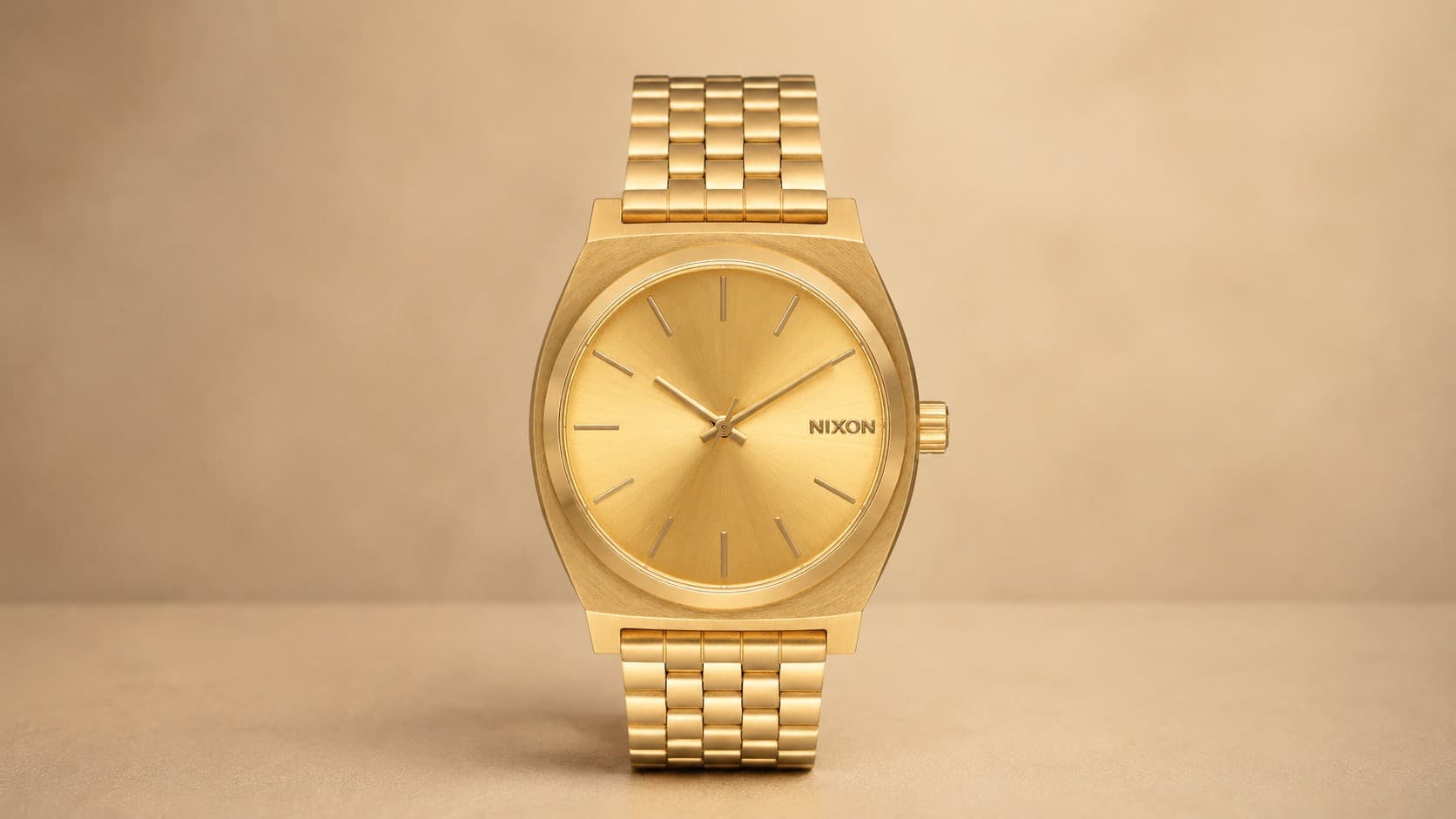
The Time Teller is built around a simple idea: a reliable, good-looking watch for wearing every single day. Nixon describes the Time Teller as one of its most popular watches of all time, and it earns that reputation by staying simple. It skips the chronograph subdials and oversized case of the 51-30, sticking to a clean three-hand analog face instead.
That simplicity keeps the price low too, with the standard Time Teller priced at $150, well under half the cost of the 51-30 Chrono. Nixon sells it across a wide range of colors, dial finishes, and case materials, including leather and stainless steel bracelet options, allowing it to dress up or down depending on the strap. This is also the watch line most likely to show up in a Nixon collaboration release, including special editions tied to musicians and films.
The Time Teller’s case measures 37mm across and only about 9mm thick, so it sits low and light on the wrist instead of feeling bulky. It runs on a Miyota Japanese quartz three-hand movement, holds a 100-meter (10 ATM) water resistance rating, and pairs a solid stainless steel fixed bezel with a hardened mineral crystal for everyday scratch protection. Because the case stays a moderate size across nearly every version, the Time Teller also works well as a unisex option, which is part of why Nixon markets many colorways of it to both men and women rather than splitting it into separate lines.
Best Nixon Watch for Active Lifestyles
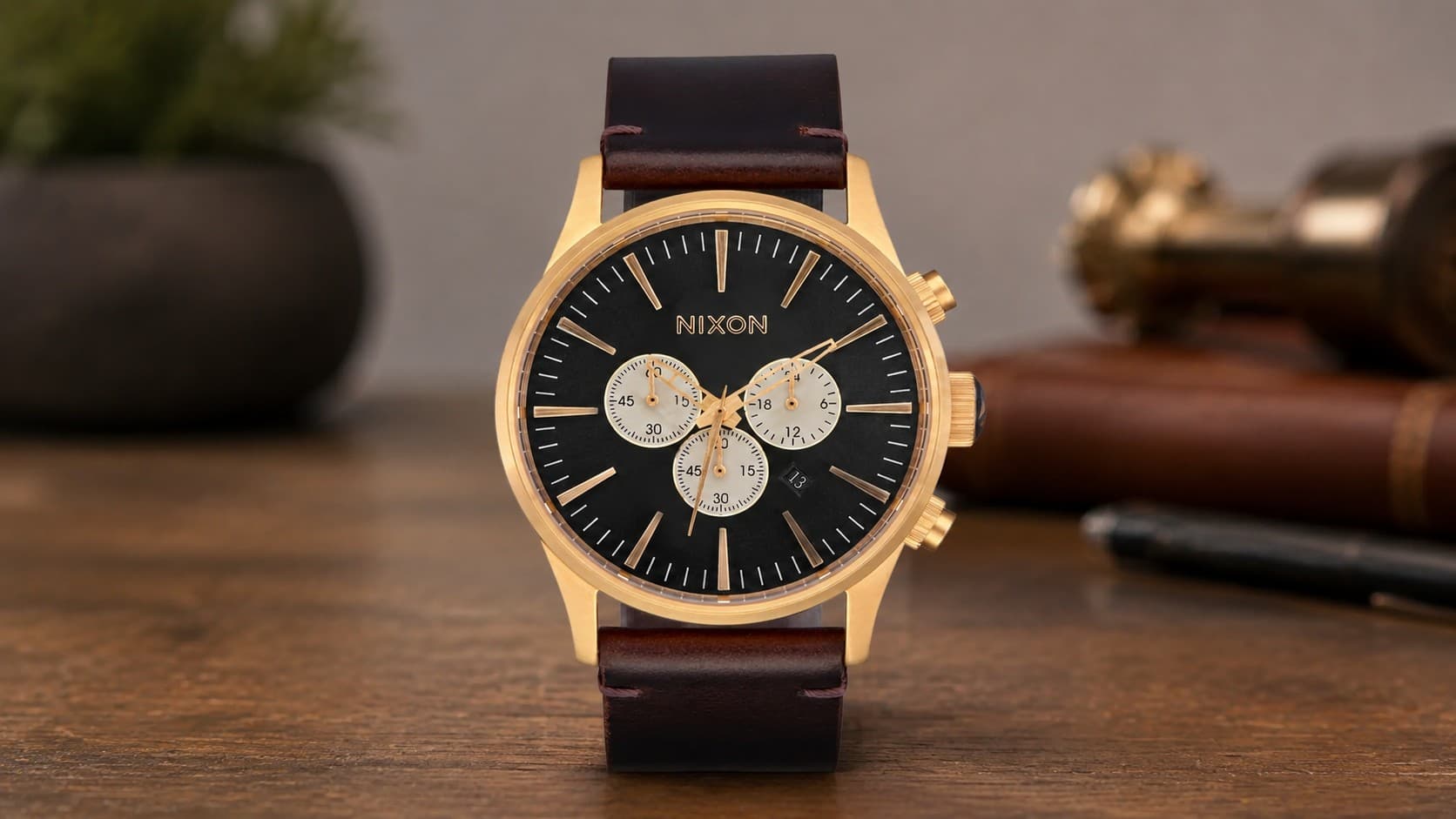
The Sentry line sits in the middle ground between the massive 51-30 and the minimal Time Teller, and it is built with slightly more rugged intent. Sentry watches typically use a larger case than the Time Teller while staying more wearable day-to-day than the 51-30, and several versions add a chronograph function for timing laps or activities.
Pricing spreads out across the Sentry family depending on materials, with leather-strap versions starting around $175 and chronograph steel versions starting around $350. That range makes Sentry a good middle option for anyone who finds the 51-30 too large but still wants a sportier look than the plain Time Teller offers.
The base Sentry SS uses a 42mm stainless steel case, a Miyota 2305 three-hand quartz movement, and a bilingual day-and-date window printed in English and Spanish, a small but genuinely useful detail. It carries a 100-meter water resistance rating, a triple-gasket crown for extra sealing against moisture, and a tapered 23-20mm bracelet with a double-locking clasp to prevent accidental slipping. Stepping up to the Sentry Chrono keeps the case at 42mm, but Nixon swaps in a six-hand chronograph movement with a 24-hour subdial, adding stopwatch functionality the base Sentry does not have.
How Water-Resistant Are Nixon Watches?
Water resistance is where Nixon’s surf-shop roots show up most clearly, and understanding the numbers matters before choosing a model.
| Model | Typical Water Resistance | Best Use |
|---|---|---|
| 51-30 Chrono | 300m / 30 ATM | Swimming, surfing, diving-adjacent activities |
| Time Teller | 100m / 10 ATM | Showering, swimming, everyday splashes |
| Sentry | 100m / 10 ATM | Daily wear, light water exposure |
A rating of 100 meters does not mean the watch is built for scuba diving, but it does mean showers, hand-washing, and swimming are generally safe. The 300-meter rating on the 51-30 provides a bigger safety margin, matching its design as the brand’s flagship, ocean-ready piece.
What Movement Does Nixon Use?
Nixon relies mainly on quartz movements rather than mechanical ones, and that is a deliberate choice rather than a shortcut. Nixon watches use Japanese or Swiss quartz movements, which keep time using a battery and a vibrating quartz crystal instead of springs and gears. Quartz movements are more accurate day-to-day than mechanical movements and need far less maintenance, which fits a brand built around watches that need to survive salt water and impact rather than sit in a display case.
The tradeoff is that quartz watches need a battery replacement every couple of years, unlike mechanical watches that never need one. For a brand focused on affordability and durability over old-world watchmaking prestige, that tradeoff makes sense, and it keeps Nixon’s prices far lower than luxury mechanical brands.
Frequently Asked Questions
Are Nixon watches good quality?
Yes, for their price range. Nixon watches use solid stainless steel cases, reliable Japanese quartz movements, and water resistance ratings that hold up to real use in and around the ocean. They are not built to the same standard as luxury Swiss mechanical watches, but they were never designed to compete in that category — the aim is durability and style at an accessible price instead.
Where are Nixon watches made?
Nixon designs its watches at its headquarters in Carlsbad, California, but like nearly every modern watch brand at this price point, the components and assembly happen overseas, primarily in Asia, where the Miyota movements Nixon uses are also manufactured.
How much do Nixon watches typically cost?
Most Nixon watches fall between $100 and $250, with entry-level models like the Time Teller closer to $150 and the flagship https://amzn.to/3SUXRKx running from roughly $500 to $600 depending on the finish and materials chosen.
Is the Nixon 51-30 too big for a small wrist?
It can be. The 51-30’s case measures 51mm across, which is significantly larger than a typical men’s watch, and it sits close to the edge of the wrist on smaller frames. For wrists under about 6.5 inches, trying one on in person before buying is a smart move.
Do Nixon watches need battery replacements?
Yes. Because Nixon primarily uses quartz movements, the battery inside needs replacing roughly every one to two years, similar to most quartz watches from any brand.
Conclusion
Picking the right Nixon watch mostly comes down to how big and bold a wrist wants to look. The 51-30 Chrono delivers maximum presence and genuine dive-ready durability for anyone chasing a statement piece, the Time Teller covers everyday wear at a friendly price, and the Sentry line splits the difference with rugged styling and chronograph function. Whichever model gets chosen, it carries the same original idea Nixon started with in 1998: gear tough enough for the surf and stylish enough for everywhere else.