The little dome of clear material sitting over a watch face doesn’t get much credit, but it’s doing one of the hardest jobs on the entire watch. It gets bumped against doorframes, brushed by shirt sleeves, and splashed with everything from seawater to hand sanitizer, all while staying clear enough to read the time at a glance. That cover is called the crystal, and it’s almost always made from one of three materials: sapphire, mineral glass, or acrylic. Each one trades off scratch resistance, toughness, weight, and price in a different way, and knowing which is which explains a lot about how a given watch is likely to age.
What Is a Watch Crystal?
A watch crystal is the clear cover that protects the dial and hands from dust, water, and knocks. Despite the name, it isn’t always made of glass at all — it can be a hard mineral, a lab-grown gem material, or a type of clear plastic.
The word “crystal” stuck around from the early days of watchmaking, when the cover really was cut from natural rock crystal or glass. Today the term just means “the clear part on top,” no matter what it’s actually made from. Which material a watchmaker picks changes how the watch looks, how much it costs, and how it holds up to years of daily wear.
Sapphire Crystal: Strength, Cost, and Care
Sapphire crystal is the hardest of the three, so it resists scratches better than mineral glass or acrylic by a wide margin. On the Mohs hardness scale, which runs from 1 (soft as talc) up to 10 (diamond), sapphire crystal sits at 9.
That’s not natural gemstone sapphire mined from the ground — it’s lab-grown crystallized aluminum oxide, made in a controlled process that produces the same hardness as the real thing for a fraction of the cost. Because it ranks so close to diamond, almost nothing encountered during a normal day, like keys, sand, or a stone countertop, is hard enough to leave a mark on it. Watches that use sapphire tend to stay looking brand new for years, which is a big reason luxury brands rely on it almost exclusively.
The trade-off is that sapphire’s hardness makes it more brittle. A hard, sharp knock — a drop onto concrete or an impact against a metal edge — is more likely to crack a sapphire crystal than to crack mineral or acrylic, because the same rigidity that resists scratching also makes it less able to flex on impact. Sapphire crystals also cost more to manufacture, since the material has to be grown and then ground and polished into shape using specialized tools, and that expense usually gets passed on to the buyer.
Sapphire crystal almost never scratches during normal wear, but if it does crack, it can’t be polished out — the whole crystal has to be replaced.
One quirk of sapphire is that it actually reflects more light than mineral or acrylic glass, which can create glare that makes the dial harder to read in bright sunlight. That’s why most sapphire watches add a thin anti-reflective (AR) coating to one or both sides of the crystal, cutting down on glare and making the dial look almost invisible behind the glass. The trade-off is that this coating is softer than the sapphire underneath it, so it can pick up faint surface scratches over time even though the sapphire itself stays flawless.
Mineral Crystal: Strength, Cost, and Care
Mineral crystal is heat-treated or chemically hardened glass that sits between acrylic and sapphire in both toughness and price. It typically ranks around 5 to 7 on the Mohs scale, tough enough to shrug off soft daily bumps but still soft enough that things like keys, sand, or a rough countertop can leave faint marks over time.
This is the crystal found on the largest share of watches sold worldwide, especially in the affordable-to-mid-range price bracket. It’s cheap to produce, handles everyday impacts better than sapphire because it flexes slightly instead of cracking, and any light scratches it does pick up can often be buffed out with a simple polishing compound. Some brands take mineral crystal a step further with proprietary hardening treatments — Seiko’s “Hardlex,” for example, is a toughened mineral crystal designed to resist scratches better than standard mineral glass while staying more affordable than sapphire.
A few brands split the difference even further by coating mineral crystal with a thin layer of sapphire, gaining some of sapphire’s scratch resistance without the full manufacturing cost. This hybrid approach shows up on watches from brands like Wenger, giving a budget-friendly crystal a noticeably tougher surface than plain mineral glass alone.
Acrylic Crystal: Strength, Cost, and Care
Acrylic crystal is a lightweight, flexible plastic that scratches the easiest of the three but is also the hardest to crack or shatter. It sits at roughly 3 on the Mohs scale, only a little tougher than a human fingernail, which means everyday objects like keys or a rough tabletop can leave visible marks fairly quickly.
Acrylic, sometimes called plexiglass, or “Hesalite” when it’s a specific tempered version used by brands like Omega, was the standard crystal material for most of the twentieth century before mineral and sapphire crystals became common. Because it’s soft and slightly flexible rather than rigid, it tends to absorb impact instead of cracking, which made it a favorite for tool watches, field watches, and anything expected to survive rough handling. Its biggest practical advantage today is that scratches buff out easily with a bit of polishing compound and a soft cloth, something that isn’t possible with sapphire. It also gives off a warm, slightly softer look under light that vintage watch fans still find appealing, which is why some modern reissues bring it back on purpose rather than by accident.
Acrylic’s shatter resistance is widely credited as a reason NASA kept the Omega Speedmaster’s Hesalite crystal for astronauts during the Apollo missions, since a shattered sapphire or mineral crystal inside a pressurized spacesuit or cabin would have been far more dangerous than a scratched one. Omega still sells a version of the Speedmaster Professional with that same Hesalite crystal today, largely because of that history.
Sapphire, Mineral, and Acrylic Compared
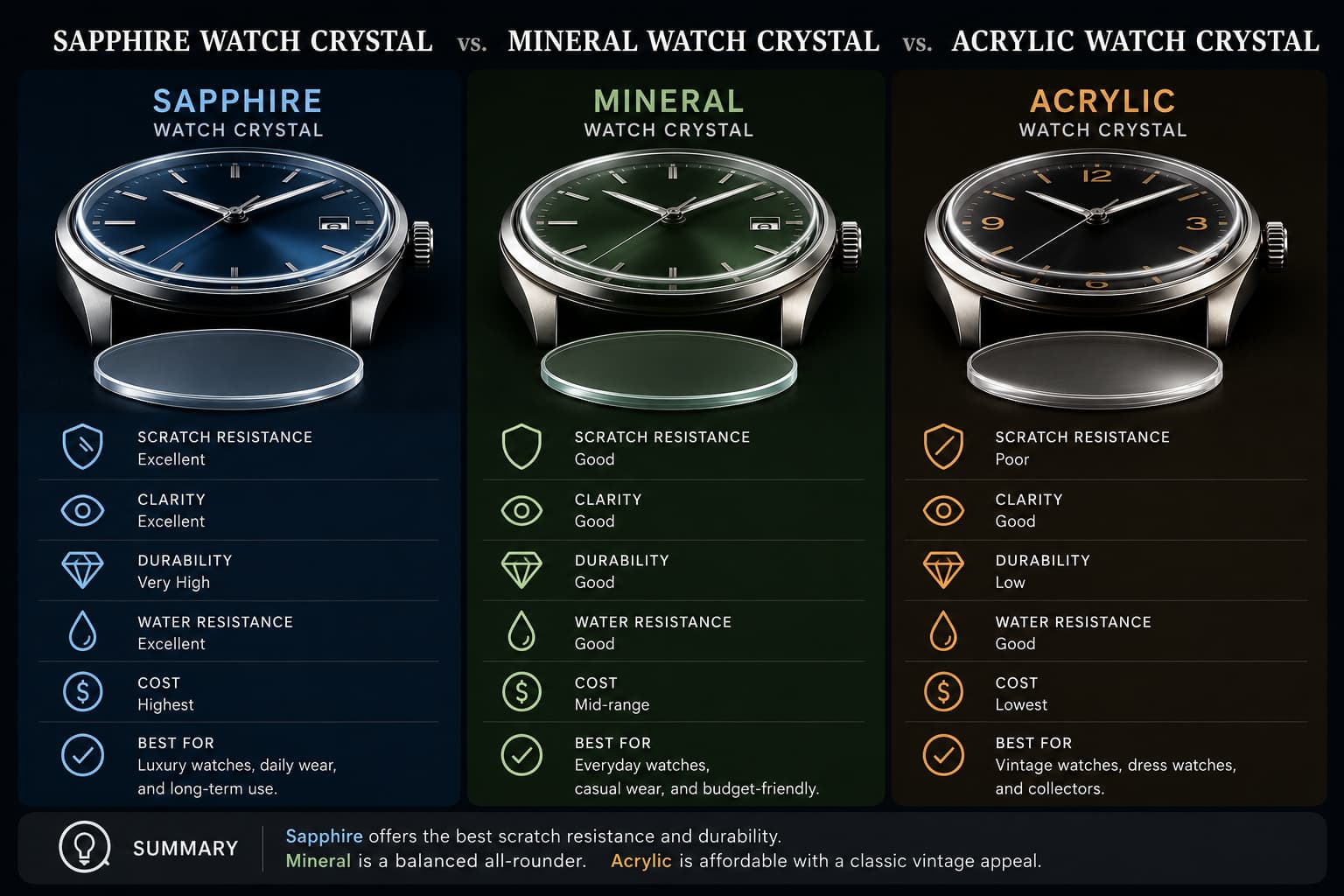
| Feature | Sapphire | Mineral | Acrylic |
|---|---|---|---|
| Mohs hardness | ~9 | ~5–7 | ~3 |
| Scratch resistance | Excellent | Good | Fair |
| Crack/shatter resistance | Fair (brittle) | Good | Excellent |
| Can scratches be polished out? | No | Yes | Yes, easily |
| Weight | Heaviest | Moderate | Lightest |
| Glare without coating | Noticeable (often AR-coated) | Low | Low |
| Typical cost to produce | Highest | Moderate | Lowest |
| Common on | Luxury and dive watches | Everyday and budget watches | Vintage-style and tool watches |
Which Crystal Scratches Least, and Which Cracks Least?
Sapphire wins on scratch resistance, while acrylic wins on crack and shatter resistance, and mineral crystal lands in between on both. These two properties don’t move together — a material can be extremely hard and scratch-proof while still being more prone to cracking under a sharp, direct hit, which is exactly what happens with sapphire.
The difference plays out much like a diamond compared to a rubber ball. A diamond is nearly impossible to scratch, but hit it at the wrong angle with enough force and it can chip. A rubber ball scuffs up easily but almost never breaks, because it flexes instead of resisting. Sapphire behaves more like the diamond, acrylic behaves more like the rubber ball, and mineral glass sits somewhere in the middle of that spectrum, flexing a bit more than sapphire while resisting scratches better than acrylic.
Can You Fix a Scratched Watch Crystal?
Scratches in mineral and acrylic crystals can usually be polished out by a watchmaker or with a home polishing kit, but scratches in sapphire crystal generally cannot. Mineral and acrylic are soft enough that a fine polishing compound can gently smooth the surface back out, while sapphire is too hard for those same compounds to have any real effect on it.
For acrylic specifically, this is one of its biggest practical advantages — even fairly deep scratches can often be buffed away with a store-bought polish and a little effort. Mineral crystal responds to the same kind of treatment, though it may take more effort depending on how deep the mark is. If a sapphire crystal does get scratched or cracked, the usual fix is a full replacement rather than a repair, which is part of why sapphire watches are built to avoid scratching in the first place rather than to make fixing them easy.
Simple Tests to Identify Watch Crystal Type
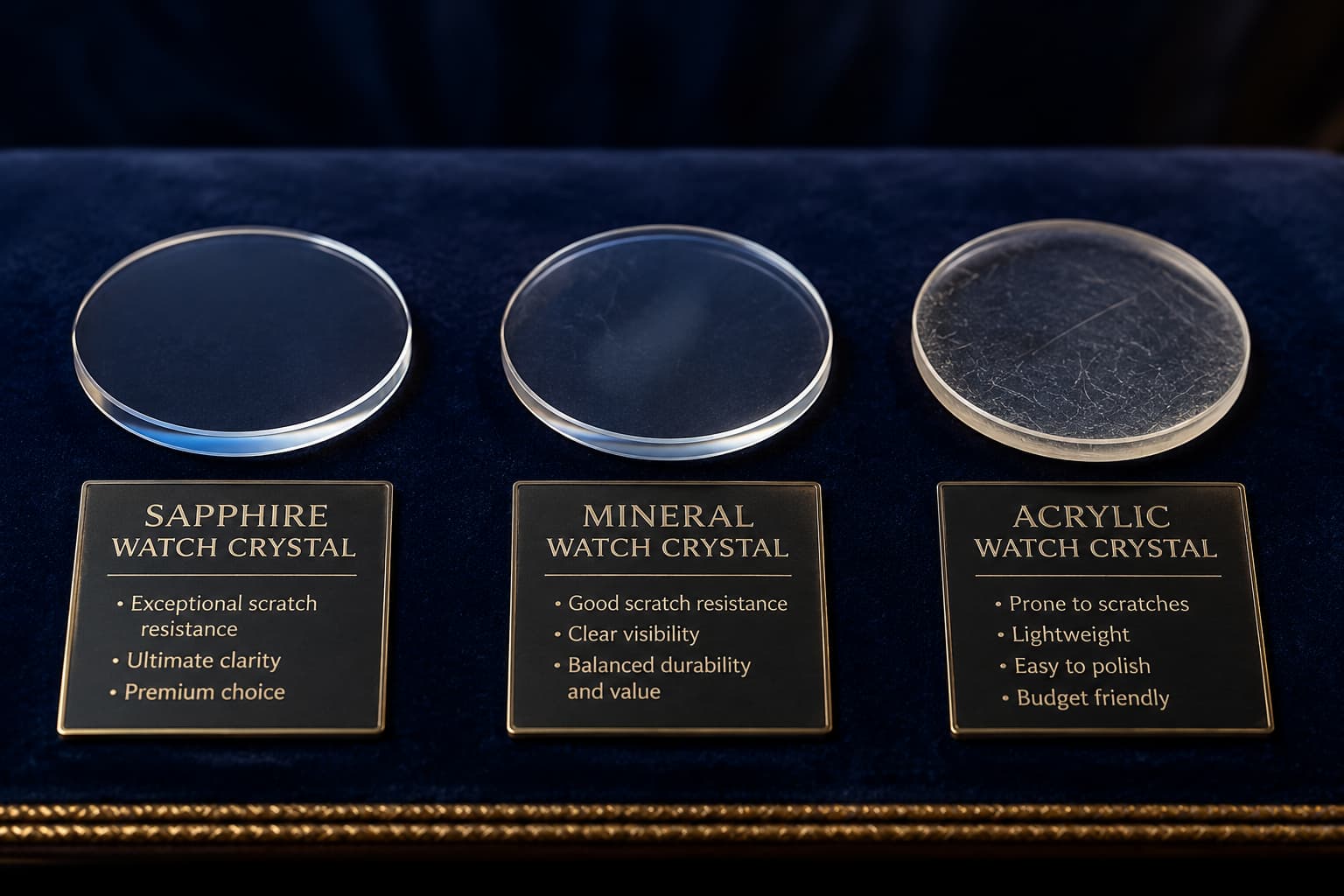
Three simple at-home checks can usually reveal which crystal is on a given watch, without needing any tools or risking damage to the piece.
The first is a touch test: resting the crystal against the skin, or a fingertip against the crystal, for a second or two. Acrylic feels noticeably warm almost immediately because plastic doesn’t pull heat away from skin, while both mineral and sapphire feel cool since they conduct heat much faster. A warm reading points to acrylic. A cool reading calls for a second check, the breath test — breathing gently on the crystal to fog it, then watching how fast the fog clears. Sapphire conducts heat so efficiently that the fog vanishes in a second or two, while mineral glass holds the fog noticeably longer.
A third option is the tap test: a gentle fingernail tap on the crystal while holding the watch close to the ear. Acrylic makes a dull, plasticky sound, mineral glass makes a slightly higher glassy ping, and sapphire tends to sound the sharpest and clearest of the three. None of these tests is perfectly scientific on its own, but two or three run together usually settle it, and the manufacturer’s spec sheet or the watch’s manual will always confirm the material directly.
Which Watch Crystal Should You Pick?
The right crystal depends less on prestige and more on how the watch will actually be worn. A watch meant to look pristine for decades with minimal upkeep gets the most value from sapphire, since it simply won’t pick up the daily scuffs that other materials do.
A budget watch, or a first watch expected to be worn and knocked around without much worry, tends to do just fine with mineral crystal, which handles normal life well and costs far less to replace if anything does go wrong. And a watch built around vintage style, rough-environment work, or the ability to survive a hard drop without cracking is often better served by acrylic, scratches and all. None of the three is objectively “better” in every situation — each is built for a different set of priorities.
Frequently Asked Questions
Is sapphire crystal worth the extra cost?
For a watch meant to be worn for years and stay scratch-free with little upkeep, sapphire is usually worth it, since it avoids the recurring scratches and periodic polishing that mineral and acrylic crystals need over time.
Can sapphire crystal break?
Yes. Sapphire resists scratches extremely well, but a hard, direct impact can still crack or chip it, and unlike a scratch, a crack usually means the whole crystal needs to be replaced.
What is Seiko’s Hardlex crystal made of?
Hardlex is Seiko’s own name for a hardened mineral crystal. It’s regular mineral glass treated to be tougher than standard mineral crystal, giving it better scratch resistance than basic mineral glass while staying more affordable than sapphire.
Why do some vintage or reissue watches still use acrylic?
Acrylic gives watches the warm, slightly domed look that original vintage pieces had decades ago, and brands making faithful reissues often use it on purpose to match that authentic appearance rather than switching to a modern material.
Why does sapphire crystal need an anti-reflective coating?
Sapphire reflects more light than mineral or acrylic glass, which can create glare that makes the dial harder to read in bright conditions. An anti-reflective coating cuts that glare down significantly, though the coating itself is softer than sapphire and can pick up light surface scratches over time even when the sapphire underneath stays perfect.
Can a mineral or acrylic crystal be replaced with sapphire?
In many cases, yes — aftermarket sapphire crystals exist for a lot of popular watch models and a skilled watchmaker can often perform the swap. This kind of modification can sometimes affect the watch’s water resistance or void its warranty, so it’s best assessed by a professional first.
Conclusion
Sapphire, mineral, and acrylic crystals aren’t really competing to be the single “best” material — they’re solving the same problem in three different ways. Sapphire trades a bit of crack resistance for near-total scratch protection, acrylic trades scratch resistance for outstanding toughness and easy repairs, and mineral crystal splits the difference for everyday watches that need to handle both without costing a fortune. Once each material’s trade-off is clear, the choice of watch crystal comes down to matching that trade-off to how the watch will actually be worn.