Oris is one of the last big Swiss watch brands still owned by itself rather than a giant luxury group, and that single fact shapes almost everything about the watches it makes. Founded in a small village more than 120 years ago, the company has survived wars, the near-death of mechanical watchmaking in the 1970s, and decades of competition from brands with far bigger marketing budgets. What it has to show for that fight is a lineup of dive watches, pilot watches, and classic dress pieces that consistently punch above their price. That combination of independence, history, and value is why collectors keep bringing Oris up in the same breath as brands many times its size.
Why Oris Stands Out Among Watch Brands
Oris stands out because it’s still independently owned and builds only mechanical watches, no batteries or quartz movements anywhere in the current lineup. That’s rare in 2026. Most well-known watch brands, from Omega to Tag Heuer to Tudor, belong to huge parent companies like the Swatch Group or LVMH. Oris answers to no one but its own leadership team.
That independence isn’t just a fun fact for the “About Us” page. It means the people running Oris get to decide what watches to build without a corporate board pushing for the highest possible profit margin every quarter. The brand has used that freedom to focus on watches with real, practical purpose — dive watches that divers actually wear underwater, pilot watches inspired by real aviation history, and mechanical movements that the company increasingly builds in-house rather than buying off the shelf. Oris also markets itself around causes like ocean conservation, tying limited editions to marine research and cleanup projects, which is part of why the brand has a loyal following among people who care about more than just a logo.
The History of Oris, From 1904 to Now
Oris was founded in 1904 in Hölstein, Switzerland, by two men, Paul Cattin and Georges Christian, who bought an abandoned watch factory next to a small stream called the Orisbach — which is where the brand’s name comes from. The company started out making pocket watches and grew quickly, becoming one of the largest employers in its home region within just a few years.
The most important chapter in that history came during the 1970s and 1980s, a period the watch industry calls the Quartz Crisis. Cheap, accurate battery-powered quartz watches from Japan flooded the market, and dozens of Swiss watchmakers either shut down or switched entirely to quartz to survive. Oris went the other way. The company doubled down on traditional mechanical watchmaking, a decision that looked risky at the time but became the foundation of its identity. In 1982, a former Oris employee named Dr. Rolf Portmann led a management buyout that separated the company from the corporate group that had absorbed it, making Oris independent again — a status it has held onto ever since. Portmann still holds the title of Honorary Chairman at Oris today, a nod to how central that rescue was to the brand’s survival.
That underdog story is a big reason longtime watch fans root for the brand, and it also explains a small design quirk seen across the lineup: a good portion of Oris’s automatic movements use a rotor finished in bright red rather than the usual steel or gold tone, easy to spot through the display back of most models. Leadership has changed hands since 1982, but the independent structure hasn’t — Oris is currently run by Joint Chief Executive Officers Rolf Studer and Claudine Gertiser-Herzog, continuing the founders’ original setup of two people steering the company together.
The Best Oris Watch Collections
Oris organizes its watches into a handful of families, each built around a different real-world use, from diving and aviation to classic dress design.
Oris Aquis
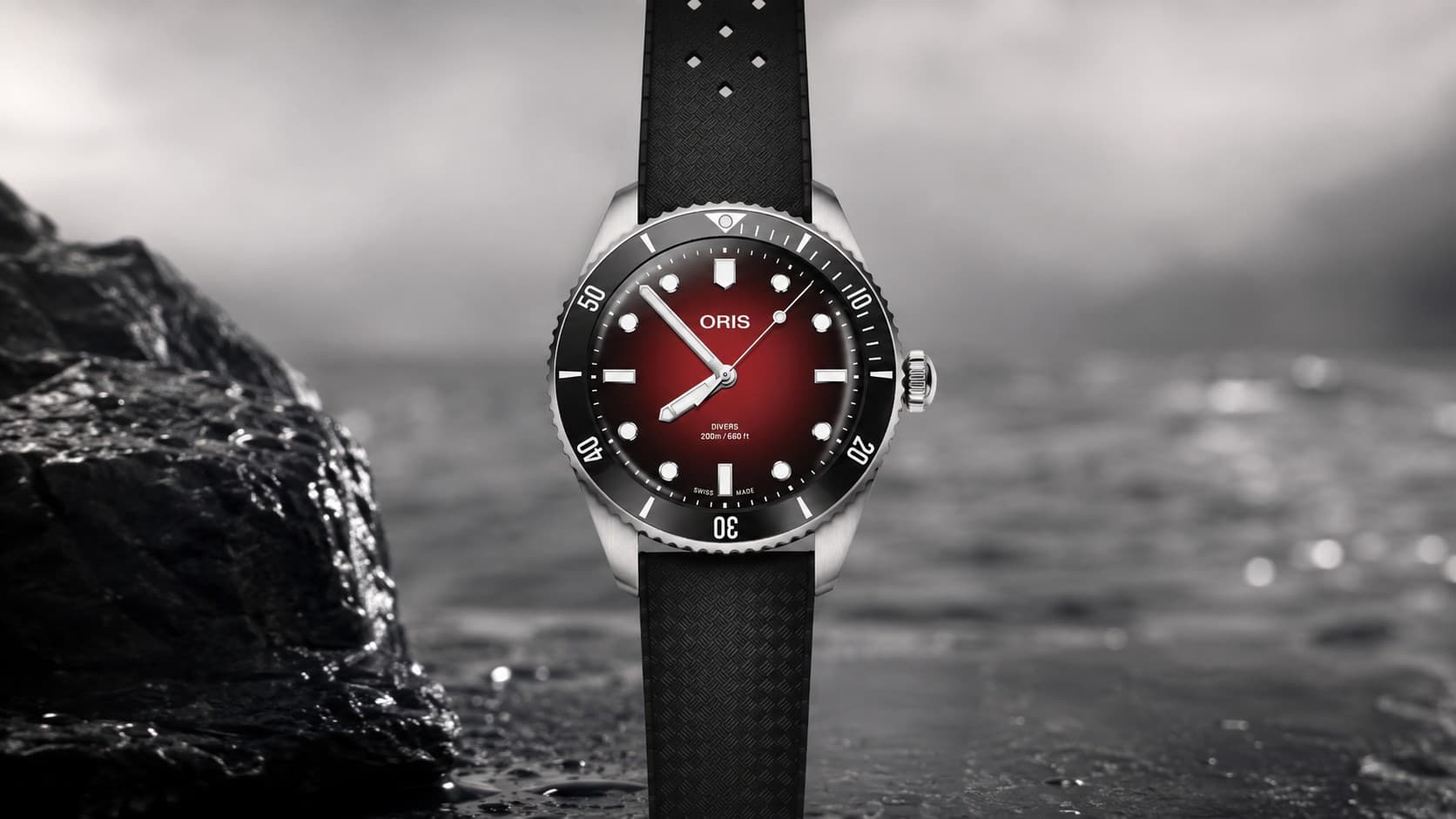
The Aquis is Oris’s modern dive watch line and its best-selling collection today. It’s a sturdy, no-nonsense diver with a rotating bezel, thick sapphire crystal, and water resistance that typically starts around 300 meters, more than deep enough for any recreational diving. The Aquis was launched in 2011, but its DNA goes back to the brand’s very first dive watch, the 1965 Oris Waterproof, so the modern collection carries roughly six decades of underwater watchmaking behind it. Within the Aquis family, Oris also builds an extreme version called the Aquis Pro, rated for professional saturation diving down to as much as 4,000 meters — a depth that goes far beyond what almost any human will ever actually dive to, but shows off the brand’s engineering muscle.
Oris regularly releases special Aquis editions tied to ocean conservation projects under its “Change for the Better” initiative, often donating a portion of proceeds to marine research groups. Past examples include the Clean Ocean Limited Edition, made with a partner working to intercept ocean plastic, and the Great Barrier Reef Limited Editions, which have funded coral restoration work in Australia. These partnerships are part of why the Aquis has become closely associated with environmental causes inside the watch community, rather than just being another dive watch on a shelf.
Oris Divers Sixty-Five
The Divers Sixty-Five is a vintage-styled diver based on an original 1960s Oris dive watch called the Waterproof. Launched in 2015, it brought back a smaller, more old-school case size — typically 36mm to 42mm depending on the version — at a time when most dive watches were getting bigger and bulkier. It has a domed crystal, a slim bezel, and a warm, retro dial that made it an instant favorite among collectors who wanted vintage looks without buying an actual 60-year-old watch that might not run reliably.
The Divers Sixty-Five is often the watch people point to when explaining why Oris earned its reputation for value: a genuinely well-made Swiss automatic with real vintage character, priced well below most Swiss competitors doing the same thing.
Oris Big Crown Pointer Date
The Big Crown line traces back to 1938 and is one of Oris’s oldest surviving designs, never once dropped from the catalog since it debuted. Its defining trait is the crown itself, built noticeably larger than normal because early pilots needed to set and wind their watches without taking off heavy flight gloves. The “Pointer Date” version pairs that oversized crown with an unusual calendar display: a slim hand mounted at the center travels in a slow circle around the outer edge of the dial, tapping out each date along a printed track instead of showing it through a small window, all set against large Arabic numerals and ornate “cathedral” hands built for quick reading at a glance.
That combination of oversized crown, bold numerals, and pointer-hand date has barely changed in close to 90 years, which is unusual in an industry where most designs get reworked every decade or two. Oris still periodically revisits the original 1938 look with new case sizes and updated in-house movements, treating the Pointer Date less like an old model to retire and more like a piece of the brand’s own history worth preserving.
Oris ProPilot
ProPilot is Oris’s modern aviation-focused collection, built for pilots and flight enthusiasts and directly descended from that same 1938 Big Crown lineage. The line took on its current identity in 2014, when Oris gave it a bezel with fine ridged grooves cut into the metal, meant to echo the look of a jet engine’s turbine housing. Some versions include genuinely useful flight tools like slide-rule scales for calculating fuel burn or airspeed, while the ProPilot X sub-line takes a more technical, sports-watch approach with an integrated bracelet, titanium case, and Oris’s in-house Calibre 400 family of movements.
The collection reflects Oris’s long relationship with real aviation — the brand made pilot-oriented pocket watches as far back as the early 1900s and produced its first pilot’s wristwatch in 1917 — and several ProPilot models have been developed with direct input from active pilots rather than designed purely for looks.
Oris Artelier
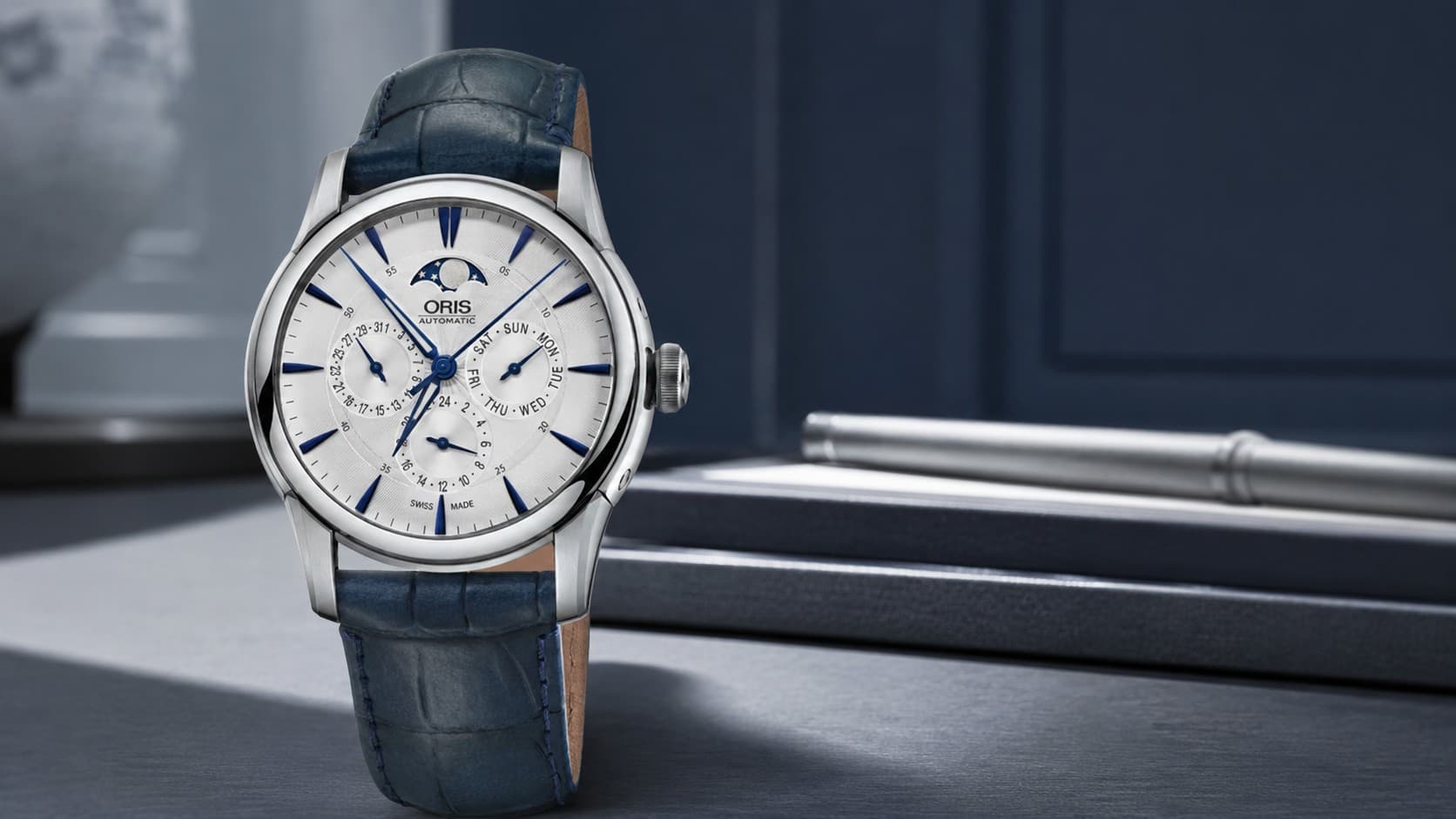
The Artelier is Oris’s dress watch line, built for people who want a slim, elegant everyday watch rather than a diver or pilot’s tool. Unlike the sport-driven collections above, the Artelier favors clean dials, slim bezels, and refined details, and it’s where Oris houses some of its more delicate mechanical complications, including chronographs and moonphase displays. The line’s flagship complicated piece, the Artelier Complication, dates back to 1991, when it debuted with an early Oris-built movement whose moonphase module the company had developed in-house — a notable milestone at a time when the brand was still working to rebuild its own movement-making capability after the Quartz Crisis.
The Artelier has moved in and out of the spotlight over the decades, fading from view for stretches before returning with fresh designs, most recently a full 2026 redesign built around mid-century-inspired styling. It’s a smaller, quieter part of the Oris catalog compared to the Aquis or Big Crown, but it’s proof that a brand known mostly for tool watches can build a genuinely elegant dress piece when it wants to.
What Is the Oris Calibre 400 Movement
The Calibre 400 is Oris’s flagship in-house automatic movement, first released in 2020, known for an unusually long five-day (120-hour) power reserve and strong resistance to magnetism. Most automatic watches need winding or wearing every day or two before they run down; the Calibre 400 can sit unworn over a long weekend and still be ticking days later.
The movement also resists magnetic fields up to 2,250 gauss thanks to silicon components in its escapement, which is well beyond what a typical smartphone, laptop, or handbag clasp could ever do to a watch. Every Calibre 400 is regulated to chronometer-level accuracy and comes with a 10-year warranty and a recommended 10-year service interval, both unusually long for the industry. Oris builds the Calibre 400 family in its own Swiss facility, a meaningful step for a brand that spent years buying and modifying movements from outside suppliers like Sellita.
How Much Should You Pay for an Oris?
Oris sits in a middle ground: pricier than mainstream brands like Seiko or Citizen, but noticeably more affordable than heritage giants like Omega or Rolex. Most current Oris models fall somewhere between $2,000 and $5,000, with entry pieces starting lower and specialized dive watches or limited editions running higher.
| Collection | Typical Price Range | What It’s Built For |
|---|---|---|
| Big Crown | Around $1,800–$4,300 | Classic, vintage-inspired everyday wear |
| Divers Sixty-Five | Around $2,200–$4,700 | Vintage-style diving and daily wear |
| Aquis | Around $2,400–$5,200 | Modern diving and sports use |
| Aquis Pro | Around $4,100–$6,900 | Extreme, professional-depth diving |
| ProPilot | Around $2,000–$5,500 | Aviation-inspired tool watches |
| Artelier | Around $2,000–$3,500 | Elegant dress watches, daily wear |
Prices shift often with new releases, so these ranges are a general guide rather than an exact price list.
Are Oris Watches Worth the Money?
Yes — Oris has built a strong reputation for reliable, well-made mechanical watches that offer more engineering for the money than most competitors at the same price point. The brand’s decision to stay independent and mechanical through the Quartz Crisis, combined with its growing use of in-house movements like the Calibre 400, gives it credibility that’s hard to fake with marketing alone. In the watch world, Oris is usually mentioned in the same breath as Longines, Tudor, and Tag Heuer — brands that also sit in that accessible-Swiss tier — rather than against giants like Rolex or Omega, which play in a different price bracket entirely.
That said, “good” depends on what someone wants from a watch. Oris doesn’t carry the instant name recognition of a Rolex or the ultra-thin dress-watch prestige of a Piaget, and its designs lean practical rather than flashy. For anyone who values solid engineering, genuine watchmaking history, and a brand that answers to itself rather than a shareholder, Oris consistently comes up as one of the smartest choices in Swiss watchmaking today.
Frequently Asked Questions
Is Oris considered a luxury watch brand?
Oris sits in what the watch industry calls the accessible-luxury or “affordable Swiss” tier. It uses genuine Swiss mechanical movements and solid materials the way true luxury brands do, but its prices are well below true high-luxury names like Patek Philippe or Vacheron Constantin.
Are Oris watches automatic or do they use batteries?
Every current Oris watch uses a mechanical movement, either automatic (self-winding through wrist movement) or hand-wound. The brand does not produce quartz, battery-powered watches.
Where are Oris watches made?
Oris designs and assembles its watches in Switzerland, primarily around its headquarters in Hölstein, and increasingly manufactures its own movements, like the Calibre 400 family, in its own Swiss facilities rather than relying entirely on outside suppliers.
What is the most popular Oris collection?
The Aquis dive watch line is generally considered Oris’s best-selling and most recognizable collection, thanks to its versatility as both a sports watch and an everyday piece.
How long do Oris watches last?
With normal care and regular servicing, a mechanical Oris watch can easily last for decades, and many vintage Oris pieces from the mid-20th century still run today. The Calibre 400 movement specifically carries a 10-year recommended service interval, longer than the industry norm of 3 to 5 years.
The Bottom Line
Oris earns its reputation the old-fashioned way: by building genuinely capable mechanical watches, staying independent when it would have been easier to sell out, and putting real engineering like the five-day, magnetism-resistant Calibre 400 into watches that regular people can actually afford. Whether the interest is a vintage-styled Divers Sixty-Five, a rugged Aquis, a classic Big Crown pilot watch, or an understated Artelier dress piece, the throughline across the whole brand is the same — practical, well-built Swiss mechanical watches from a company that has spent 120 years answering to nobody but itself.