Jewelry stalls and wellness ads alike are full of bracelets and necklaces advertised as “magnetic.” Some pieces simply use a magnet to snap the clasp shut, while others are strung with dark, shiny beads and marketed as tools for pain relief, better sleep, or general “energy balance.” The two ideas get mixed together constantly, blurring the line between a purely practical magnetic clasp and a magnetic therapy product sold with health claims. That distinction, along with what current research says about those claims, matters most for anyone with a pacemaker or other implanted medical device, since safety is the one area where the details genuinely count.
What Is Magnetic Jewelry?
Magnetic jewelry is any bracelet, necklace, ring, or anklet that contains a magnet, either as a small piece hidden in the clasp or built into the beads themselves. The magnets are almost always made from a material called neodymium, an alloy of neodymium, iron, and boron that produces one of the strongest magnetic fields available in a small, everyday object.
There are really two very different products hiding under the same name. The first is purely practical: a magnetic clasp that makes a necklace or bracelet easy to open and close, especially helpful for people with arthritis or limited hand mobility. The second is marketed as “magnetic therapy” jewelry, sold with claims that wearing it near the skin can ease pain, improve circulation, or boost overall wellness. Only one of those two categories has ever been tested for the health claims attached to it.
The Origins of Magnetic Jewelry
The belief that magnets can heal the body is genuinely ancient, not a modern marketing invention. Physicians in ancient Greece, including figures associated with Hippocrates, wrote about using naturally magnetic stones called lodestones to ease pain and swelling, and similar practices show up independently in traditional Chinese medicine, where healers placed magnetite near acupuncture points to influence the body’s energy, or qi.
The idea got a strange boost in the late 1700s from an Austrian physician named Franz Anton Mesmer, who popularized a theory he called “animal magnetism,” claiming an invisible magnetic force flowed through the human body and could be redirected to cure illness. Mesmer’s methods were eventually dismissed by the French scientific establishment as unscientific and closer to what we’d now call hypnotism, but his showmanship is where the word “mesmerize” comes from, and it left a long shadow of skepticism over magnetic healing claims that persists today.
Modern magnetic jewelry really took off in the late 20th century, partly through professional athletes and golfers who publicly credited magnetic bracelets with easing joint and muscle soreness. That visibility, combined with the arrival of cheap, powerful neodymium magnets in the 1980s, is largely why magnetic jewelry became a mainstream retail category rather than a niche alternative-medicine product.
Types of Magnets Used in Jewelry
Jewelry makers add magnets in one of two ways: as a functional clasp, or as magnetized beads strung along the entire piece. Each method changes how strong the magnetic pull is and how the jewelry is meant to be worn. The type of magnet used also matters, since not every “magnetic” piece uses the same material underneath the plating.
| Magnet Type | Relative Strength | Common Use in Jewelry | Notes |
|---|---|---|---|
| Neodymium (NdFeB) | Very strong | Clasps, magnetic hematite beads | Most common choice; small size but powerful pull |
| Samarium cobalt | Strong | Higher-end clasps | Resists heat and corrosion better than neodymium |
| Ceramic (ferrite) | Moderate | Budget clasps, some novelty pieces | Cheaper, weaker, more brittle |
| Alnico | Weak to moderate | Rarely used in modern jewelry | Mostly seen in vintage or industrial pieces |
Magnetic Clasps
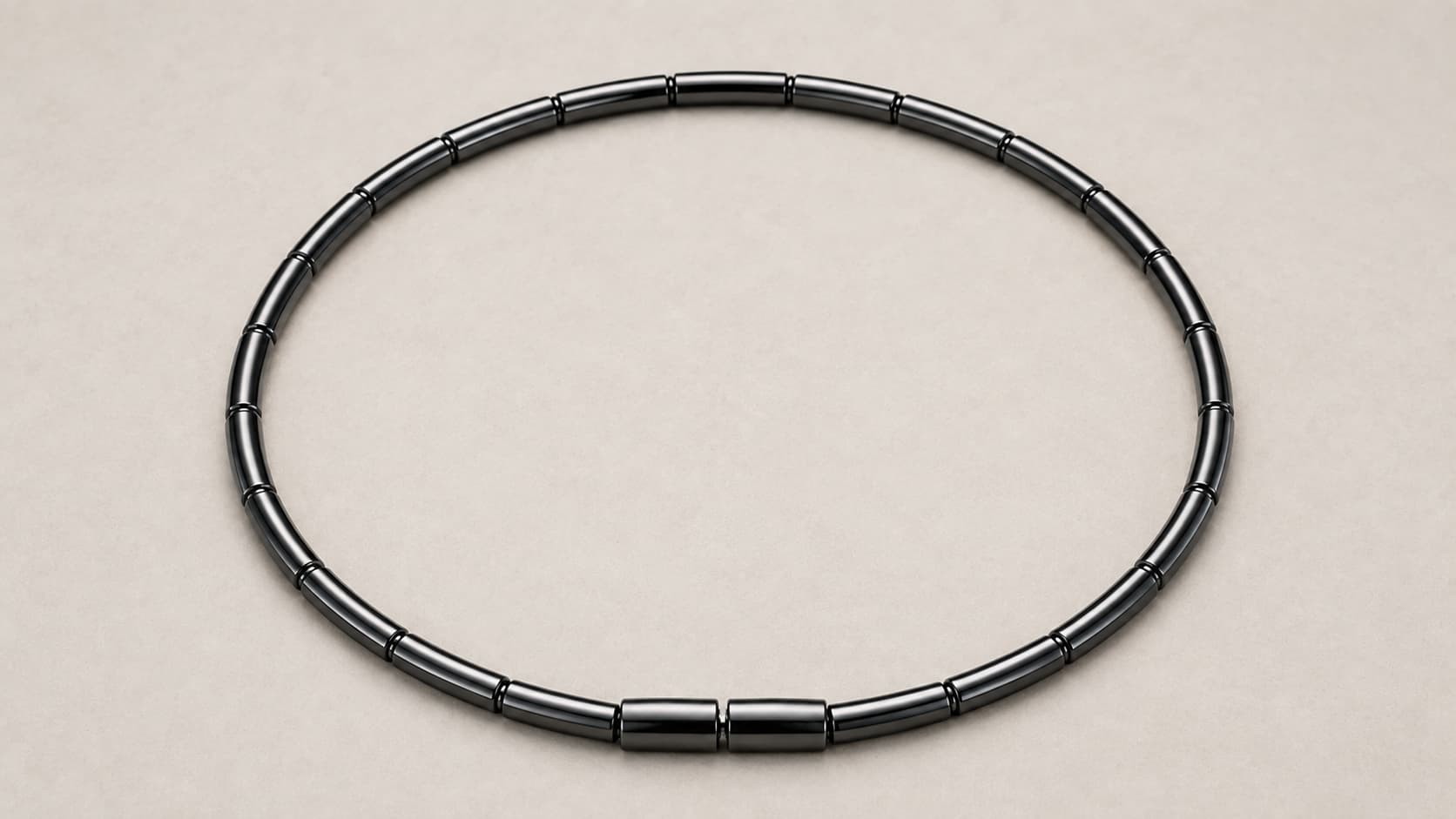
A magnetic clasp uses two small magnetized discs, usually neodymium, set into the ends of a necklace or bracelet so they snap together with a satisfying click. These clasps are popular because they don’t require the fine motor skills that a traditional lobster clasp or spring ring does, which makes dressing easier for people with stiff fingers, tremors, or reduced grip strength. A magnetic clasp on its own isn’t sold as a health product; it’s just a convenient way to open and close jewelry.
Magnetic Beads and Hematite
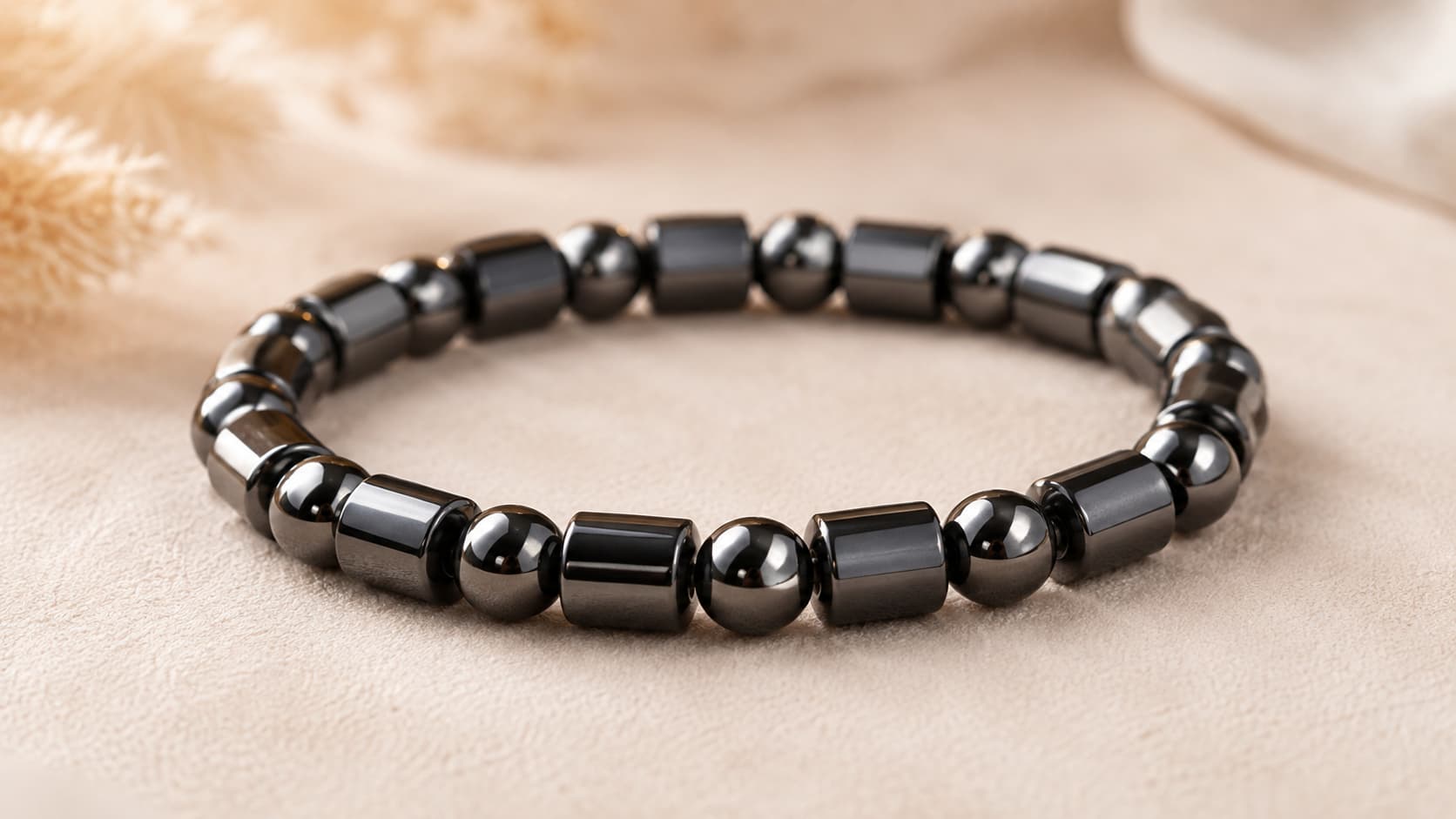
The second style strings a whole chain of magnetized beads, often made from a material sold as “magnetic hematite.” Real hematite is a naturally occurring iron oxide mineral, but it isn’t naturally magnetic on its own in the way these beads are. Most beads labeled “magnetic hematite” are actually a manufactured composite of iron oxide powder and a ceramic or resin binder that gets magnetized during production, which is why they’re sometimes called “hemalyke” or synthetic hematite in more accurate listings. This is the style most often marketed with wellness claims, and sellers frequently list a gauss rating, sometimes several thousand gauss per bead, to suggest the magnets are unusually powerful.
Hematite jewelry that isn’t clearly labeled as natural is almost always the manufactured, magnetized version. Naturally magnetic hematite jewelry is uncommon and would typically be marketed as a novelty because of how unusual it is.
Does Magnetic Jewelry Actually Relieve Pain or Improve Health?
The short answer is no, not according to the current body of scientific research. Large reviews of clinical trials have found that static magnets, the kind used in bracelets and necklaces, do not produce pain relief that’s meaningfully better than a placebo.
Government health researchers who study complementary and alternative medicine have looked into this question repeatedly. The National Center for Complementary and Integrative Health has concluded that current research does not conclusively support using static magnets for pain relief, even though a different technology called electromagnetic field therapy has shown more promise for certain conditions when used under medical supervision. The Arthritis Foundation has gone further, stating plainly that studies show magnetic and copper bracelets don’t help with arthritis pain or stiffness, and a British study comparing magnetic bracelets, copper bracelets, and plain non-metal bracelets found no meaningful difference in pain relief between them.
This gap between marketing and evidence hasn’t gone unnoticed by regulators. Consumer protection agencies and the FDA have taken action against sellers of magnetized health devices over the years for making pain-relief promises they couldn’t back up with real clinical evidence, and the general standard regulators apply is that a specific health claim needs at least one well-conducted, placebo-controlled clinical study behind it before it can legally be advertised as fact. Most magnetic jewelry sold today sidesteps this by using softer language, like “supports wellness” or “may help,” rather than direct medical claims.
So why do so many people swear their magnetic bracelet helps? The most likely explanation is the placebo effect combined with the power of expectation and ritual. When someone believes a piece of jewelry will help, their brain can genuinely change how it processes pain signals, which means the relief people feel is often real to them even though it isn’t coming from the magnet itself. That’s not the same as saying magnetic jewelry is a scam; it just means the benefit, if any, likely isn’t magnetic.
Some marketing insists that the negative, or north-facing, pole of a magnet has a calming effect while the positive, or south-facing, pole is energizing, and that wearing a bracelet “the wrong way” cancels the benefit. There’s no scientific evidence that a magnet’s pole orientation has any distinct effect on the human body, making this detail closer to folklore than fact.
What Does “Gauss” Mean on a Magnetic Jewelry Listing?
Gauss is simply the unit used to measure how strong a magnetic field is, the same way pounds measure weight or Fahrenheit measures temperature. A higher gauss number means a stronger magnet, but a bigger number on a listing doesn’t automatically mean a better or safer product.
Magnetic hematite beads are commonly listed somewhere around 3,000 to 5,000 gauss, while the small magnets built into clasps can run much higher, often in the 5,000 to 13,000 gauss range, because they need extra strength to hold the jewelry securely closed. For comparison, the World Health Organization has stated that everyday exposure to magnetic fields up to about 20,000 gauss (2 tesla) doesn’t appear to cause harm to general human health, which is roughly the strength used inside a standard MRI machine. The gauss number matters far more for people with implanted medical devices than it does for anyone else.
Is Magnetic Jewelry Safe to Wear?
For most healthy adults, wearing magnetic jewelry day to day carries very low risk. The magnets used in commercial jewelry are far weaker than those used in medical equipment, and simply wearing a magnetic bracelet or necklace won’t magnetize a person’s blood, disrupt the nervous system, or cause the kind of internal effects some marketing claims suggest.
That said, there are specific groups of people who are consistently advised to avoid magnetic jewelry, and the reasons are backed by real medical concerns rather than guesswork.
Who Should Avoid Magnetic Jewelry
- People with a pacemaker or implantable cardioverter-defibrillator (ICD). Strong magnets can trick these devices into switching to a “magnet mode” that suspends their normal function. For a defibrillator, this could mean it fails to deliver a lifesaving shock during a dangerous heart rhythm. Medical guidance generally recommends keeping strong magnets, including magnetic jewelry, at least six inches away from an implanted cardiac device.
- People with insulin pumps or certain neurostimulators. These devices can also be affected by strong magnetic fields, though the documented risk is less extensive than for cardiac devices.
- Pregnant individuals. Most jewelry and health organizations recommend avoiding magnetic jewelry as a precaution during pregnancy simply because the long-term effects on fetal development haven’t been well studied, not because of confirmed harm.
- Anyone getting an MRI or X-ray. Magnetic jewelry needs to come off before any MRI, since the machine’s magnetic field is thousands of times stronger than a bracelet’s and can heat, move, or damage the jewelry, and interfere with the scan itself.
Everyday Safety Tips
Skin irritation is the most common complaint tied to magnetic jewelry, and it’s usually caused by a nickel-containing clasp or setting rather than the magnet itself, so anyone with metal sensitivities should look for hypoallergenic or nickel-free findings. It’s also worth keeping small, high-powered magnetic jewelry pieces away from young children and teens, since swallowing two or more strong magnets can cause serious internal injuries if the pieces attract each other through the walls of the stomach or intestines, sometimes requiring emergency surgery. The U.S. Consumer Product Safety Commission has documented real cases tied specifically to jewelry, including a child who suffered an intestinal injury after swallowing magnetic jewelry worn on the tongue, so pieces meant to look like piercings or mouth jewelry deserve extra caution around kids.
Does Magnetic Jewelry Affect Electronics or Airport Security?
The magnets in most jewelry are too small and localized to reliably erase data on phones or laptops, though it’s still smart to avoid pressing a strong magnetic bracelet directly against a credit card’s magnetic stripe or an older hard drive for extended periods. As for airport security, standard walk-through metal detectors and X-ray scanners are built to handle everyday magnetic jewelry without issue, though very large or unusual pieces might prompt a closer look simply because of their size or metal content, not because of the magnet.
How to Keep Magnetic Jewelry in Good Shape
Magnetic clasps and beads generally don’t need special cleaning beyond what any other jewelry requires, but a few habits help them last longer. Magnetic pieces hold up best when kept away from moisture, since some magnetic clasps use coatings that wear down with repeated exposure to water or sweat, weakening the bond over time. Storing magnetic jewelry apart from other magnetic items, credit cards, and sensitive electronics, and keeping magnetic bracelets separated from each other in a jewelry box, prevents the magnets from pulling toward one another and scratching neighboring pieces.
Frequently Asked Questions
Can magnetic jewelry be resized?
It depends on the piece. Jewelry with a magnetic clasp on an adjustable chain or elastic band can usually be resized easily, but beaded magnetic bracelets strung to a specific wrist measurement often need to be restrung by a jeweler rather than simply cut and retied.
Will a magnetic bracelet set off a magnetometer or interfere with a smartwatch?
A standard magnetic bracelet is far too weak to trigger airport security alarms or meaningfully interfere with a smartwatch’s sensors during normal wear. Problems are much more likely with implanted medical devices than with consumer electronics.
Is “magnetic hematite” the same as real hematite?
Usually not. Most jewelry labeled magnetic hematite is a manufactured composite designed to look like the natural mineral while holding a magnetic charge, since naturally occurring hematite isn’t strongly magnetic on its own.
Can children wear magnetic jewelry?
Small magnetic pieces pose a swallowing hazard for young children, since ingesting multiple strong magnets can cause serious internal injury. If a child wears magnetic jewelry, it should be sized so it can’t easily come apart into small pieces, and always supervised.
Does a stronger gauss rating mean better pain relief?
No. Since static magnets haven’t been shown to relieve pain more effectively than a placebo in controlled studies, a higher gauss number mainly indicates a stronger magnetic pull for holding the clasp shut, not a stronger therapeutic effect.
Conclusion
Magnetic jewelry breaks down into two honest categories: a genuinely useful magnetic clasp that makes dressing easier, and magnetic bead jewelry sold with wellness promises that current research simply doesn’t back up. Neither category is inherently dangerous for the average healthy adult, but anyone with a pacemaker, ICD, insulin pump, or upcoming MRI needs to treat these pieces with real caution and keep them at a safe distance from implanted devices. The style and feel of magnetic jewelry hold up fine on their own merits; the magnet itself just shouldn’t be expected to do any medical heavy lifting.