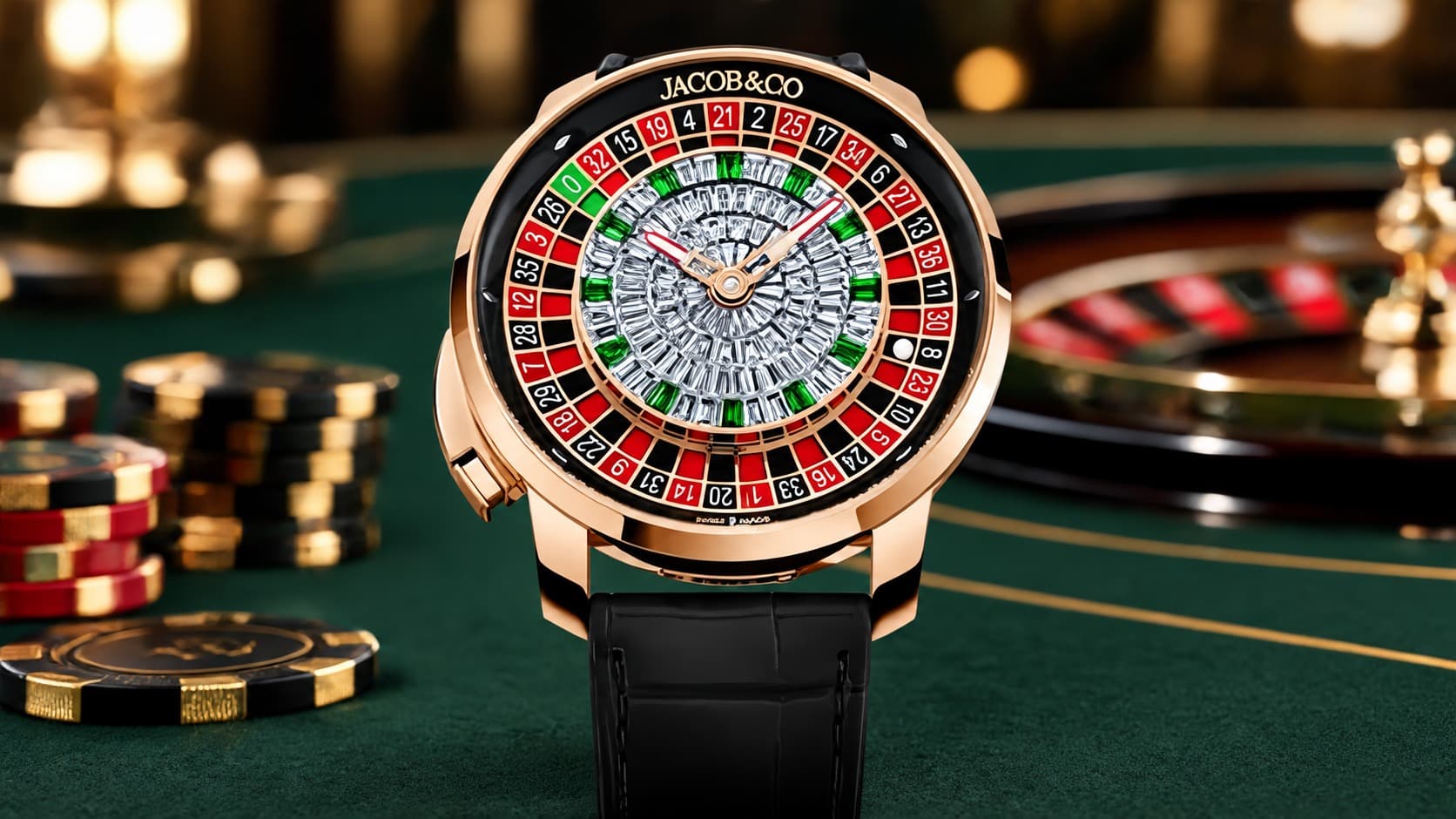
Jacob & Co. makes watches that look like nothing else on a wrist. Some spin, some light up, and one even has a tiny toy-sized engine that moves its own pistons. The brand started as a jewelry shop in New York and grew into one of the most talked-about names in high-end watchmaking, known for taking ideas that other watchmakers would call impossible and building them anyway. This article covers the brand’s story, its most famous watches, and what makes each collection worth knowing about.
Who Founded Jacob & Co?
Jacob & Co. was started in 1986 by a young jeweler named Jacob Arabo, who registered the company under the name Diamond Quasar before settling on the Jacob & Co. label for his designs. Before that, he had cut his teeth designing pieces for other jewelry labels and private clients out of a modest space in New York’s Diamond District.
Arabo was born in 1965 in Tashkent, in what was then the Uzbek Soviet Socialist Republic, and moved to the United States as a teenager. He trained fast, graduating early from a jewelry design course, then went straight to work designing for other people before launching his own label.
His nickname, “Jacob the Jeweler,” came from an unlikely source. The rapper Notorious B.I.G. gave him that name after being impressed by his jewelry, then introduced him to friends in the entertainment industry. Through the 1990s and 2000s, Arabo became the go-to jeweler for hip-hop artists, and he gets a shout-out in dozens of famous songs, including lines from Jay-Z, Kanye West, and Beyoncé.
Watches came later, and almost by accident of timing. Arabo has said in interviews that watches were always on his mind even while he was building his jewelry business, and that he simply had to wait until jewelry gave him the money and reputation to chase it. That dream traced back to childhood: his father gave him a world time watch when he was 13, and the idea stuck with him for decades.
How Jacob & Co Got Into Watchmaking
The brand’s first watch line, the Five Time Zone, launched in 2002. It was a colorful, quartz-powered travel watch with swappable bezels and straps, built for people who flew often and wanted a fun way to track more than one time zone.
The design caught on with a jet-setting crowd, and a photo of supermodel Naomi Campbell wearing one helped put Jacob & Co. on the map as a watch brand, not just a jeweler. Around the same time, the business was growing fast enough that Arabo moved his operation from the Diamond District into a striking, mine-inspired flagship boutique at 57th Street and Park Avenue in 2004, a sign of how far the jewelry side of the company had already come.
The real turning point for watches came a few years later. In 2007, Arabo opened Jacob & Co. SA in Geneva, Switzerland, the heart of the traditional watch industry, and released the brand’s first serious mechanical watch: the Quenttin. That model had a 31-day power reserve, meaning it could run for over a month without winding, powered by seven mainspring barrels working together, and it was built around a straight-line tourbillon standing upright inside the case rather than lying flat like most tourbillons of the time.
Getting Swiss watchmakers on board wasn’t easy at first. Arabo has described being turned away by Swiss suppliers early on, since his design concepts broke most of the usual rules of traditional watchmaking. He eventually found partners willing to build what he wanted, and from there the brand built a reputation for watches that push mechanical complexity about as far as it can go.
What Is the Jacob & Co Astronomia Collection?
The Astronomia is Jacob & Co.’s signature collection, built around a moving dial where several mechanical arms rotate around a central point like a tiny solar system. It debuted in 2014 and immediately became the watch most associated with the brand.
The original Astronomia has four arms mounted on an exposed vertical movement: one arm carries a small globe representing Earth, one carries a specially cut diamond representing the moon, and two arms are driven by triple-axis gravitational tourbillons. A tourbillon is a rotating cage that holds the watch’s balance wheel and escapement, designed to cancel out the effect of gravity on timekeeping accuracy. Fitting two of them into a single watch, and making the whole assembly rotate around the dial, was not something any other brand had attempted at that scale.
The diamond “moon” on the Astronomia deserves its own mention. It’s a genuine white diamond of around one carat, cut using a spherical, 288-facet style that Jacob & Co. developed itself, and it spins on its own axis once every 60 seconds.
Three later versions expanded on the original design in different directions.
- Astronomia Sky (2016) — added celestial-themed complications, including a sidereal time display, a vertical month display, zodiac signs, and a day-and-night indicator.
- Astronomia Revolution (2023) — sped up the central carousel’s rotation dramatically, down from the original 20-minute cycle to just 60 seconds.
- Astronomia Revolution Four-Axis Tourbillon (2025) — added a fourth axis of rotation to the tourbillon itself, with each axis spinning at a different speed, limited to 18 pieces worldwide.
Prices in this collection sit firmly in six-figure territory, generally landing somewhere between $600,000 and $800,000 depending on materials and complications. Diamond-set versions push well past that: the Astronomia Tourbillon Baguette, covered in baguette-cut stones, launched at roughly $1,015,000 when it debuted in 2015. Arabo himself has called the Astronomia “revolutionary,” and it remains the model most people picture when they think of the brand’s engineering ambitions.
What Is the Jacob & Co Epic X Collection?
The Epic X is Jacob & Co.’s everyday sports watch line, and it’s the most accessible way into the brand. It skips the diamonds and dual tourbillons of the flagship pieces, offering instead a bold 44mm titanium case built around a manual-winding skeleton movement that puts the mechanics on full display.
The name comes straight from its design: the lugs and the bridges of the in-house movement are shaped to form an X pattern across the dial. Complexity and price across the line vary widely by version.
| Epic X Version | Key Feature | Typical Price Range |
|---|---|---|
| Epic X Skeleton (titanium) | Open-worked dial, no tourbillon | ~$14,000–$27,500 |
| Epic X Chronograph | Adds stopwatch functions | ~$24,500–$38,000 |
| Epic X Tourbillon | Adds a flying tourbillon at 6 o’clock | ~$58,000–$110,000 |
| Epic X Tourbillon Baguette | Tourbillon plus baguette-cut diamonds | ~$330,000–$1.4 million |
| Epic SF24 | Split-flap display complication | ~$63,000–$86,000 |
The SF24’s name doesn’t give much away: it swaps the usual hands for a mechanical split-flap display, the same flipping-card style used on old airport departure boards, rebuilt in miniature to show the time.
The wide gap between the cheapest and most expensive Epic X shows how far the brand can stretch within a single collection. The same basic case shape can carry either a simple skeleton dial or a diamond-covered, tourbillon-equipped showpiece, all under one collection name.
The Epic X first appeared in 2015. Its hand-wound skeleton caliber, designated JCAM02, comes from the Swiss movement house Concepto and is built solely for Jacob & Co., running at 28,800 vibrations per hour with a 48-hour power reserve, a normal, practical number for daily wear even though the watch’s looks are anything but ordinary.
What Is the Jacob & Co Bugatti Watch?
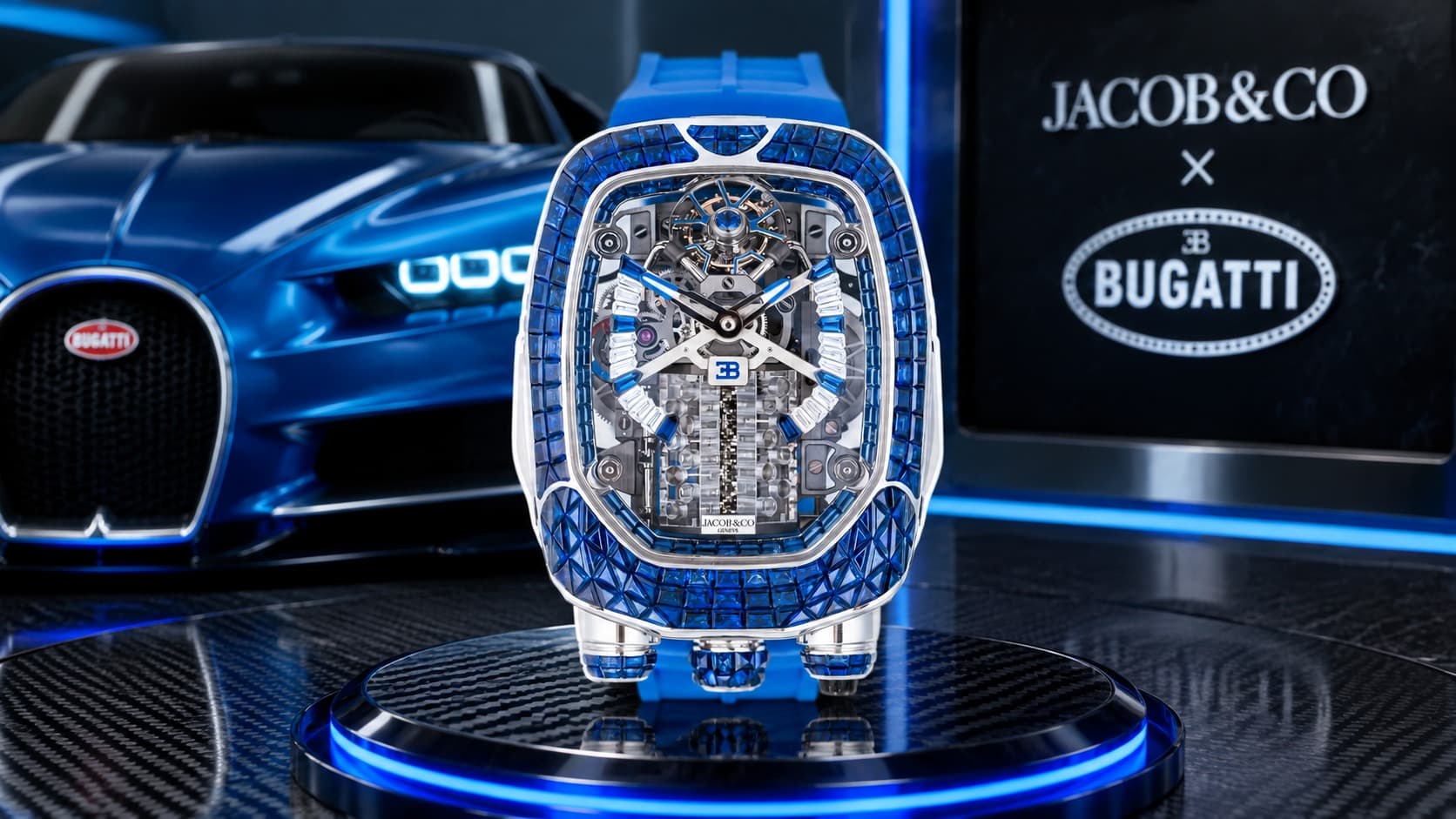
The Bugatti Chiron Tourbillon is a watch with a tiny, fully working replica of a car engine built into it. Pressing the crown on the right side of the case sets off a miniature crankshaft, pumping pistons, and two spinning turbochargers, built from more than 570 individual components.
This came out of a partnership Jacob & Co. signed with Bugatti in 2019, the French hypercar maker famous for the Chiron, a car capable of speeds over 260 mph. The engine mechanism inside the watch was built to imitate the real Chiron’s quad-turbocharged W16 engine, and it took Jacob & Co. more than a year to design and perfect. The case itself measures 54mm by 44mm, sized to hold the four “shock absorber” mounts that suspend the movement, and the original all-black titanium version was limited to 126 pieces.
Pressing the crown starts a short show that lasts roughly 20 seconds, with the pistons and turbos all moving through their sequence like a scaled-down running engine. The watch’s movement, called the JCAM37, hangs across four suspension points inside the case, and its flying tourbillon sits at a 30-degree tilt, a slant borrowed from the angled horseshoe grille on the front of every Bugatti car.
The original all-black titanium version launched around $280,000. Since then, Jacob & Co. has released gem-set and precious-metal versions that cost considerably more, with some editions covered in white diamonds and colored sapphires pushing well past half a million dollars.
Other Notable Jacob & Co Watches
Two other models come up constantly whenever the brand’s history gets discussed, and both show a different side of Jacob & Co.’s approach to complications. The Twin Turbo Furious, launched in 2018, packed a twin triple-axis tourbillon, a minute repeater, and a chronograph into a single case, a mechanical combination no other watchmaker had put together before. Its two tourbillon cages rotate at different speeds to help cancel out gravity’s pull from every angle, while a repeater chimes in ten-minute intervals and a mono-pusher chronograph tracks elapsed time against a reference. Built from over 830 parts and limited to 99 pieces, it launched at roughly $554,000, and Jacob & Co. later produced special editions tied to the Fast & Furious film franchise and to Bugatti’s record-breaking Chiron Super Sport 300+.
The Opera Godfather Musical Watch takes a completely different approach, trading extra tourbillon axes for a working music box. Made under an official license from Paramount Pictures, it uses two rotating cylinders with 36 teeth striking against tiny combs to play 120 notes of Nino Rota’s Godfather theme at the press of a button. The watch carries real personal weight for Arabo, who has said The Godfather was the first film he ever saw in a theater after immigrating to the U.S. as a teenager, and that its themes of family and ambition shaped how he thinks about the brand. First released in 2019 and updated for the film’s 50th anniversary in 2022, it retails north of $400,000, with the anniversary edition pricing above $600,000.
Why Do Jacob & Co Watches Cost Millions?
The short answer is complexity and materials. Jacob & Co. builds movements with an unusually high number of moving parts, uses large amounts of gold, titanium, and diamonds, and often produces watches in extremely limited numbers, sometimes as few as six or eighteen pieces.
Limited production matters a lot here. A watch built in a run of six pieces costs more to engineer per unit than one built by the thousands, since tooling, hand-finishing, and testing costs get spread across so few watches. Many Jacob & Co. models also use gemstone-cutting techniques the brand developed in-house, like the 288-facet diamond cut used on the Astronomia’s “moon,” which adds both cost and exclusivity.
Context matters too. Jacob & Co. competes in a small, high-end space known as haute horology, alongside names like Richard Mille and Franck Muller. These brands aren’t competing on affordability. They’re competing on how far a mechanical watch can be pushed as a piece of engineering and art at the same time.
The far end of that pricing scale gets extreme fast. In 2015, Jacob & Co. unveiled the Billionaire watch, an 18k white gold piece covered in 260 carats of diamonds, priced at $18 million. Boxing champion Floyd Mayweather bought one in 2018. Watches at that level aren’t really competing with other timepieces at all. They’re closer to wearable jewelry pieces that happen to also tell the time.
Frequently Asked Questions
What is the cheapest Jacob & Co watch?
The most accessible models come from the Epic X collection in titanium, which typically start around $14,000 for a skeletonized three-hand watch without a tourbillon.
What is the most famous Jacob & Co watch?
The Astronomia is the brand’s signature model and the one most associated with Jacob & Co., known for its spinning arms, dual tourbillons, and diamond “moon.”
Is Jacob & Co a real Swiss watch brand?
Yes. While the company was founded in New York as a jewelry business, Jacob Arabo established Jacob & Co. SA in Geneva, Switzerland, in 2007, and the brand’s fine watches are built there using Swiss-made movements.
Does Jacob & Co only make expensive watches?
The brand is best known for its six- and seven-figure showpieces, but the Epic X line was created specifically to offer a more wearable, everyday option that still carries the brand’s bold design language.
Who wears Jacob & Co watches?
The brand built its early reputation among hip-hop artists and entertainers in the 1990s and 2000s, and its watches have since been worn by celebrities, athletes, and collectors of high-complication timepieces worldwide.
The Bottom Line
Jacob & Co. built its name on refusing to make ordinary watches, and that pattern runs from its founder’s early days in the Diamond District all the way to today’s spinning tourbillons, miniature car engines, and mechanical movie themes. The Astronomia remains the clearest example of the brand’s mechanical ambition, the Epic X shows how that same design language can work at a more everyday price, and pieces like the Bugatti Chiron Tourbillon and the Opera Godfather prove how far a licensed collaboration can push a watch beyond simple timekeeping. Across every collection, the common thread is the same: Jacob & Co. treats a watch as a stage for showing off what mechanical engineering can actually do.