There are very few people left in the world who can make a watch entirely by hand, from the first screw to the final polish, and Roger W. Smith is the most famous one alive today. He runs a small workshop on the Isle of Man, where he and a handful of helpers build fewer than 20 watches a year. Because so few exist, and because each one takes months of careful work, Roger W. Smith watches have become some of the most valuable and talked-about timepieces in the world, selling for hundreds of thousands of dollars and sometimes millions at auction. A brand that size, built on a single man’s training under the last great English watchmaker, is rare enough to deserve a closer look.
Meet Roger W. Smith, Britain’s Master Watchmaker
Roger W. Smith is a British watchmaker who learned his craft directly from George Daniels, the man many consider the greatest watchmaker of the last 200 years. Smith grew up in Bolton, near Manchester, and first saw Daniels give a talk while he was still a watchmaking student. He was so inspired that he spent years building a pocket watch entirely on his own, following Daniels’ book as his only guide, just to prove he was good enough to work with him.
His first attempt was rejected. Daniels told him it looked “handmade” rather than “created,” which was not a compliment from a perfectionist like him. Smith went back to his workshop and spent roughly five more years building a second, far more difficult pocket watch, a tourbillon with a perpetual calendar. When he finally showed it to Daniels in 1998, it won him an apprenticeship, and the two men worked together on the Isle of Man until Daniels’ death in 2011. Daniels left his entire workshop to Smith, along with the responsibility of keeping the tradition alive.
Smith set up his own studio on the Isle of Man in 2001 and has stayed there ever since, even engraving the island’s triskelion symbol onto every watch he makes as a small, personal tribute to the place. A 2015 documentary called “The Watchmaker’s Apprentice” followed his story in detail, and in 2018 he was awarded an OBE for his services to British watchmaking. In 2025, he received the Gaïa Prize for craftsmanship, one of horology’s highest honors, and today he also trains a small team of younger watchmakers inside his own studio, passing on the same skills Daniels once passed on to him.
The Secret Behind Roger W. Smith’s Watches
A Roger W. Smith watch is different because almost every part of it, down to the screws and the dial engraving, is made inside his own workshop by his own team, not bought in from an outside supplier. This is known as the “Daniels Method,” a set of 32 separate skills that a watchmaker must master to build a watch completely from scratch. Most luxury watch brands, even very famous Swiss ones, buy components like hairsprings or cases from specialist suppliers. Smith’s studio does almost none of that.
Every Roger W. Smith watch also uses a version of the co-axial escapement, the mechanism George Daniels invented in the 1970s to make watches run more accurately with less friction. Smith has continued refining it over the years, developing his own single-wheel version of the design, which also extends service intervals well beyond what’s typical in the wider watch industry. Because the whole studio produces somewhere between 15 and 20 watches a year across the entire range, clients who placed orders before the book closed sometimes waited the better part of a decade for delivery, and Smith shut that order book entirely in 2021 simply because demand had outgrown what his tiny workshop could ever realistically produce.
“I’m incredibly proud of my Series Two.” — Roger W. Smith
Series One: Roger Smith’s Simplest Watch
The current Series One is a simple, time-only watch housed in a 38mm or 40mm case, and it’s the easiest entry point into the collection. It shows only the hours, minutes, and seconds, with nothing else cluttering the dial. It isn’t the same watch as the very first “Series 1” Smith built back in 2001, which was a rectangular, nine-piece collection with a retrograde date display, inspired partly by A. Lange & Söhne’s Arkade watch.
That original rectangular design was eventually retired, and its retrograde date idea reappeared years later in a completely different model, the Series Three. The modern round Series One was part of a wider relaunch Smith unveiled in 2015, when he presented refreshed versions of the Series One through Four together as a more unified, round-cased collection, with the current Series One first delivered to a client around 2018.
The watch keeps things deliberately understated. It’s meant to show off Smith’s finishing, the frosted and gilded plates, the hand-shaped bridges, and the engine-turned dial work, along with his signature scalloped hands, without any complication competing for attention. It’s also available as an Open Dial version, which exposes the movement through the front of the watch instead of hiding it beneath a solid dial.
Series Two: Roger Smith’s Most Important Watch
The Series Two is widely considered Smith’s most important production watch, because it was the first one made entirely in his own workshop using his own co-axial movement. Design work began in 2002, and the finished watch reached the market in February 2006. Smith has pointed to it himself as the single most significant watch his company has made, and the claim holds up historically too: no British watchmaker in the modern era had previously managed to bring a wristwatch to market built around a caliber of their own design and manufacture.
The Series Two is a round watch available in 38mm or 40mm cases, showing hours, minutes, seconds, and a power reserve indicator visible through the back. The movement alone is made up of roughly 225 separate components, and the vast majority of them never leave Smith’s workshop before final assembly. That popularity with collectors is partly why Smith watches keep setting price records at auction: a Series Two in pink gold sold for $715,478 at a Phillips auction in November 2021, breaking the record at the time for any watch made by a British maker. An Open Dial version also exists, letting the movement’s finishing take center stage on the front of the watch.
Series Three: A Retrograde Date Watch
The Series Three brings back the retrograde date display that first appeared on Smith’s original 2001 rectangular watch, but in a completely new, round case. Introduced in 2015, it shows the date on an arc at the top of the dial, where a small hand sweeps across the days of the month and then instantly jumps back to day one. The dial is designed to be symmetrical, balancing the date display with the rest of the layout.
Housed in a 40mm case, the Series Three grew out of two bespoke, one-off commissions Smith built in 2012 that used the same retrograde calendar idea. He liked the mechanism so much, both for how it worked and how it looked, that he decided to build it into a proper ongoing model. Around that same period, he also made the escape wheel noticeably smaller and lighter, which let the co-axial system react more quickly to the balance wheel’s motion without needing a case larger than a typical wristwatch. Like the rest of the range, it’s available as a standard dial or as an Open Dial, and because each one takes so long to build, only a small number exist, with roughly 25 examples made across the model’s history so far.
Series Four: The Triple Calendar Watch
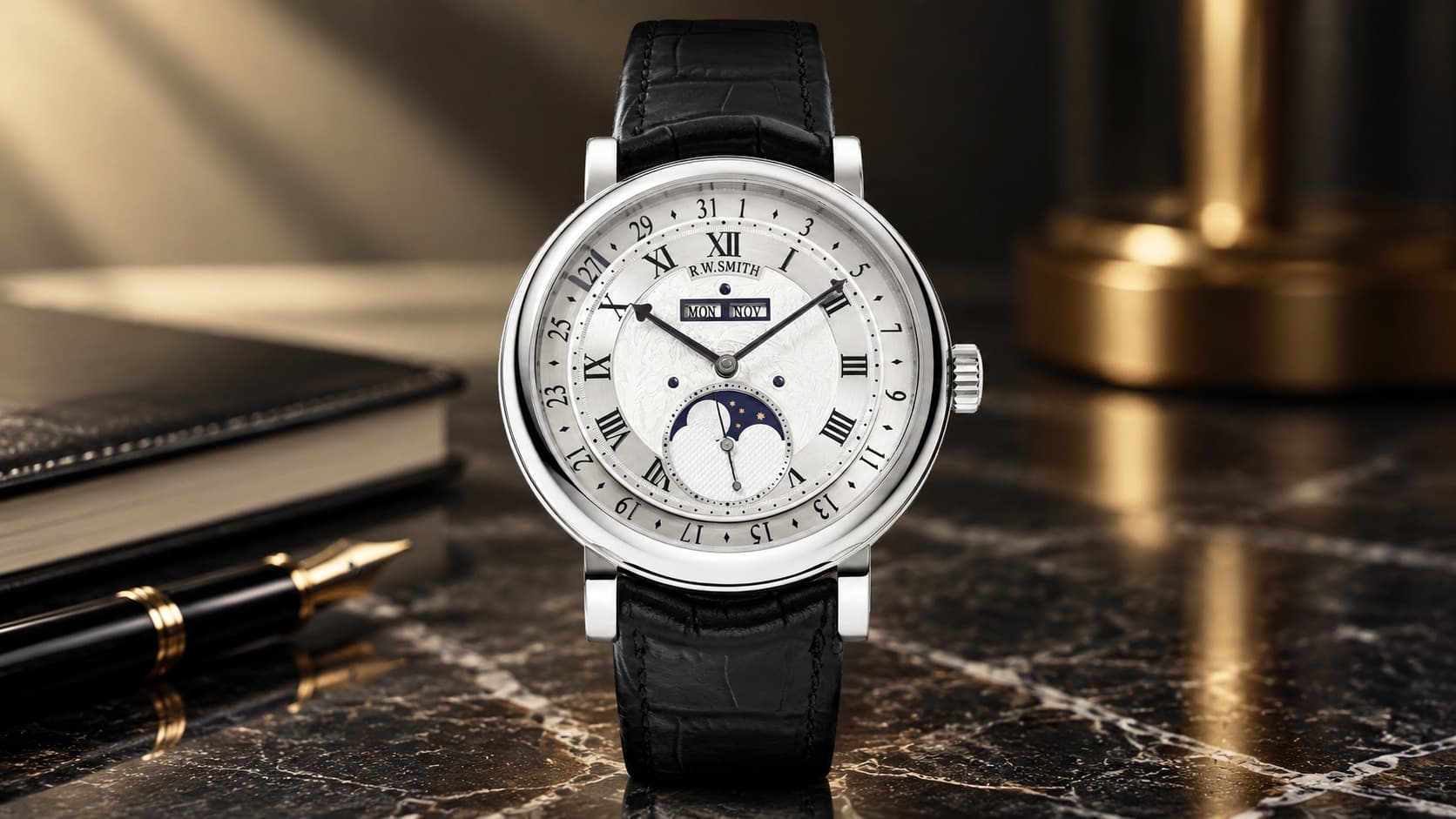
The Series Four combines three calendar functions with a moon-phase display, tracking the day of the week, the date, and the month alongside the time, and needs a slightly roomier 41mm case to hold all of that on one dial. What makes it genuinely unusual isn’t the complication itself, since triple-calendar watches have existed for a very long time, but how Smith chose to display the date. Traditional triple-calendar watches use a date hand that sweeps across the dial and often blocks other information for a few days each month.
Smith solved this by inventing something he calls the “Travelling Date” aperture, which flips the usual setup around. Rather than a hand sweeping past printed numbers, a small cut-out window itself moves in a slow circuit near the rim of the dial, passing over a fixed ring of numbers underneath it. This keeps the dial far easier to read at a glance. Smith has noted that the idea has since been picked up by other watchmakers too, which he sees as proof the design genuinely works.
Series Five: An Open-Dial Watch
The Series Five arrived in 2019 as a second attempt at an idea Smith first worked out nine years earlier: an Open Dial edition of the Series Two, originally built in 2010. Instead of hiding the mechanism behind a solid dial, the Series Five leaves it exposed at the front, forcing every bevel, every polished edge, and every gilt or frosted surface to hold up under direct scrutiny rather than staying tucked away inside the case. Because nothing is concealed, it demands an unusually high bar of finishing, since any inconsistency in the handwork would be immediately visible.
It comes in either a 38mm or 40mm case, matching the sizing of the Series One and Series Two. Open Dial pieces are rarer than Smith’s standard watches across every series, which is part of why they tend to draw particular attention from collectors when one changes hands.
Series Six: Roger Smith’s Latest Watch
Smith unveiled the Series Six in September 2025, marking six years since his last all-new model and reusing the Travelling Date aperture he first worked out for the Series Four in 2014. The dial layout is simpler than the Series Four’s, though: the hour, minute, and seconds hands sit on a center section that’s been raised above the rest of the dial, and the date lives on its own separate level near the bottom, read off the same orbiting window used elsewhere in the collection.
Inside is a newly built movement that Smith designed from scratch to house the Travelling Date mechanism alongside his most recent take on the single-wheel co-axial escapement, and it can run for two full days on a single wind. The case measures 40mm across and about 13mm top to bottom, offered in either gold or platinum, with prices reportedly starting near £320,000. Smith has framed the watch as a continuation of decades of work rather than a departure, describing it as something that “draws on my 36 years of watchmaking experience” despite its understated appearance.
Pocket Watch Number Two: The Watch That Started Everything
Pocket Watch Number Two is the hand-built tourbillon pocket watch Smith made in the 1990s specifically to win his apprenticeship with George Daniels, and it’s considered the single most important object in his entire career. It carries a perpetual calendar and a detent escapement, and Smith spent roughly five years on it, scrapping and restarting sections of the work until the result met Daniels’ standard. When he brought the finished piece to Daniels in 1998, Daniels went through it piece by piece, asking who had made each part. Smith’s reply never changed: “I did.”
That test is the reason the Roger W. Smith brand exists in its current form. Had he failed it, there would have been no apprenticeship, no inherited workshop, and almost certainly no Series collection built afterward. Smith himself has called it “the most important watch I’ve made, without a doubt,” and in June 2023, it sold at a Phillips auction in New York for $4.9 million, which remains the highest price ever paid for any British watch at auction. The sale wasn’t just about the price, though. It was also a public confirmation of how far an unknown apprentice’s test piece had traveled to become one of the most significant watches of modern horology.
The GREAT Britain Watch: A One-of-a-Kind Commission
The GREAT Britain watch is a unique piece Smith built in 2012, commissioned by the UK government under then-Prime Minister David Cameron as part of the “GREAT Britain” campaign that promoted British design and industry around that year’s London Olympics. Based loosely on the Series Two, it sits in a 40mm platinum case, and its solid silver dial carries a section of the Union Jack rendered entirely through hand engraving, work Smith did himself. It took roughly ten months of skilled labor to complete.
Because it was commissioned as a single, one-of-a-kind piece rather than a product for sale, it cannot be purchased, even on the secondhand market. Smith has said that if he were to build another and sell it, he estimated the price at around £180,000 at the time. It remains one of the most recognizable individual pieces in his entire body of work, even though almost no one has seen it in person outside of exhibitions.
How Much Does a Roger W. Smith Watch Cost?
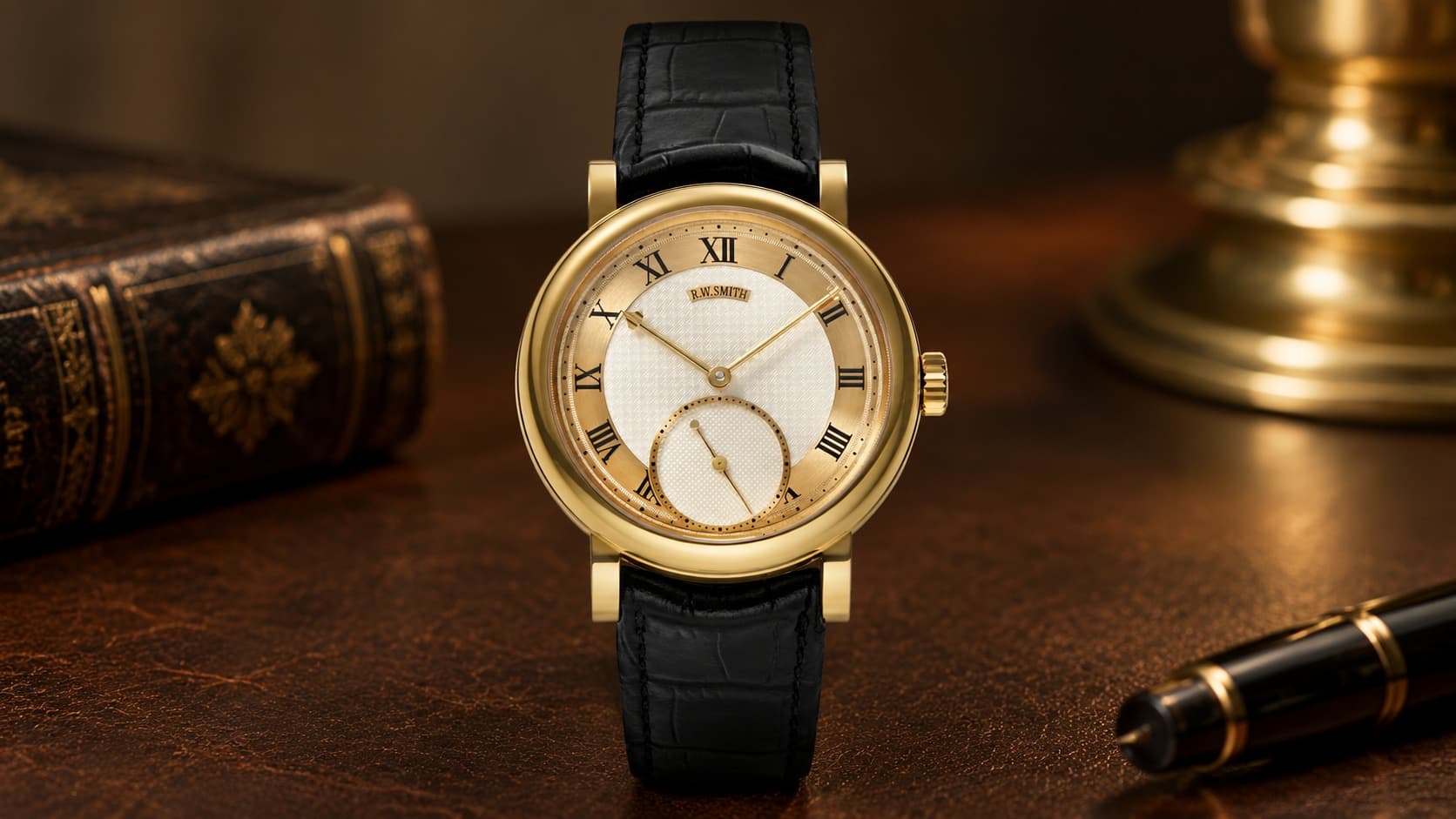
A Roger W. Smith wristwatch typically starts around £130,000 and can rise well beyond £300,000 depending on the model, metal, and any personal touches requested by the original buyer. Because every watch is handmade to order, prices vary more than they would at a typical watch brand, and the studio doesn’t publish a fixed price list.
| Model | Typical Case Size | Main Feature |
|---|---|---|
| Series One | 38mm or 40mm | Time-only, hours/minutes/seconds |
| Series Two | 38mm or 40mm | In-house co-axial movement, power reserve |
| Series Three | 40mm | Retrograde date display |
| Series Four | 41mm | Triple calendar with Travelling Date |
| Series Five | 38mm or 40mm | Open Dial, exposed movement |
| Series Six | 40mm | Floating dial with Travelling Date, launched 2025, from around £320,000 |
On the secondhand and auction market, prices can climb far higher. Pocket Watch Number Two set the all-time record for any British watch at $4.9 million in 2023, and individual Series Two wristwatches have also broken records, with one pink gold example reaching $715,478 at auction in November 2021.
What Makes Roger W. Smith Watches So Valuable
Roger W. Smith watches keep setting price records because supply is extremely limited and demand from serious collectors keeps growing every year. With an order book that’s been closed since 2021 and total annual output somewhere between 15 and 20 pieces across the whole range, there simply aren’t enough watches to go around for the number of people who want one. By the time the Series Six appeared in 2025, Smith’s entire output of wristwatches going back to the original Series One in 2001 still sat under 200 pieces, a tiny figure next to what even a small Swiss manufacture might produce in a single month.
This scarcity is made more extreme by the fact that nearly every component is made in-house, which caps how fast the workshop can realistically produce watches no matter how much money is offered. Collectors also value the direct link to George Daniels, since Smith is widely seen as the last person trained to build a watch the exact way Daniels did. That combination of rarity, hand-craftsmanship, and horological history is why auction houses like Phillips have repeatedly seen Smith’s watches sell for several multiples of their estimated price.
Is It Possible to Order a Roger W. Smith Watch?
Roger W. Smith closed his order book in 2021 and has not reopened it to new clients since. The only realistic way to acquire one today is through the secondhand and auction market, where prices are typically higher than the original studio prices because of scarcity and demand.
Auction houses such as Phillips occasionally offer Smith watches, and a small number of authorized resellers specialize in pre-owned independent watchmaking. Because so few examples of each model exist, patience is usually required even on the resale market, and prices can shift quickly depending on which specific piece, metal, or complication becomes available.
There has been at least one notable exception. In 2023, Smith built and sold a unique Series One directly to a member of the public through a closed-bid charity auction tied to British Watchmakers’ Day, with proceeds supporting the Alliance of British Clock and Watchmakers. It was listed with a reserve in the region of £275,000 to £295,000 excluding VAT, and the final sale came in well above £600,000, showing that one-off opportunities can still appear even with the regular order book closed.
Frequently Asked Questions
How many watches does Roger W. Smith make per year?
Roger W. Smith’s workshop produces roughly 15 to 20 watches a year across his entire Series One through Six collection, since every part is made and finished by hand rather than mass-produced.
Is Roger W. Smith related to George Daniels?
They aren’t related by family, but Smith was George Daniels’ only apprentice and later his closest collaborator, working alongside him on the Isle of Man until Daniels passed away in 2011 and left his workshop to Smith.
What’s the difference between a Roger Smith watch and a George Daniels watch?
A George Daniels watch was designed and signed by Daniels himself during his lifetime, while a Roger Smith watch is designed, signed, and sold under Smith’s own name. The one place the two names overlap is a 2010 project of 35 wristwatches, built by Smith but issued under Daniels’ name, timed to mark 35 years since Daniels first came up with the co-axial escapement. It turned out to be the last project the two men worked on together before Daniels died the following year.
Is Roger W. Smith still taking new orders?
No. Smith closed his order book to new clients in 2021 because demand far outpaced what his small workshop could produce, so the only current option is buying a pre-owned piece through auction or a specialist dealer.
What is Smith’s newest watch?
The Series Six, launched in September 2025, is Smith’s newest model and his first all-new production watch since the Series Five in 2019, combining his Travelling Date aperture with his latest single-wheel co-axial escapement in a 40mm case.
The Bottom Line
Roger W. Smith’s watches matter not because of flashy marketing or celebrity endorsements, but because they represent one of the last places on Earth where a single workshop still builds complete watches almost entirely by hand, the way it was done centuries ago. From the understated Series One to the record-breaking Pocket Watch Number Two, each piece traces directly back to the standards George Daniels set and Smith has spent his whole career protecting. With the order book closed and output capped at a handful of pieces a year, owning one has become less about simply buying a watch and more about holding a small piece of British watchmaking history.