Vertex is one of the more unusual comeback stories in modern watchmaking. The brand made rugged field watches for British soldiers during World War II, disappeared for over forty years, and then came back from the dead when the founder’s great-grandson decided the story deserved a second chapter. Today Vertex builds a small, focused lineup of mechanical watches that lean hard into that military history, and each model tells a slightly different piece of it, from the field watch that restarted the brand to its first chronograph and first dive watch.
The Story Behind Vertex Watches
Vertex is one of only twelve companies that built the original “Dirty Dozen” military watches for Britain in World War II, and it is the only British one among them. That single fact shapes almost everything the brand makes today.
In 1943, the British Ministry of Defence needed tough, accurate watches for soldiers heading into combat. It gave the job to twelve watchmakers, including big names like Omega, Longines, IWC, and Jaeger-LeCoultre. Vertex was the only British company on that list. The watches it produced were called W.W.W., short for “Watch, Wristlet, Waterproof,” and they were built to survive mud, water, and chaos while still telling accurate time.
Vertex shut down in 1972 when cheap, battery-powered quartz watches flooded the market and sank many traditional watchmakers. It stayed closed for over forty years until Don Cochrane, the great-grandson of founder Claude Lyons, revived the company in 2015. The brand released its first new watch, the M100, in 2016, exactly one hundred years after Lyons had founded it in London’s Hatton Garden jewelry district. Every watch Vertex makes now connects back to that wartime story in some way, whether through its shape, its markings, or its name.
Vertex M100: The Watch That Brought the Brand Back
The M100 is Vertex’s modern recreation of its original wartime watch, and it’s the model that brought the brand back to life. It was the very first watch Vertex released after its 2015 relaunch, and it borrows its look directly from the 1944 Cal 59 field watch issued to soldiers before D-Day.
Watches from the original Dirty Dozen all carried a broad arrow symbol pointing toward the number 12. It marked the watch as property of the British government, not the soldier wearing it.
The M100 keeps that same broad arrow on the dial, along with large, easy-to-read numerals and a shape built for legibility over flash. It runs on a Swiss-made mechanical movement rather than a battery, which fits the old-school, tool-watch feel the brand is going for. Because the original design was built for soldiers checking the time in poor light and stressful conditions, the dial avoids unnecessary decoration. Everything on the face exists to help someone read the time fast.
The M100 comes in a few finishes. The standard M100A uses a polished or brushed steel case, while the M100AC swaps that for a DLC (diamond-like carbon) coating that turns the case black and adds extra scratch resistance. A later version, the M100B, pushed that blacked-out look even further as a limited run of 150 pieces. When the watch first launched, Vertex sold it in a deliberately unusual way, offering it by referral and to owners of original Vertex watches rather than putting it up for open sale, which helped build the sense that this wasn’t just another heritage reissue.
Vertex M36: A Smaller Take on the M100
The M36 is a scaled-down version of the M100, built for people who want the same design in a 36mm case instead of the larger original size. Case size has become a bigger deal in recent years, as more buyers look for watches that sit closer to vintage proportions rather than the oversized sports watches that dominated the 2000s and 2010s.
A lot of military watches from the 1940s were actually quite small compared to modern watches, since wrist tech back then wasn’t built around large cases. The M36 leans into that history more literally than the M100 does. It keeps the broad arrow, the clean dial layout, and the automatic mechanical movement, just inside a case that some collectors find more comfortable and more true to the era it’s inspired by.
Vertex also offers the M36 in bronze, under names like Bronze 36 Black and Bronze 36 Green, pairing the smaller case with the same aging metal used elsewhere in the catalog. This model matters for one simple reason: it proves Vertex isn’t just repeating one design over and over. It’s adjusting proportions to fit how people actually wear watches today, while keeping the historical details intact.
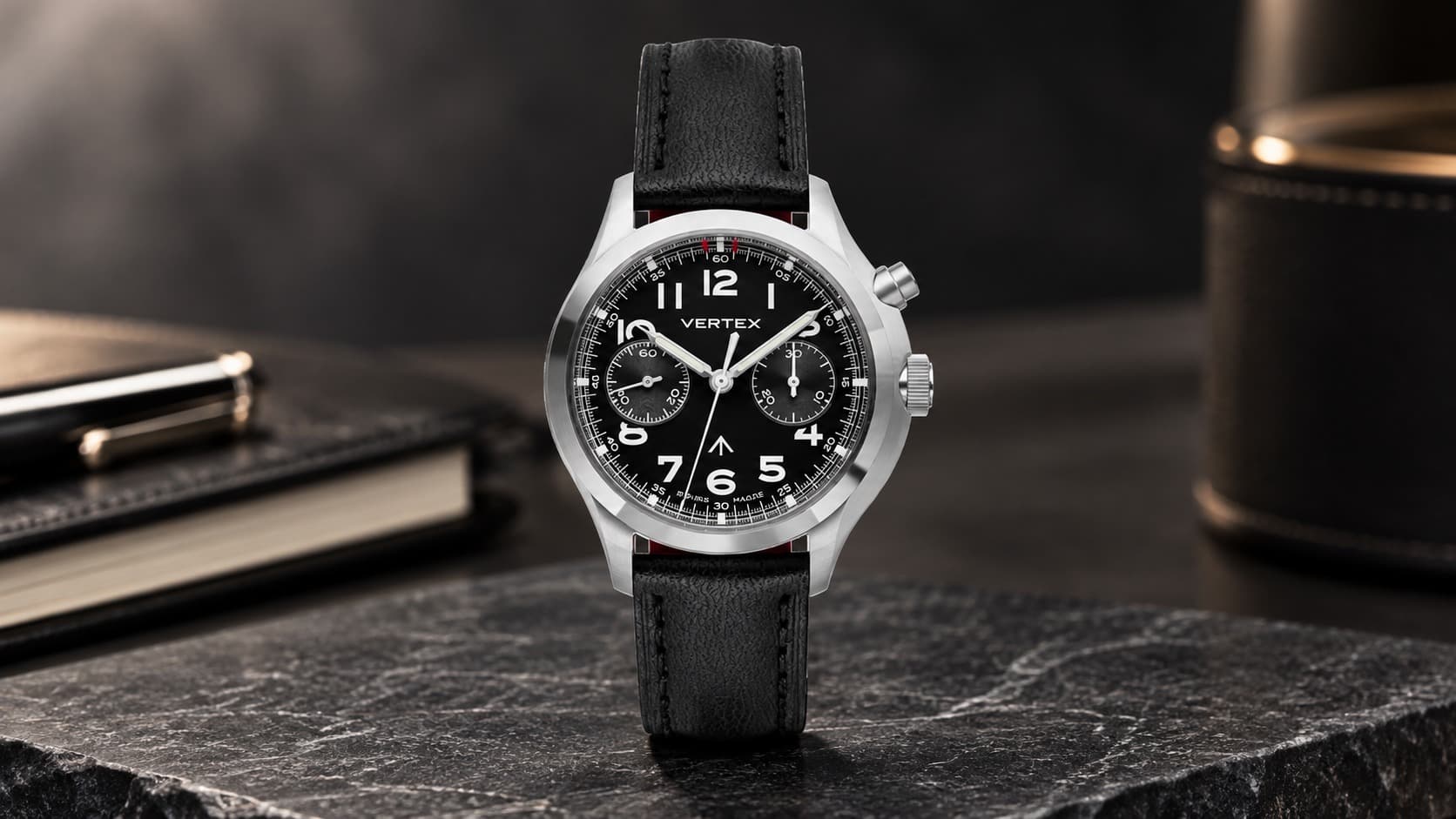
Vertex MP45: The Brand’s First Chronograph
The MP45 is Vertex’s monopusher chronograph, meaning it uses a single button to start, stop, and reset the stopwatch function instead of the two buttons most chronographs use. This was the brand’s first chronograph since its relaunch, and it’s based on a watch design the British military requested in 1945 but never actually put into production.
Because that original watch never got built, Vertex had more freedom with the MP45 than it did with the M100. The dial still uses the brand’s signature bold Arabic numerals and strong lume (the glow-in-the-dark coating on hands and markers), but the chronograph layout gives it a busier, more technical look than the simpler field watches. It sits under a double-domed sapphire crystal and measures around 40mm across. Vertex built it around Sellita’s SW510MP chronograph movement, offering both a hand-wound version and an automatic version that’s a couple of millimeters thicker because of the self-winding rotor inside.
A monopusher design is harder to engineer than a standard two-button chronograph, since one button has to handle three different jobs (start, stop, and reset) without causing timing errors. The first MP45 release was limited to 400 watches, split evenly between the manual and automatic versions, and Vertex later expanded the line with new dial colors, including an “Arctic” white dial and a lighter “Silver Panda” style, alongside the original black-dial and full-black DLC versions.
Vertex M60 AquaLion: The Brand’s First Dive Watch
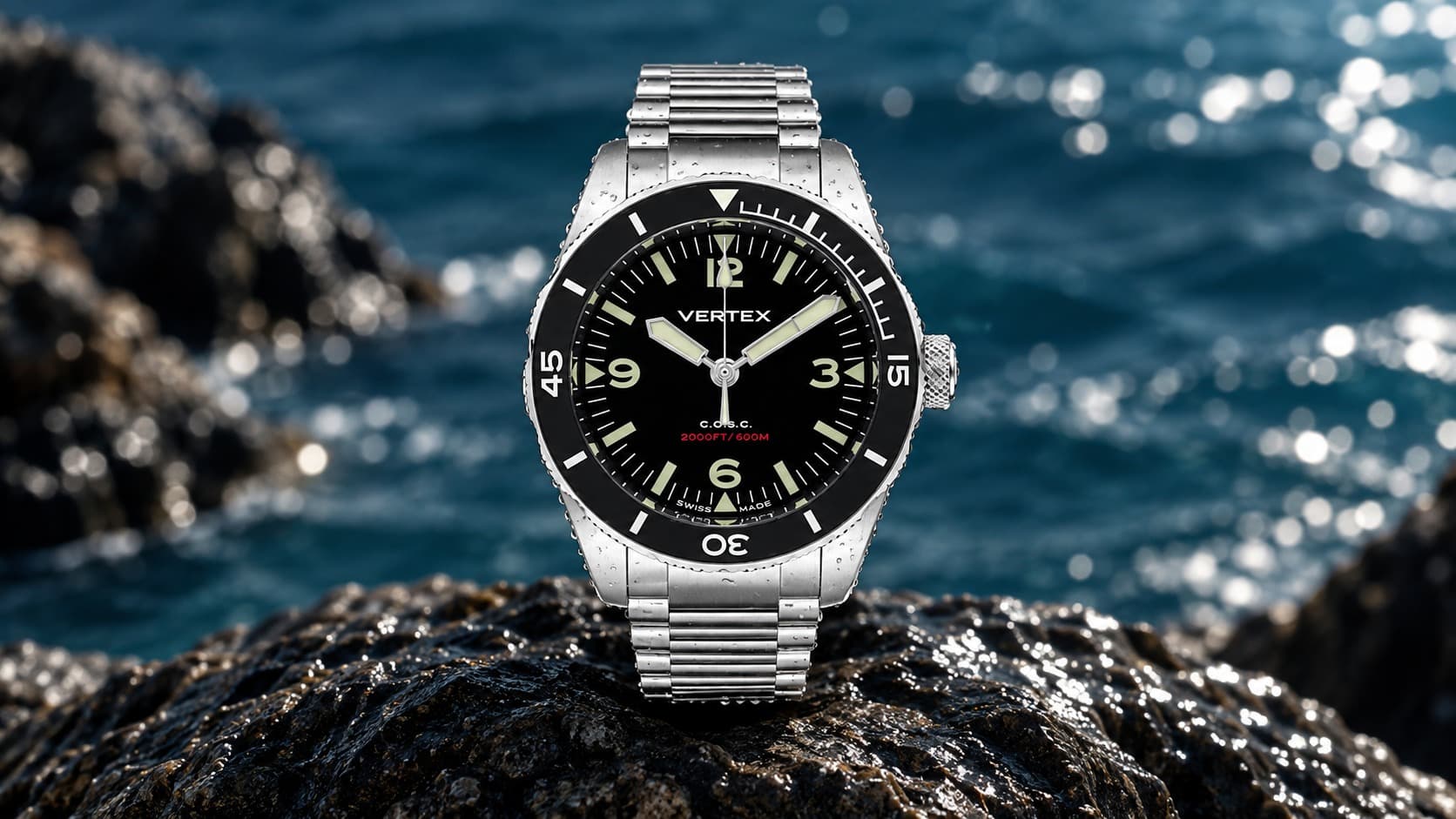
The M60 AquaLion is Vertex’s dive watch, and it marked the first time the brand built something for underwater use rather than a general field watch. It has a 40mm-wide, 14mm-tall stainless steel case, a rotating bezel for tracking dive time, and a Sellita SW300-1 automatic movement powering it from the inside.
Dive watches need a few things field watches don’t: a sealed case that can handle water pressure, a bezel you can grip and turn even with gloves on, and enough lume on the numerals to read the time in low light underwater. The M60 AquaLion checks all three boxes, pairing a ceramic bezel with Arabic numerals made from thick, molded X1 SuperLuminova for extra brightness. It’s sold in a no-date version (M60 AquaLion ND), a version with a date window (M60 AquaLion D), and a DLC-coated black version (M60C AquaLion DC), and it comes on either a steel bracelet with a quick-release system or a rubber dive strap.
Vertex didn’t actually make dive watches back in the 1940s, so the AquaLion isn’t a direct recreation of an old model the way the M100 is. Instead, it takes the brand’s design language, the bold numerals, strong lume, and no-nonsense dial, and applies it to a completely new type of watch built for a job the original company never had to do.
Vertex Bronze Editions: Watches That Age Over Time
Vertex also makes limited bronze versions of some of its core models, including the M100 and M36. Bronze is a metal that reacts with air and skin oils over time, developing a greenish-brown coating called patina that makes every watch look slightly different the longer someone wears it.
This matters because it’s the opposite of how steel watches work. A steel case looks basically the same on day one and day one thousand, aside from scratches. A bronze case actually changes color and texture as it ages, which some collectors love because it means their watch becomes visually unique to them over time, shaped by their own skin chemistry, climate, and how often they wear it. Vertex’s bronze editions, including runs like the Bronze 75, use the same internal design and movement as their steel counterparts, so the mechanics and dial layout stay familiar even though the case material behaves completely differently.
Why Vertex Watches Are Limited Editions
Vertex sells almost entirely direct to customers through its own website rather than through traditional watch retailers or department stores. That approach isn’t an accident. It keeps the brand’s costs down, since there’s no retail middleman taking a cut, and it lets Cochrane keep tight control over how each model is presented and sold.
Most Vertex releases are also produced in limited numbers rather than as an open-ended product line. The original MP45 run, for example, was capped at 400 pieces, and the M100B was limited to 150. This isn’t unusual for a small independent brand working with Swiss suppliers, since it’s far less risky to build a few hundred watches and see how they sell than to commit to mass production. The tradeoff for buyers is that popular models can sell out and may not come back in the exact same configuration, so a specific dial color or case finish that’s available today isn’t guaranteed to still be there in a year.
Choosing the Right Vertex Watch
The right Vertex model mostly comes down to what a buyer wants to use it for and how closely they want it tied to the brand’s original wartime story.
- Closest link to Vertex’s military history: The M100 is the obvious starting point, since it’s the closest modern match to the 1944 Cal 59 and the watch that relaunched the brand in the first place.
- Smaller, more vintage-proportioned case: The M36 keeps the same design in a case size closer to what soldiers actually wore in the 1940s.
- A watch that does more than tell time: The MP45 adds a working chronograph, and its monopusher function gives it a more mechanically interesting story than a standard two-button chronograph.
- Built for the water, not just the office: The M60 AquaLion is the only model in the lineup actually designed and sealed for diving.
- A watch that looks different over time: The bronze editions change color and texture with wear, which steel and DLC cases simply don’t do.
Vertex Watch Collections Compared
| Model | Type | Case Size (approx.) | Movement | Best Known For |
|---|---|---|---|---|
| M100 | Field watch | 40mm | Swiss mechanical | The original relaunch model, based on the 1944 Cal 59 |
| M36 | Field watch | 36mm | Swiss automatic | A smaller, more vintage-proportioned version of the M100 |
| MP45 | Chronograph | 40mm | Sellita SW510MP | Single-button monopusher chronograph function |
| M60 AquaLion | Dive watch | 40mm | Sellita SW300-1 | Vertex’s first watch built specifically for diving |
| Bronze Editions | Field/Dive | Varies by model | Matches steel equivalent | Cases that develop patina and change color over time |
Frequently Asked Questions
Is Vertex a real military watch brand or just a modern company using old branding?
Vertex is a real historical military brand, not a company borrowing a name for marketing purposes. It was one of twelve watchmakers chosen by the British Ministry of Defence to build field watches during World War II, and it’s the only British company among that group, known collectively today as the Dirty Dozen.
Why did Vertex stop making watches for so long?
Vertex closed in 1972 because of what’s commonly called the quartz crisis. Cheap, battery-powered quartz watches from Japan became widely available around that time, and many traditional mechanical watchmakers, Vertex included, couldn’t compete on price and eventually shut down.
Who owns Vertex watches today?
Vertex is run by Don Cochrane, the great-grandson of founder Claude Lyons. He revived the company in 2015, more than forty years after it closed, specifically to bring back his family’s watchmaking legacy.
Are Vertex watches automatic or manual?
Vertex makes both. Some models, like the hand-wound version of the M100 and MP45, need to be wound manually. Others, like the M60 AquaLion and the automatic version of the MP45, wind themselves through normal wrist movement using a rotor inside the movement.
What’s the difference between the M100 and the M36?
The main difference is size. The M100 uses a 40mm case, while the M36 uses a smaller 36mm case that sits closer to the proportions of original 1940s military watches. Both share the same broad arrow design and dial layout.
The Bottom Line
Vertex’s whole lineup makes more sense once you see it as one continuous story rather than a random set of watches. The M100 and M36 rebuild the brand’s original wartime design at two different sizes, the MP45 pushes that same philosophy into a technically harder chronograph format, and the M60 AquaLion takes the brand somewhere it had never actually gone before: underwater. The bronze editions, meanwhile, add a personal touch by letting each case age differently depending on who wears it. None of these watches try to be flashy. They’re built around the same idea that got Vertex chosen for military service back in 1943: a watch should be easy to read, hard to break, and built to last far longer than its original owner expected.