Smiths is one of the strangest success stories in watchmaking. It started as a company that fixed carriage clocks in London, grew into a giant that built speedometers for British cars, and somewhere in between, it made the watch that one of its wearers claims went to the top of Mount Everest before any Swiss brand got there. The original Smiths watch factory closed in the 1970s, yet the name lives on today through a small British company that builds new Smiths watches using old-school engineering and a very modern level of care. The brand’s modern lineup, and the history behind it, explain why it still matters to anyone who follows British watchmaking.
The History of Smiths Watches
Smiths was Britain’s last fully home-grown watchmaker, building complete watches on British soil from movement to case. That single fact separates it from almost every other “heritage” brand still talked about today.
The company began in 1851 as a jewelry and clock shop in London, founded by Samuel Smith. His descendants expanded the business into car dashboard instruments after World War I, when Britain’s booming automobile and aircraft industries needed speedometers, gauges, and clocks far more than they needed wristwatches. Through the 1930s the business restructured several times under different names, including Smiths English Clocks Limited and later Smiths Clocks and Watches Ltd, and it absorbed a Coventry-based firm called English Clock and Watch Manufacturers Ltd along the way. This was also around the era British watchmaking once dominated globally: in 1800, Britain accounted for roughly half of the world’s watch production, before losing ground to Switzerland and, later, Japan.
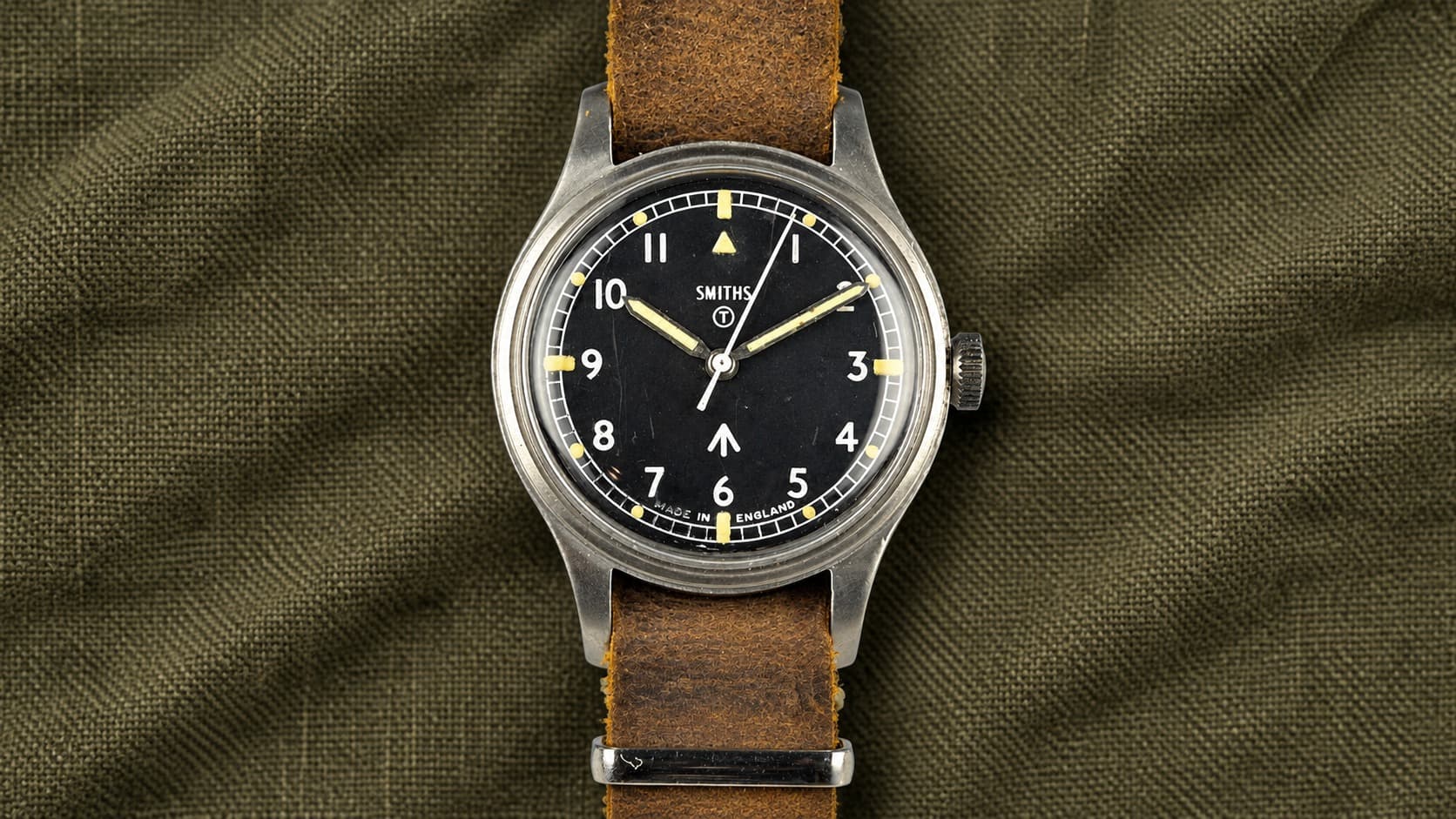
World War II pulled Smiths back into serious watch production out of wartime necessity, and by 1947 the company had built a dedicated watch factory in Cheltenham, Gloucestershire. From the 1950s through the 1970s, Smiths supplied watches to the British Ministry of Defence, including the now-famous W10 pilot’s watch issued to the Royal Air Force and Army from the late 1960s until the company’s watchmaking arm shut down around 1979 or 1980.
Smiths was the last British watch company to build its watches entirely in the UK, down to the balance springs and jewels.
That closure wasn’t really about bad watches. Cheaper quartz movements from Japan and Switzerland flooded the market in the 1970s, a period the industry still calls the Quartz Crisis, and the British government declined to bail Smiths out, reportedly directing support elsewhere in UK industry instead. The brand went quiet for years until Timefactors, a UK-based watch company run by enthusiast Eddie Platts, acquired the rights to the Smiths name and revived it, with the Everest PRS-25 arriving as its flagship model in 2011. Few buyers today realize Smiths also had a separate historical offshoot called Ingersoll, a watch brand built in Wales and unrelated to the better-known American Ingersoll company, though that thread of the brand’s past has no connection to Timefactors’ modern revival.
Did a Smiths Watch Really Reach the Top of Everest?
Yes, by Sir Edmund Hillary’s own account, he wore a Smiths De Luxe watch when he and Tenzing Norgay became the first climbers confirmed to reach the summit of Mount Everest on May 29, 1953.
The story is more tangled than most watch marketing admits. Rolex also sponsored the 1953 British Everest expedition and supplied watches to several team members, including an Oyster Perpetual that Hillary carried as well. Norgay wore a Rolex on his own wrist that day. But Hillary stated publicly, and Smiths later cited this in print, that the watch he had with him at the very top was a hand-wound Smiths De Luxe, built in a waterproof steel case by the Dennison Watch Case Company with special lubricant designed to handle the extreme cold at high altitude.
Trade publications from 1953 back this up. The British Horological Institute’s magazine ran a piece that September stating Smiths reached the summit, and Rolex’s own response the following month didn’t dispute it. Fifteen Smiths watches accompanied the expedition in total, part of the brand’s formal sponsorship arrangement with the climbing team. Hillary’s actual Smiths De Luxe is now preserved at the Clockmakers’ Museum in London, part of the Science Museum Group. Whatever side of the debate you land on, the episode explains why “Everest” became the name of Smiths’ best-known modern watch line.
The Best Smiths Watches Available Today
Modern Smiths watches are built by Timefactors, not by any surviving piece of the original Cheltenham factory. The company designs each model in-house, sources Japanese or Swiss movements, and assembles the watches to order. Stock is famously limited, which keeps demand high among collectors who like a good story behind their watch.
Smiths Everest PRS-25: Best Overall Pick
The Everest PRS-25 is the clearest link between Smiths’ past and present, and it’s the model most people mean when they say “Smiths watch.” It first launched at 40mm in 2011 and became far more popular after Timefactors introduced a 36mm version in 2018, a size that better matches the vintage tool-watch look the design is going for.
The watch is built from 316L stainless steel, brushed on top with polished sides, and measures 36mm across (39.3mm including the crown) with a 43.5mm lug-to-lug height and 20mm lug spacing, figures that matter most when sourcing a replacement strap. It uses a screw-down crown with drilled lugs and a hi-dome sapphire crystal with anti-reflective coating. Inside sits a Miyota 9015, a Japanese automatic movement with 24 jewels running at 28,800 beats per hour, built by Miyota, a division of Citizen. Water resistance sits at 100 metres, and the watch is rated anti-magnetic to 4,800 A/m, which together cover daily wear, swimming, and most accidental knocks against electronics.
On the stock oyster-style bracelet, with solid links, screwed construction, and a signed adjustable clasp, the watch weighs around 151 grams. The dial comes in several finishes over the years, including black, white, and a honeycomb texture introduced in 2023, with gilt versions appearing periodically as limited runs that tend to sell out within minutes.
| Pros | Cons |
|---|---|
| Reliable automatic Miyota 9015 movement | Only available in scheduled drops, not always in stock |
| Sapphire crystal resists scratches well | 36mm will feel small to anyone used to larger modern watches |
| 100m water resistance covers daily wear and swimming | Dial variants sell out fast, so popular finishes are hard to catch |
Everest Expedition (De Luxe): Best for Collectors
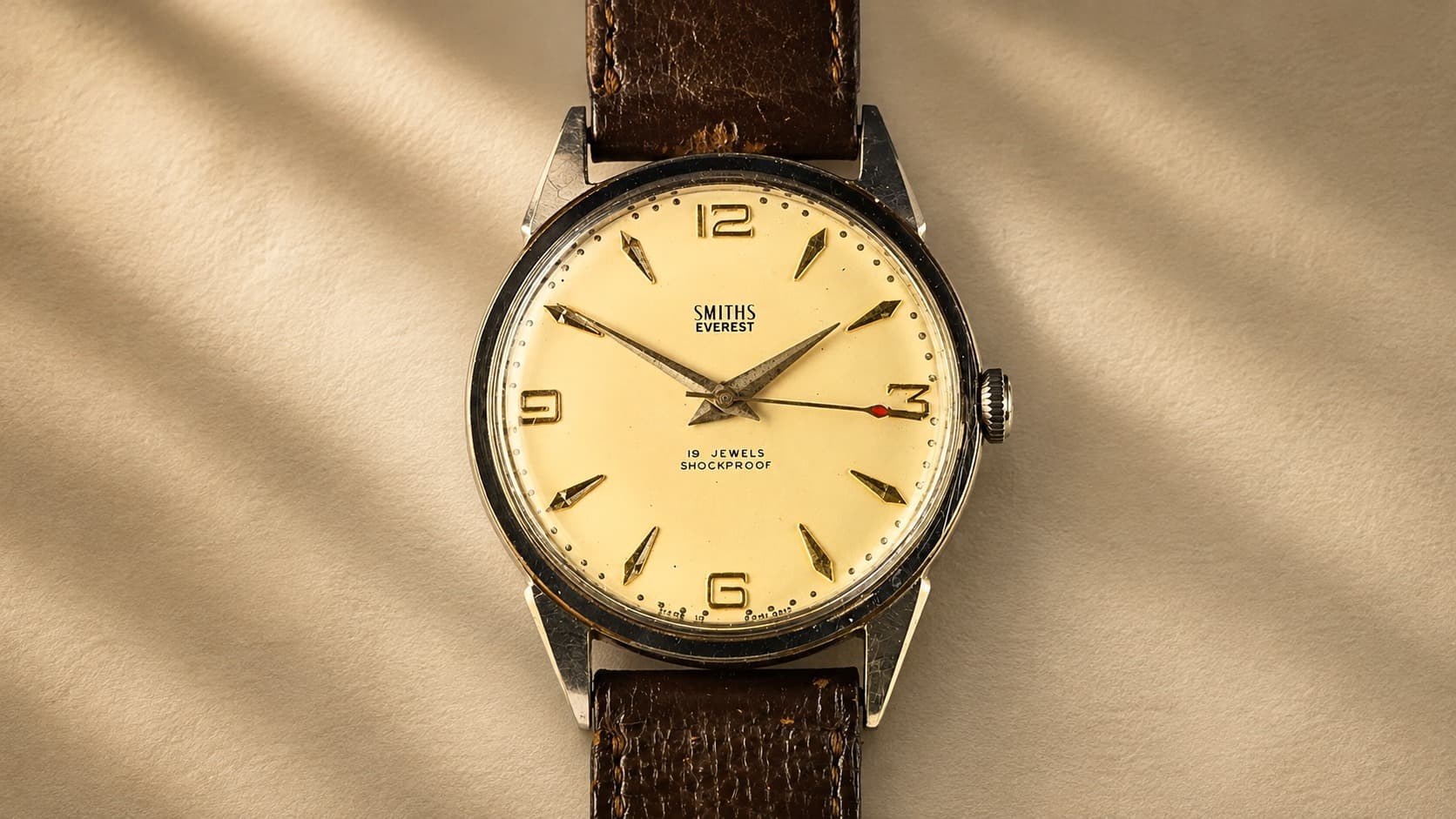
If the PRS-25 is Smiths’ tribute to Everest in general, the Expedition version is a more direct nod to the actual watch Hillary wore. It borrows the “De Luxe” name and minimalist dial text, with “SMITHS” and “DE LUXE” printed at 12 o’clock and “Everest Expedition, 24 Jewels” at 6, closely mirroring the layout of the 1953 original.
This hand-wound feel is closer to what the real Everest expedition watch would have offered climbers in 1953, even though every component inside is modern. It uses a Miyota 9039, a 24-jewel automatic-grade movement from the same Premium range as the 9015, but set up with hand-winding and hacking seconds, which lets the second hand be stopped for precise time-setting. Case dimensions and water resistance track closely with the standard PRS-25. Collectors who care about the brand’s backstory tend to gravitate toward this version over the standard automatic Everest, and it’s typically sold in smaller batches with white or cream dials.
| Pros | Cons |
|---|---|
| Closest design link to the actual 1953 Everest watch | Hand-wound, so it stops if left unwound for a day or two |
| Hacking seconds for precise time-setting | Sold in smaller batches than the standard PRS-25, so even scarcer |
| Same durable case and water resistance as the standard Everest | Dial text and detailing may not suit buyers who prefer a cleaner modern look |
Smiths Military PRS-29: Best Field Watch
The PRS-29 is Timefactors’ rebuild of the original Smiths W10, the pilot and field watch issued to British forces for just four years, between 1967 and 1970, which still makes it one of the most recognisable British military watches despite that short service life. It comes in 36mm and, in some production runs, a larger 39mm case, both built from brushed 316L steel with a screw-down back.
Specs vary slightly by production batch, but typical figures include a thickness of about 11.1mm, 18mm lug spacing, and a head weight between 45 and 51 grams. Every version carries a fully anti-magnetic inner cage, with ratings that have ranged from roughly 20,000 A/m up to 50,000 A/m depending on the batch, comfortably beating what most ordinary watches offer and matching the kind of spec a 1960s military watch actually needed to survive near aircraft instruments. Water resistance is rated to 100 metres (10ATM). Recent batches use a Swiss ETA 2801-2 movement, a hand-wound caliber with 17 jewels, Incabloc shock protection, and hacking seconds; Timefactors has noted that supply of this particular movement is limited, so future runs may not always use it.
Each PRS-29 also carries an official NATO Stock Number, a detail serious military-watch collectors appreciate because it ties the reissue to a genuine supply classification system rather than just a design reference. Watches typically ship with a grey NATO strap plus clip-on leather options in black and brown.
| Pros | Cons |
|---|---|
| Strong anti-magnetic rating, up to 50,000 A/m on some batches | Swiss ETA 2801-2 movement supply is limited, so future runs may change |
| Genuine NATO Stock Number ties it to real military history | Hand-wound only, no automatic option |
| Available in two case sizes (36mm and 39mm) | 18mm lug spacing won’t fit straps made for the Everest’s 20mm lugs |
Smiths Everest 40mm: Best for Big Wrists
The original 2011 Everest launch was 40mm before the 36mm version arrived, and Timefactors has kept the larger case in rotation for buyers who find 36mm too small for their wrist. Specs track closely with the 36mm PRS-25: a Miyota automatic movement, sapphire crystal, and 100-metre water resistance, just scaled up in diameter and lug spacing. It suits anyone accustomed to modern 40mm-plus sport watches who would otherwise find the smaller Everest undersized on the wrist.
| Pros | Cons |
|---|---|
| Better proportions for larger wrists | Less availability than the 36mm, which is now the brand’s main focus |
| Same reliable Miyota automatic movement as the 36mm | Strays further from the original 1953 watch’s smaller proportions |
| Sapphire crystal and 100m water resistance carry over | Harder to find on the secondhand market than the 36mm |
Other Smiths Models Worth a Look
Timefactors has released several other models under the Smiths name over the years, including the Vanguard PRS-32, an automatic chronograph built around a Seiko Instruments NE88 column-wheel movement, and the Navigator PRS-48. Both appear far less often than the Everest and Military lines, so detailed specs can vary significantly batch to batch, and Timefactors regularly tweaks dials, cases, and movements between production runs, so a current listing shouldn’t be assumed to match an older release.
Smiths Watch Models Compared
| Model | Case Size | Movement | Water Resistance | Best For |
|---|---|---|---|---|
| Everest PRS-25 | 36mm (also 40mm) | Miyota 9015 automatic | 100m | Everyday wear |
| Everest Expedition/De Luxe | 36mm | Miyota 9039 hand-wind, hacking | 100m | History fans |
| Military PRS-29 | 36mm / 39mm | ETA 2801-2 hand-wind | 100m | Military watch collectors |
| Everest 40mm | 40mm | Miyota automatic | 100m | Larger wrists |
Buying a Smiths Watch: What to Expect
Smiths watches are sold directly through Timefactors’ website, and stock usually appears in scheduled drops rather than being available year-round. The company has sold watches and straps online since 1996, and it still releases new batches on specific Sundays, often at 2pm UK time, with a strict one-per-customer limit on popular models.
This system exists because Timefactors is a small operation, not because of artificial hype. Each batch is a genuine production run, and once it sells out, the next one might not appear for months. Recent retail pricing has generally landed around £345 for the Everest PRS-25 and roughly £405 for the Military PRS-29, though prices shift between batches and currency exchange rates affect what buyers outside the UK pay.
That scarcity is also why secondhand Smiths watches move briskly on resale and collector marketplaces. Standard PRS-25 examples in good condition typically trade somewhere in the $400 to $700 range, while rare dial variants, like limited aventurine or gilt-dial runs, have sold for well over $1,000. Buying secondhand is usually the faster route to ownership for anyone who misses a drop, though it tends to cost more than waiting for the next official release.
Key Things to Check Before You Buy
Movement type is the first thing worth confirming, since Smiths mixes automatic and hand-wound calibers across its lineup. An automatic Miyota 9015 or 9039 winds itself through normal wear, while a hand-wound ETA 2801-2 needs a daily twist of the crown and will stop overnight if left unwound for a day or two. Neither type is better across the board; they simply suit different habits.
Crystal material and lug spacing are worth checking next. Most current Smiths watches use sapphire, which resists scratches far better than the acrylic crystals found on some older runs and budget watches generally. Lug spacing also matters for strap shopping: it’s 20mm on the Everest line and 18mm on the Military PRS-29, so a strap sized for one won’t necessarily fit the other.
Finally, water resistance and case finishing should match what the listing claims, especially on secondhand purchases. A 100-metre rating is standard across the current Everest and Military lines, and a screw-down crown should be part of that spec. A reputable seller states both clearly, and a missing detail is worth asking about before purchase.
Frequently Asked Questions
Is Smiths still a British company?
Smiths watches are designed and sold by Timefactors, a UK-based company, but production of individual components, including movements, is sourced internationally like almost every watch brand at this price point today. The original Smiths factory in Cheltenham closed around 1979, and the current brand operates under rights to the historic name rather than as a direct continuation of the old manufacturing operation.
What movement do modern Smiths watches use?
Why are Smiths watches so hard to find in stock?
Timefactors releases watches in limited batches on announced dates rather than keeping continuous inventory, and demand regularly outpaces supply for popular models like the PRS-25. Signing up for the brand’s newsletter is the most reliable way to catch a release before it sells out.
Did Hillary definitely wear a Smiths watch to the Everest summit?
Hillary stated he carried and relied on a Smiths De Luxe watch during the final push to the summit, and Smiths’ claim went largely unchallenged by Rolex in trade press at the time. He also carried a Rolex Oyster Perpetual on the expedition, so both brands have a legitimate connection to the 1953 climb, which is why the debate over “whose watch summited” still comes up among collectors.
Are Smiths watches a good investment?
Smiths watches are priced as accessible collector pieces rather than investment vehicles, with most new releases falling well under $1,000 at retail. Certain limited runs, particularly early PRS-25 batches with gilt dials or original bracelets, have appreciated on the resale market, but buying one should be driven by interest in the design and history rather than an expectation of guaranteed returns.
The Bottom Line
Smiths earns its reputation through an unusual combination of real wartime and expedition history paired with genuinely well-built modern watches that don’t cost a fortune. The Everest PRS-25 remains the best starting point for most buyers thanks to its reliable automatic movement, practical 100-metre water resistance, and direct tie to the 1953 expedition story, while the Military PRS-29 is the stronger pick for anyone drawn to its W10 service-watch roots and hand-wound mechanics. Any model in the current lineup carries one of the few watch names that can trace its DNA back to an actual British factory, an actual World War, and, by the account of the man who wore it, the actual summit of the world’s tallest mountain.