Karl Lagerfeld spent his career dressing other people, yet his own wrist told a story too. The designer behind Chanel’s modern revival and Fendi’s double-F logo was almost never photographed without sunglasses, fingerless gloves, and a watch peeking out from under a starched white cuff. That watch habit splits into three threads worth untangling: the one piece Lagerfeld actually wore for decades, the watches he helped put on other people’s wrists at Chanel, and the Karl Lagerfeld watch brand that still carries his name today. All three matter if you want the full picture of why his name keeps coming up in watch conversations years after his death in 2019.
Karl Lagerfeld’s Black Audemars Piguet Watch
Lagerfeld was famous for one watch above all others: an Audemars Piguet Royal Oak that he had customized entirely in black. He stuck with this single piece for decades instead of rotating through a collection, which made it instantly tied to his image.
The Royal Oak itself has a famous origin story. Designer Gérald Genta sketched it in a single night in 1971 after Audemars Piguet’s distributor asked for something radical, and it launched in 1972. It was a big deal at the time because Audemars Piguet, a serious luxury brand that had always worked in gold, had never made a steel sports watch before, and it was priced like a gold watch despite being steel, which confused the market at first before it became one of the most copied watch designs in history. Lagerfeld owned a Royal Oak Jumbo from this earliest production run and had it customized around 1979, in keeping with his lifelong love of all things black and white. He had the case, bracelet, and bezel coated entirely in black, while the dial stayed its original black color, with only small steel and white accents left untouched.
What makes this watch interesting is timing. Lagerfeld spotted the all-black trend decades before it became common in watchmaking. The wider fashion for blacked-out luxury sports watches, built around the Royal Oak, the Nautilus, and various Rolex sports models, did not take off until the mid-2000s, through aftermarket customizers. Lagerfeld was doing it in the late 1970s, purely because it matched his personal style, which makes his watch an early example of a trend that took the rest of the industry nearly thirty years to catch up to.
There is also a fun piece of trivia attached to this watch. Rumor has it that Lagerfeld never actually set it to the correct time. He apparently wore it as a style statement rather than a tool for checking the hour, which fits a man who was always more interested in how something looked than how it worked.
Provenance in the watch world means a piece carries real history because someone famous or important owned it. A Royal Oak with Lagerfeld’s name attached stops being just a watch and becomes a piece of fashion history, which is part of why customized vintage Royal Oaks with a documented celebrity owner can sell at auction for far more than an identical, unmodified model.
Karl Lagerfeld’s Custom Gold Apple Watch
Lagerfeld’s second famous watch moment happened decades later, and it had nothing to do with traditional watchmaking. In 2015, shortly after the Apple Watch launched, Apple’s chief designer Jony Ive gave Lagerfeld a one-of-a-kind Apple Watch Edition finished in 18-karat solid gold, paired with a matching gold Link Bracelet that Apple never sold to the public. The public version of that bracelet only ever came in stainless steel.
Apple reportedly handed out custom pieces like this only to a small circle of people it considered close friends of the brand, and the gift made sense for Lagerfeld specifically. He was known as a serious Apple collector, reportedly owning around 20 iPads and roughly 300 iPods at the time, so a personalized Apple Watch fit someone who already treated Apple products as part of his wardrobe.
Estimating the exact value is tricky since Apple never sold this exact configuration. Experts at the time guessed the solid gold link band alone could be worth upwards of $25,000 on top of the Watch Edition’s own price, which already started at $10,000 to $17,000 for the standard gold models. True to form, the watch appeared not to have been set up or activated when it was first photographed on his wrist. One watch he never wound, one watch he apparently never turned on. Lagerfeld clearly saw timepieces as style objects first and functional tools a distant second.
Karl Lagerfeld’s Role in Chanel Watches
Yes, watches were part of Lagerfeld’s broader design legacy at Chanel, even if he was not personally sketching every dial. Chanel released its first watch, the Première, in 1987, four years after Lagerfeld joined the house as artistic director, and it became one of the brand’s signature pieces, with its octagonal case inspired by the stopper on a bottle of Chanel No. 5 and the top of the Place Vendôme in Paris.
Chanel did not stay content having outside suppliers build its watches. In 1993, the brand acquired a Swiss movement manufacturer, G&F Châtelain in La Chaux-de-Fonds, giving Chanel in-house manufacturing capability most fashion houses never bother to build. That investment eventually supported later releases like the J12 in 2000, a ceramic sports watch that, notably, also launched in all-black, echoing the aesthetic Lagerfeld had already been wearing on his own wrist for over twenty years by that point. Watch design at Chanel was technically led by artistic director Jacques Helleu rather than Lagerfeld directly, but the brand’s monochrome, design-forward approach to watches during his decades there lines up closely with his own personal taste.
The History of the Karl Lagerfeld Watch Brand
Separate from the watches Lagerfeld personally wore or influenced at Chanel, there is also a commercial watch brand that carries his own name today. This brand did not exist until near the end of his life, and it has changed manufacturing partners more than once.
How Fossil Launched Karl Lagerfeld Watches
Karl Lagerfeld’s fashion label announced in October 2011 that it was teaming up with Fossil to design, develop, and distribute an exclusive line of watches, as part of a wider relaunch of the Lagerfeld label’s accessories. The collection launched globally on February 28, 2013, in North America, Europe, and Asia at the same time.
The launch lineup included seven collections built around bold design touches like link chains, metallic leathers, and pyramid studs, with an outline of Lagerfeld’s own head, ponytail, and sunglasses worked into the design as a signature detail, plus an engraved caseback on every piece. The standout was a model called the Karl Zip, reportedly Lagerfeld’s own favorite in the range, made from three leather straps held together by working zips, which let the wearer change the strap’s thickness by unzipping sections. The collections people kept coming back to were Karl 7, Karl Chain, and Karl Energy, with Karl 7 alone released in twelve different dial versions, named after Lagerfeld’s favorite number.
Every watch in this era ran on a Japanese quartz movement, with styles ranging from simple three-hand watches to chronographs with extra sub-dials. Prices sat between roughly $150 and $600, which fit the brand’s stated goal, in Lagerfeld’s own words, of selling a beautiful watch “without spending a fortune,” rather than carrying the price tag of his runway clothing.
Karl Lagerfeld Switches to Swarovski
The Fossil era did not last forever. In 2018, Karl Lagerfeld announced a new watch licensing deal with Swarovski, the Austrian crystal company, taking over starting in autumn/winter 2019. The two companies had already worked together since 2016 on a Karl Lagerfeld jewelry line, so extending the partnership to watches was described at the time as a natural next step rather than a fresh start.
The new watches were marketed as “accessible luxury,” blending modern design with more classic shapes than the earlier studded, rock-inspired Fossil years, and priced between 99 and 250 euros. They were sold through Karl Lagerfeld boutiques, the brand’s own website, and Swarovski’s Kristallwelten stores in Wattens, Austria, alongside selected retail partners worldwide.
The Current Karl Lagerfeld Watch Maker
The brand changed partners again more recently. Karl Lagerfeld signed a new licensing agreement for watches and fashion jewelry with Italy’s Morellato Group, effective from the fall 2024 season. Morellato is a long-established Italian watch and jewelry manufacturer that also produces or has produced pieces for other fashion-licensed brands, giving it deep experience distributing fashion watches at scale. Morellato now handles product development and distribution for Karl Lagerfeld watches worldwide, with the exception of the United States, Canada, and Mexico. A separate agreement with New York-based The Jewelry Group continues to cover Karl Lagerfeld jewelry in those North American markets, plus parts of Asia.
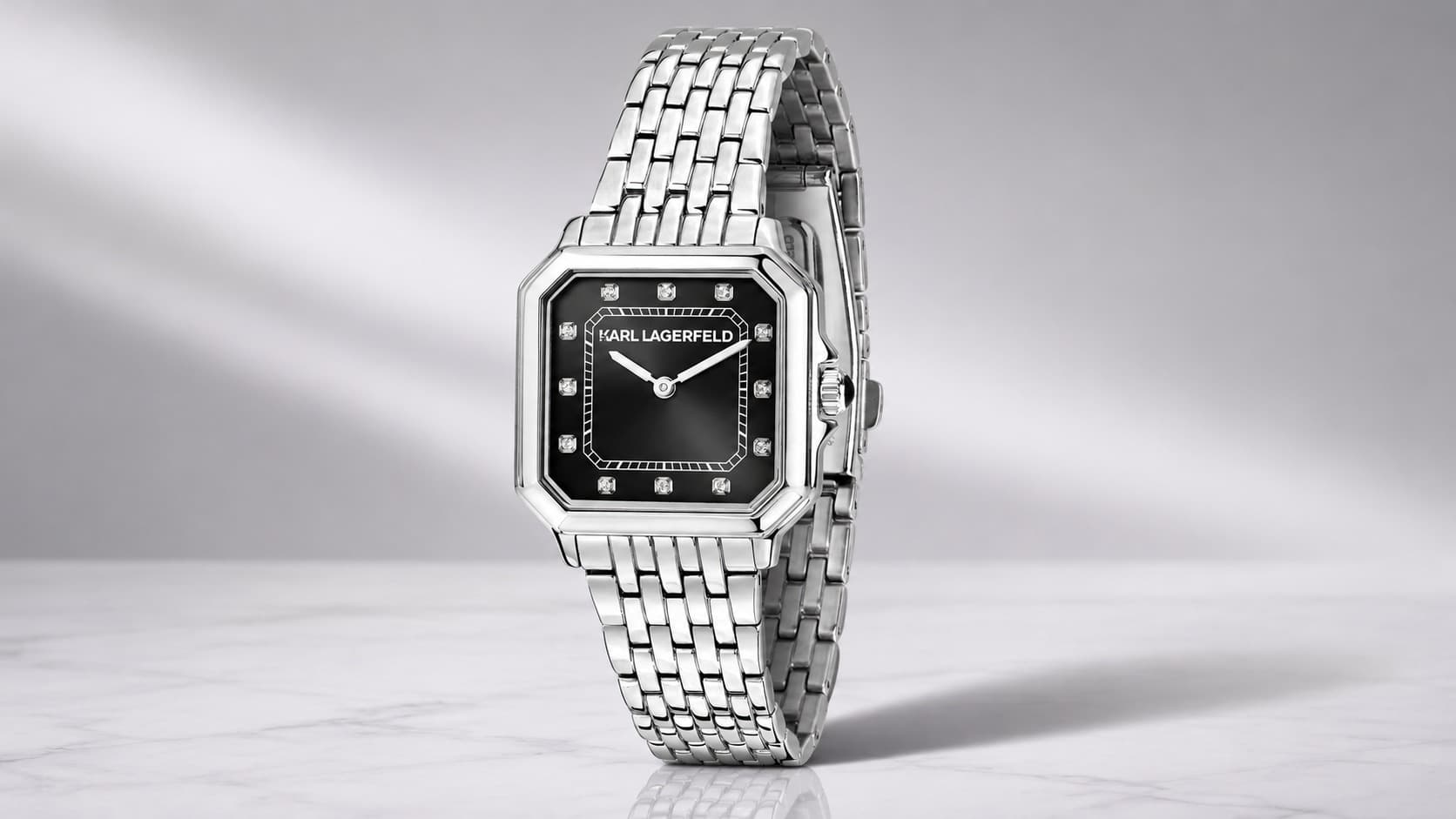
If you are shopping for Karl Lagerfeld watches today, this matters because the newest designs all come from Morellato. Recent seasonal drops have leaned into softer, more elegant looks than the brand’s early studded years, including a Paris-themed collection launched for fall/winter 2025 featuring a handwritten-style “Karl” signature across a mother-of-pearl dial and the brand’s first-ever mesh strap, priced around 44,000 yen in Japan, which converts to roughly 280 to 300 US dollars depending on the exchange rate.
Karl Lagerfeld Watch Collections
Each collection has its own personality, so knowing the names helps when you are browsing a store or a resale site.
- Karl 7 — Built around the number seven, Lagerfeld’s own favorite number, with a beveled top ring and a clean, modern case shape. Released in twelve dial variations at launch.
- Karl Chain — Leans into chain-link bracelet details, giving the watch a jewelry-like look on the wrist rather than a traditional strap.
- Karl Zip — The brand’s original signature piece, made from leather straps held together with working zippers that let you adjust the strap’s thickness yourself.
- Karl Energy — A sportier, dive-inspired line with oversized cases, offered in both chronograph and three-hand versions on leather or steel bracelets.
- Kolor — A summer-focused line that broke from the brand’s usual black, gold, and steel palette with purple and reddish-pink tones.
- Paris — The newest direction under Morellato, built around softer jewelry-style details like mother-of-pearl dials, handwritten logo text, and mesh bracelets.
What Movement Do Karl Lagerfeld Watches Have?
Karl Lagerfeld watches have used Japanese quartz movements across the entire range since the brand’s 2013 launch, and that has not changed under either later licensee. Quartz movements run on a small battery and a vibrating quartz crystal instead of springs and gears. This matters for buyers because it means these watches need a battery change every one to three years rather than regular servicing by a watchmaker, and quartz movements tend to keep time more accurately day to day than an entry-level mechanical watch. There are no mechanical or automatic Karl Lagerfeld watches on the market, which keeps the whole range affordable, lightweight, and low-maintenance, but also means collectors looking for traditional watchmaking craftsmanship should look elsewhere.
How Much Does a Karl Lagerfeld Watch Cost?
Pricing has shifted depending on who was licensing the brand at the time.
| Era | Licensee | Approximate Price Range |
|---|---|---|
| 2013–2018 | Fossil Group | $150 – $600 |
| 2019–2024 | Swarovski | €99 – €250 |
| 2024–present | Morellato Group | Roughly $150 – $350 |
These are fashion watches, not fine watchmaking pieces, so the price reflects design and brand name rather than complicated movements or precious materials. That is also true of most watches released under a fashion designer’s name rather than built in-house by a dedicated watch manufacturer, which is part of why prices have stayed in roughly the same band across three very different owners over more than a decade.
Should You Buy a Karl Lagerfeld Watch?
A Karl Lagerfeld watch makes sense if you want a design-forward accessory with a recognizable fashion name, not if you are looking for a serious mechanical timepiece or an investment piece. The brand has always positioned itself as accessible luxury, meaning you get Lagerfeld’s visual language, the sunglasses silhouette, the bold monochrome palette, the chain and stud details, without paying runway prices for it.
If you want something closer to what Lagerfeld himself actually wore, you are looking at a different category entirely. His personal Royal Oak was a one-of-one customized piece from a brand that now sells secondhand steel Royal Oaks for tens of thousands of dollars and up, long before any custom work is factored in, and that gap between the namesake watch brand and Lagerfeld’s own taste is worth keeping in mind before you buy expecting one to resemble the other.
Frequently Asked Questions
Did Karl Lagerfeld design his own watch brand?
Not directly in a hands-on design sense. His fashion label partnered with Fossil to create, develop, and distribute the first Karl Lagerfeld watch collection, which launched in 2013. The brand has since changed licensing partners twice, moving to Swarovski in 2019 and then to Morellato Group in 2024.
What watch brand did Karl Lagerfeld personally wear?
Lagerfeld was famous for wearing one watch above all: an Audemars Piguet Royal Oak that he had customized entirely in black. He also owned a one-of-a-kind solid gold Apple Watch Edition, gifted to him by Apple in 2015.
Are Karl Lagerfeld watches mechanical or quartz?
The Karl Lagerfeld watch brand has used Japanese quartz movements since its 2013 launch, and no mechanical models have been released under any of its three licensees.
Who currently makes Karl Lagerfeld watches?
Italy’s Morellato Group has handled Karl Lagerfeld watches worldwide, outside the United States, Canada, and Mexico, since the fall 2024 season. Jewelry in those North American markets is handled by a separate licensee, The Jewelry Group.
How much does a Karl Lagerfeld watch typically cost?
Prices have ranged from under $150 to around $600 depending on the collection and the era. Early Fossil-made pieces topped out closer to $600, the Swarovski era priced watches between 99 and 250 euros, and current Morellato pieces tend to sit in a similar mid-range of roughly $150 to $350.
The Bottom Line
Karl Lagerfeld’s connection to watches runs in three directions that rarely overlap. The man himself stuck to one deeply personal piece, a black-coated Audemars Piguet Royal Oak he reportedly never even set the time on, plus a one-of-a-kind gold Apple Watch he treated more like jewelry than tech. His design influence also shaped Chanel’s watch ambitions during his decades there, including the brand’s move into owning its own Swiss manufacturing. The brand that carries his own name, meanwhile, has always been about accessible design: bold, logo-driven quartz watches that have passed through three different licensing partners since 2013, from Fossil to Swarovski to today’s Morellato Group. If you want a taste of Lagerfeld’s monochrome, accessory-first style on your wrist, the namesake brand delivers that at a reasonable price. If you want the watch Lagerfeld actually wore, you are chasing a customized Royal Oak that now belongs firmly in serious collector territory.