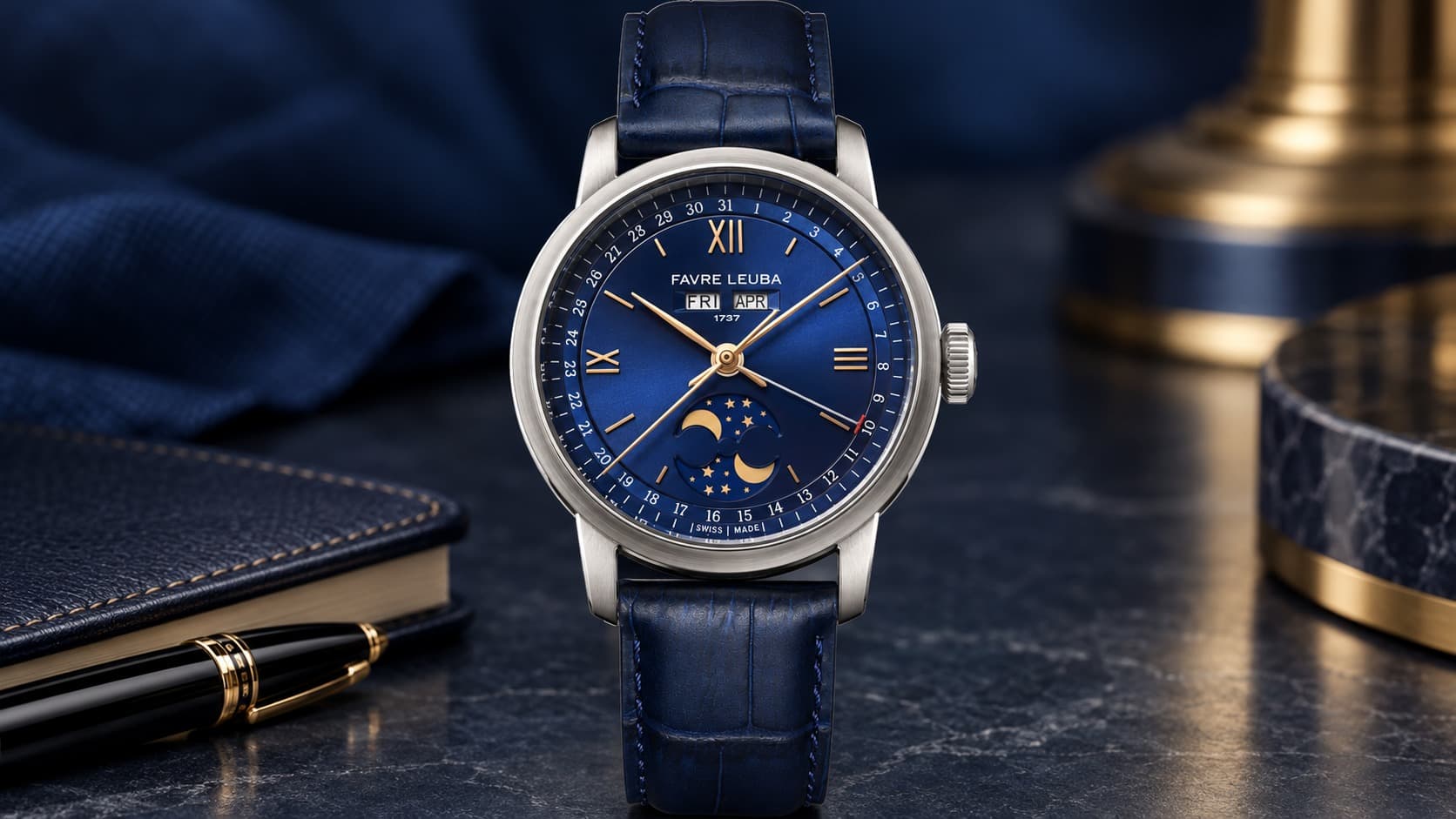
Favre-Leuba does not get mentioned nearly as often as Rolex or Omega, yet it has been making watches for longer than almost any other Swiss brand alive today. Founded in 1737 and reborn several times since, the company spent decades fading in and out of view before a 2024 relaunch brought it back with a sharper focus and a lineup that actually makes sense to shop for. The watches that matter most today fall into two collections, the Chief and the Deep Raider, each one built on real tool watches the brand made decades ago rather than on invented heritage.
Why Favre-Leuba Is Worth Knowing
Favre-Leuba stands out because it is the second-oldest Swiss watch brand still operating, founded just two years after Blancpain. That matters because almost every design decision the brand makes today points back to real tool watches it built in the 1950s and 60s, rather than invented heritage. The Chief, the Deep Raider, and the famous Bivouac all trace back to watches that mountaineers, divers, and soldiers actually wore and used.
The brand also sits in an unusual price lane. Most of its current watches land between roughly $2,850 and $5,800, which puts them well above fashion-watch territory but noticeably below the big Swiss luxury names. That gap is intentional. Favre-Leuba’s leadership has been open about targeting the CHF 2,000 to 4,500 range, a spot many legacy brands have abandoned as they chase higher margins.
The History of Favre-Leuba Watches
Favre-Leuba began in 1737 when Abraham Favre registered as an independent watchmaker in Le Locle, Switzerland. Favre Leuba is the second-oldest Swiss watch brand, with Blancpain having been founded two years earlier in 1735. The Favre-Leuba name itself did not exist yet; that came later, when a descendant partnered with another watchmaking family.
In 1815, Henry-Augustus Favre, only 19 at the time, collaborated with Auguste Leuba, a member of a family of watchmakers and merchants, creating the brand name Favre-Leuba and pushing the business into international markets. The brand earned early recognition quickly, picking up awards at international exhibitions in London, New York, Paris, Bern, and Porto between 1851 and 1865. India became especially important to the company too, and by the end of the Second World War it was arguably the brand’s most significant market thanks to an office in Mumbai.
The 1950s and 60s were Favre-Leuba’s golden era. The brand developed its own movements, including the FL101 caliber and the twin-barrel FL251, and for a stretch through the 1960s it also distributed other Swiss brands such as Zenith across Asia, even selling co-branded “Favre-Leuba Zenith” pieces. In 1962, Favre-Leuba released the Bivouac, the world’s first mechanical wristwatch with a built-in aneroid barometer for measuring altitude and air pressure. It followed that with dive watches like the Water Deep and the Deep Blue, both rated to 200 meters, at a time when few brands were pushing water resistance that far. By 1969, the company had been brought together with Jaeger-LeCoultre under a shared group called SAPHIR, positioned as the more accessible of the two names.
Then came the quartz crisis of the 1970s, which devastated Swiss mechanical watchmaking across the board. Ownership changed hands several more times after that. The Benedom group took over in 1978, the brand later moved through LVMH and a string of private holders, and Titan Company, part of India’s Tata Group, bought it in 2011. In 2023, the brand passed to Switzerland’s Silvercity Brands, which relaunched it at Geneva Watch Days in 2024 with a rebuilt, modern collection.
The Best Favre-Leuba Watches
Favre-Leuba Chief Date
The Chief Date is the brand’s entry point and its best-selling shape. It comes in a 40mm steel case and is built as a daily-wear sports watch rather than a tool watch, which makes it the easiest Favre-Leuba to live with day to day.
The design borrows from 1970s Favre-Leuba references, reworked with a modern case and dial finishing. It is offered in a handful of dial colors, including a Royal Purple version alongside the more neutral options, so there is some room to pick a look rather than settling for one standard dial. Pricing starts around $2,950 on a rubber strap and $3,050 on a steel bracelet, putting it near the bottom of the brand’s current lineup and making it the most sensible starting point for anyone curious about Favre-Leuba.
Favre-Leuba Chief Chronograph
The Chief Chronograph answers a simple question fast: can Favre-Leuba make a proper chronograph? Yes, and it does it in a slightly larger 41mm case with three dial options to choose from.
Pricing runs about $5,700 on rubber and $5,800 on steel, a meaningful step up from the Chief Date. That jump reflects the added chronograph mechanism and movement finishing rather than just a bigger case, which is why the Chronograph sits in its own price tier instead of reading as simply a larger Chief Date.
Favre-Leuba Chief Skeleton
The Chief Skeleton is the first openworked watch in Favre-Leuba’s history, and that alone makes it notable. Unlike the Chief Date and Chronograph, it skips the steel bracelet entirely and ships on a strap, which keeps the focus on the visible movement rather than the case hardware.
Inside is the Caliber FLS01, built in partnership with Manufacture AMT, a specialist movement maker that operates under Switzerland’s Sellita Group. Two finishes are available, an Anthracite version priced around $4,600 and a Gold Finish version around $4,500, with the small price gap reflecting a difference in finish rather than a difference in quality.
Favre-Leuba Chief Tourbillon
The Chief Tourbillon is the most expensive watch Favre-Leuba currently makes, and it is the clearest sign of how seriously the relaunched brand wants to be taken. At roughly $33,000, it sits in a completely different price bracket from the rest of the Chief family.
A tourbillon is a small rotating cage that houses the watch’s escapement, designed to counteract the effect gravity has on timekeeping accuracy when a watch sits in one position for a long time. Including one in the lineup signals that Favre-Leuba wants a genuine halo piece, not just a story about one from decades ago.
Favre-Leuba Deep Raider Revival
The Deep Raider Revival is where Favre-Leuba’s diving heritage comes through most clearly. It wears a 39mm steel case that measures 12.75mm thick, keeping it close to the proportions of real vintage dive watches rather than the oversized divers many modern brands favor.
It carries 300 meters of water resistance, handled through a screw-down crown and caseback, and a box-style sapphire crystal that echoes the domed crystals used on 1960s tool watches. Inside sits the FLD01 automatic movement, adapted from the La Joux-Perret G100, with enough power reserve (68 hours) that the watch can sit unworn for a long weekend and still be keeping correct time afterward.
The Deep Raider Revival has also become the model Favre-Leuba uses for limited collaborations, including a 2025 trio made with French strap specialist Jean Rousseau, priced around $3,200 and limited to 99 pieces total. That pattern suggests this is the reference the brand leans on when it wants to try something more playful without touching its core lineup.
Favre-Leuba Deep Raider Renaissance
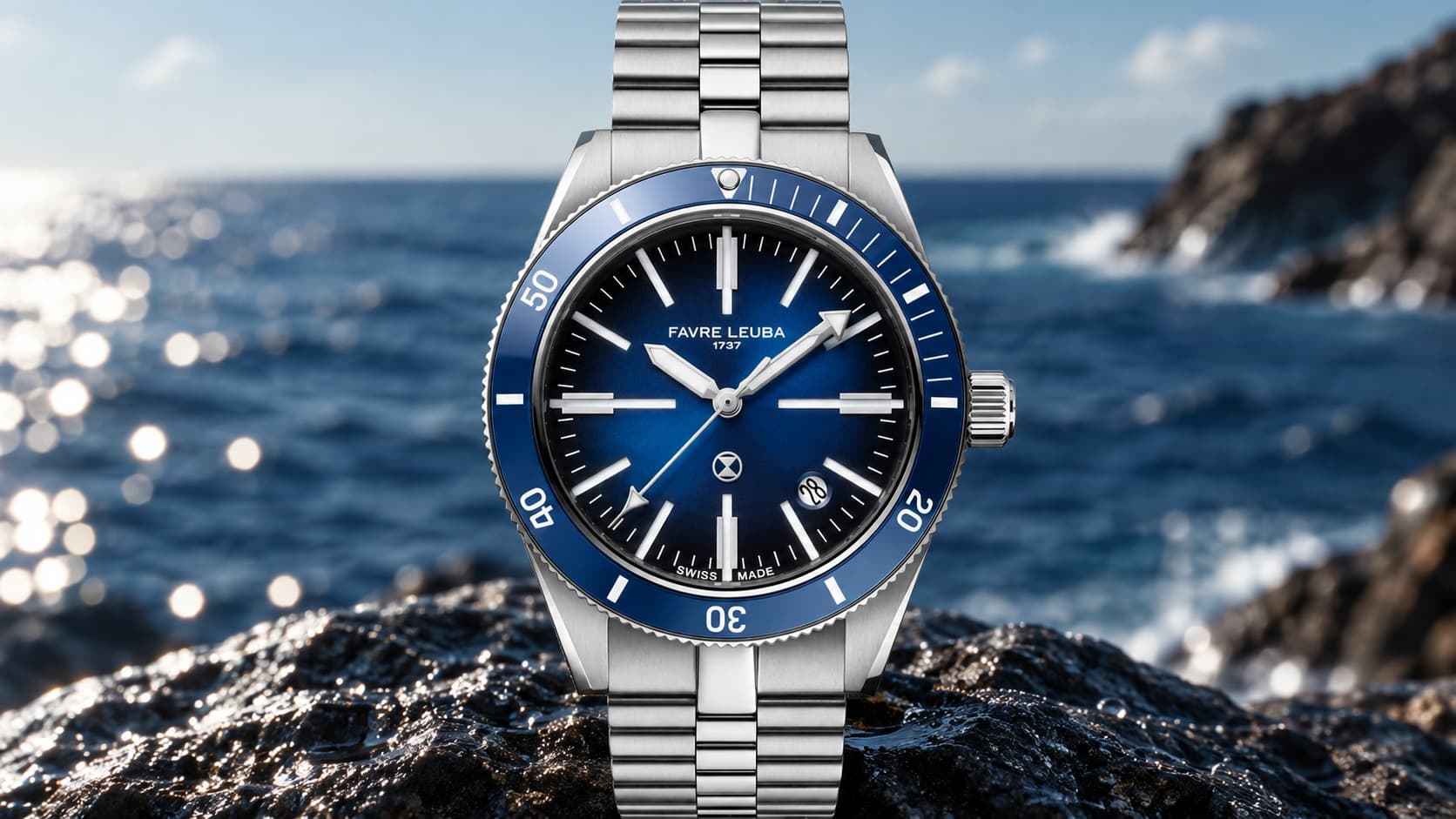
The Deep Raider Renaissance is a direct nod to the original 1964 Deep Blue, one of the most collectible vintage Favre-Leuba references among watch enthusiasts today. It uses a 40mm steel case with a ceramic bezel that turns in one direction only, and scratch-resistant sapphire glass covers both the dial and the caseback.
The water resistance rating has now been increased to 300 meters, up from the 200-meter rating of the original Deep Blue it is based on. Power comes from the in-house FLD02 automatic movement, which also offers a 68-hour power reserve. Pricing for the standard color options runs $2,850 on rubber and $2,950 on steel, while special dial versions using materials like meteorite or malachite climb to around $3,800 to $3,900.
Favre-Leuba Deep Raider Day Date
The Deep Raider Day Date is the newest expansion of the dive collection, built for people who want diver looks without giving up a useful everyday complication. Adding a day and date display makes it more practical for regular wear than a pure tool-diver, while keeping the same core case and water resistance as the rest of the Deep Raider range.
It launched first in steel, then followed with two-tone steel and gold-tone editions, which gives buyers a dressier option within what is otherwise a sporty collection. According to Favre-Leuba’s CEO Patrik Hoffmann, 2026 marks a deliberate push to grow this specific collection after the Chief family’s expansion in 2025, so expect more Deep Raider variants to keep arriving through the rest of the year.
Favre-Leuba Bivouac: Favre-Leuba’s Legendary Watch
The Bivouac is not part of the current core lineup, but it remains the single watch most responsible for Favre-Leuba’s reputation. Launched in 1962, it was the first mechanical wristwatch ever built with a working aneroid barometer, letting wearers read altitude and air pressure directly from the dial without any electronics. The original measured altitude up to 3,000 meters, and it quickly became a genuine mountaineering tool rather than a novelty: Walter Bonatti wore one climbing the north face of Pointe Whymper in 1964, and Junko Tabei wore one during her historic 1975 Everest ascent.
Favre-Leuba revived the concept decades later with the Raider Bivouac 9000, launched at Baselworld 2017 for the brand’s 280th anniversary. The new version pushed the altitude measurement range up to 9,000 meters, added water resistance the original never had, and went on to be named the best new watch of that year by the Watchstars panel of industry judges. Climbers carried it to the summit of Mount Everest the following year and to the top of K2 in 2019, making it the only mechanical watch with a working barometer known to have reached both mountains. If Favre-Leuba brings a modern Bivouac back into regular production, it would likely become the brand’s most distinctive watch again, simply because nothing else in its history matches that level of mechanical ambition.
Favre-Leuba Models Compared
| Collection | Case Size | Water Resistance | Movement | Starting Price |
|---|---|---|---|---|
| Chief Date | 40mm | Not a diving watch | Automatic | ~$2,950 |
| Chief Chronograph | 41mm | Not a diving watch | Automatic chronograph | ~$5,700 |
| Chief Skeleton | 40mm | Not a diving watch | FLS01 (with Manufacture AMT) | ~$4,500 |
| Chief Tourbillon | 40mm | Not a diving watch | Tourbillon | ~$33,000 |
| Deep Raider Revival | 39mm | 300m | FLD01 (La Joux-Perret base) | ~$3,200 |
| Deep Raider Renaissance | 40mm | 300m | FLD02 (in-house) | ~$2,850 |
| Deep Raider Day Date | 40mm | 300m | Automatic | Varies by metal |
Prices shift fairly often with new colorways and limited runs, so these figures serve as a starting guide rather than a fixed price list. Favre-Leuba’s own site remains the only reliable source for current pricing.
Things to Consider Before Buying
Favre-Leuba is a genuinely old brand, but the company making watches today is a recent restart, not a continuous operation stretching back to 1737. That is not a red flag by itself; plenty of heritage brands have changed ownership and still make excellent watches. It is simply useful context behind phrases like “second-oldest Swiss watch brand” when they are attached to a watch that was designed in 2024 or 2025.
Parts availability and resale value are also still developing. Because the relaunched collection is young, there is not yet a long track record showing how well these specific watches hold their value or how easy servicing will be ten years from now. A current Favre-Leuba makes the most sense as a watch chosen for its design and price, not as a speculative investment.
Movement sourcing is worth paying attention to as well. Some models, like the Deep Raider Revival, use movements based on outside suppliers such as La Joux-Perret, while others, like the Deep Raider Renaissance’s FLD02, are described as in-house. Neither approach is better by default, but knowing which one sits inside a given model makes it easier to compare prices across the lineup.
Frequently Asked Questions
Is Favre-Leuba a real luxury Swiss watch brand?
Yes. Favre-Leuba is a genuine Swiss watchmaker founded in 1737, making it the second-oldest Swiss watch brand in continuous name use. It has gone through several ownership changes, most recently being acquired by Silvercity Brands in 2023 and relaunched in 2024, but its watches are designed and assembled as Swiss products.
Who owns Favre-Leuba now?
Favre-Leuba is currently owned by Silvercity Brands, a Swiss company that acquired the brand in 2023 and led its 2024 relaunch at Geneva Watch Days. Before that, it was owned by Titan Company, part of India’s Tata Group, which had held the brand since 2011.
What is the cheapest Favre-Leuba watch?
The Chief Date is generally the most accessible model in the current lineup, starting at around $2,950 on a rubber strap. The Deep Raider Renaissance sits close behind it, with standard colorways starting around $2,850.
Are Favre-Leuba watches good for diving?
The Deep Raider Revival and Deep Raider Renaissance are both rated to 300 meters of water resistance, which comfortably covers recreational scuba diving. Both use screw-down crowns, sapphire crystals, and unidirectional bezels, the standard features expected on a serious dive watch.
What is special about the Favre-Leuba Bivouac?
The original 1962 Bivouac was the first mechanical wristwatch ever built with a working aneroid barometer, letting the wearer read altitude directly from the dial, and it was later worn on real climbs by mountaineers like Walter Bonatti and Junko Tabei. The modern Raider Bivouac 9000 took that idea even further, reaching both Everest and K2 while still measuring altitude mechanically, which makes it the single most historically important watch in Favre-Leuba’s catalog.
The Bottom Line
Favre-Leuba’s 2024 relaunch gave the brand something it had lacked for decades: a lineup that is easy to actually evaluate. The Chief Date and Deep Raider Renaissance cover the accessible end with honest pricing and real specs, the Chief Chronograph and Skeleton add genuine mechanical interest a step up in price, and the Chief Tourbillon shows the brand is willing to compete at the top end too. None of that erases the gaps in the brand’s history or the uncertainty around long-term resale value, but it does mean Favre-Leuba’s current watches can be judged on their own merits rather than on nostalgia alone. For most buyers, that makes the Chief Date or Deep Raider Renaissance the smartest place to start.