A three-stone ring is one of the most recognizable styles in jewelry, instantly familiar even to people who don’t know its name. One center stone sits between two smaller ones, lined up in a row across the top of the band. The design shows up everywhere from engagement rings to anniversary gifts, and it carries a story that most people only half-know: something about the past, the present, and the future. That story has a real history behind it, and understanding where it came from, what the stones mean, and how the design actually works makes the ring far more interesting than a quick glance would suggest.
Defining the Three-Stone Ring
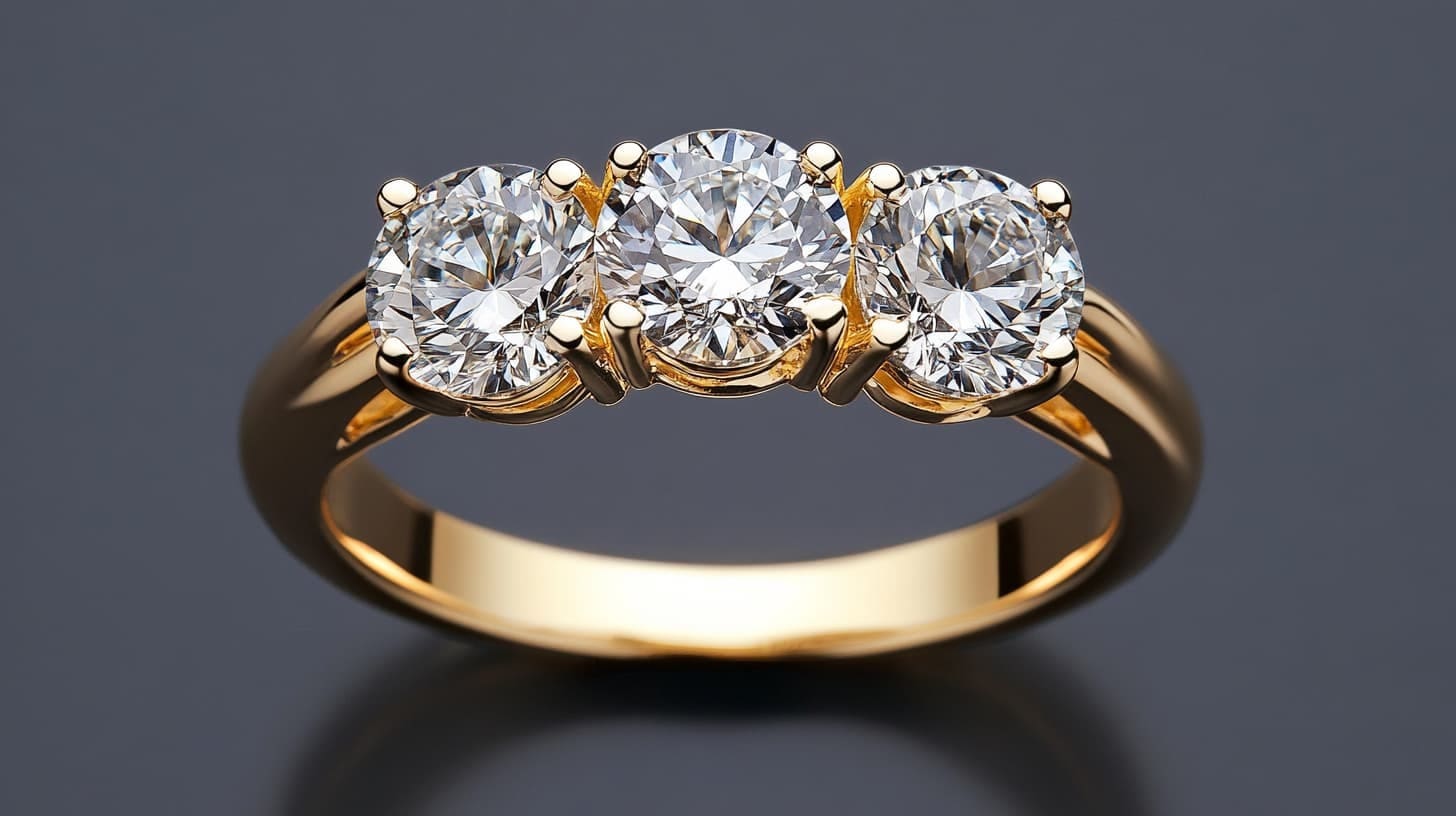
A three-stone ring is a ring set with three gemstones arranged side by side, usually with a larger stone in the middle and two smaller matching stones on either side. It’s also called a trilogy ring or a trinity ring, and all three names describe the same basic layout.
The center stone almost always draws the eye first because it’s typically 30 to 50 percent larger than the two stones flanking it. Diamonds are the most common choice for all three positions, but colored gemstones work just as well, and a center sapphire or ruby with diamond side stones is a popular variation. The stones don’t have to be the same shape either, though most traditional versions keep all three in matching cuts for a cleaner, more balanced look.
Why Do Three-Stone Rings Mean Past, Present, Future?
The phrase comes from a marketing campaign, not an ancient tradition. The diamond company De Beers popularized the “past, present, future” meaning for three-stone rings starting in the late 1990s, giving a design that had already existed for generations a new, romantic story to go with it.
The ring itself is much older than that campaign. Three-stone rings appear in Georgian jewelry as early as the 1700s, and they continued through the Victorian, Edwardian, and Art Deco eras in many forms — sometimes three matched diamonds of equal size, sometimes a larger center stone with smaller flankers, and sometimes rows of colored stones. For roughly two centuries before anyone attached a love story to it, it was simply a classic, well-balanced ring design.
De Beers changed that in the late 1990s and early 2000s by giving the existing format a specific, marketable meaning: the left stone for the relationship’s past, the center stone for the present, and the right stone for the future. The idea caught on quickly because it gave an already-beautiful ring a sentimental reason to choose it, and it’s been the dominant meaning associated with the style ever since.
The three-stone setting itself predates that marketing story by roughly two centuries. What changed in the late 1990s wasn’t the ring — it was the meaning people attached to it.
What Does Each Stone Symbolize?
In the most common interpretation, the three stones stand for a relationship’s past, present, and future, with the center stone symbolizing the present chapter a couple is living in right now. The two outer stones bookend that moment, one looking backward and one looking forward.
This meaning became especially well known after Prince Harry proposed to Meghan Markle in 2017 with a three-stone ring he designed himself. The center stone was a cushion-cut diamond from Botswana, a country significant to the couple’s early relationship, and the two smaller round diamonds came from Princess Diana’s personal jewelry collection. That combination of symbolism — a stone for the couple’s own story paired with stones connected to family history — pushed the “past, present, future” concept into mainstream popularity and made three-stone rings one of the most requested engagement ring styles of the following years.
Alternative Meanings Beyond Romance
The three stones don’t have to represent a romantic timeline at all. Because the meaning behind any piece of jewelry is ultimately personal, plenty of people choose their own interpretation for the design, among them:
- Three children or family members, with each stone representing one person
- Mind, body, and spirit, a meaning some buyers use for personal or spiritual jewelry
- Three close friends or siblings, often chosen for a non-romantic gift
- Three major life milestones the wearer wants to commemorate
A three-stone ring given as a graduation gift, a friendship ring, or a push present after having a baby can carry any meaning the giver wants to attach to it. The format is flexible enough to fit stories that have nothing to do with romance at all.
Popular Stone Choices for Three-Stone Rings
Diamonds are the traditional choice for all three stones, largely because of their durability and the De Beers campaign that popularized the style. That said, there’s no rule requiring diamonds, and colored stone combinations have become increasingly common, especially as buyers look for more personal or budget-friendly options, such as:
- All diamonds — the classic, most traditional version
- Sapphire center with diamond side stones — a popular choice for both engagement rings and anniversary jewelry
- Ruby center with diamond side stones — often chosen for its bold color and connection to passion or courage in jewelry symbolism
- Birthstone combinations — using the birthstones of three family members, three children, or a couple and a future child
Should All Three Stones Be Equal in Size?
Not necessarily, though the center stone is almost always the largest. In the traditional version of the design, the two side stones match each other in size and cut, while the center stone is noticeably bigger to serve as the ring’s visual focal point.
Some modern versions flip the balance slightly, using side stones closer in size to the center stone to put more emphasis on the “past” and “future” symbolism rather than letting the “present” dominate the design. Either approach is correct — it comes down to which part of the story the wearer wants to stand out.
Which Setting Is Best for a Three-Stone Ring?
The setting is the metalwork that holds each stone in place, and it affects both how the ring looks and how well it protects the stones day to day.
| Setting Type | How It Works | Best For |
|---|---|---|
| Prong setting | Small metal claws grip each stone, leaving most of it visible | Maximizing sparkle and light |
| Bezel setting | A thin metal rim surrounds each stone completely | Active lifestyles, extra stone protection |
| Shared prong | Side-by-side stones share connecting prongs between them | A seamless, continuous look |
| Channel setting | Stones sit in a groove between two metal walls | A sleek, low-profile style |
A prong setting is the most common choice for three-stone rings because it lets the most light reach each stone, which makes diamonds and faceted gemstones sparkle more. Someone who works with their hands often or plays sports regularly may prefer a bezel setting instead, since the metal rim shields the stone’s edges from everyday bumps and scratches.
What to Look for in a Three-Stone Ring
The center stone usually drives the rest of the decision, since it sets the scale and style for the whole ring. A larger center stone with smaller side stones creates a dramatic, traditional look, while three stones closer in size creates a more modern, balanced appearance.
After the center stone, the next decision is whether the side stones should match it exactly in shape or contrast with it. A round center diamond paired with trapezoid or half-moon side stones is a popular modern combination, while a fully matched trio — three round diamonds, for example — leans more classic and traditional.
Matching Metal and Cut
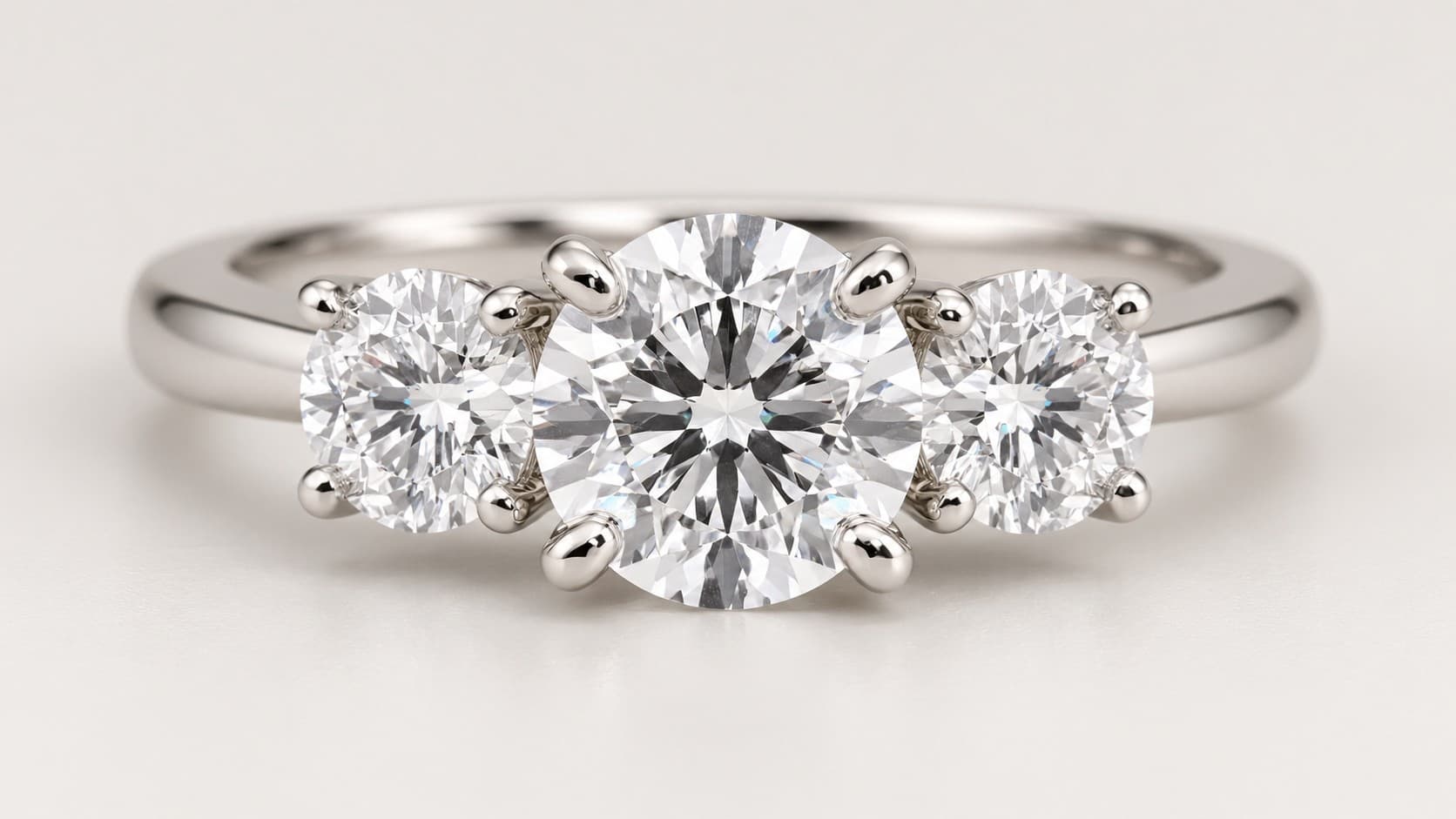
The metal band should complement the stone colors chosen. White gold or platinum tends to make diamonds and blue or white gemstones look brighter and cooler, while yellow gold warms up the same stones and pairs especially well with rubies or sapphires.
Cut consistency matters too. If all three stones share the same cut — all round, all cushion, all oval — the ring reads as more traditional and uniform. Mixing cuts creates a more custom, one-of-a-kind look, but it requires more careful matching by a jeweler to make sure the stones still look balanced sitting next to each other.
Getting the Sizing Right
A three-stone ring usually sits wider across the finger than a single-stone ring, since the band has to carry two extra stones on either side of the center one. That means someone used to wearing a solitaire in a certain size may find the same size feels snugger in a three-stone style, simply because more metal and more stone surface are sitting against the finger at once.
Jewelers generally recommend getting sized specifically for the three-stone ring being bought, rather than carrying over a size from an existing ring. Finger size can also shift slightly with temperature and time of day, so a sizing done later in the day, when fingers are a touch larger, tends to produce a more reliable fit.
What Affects the Price of a Three-Stone Ring?
Three-stone rings generally cost more than a single-stone ring of similar quality, simply because the buyer is paying for three gemstones instead of one. The exact price depends heavily on the size, quality, and type of stones chosen, along with the metal used for the band.
A three-stone ring with smaller, more affordable diamonds or gemstones can cost a few hundred dollars, while one with larger, high-quality diamonds can run into the tens of thousands. Independent grading reports, such as those from GIA or IGI, add to the overall cost but give a buyer a clear, third-party record of each stone’s carat weight, cut, and quality, which many buyers request on any three-stone ring with a significant center stone. Because three separate stones need to be selected and matched, buyers commonly ask a jeweler for a written cost breakdown of each stone before purchase, so the total price is clear upfront.
Cleaning and Maintaining a Three-Stone Ring
A three-stone ring needs regular cleaning with warm water, a small amount of mild dish soap, and a soft toothbrush to keep dirt from building up around and underneath each stone. Because there are three stones set close together, debris collects more easily than it does on a single-stone ring, especially underneath prongs and in the small gaps between stones.
Jewelers generally recommend having the ring checked once or twice a year to make sure none of the prongs have loosened. With three separate stones to secure, a three-stone ring has more prongs overall than a solitaire, and a single loose prong can put a stone at risk of falling out unnoticed. Storing the ring in its own compartment or pouch, rather than tossed in with other jewelry, also helps protect it, since the exposed edges of three stones sitting close together are more prone to chipping each other than a single centered stone would be.
Resizing is also more involved on a three-stone ring than on a solitaire. Stretching or shrinking the band changes the spacing between all three settings, not just one, so a jeweler has to adjust the metal carefully to keep the stones evenly aligned rather than simply cutting and resoldering the shank. For a significant size change, buyers are often advised to ask the jeweler upfront whether the ring can be resized without disturbing the side stone settings.
Frequently Asked Questions
Is a three-stone ring the same as a trilogy ring?
Yes. Three-stone ring, trilogy ring, and trinity ring all describe the exact same design: a center stone flanked by two smaller stones of matching size and cut.
Can a three-stone ring be used as a wedding band instead of an engagement ring?
Yes. While the style is best known for engagement rings, three-stone rings are also popular as anniversary gifts, right-hand rings, and stand-alone fashion rings with no romantic meaning attached at all.
Do the three stones have to be diamonds?
No. Diamonds are the most traditional and common choice, but sapphires, rubies, emeralds, and birthstones are all popular alternatives, either for all three stones or just the two side stones.
What does it mean if the side stones are bigger than the center stone?
There’s no fixed symbolic rule for this. It’s usually a stylistic choice that puts more visual weight on the “past” and “future” stones rather than the center “present” stone, and some wearers choose it specifically to shift that emphasis.
How do I know what carat weight to choose for each stone?
There’s no single correct carat weight — it depends on budget, hand size, and personal style. A jeweler can show the ring in person or via detailed photos at different carat combinations to help compare how the proportions look before committing to one.
The Bottom Line
A three-stone ring carries more flexibility than its popular “past, present, future” reputation suggests. The design itself is centuries old, dating back to the Georgian era, and the romantic meaning behind it is a relatively recent marketing story. The stones, settings, and proportions can all be adjusted to fit almost any budget or personal story a wearer wants to tell. Whether it’s chosen for an engagement, a family milestone, or simply because the layout is beautiful, the three-stone format remains one of the most adaptable styles in fine jewelry.