Most well-known watch brands build their watches with machines, even the expensive Swiss ones. Garrick does not. This small company works out of a single workshop in Norfolk, England, where a handful of watchmakers build every single watch by hand, one at a time, to order. That makes Garrick one of the few brands left anywhere in the world where the person who designs the watch and the person who assembles it work in the same room. For anyone curious about what modern British watchmaking actually looks like, Garrick is one of the clearest examples to study.
Garrick Watches: Brand History and Overview
Garrick is a British watch company founded in 2014 by David Brailsford and watchmaker Simon Michlmayr, based in a workshop in Norwich, Norfolk. It matters because it is one of the only companies still making watches almost entirely by hand in a country that used to lead the world in watchmaking before Switzerland took over in the 1800s.
Brailsford started the company because he wanted to see British watchmaking come back to life. For centuries, England was home to some of the greatest watchmakers in history, names like John Harrison, John Arnold, and Thomas Mudge. Then Swiss factories took over the industry in the 19th and 20th centuries, and British watchmaking all but disappeared. Garrick is part of a small wave of companies, alongside names like Bremont and Christopher Ward, trying to bring it back, though Garrick takes the handmade approach further than almost anyone else.
The company only makes between 50 and 70 watches a year. Every watch is built to order rather than pulled off a shelf, and buyers can choose their dial finish, metal, and sometimes the movement decoration too. That is a tiny number compared to a brand like Rolex, estimated to make around a million watches annually (the company does not publish exact figures), but it is exactly why collectors pay attention to Garrick.
Garrick’s first two watches, the Shaftesbury SM301 and the Hoxton SM302, launched in 2014 and used a modified vintage Unitas pocket watch movement fitted with the brand’s own free-sprung balance wheel, a feature normally reserved for far pricier watches. The workshop itself is built around the same obsession with control that goes into the watches. It runs under positive air pressure, meaning only filtered air is allowed in, which keeps dust away from delicate parts during assembly, the kind of setup more commonly associated with a semiconductor lab than a small shop in Norwich.
The Best Garrick Watches
Garrick’s lineup changes often because it is such a small operation, and some models get discontinued once a production run ends. Its range spans from accessible, relatively simple pieces to the brand’s most ambitious and technically complex watches, and includes one discontinued model that remains central to understanding how the company reached its current form.
Garrick S4
The S4 is Garrick’s most affordable watch and the easiest way into the brand. It uses a heavily modified ETA 6498 movement rather than Garrick’s own in-house calibre, which is why it costs thousands less than the brand’s flagship pieces.
Despite the lower price, the S4 still gets Garrick’s full hand-finishing treatment. The dial can be ordered with a frosted finish and a guilloche sub-dial, or a fully guilloche dial for a step up in detail, and the movement is decorated in-house in Norfolk even though the base parts come from Switzerland. A red guilloche-dial version of the S4 was even shortlisted as a finalist at the Grand Prix d’Horlogerie de Genève in 2021, one of watchmaking’s most respected awards, which is a serious achievement for an entry-level watch from a tiny workshop.
The S4 launched at £4,995 for the frosted dial version and £5,995 for the fully guilloche dial, and while prices have moved up a little since then, it remains Garrick’s cheapest route into the brand. Buyers can also choose a strap in alligator, calf, buffalo, or ostrich leather, a level of choice rarely available on a watch at this price point.
Garrick S6
The S6 sits next to the S4 as another accessible option, launched in 2023 to widen Garrick’s entry-level range. It comes in a 42mm stainless steel case made in England, with a sapphire crystal and a see-through caseback that reveals the movement at work.
Its movement, called the BF03, is also a modified ETA 6498, built with 19 jewels, beating at 21,600 vibrations an hour and holding a power reserve of roughly 50 hours, noticeably longer than the standard 46 hours found on an unmodified ETA 6498. The case is water-resistant to 100 metres, which is unusually tough for a dress-style watch. Garrick also offers the S6 in precious metal cases for buyers who want something beyond steel, though that pushes the price well past the standard starting point of around £5,400 before tax.
Garrick S2 Deadbeat Seconds
The S2 is where Garrick moves into serious, high-end territory. It uses the brand’s own Calibre DB-G06 movement, built entirely around a feature called deadbeat seconds, where the seconds hand jumps crisply from one second to the next instead of sweeping smoothly, mimicking the tick of an old clock.
The S2 was the first Garrick watch to feature a deadbeat seconds complication, and the brand describes it as among the most beautiful timepieces it has made.
Every visible part of the S2’s movement is hand-finished, including the Trinity balance wheel made from Sircumet, a non-magnetic metal alloy that Garrick developed specifically for its own movements. The dial is engine-turned by hand using a technique called guilloche, which creates a fine repeating pattern using an old-fashioned machine operated manually, and buyers can choose between faceted lancine or anchor-style hands for the finished look. Pricing sits around £20,000 before tax, reflecting the amount of hand labour involved.
Garrick S3
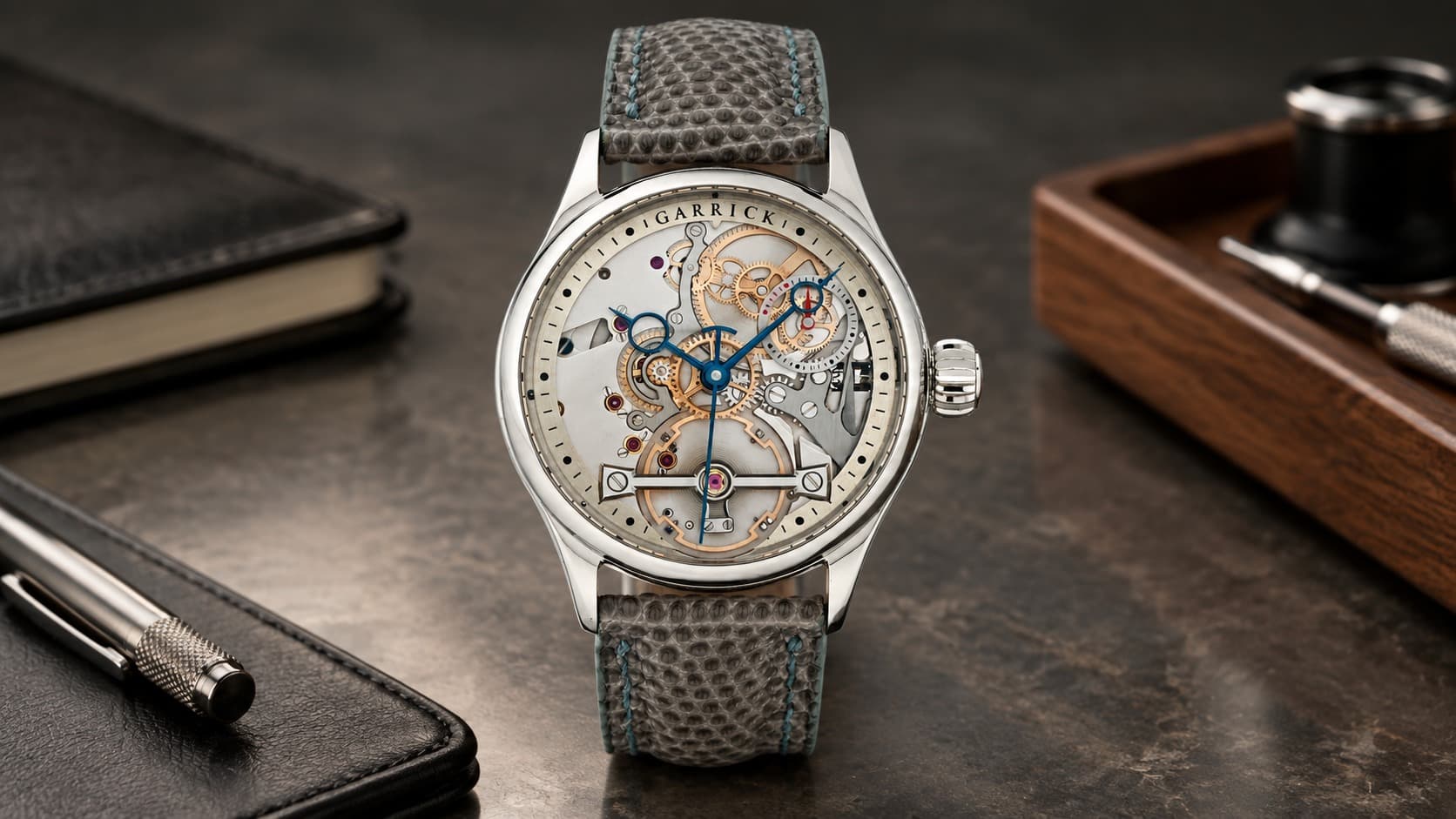
The S3 is Garrick’s most technically complicated watch to date. Its dial is openworked, meaning parts of it are cut away to expose the moving gears underneath, and the mainplate beneath it is carved with recesses to hold all the extra components needed to make that work.
Garrick first released the S3 in 2020 at roughly £24,160 before tax (about £28,995 including UK VAT), and the model has since been updated to the current S3 MK2, which uses the in-house Calibre UT-G04 with 19 jewels and a 45-hour power reserve, now priced at £32,450 before tax. Garrick builds only around five S3 watches a year because each one takes roughly five months to finish. At the very top of the S3 family sits the S3 Deadbeat Seconds, a more extreme version with an almost dial-less, fully openworked face and a jumping seconds hand. Its price has climbed since launch and varies by listing and case metal, running upward of £40,000 before tax and into six figures in US dollars at some retailers, making it the most expensive watch Garrick currently offers. Even at the lower end of that range, it remains well below what comparable hand-finished, openworked watches cost at the big Swiss houses.
Garrick S7
The S7 is a smaller, more wearable option in Garrick’s current lineup, built in a 38mm case rather than the 42mm size used across most of the brand’s other watches. It comes in a range of dial colours, including black, red, blue, rhodium, and pink gold tones.
Like the rest of the S-series, the S7 is finished entirely by hand in the Norfolk workshop, with dial and movement options that let buyers personalise the watch during the ordering process. Its movement, the Calibre BF04, is a heavily modified vintage movement built with 19 jewels, running at 21,600 vibrations an hour and tested to within five seconds a day of accuracy, and the case carries 100 metres of water resistance despite the watch’s dressy look. Starting price is around £7,500 before tax, making it one of Garrick’s more affordable in-house-finished options alongside the S4 and S6, and its smaller case size makes it a good choice for anyone who finds Garrick’s standard 42mm watches too large for their wrist.
Garrick Regulator MK II
The Regulator MK II is a modern take on an old clockmaking idea. A regulator clock separates the hours, minutes, and seconds onto different parts of the dial rather than stacking them on one set of hands, a layout originally used in clocks built to keep reference time for other clocks.
Garrick’s version puts its Trinity free-sprung balance wheel directly on the dial at six o’clock, where it is visible swinging back and forth as the watch runs. It is powered by the in-house Calibre UT-G02, a 19-jewel hand-wound movement with a 45-hour power reserve, built with help from Swiss watchmaker Andreas Strehler’s company. The case measures 42mm across and 10mm deep, with 22mm lugs and a sapphire caseback so the movement stays on display, and dial colours include black, burgundy red, and a deep jeans blue alongside the standard silver and gold options. Garrick limits the Regulator MK II to around 10 pieces a year, and prices start near £9,995 before tax for a frosted dial, rising to roughly £10,995 for the engine-turned version.
Garrick Norfolk
The Norfolk is one of Garrick’s earlier, more traditional designs, and it leans hard into Britain’s maritime history. Its most recognisable feature is a large nameplate across the dial, inspired by old ship instruments that displayed their maker’s name on a brass or steel plate.
The watch uses a 42mm case built locally in Norfolk, paired with a hand-wound Unitas 6497 movement finished to Garrick’s standards, and was designed in partnership with freelance designer Michael Horlbeck. Its dial is made from solid silver and coated in fired enamel on both sides, a traditional technique that prevents the dial from warping in the kiln, and it is paired with Garrick’s own blued “maritime” hands shaped like small anchors. The Norfolk is also Garrick’s most accessible watch by a wide margin, priced between roughly £2,295 for a plain caseback version and £2,795 for the exhibition caseback with a better-finished movement, which makes it one of the few genuinely handmade British watches available for under £3,000. It remains one of the clearest examples of Garrick’s design philosophy: take something historical and give it a modern, hand-finished execution.
Garrick Portsmouth (Discontinued)
The Portsmouth is no longer in production, but it is the watch that changed what Garrick was capable of. Launched in 2016, it was the first Garrick model built around the company’s own movement rather than a modified Swiss one.
That movement, the Calibre UT-G01, came out of a partnership with Swiss independent watchmaker Andreas Strehler, whose company supplied base components that Garrick’s own team then finished, assembled, and regulated in Norfolk. The case was 42mm of 904L stainless steel, a grade more resistant to corrosion and scratching than the 316L steel most watch brands use, and it was designed in collaboration with Michael Horlbeck, the same freelance designer behind the Norfolk. When it sold, the Portsmouth was priced at £14,995 before tax, and every Calibre since, from the UT-G02 in the Regulator MK II to the UT-G04 in the S3, traces its roots back to this one watch.
Garrick Watch Buying Process Explained
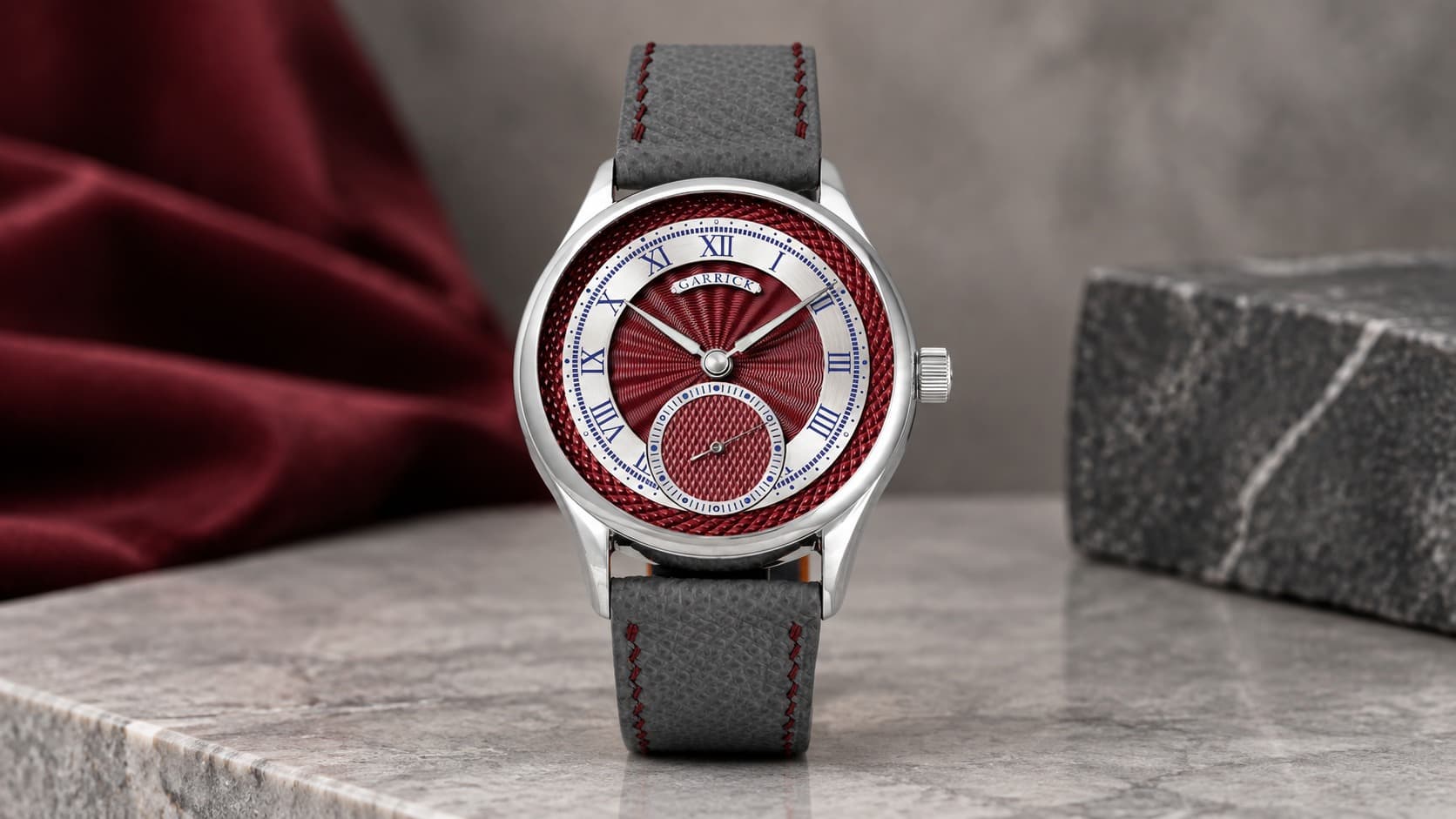
Garrick does not sell through a cart-and-checkout website the way most retailers do. Every order begins with a direct conversation between the buyer and the company about the exact specification wanted, and a deposit of 65 percent of the price is required before Garrick starts building.
Build times vary enormously depending on the model. Simpler watches can take a few months, the S3 takes around five months because of how intricate its openworked dial is, and the S2 Deadbeat Seconds can take close to a year, sometimes stretching toward 18 months when Garrick’s order book is full. Founder David Brailsford has explained that the brand deliberately avoids a simple online configurator, since the number of possible combinations of case metal, dial finish, hands, and movement decoration is too large to present as a dropdown menu, and customers often change their minds on details between placing an order and the watch actually arriving.
Warranty terms have varied across Garrick’s history and sales channels. Garrick’s own listing for the discontinued Portsmouth cited a five-year warranty, and one authorized retailer advertises the same five-year term, while other listings reference a two-year manufacturer warranty with an additional year added by the retailer. Given that inconsistency, buyers are better off confirming the exact warranty length directly with Garrick or the retailer at the time of ordering rather than assuming a fixed term.
How Much Does a Garrick Watch Cost?
Garrick watches range from about £2,295 for the simplest Norfolk model to around £40,000 for the flagship S3 Deadbeat Seconds, with most of the brand’s core lineup landing somewhere between £5,000 and £20,000. Because every watch is built to order, the final price depends heavily on the case metal, dial finish, and movement decoration a buyer chooses, so two examples of the same model can carry noticeably different price tags.
| Model | Movement | Case Size | Starting Price (approx.) |
|---|---|---|---|
| Norfolk | Unitas 6497 (modified) | 42mm | £2,295–£2,795 |
| S4 | Modified ETA 6498 | 42mm | £4,995–£5,995 |
| S6 | Modified ETA 6498 (BF03) | 42mm | £5,400+ |
| S7 | Modified vintage calibre (BF04) | 38mm | ~£7,500 |
| Regulator MK II | In-house UT-G02 | 42mm | £9,995–£10,995 |
| S2 Deadbeat Seconds | In-house DB-G06 | 42mm | ~£20,000 |
| S3 MK2 | In-house UT-G04 | 42mm | ~£32,450 |
| S3 Deadbeat Seconds | In-house DB-G07 | 42mm | £40,000+ |
These figures are approximate and change as Garrick updates its pricing or releases new dial and metal options. Different sources also quote some of these prices with or without VAT included, so the true cost can shift depending on the buyer’s location and the retailer involved, and anyone seriously considering a purchase should confirm current pricing directly with the brand.
Why Garrick Is Different From Other Watchmakers
Garrick builds as much of each watch in-house as it realistically can, which is rare for a company this small. Most tiny watch brands buy finished movements from Switzerland and simply put their name on the dial, but Garrick’s own Calibre UT-G01 through UT-G04 movements were developed with Swiss watchmaker Andreas Strehler and are substantially finished, assembled, and regulated by hand in Norfolk.
The brand’s Trinity balance wheel is a good example of this approach. It is made from Sircumet, a non-magnetic alloy that Garrick uses specifically because magnetism is one of the most common reasons mechanical watches lose accuracy over time. Building a custom alloy just for a balance wheel is the kind of detail only a brand this focused on long-term craftsmanship bothers with, since it adds cost and complexity without changing how the watch looks on the wrist.
Garrick also makes many of its cases, dials, and hands locally rather than importing finished parts. Because the company only builds a small number of watches each year, it can afford to spend far more time on each individual piece than a factory that needs to produce thousands of identical watches. That is really the whole story behind Garrick: slower, smaller, and far more hands-on than almost anything else being made today.
Frequently Asked Questions
Are Garrick watches handmade?
Yes. Garrick builds every watch to order in its Norfolk workshop, with case parts made locally and movements assembled, finished, and regulated by hand rather than by machine.
Who owns Garrick watches as a company?
Garrick was founded by David Brailsford and watchmaker Simon Michlmayr in 2014, and the company remains an independent British watchmaker based in Norwich, Norfolk.
How many watches does Garrick make per year?
Garrick produces somewhere between 50 and 70 watches a year across its entire range, making it one of the smallest watch manufacturers in the world by volume.
What is the cheapest Garrick watch?
The Norfolk is Garrick’s most affordable model, starting around £2,295 before tax, thanks to its simpler modified Unitas movement. For buyers wanting more of Garrick’s proprietary dial finishing, the S4 is the next step up, typically starting around £4,995.
Does Garrick use Swiss parts in its watches?
Yes, for some models. Entry-level watches like the S4 and S6 use modified ETA movements from Switzerland, while higher-end models use Garrick’s own in-house movements, which were originally developed in partnership with Swiss watchmaker Andreas Strehler.
The Bottom Line
Garrick’s lineup spans a wide gap, from the relatively accessible S4 and S6 to the genuinely complex S3 and S2, but every watch in between shares the same core idea: build it slowly, build it by hand, and build it in England. That approach will not suit anyone looking for a big, well-known logo on their wrist, but for collectors who care about where a watch actually comes from and who actually touched it, Garrick remains one of the most honest stories in modern watchmaking. For collectors who value British craftsmanship and genuine hand-finishing over brand recognition, Garrick is worth far more attention than its small production numbers would suggest.