Perfume counters today are full of one recurring phrase: skin scent. It sounds like an odd thing to sell, since everyone already has skin, and skin already has a scent. But the phrase describes one of the biggest shifts in fragrance in years. Instead of a perfume built to fill a room, people are increasingly choosing scents designed to barely leave the body at all — something that smells like a cleaner, warmer version of the wearer, rather than something layered on top of them. That shift didn’t happen by accident, and it says a lot about how fragrance, and personal style more broadly, has changed.
What Does “Skin Scent” Mean?
A skin scent is a fragrance built to sit close to the body instead of spreading through a room. It blends with a person’s natural body odor rather than covering it up, so the final result feels personal instead of like a cloud of perfume.
This is different from how perfume worked for most of the last century. Classic fragrances were often designed for sillage, the technical term for how far a scent trail travels away from the wearer. A big, sillage-heavy perfume announces itself the moment someone enters a room. A skin scent does the opposite. It stays quiet until someone leans in for a hug or sits close beside the wearer, and only then does it register. Perfumers sometimes describe this as the “skin, but better” effect, because the goal isn’t to smell like flowers or fruit — it’s to smell like an improved, warmer version of a person’s own natural scent.
“Skin scent” isn’t an official fragrance category with strict rules. It can describe a specific perfume marketed as soft and close-wearing, a note (like musk) that naturally behaves that way, or an alcohol-free oil format that physically can’t project far. Most fragrances labeled as skin scents share two traits: a musk-forward base, and a lighter reliance on the sharp, loud top notes — strong citrus bursts or aggressive spice — that normally push scent out into a room.
Why the Same Perfume Smells Different on Different People
A skin scent rarely smells identical on two different wearers, and that inconsistency is part of the appeal. It reacts with each person’s individual skin chemistry, so the final result becomes somewhat unique to whoever is wearing it.
Skin has its own natural oils, pH level, and warmth, and all three affect how a fragrance develops after application. A strong, heavily-layered perfume can mostly override those differences. A lighter skin scent cannot, because it is built to blend rather than dominate. That is why one person’s “signature scent” can smell remarkable on them and far more muted on someone else — the two people aren’t smelling quite the same thing, since each wearer’s skin is altering it slightly. Fans of skin scents generally treat this as a feature rather than a flaw, since it turns a mass-produced bottle into something that reads as personal rather than interchangeable.
Musk and Ambroxan: The Key Ingredients
Two ingredients show up in nearly every skin scent, and they are the reason the category exists at all: musk and a molecule called ambroxan.
Musk: The Clean Skin Note
Musk notes form the backbone of most skin scents because they create a warm, soft, slightly powdery smell that reads as “clean” rather than “flowery” or “sweet.” Centuries ago, musk came from a gland in male musk deer, but that practice is now banned or heavily restricted in most of the world for animal welfare reasons. Nearly all musk used in fragrance today is created synthetically in a lab, and modern versions are designed specifically to be gentle, skin-hugging, and long-lasting without any animal source involved.
Within synthetic musks, “white musk” is the term most closely associated with skin scents specifically. It leans softer and more laundry-clean than deeper, more animalic musk variations, which is why it shows up so often in fragrances marketed as fresh-out-of-the-shower or barely-there. Perfumers often pair it with a related note, ambrette, which comes from a seed rather than a lab compound and adds a faint, slightly fruity warmth on top of that same clean-skin feeling.
Ambroxan: The Skin Scent Molecule
Ambroxan is a synthetic ingredient known for a particular trick: it makes a fragrance seem to come from a person’s own body rather than from something applied to the surface of it. Chemically, it is related to ambergris, a rare substance that forms in the digestive systems of sperm whales and was historically prized — and expensive — for its warm, salty smell. Scientists eventually found a way to recreate that same effect using sclareol, a compound found in clary sage plants, making the smell available without involving whales at all.
What makes ambroxan distinctive is how it behaves on skin. It doesn’t add a strong smell of its own so much as amplify everything around it — a citrus note lasts longer, a floral feels warmer, a musk feels closer to the body. Fragrance chemists refer to this as a diffusion effect: the scent carries slightly further into the air without becoming louder or heavier close-up, which is exactly the balance a skin scent needs.
A notable quirk of ambroxan is that some people cannot smell it at all, due to a small genetic difference in how their sense of smell works. That is a real reason a skin scent can seem to “do nothing” on some wearers — part of the composition may be genuinely invisible to them.
Other Notes: Soft Woods and Iris
Musk and ambroxan carry most of the effect, but a few other notes commonly round out skin scents. Soft woods like sandalwood and cedar add a creamy, low-key warmth without introducing any sharp or smoky edge, keeping the composition from feeling heavier than intended. Iris tends to be used more sparingly, contributing a smooth, powdery quality that blends easily with musk rather than competing with it. None of these notes are unique to skin scents on their own, but combined at a light hand, without heavy top-note interference, they reinforce the same soft, close-to-body character.
How Fragrance Concentration Affects a Skin Scent
Ingredients are not the only reason a fragrance stays close to the skin — how it is mixed matters just as much. Fragrance is sold in different concentrations, and each one changes how far a scent is able to travel.
Eau de toilette usually holds around 5–15% fragrance oil dissolved in alcohol, eau de parfum holds roughly 15–20%, and extrait de parfum can reach up to 40%. The alcohol in these formulas evaporates quickly and carries scent molecules into the air, which is what creates a noticeable trail. Perfume oils work differently. They are usually alcohol-free, blending fragrance oil directly with a carrier oil instead, and without alcohol to lift the scent outward, they stay much closer to the skin and tend to develop slowly over several hours.
This is why many newer skin scent products are sold as oils, rollerballs, or solid balms rather than traditional sprays. The format itself is built to behave the way the name promises, rather than it being purely a marketing choice. A spray can still qualify as a skin scent if it is formulated with a light hand and musk-heavy base notes, but an alcohol-free oil achieves that effect almost automatically.
Why Skin Scents Are So Popular Right Now
No single event created the skin scent trend. It grew out of several shifts that all pointed toward the same idea: quieter fragrance was becoming more desirable than loud fragrance.
People Got Tired of Loud Perfume
For a long time, a “good” perfume was judged by how far it traveled and how long it lingered in a room after someone left. That standard has softened considerably. Heavy, overpowering fragrance has become less welcome in shared spaces like offices, public transport, or small restaurants, shifting demand toward scents that read as pleasant up close rather than announcing themselves down a hallway.
Minimalism Moved Into Fragrance
The same “quiet luxury” mindset that reshaped clothing and interior design — fewer logos, simpler shapes, softer colors — eventually reached the perfume counter. A subtle, skin-like fragrance fits that aesthetic more naturally than a bold, statement scent, since it signals restraint rather than an attempt to impress.
Changing Layering Habits
Rather than relying on one strong, do-everything perfume, many wearers now layer a light skin scent underneath a primary fragrance, or wear it entirely on its own for a more low-key effect. Because skin scents are gentle by design, they mix easily with lotions, hair products, or other scents without clashing.
How Social Media Fueled the Trend
Phrases like “skin but better” and “clean girl perfume” spread quickly across social platforms, giving a name to something wearers already wanted but had no simple way to describe. Once the phrase existed, it became easy to search, recommend, and compare, pushing skin scents from a niche preference into a mainstream shopping category in a short span of time.
Skin Scent vs. Traditional Perfume
| Skin Scent | Traditional Perfume | |
|---|---|---|
| How far it travels | Stays close to the body | Fills a room (strong sillage) |
| Main ingredients | Musk, ambroxan, soft woods | Often heavier florals, sweets, or spices |
| How it changes person to person | Noticeably, due to skin chemistry | Less noticeably |
| Best suited for | Everyday wear, close contact, layering | Making a strong entrance |
| Typical longevity | Often shorter projection, though base notes can last hours | Can project for many hours |
Popular Skin Scent Perfumes Worth Knowing
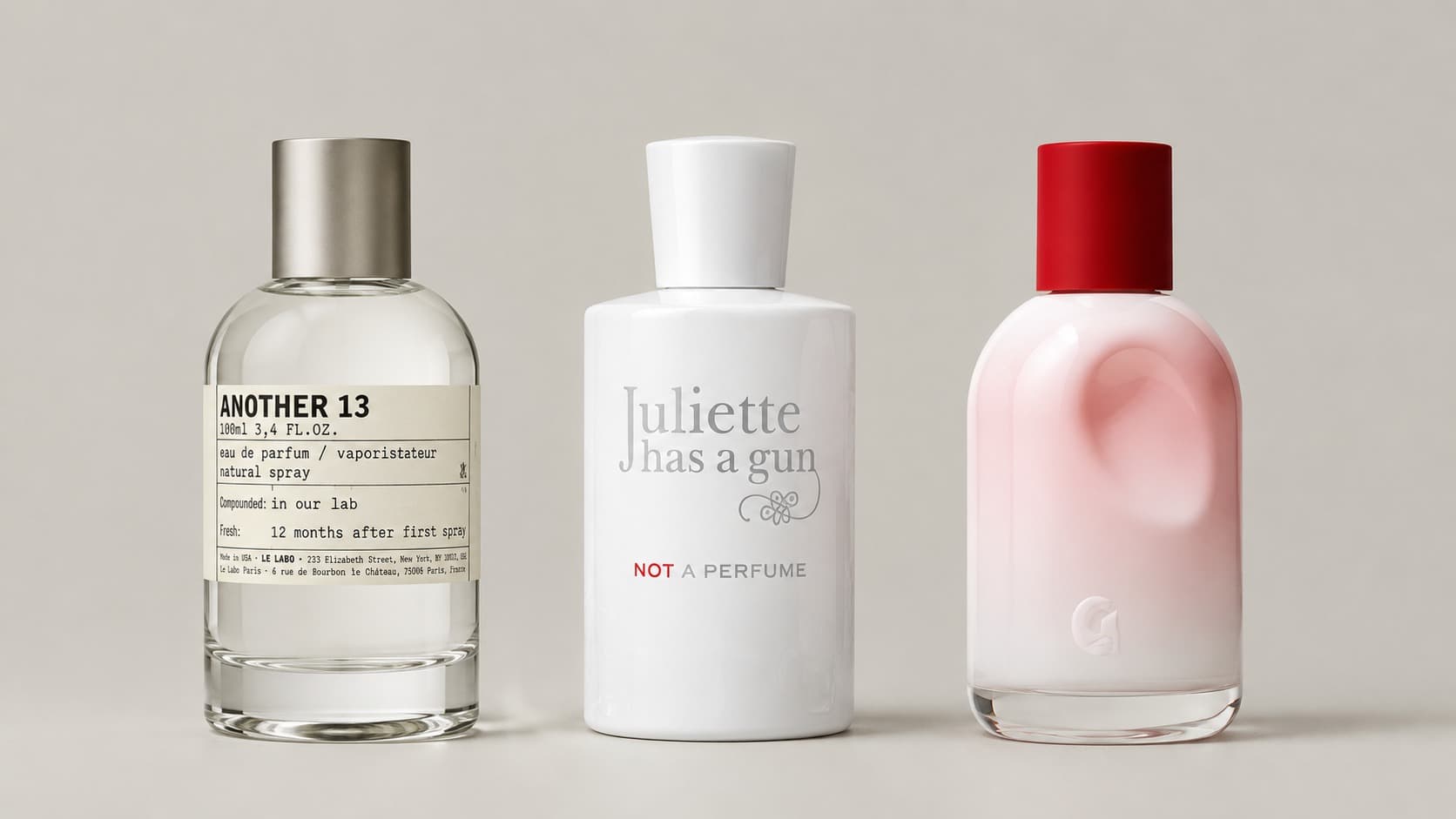
Five perfumes are named most often when the trend comes up: Glossier You, Le Labo Another 13, Juliette Has A Gun Not A Perfume, Escentric Molecules Molecule 01, and Byredo Blanche. Three of them are built around one or two lab-made molecules, while the other two rely on a short blend of soft notes, yet all of them are designed to stay close to the body. This selection reflects how often the perfumes appear in fragrance coverage, not sales figures, because brands do not publish comparable numbers.
Glossier You
Glossier You is a soft, skin-hugging perfume built on pink pepper, ambrette, iris, ambrox, and musk. Glossier, a beauty brand, released it in 2017 as its first fragrance. Ambrox is a close relative of the ambroxan described earlier, and it gives the base a warm, lightly salty feel.
Pink pepper adds a faint spice at the start, while iris keeps the scent earthy instead of sweet. Because the formula is so gentle, it blends with each wearer’s skin and smells slightly different from person to person, which is the core idea behind the whole category.
Le Labo Another 13
Le Labo Another 13 is one of the clearest real-world examples of the ingredients described above, since it is built mostly on ambroxan and white musk. Le Labo co-founder Fabrice Penot has said those two materials make up about 90 percent of the formula. Retailer descriptions add pear, apple, ambrette, moss, and jasmine, and reviewers often say it projects more than a typical skin scent, which places it at the louder end of the category.
The perfume started as a collaboration with AnOther Magazine and first appeared in a limited run of 500 bottles at the Paris store Colette. It reached all Le Labo stores only after Colette closed in 2017.
Juliette Has A Gun Not A Perfume
Not A Perfume contains a single scent ingredient, a lab-made molecule called Cetalox that is closely related to ambroxan. Romano Ricci, the founder of Juliette Has A Gun, launched it in 2010. With nothing else in the formula, the smell stays simple: clean, lightly woody, and warm, much like washed skin or fresh laundry.
Some wearers find it slightly synthetic, which is the trade-off of a one-molecule design. Others say its simplicity makes it easy to layer under other fragrances.
Escentric Molecules Molecule 01
Molecule 01 is built around Iso E Super, a different lab-made ingredient from ambroxan, with a smooth, cedar-like warmth. Iso E Super was developed in a laboratory at the fragrance company IFF in 1973, and perfumer Geza Schön built the fragrance around it, which launched in 2006.
The brand describes the effect as a scent that hovers near the skin and seems to fade and return, because the molecule releases slowly. Like Not A Perfume, it shows how a fragrance can be defined by a single material instead of a traditional blend of notes.
Byredo Blanche
Blanche takes a different route: it is clean and soapy instead of woody or molecular. The idea came from Byredo founder Ben Gorham, who wanted to capture the color white in scent. It opens with white rose, pink pepper, and aldehydes, moves through violet, orange blossom, and peony, and settles into light woods, sandalwood, and musk.
The result is often compared to fresh laundry and soap. That makes Blanche a useful reminder that a skin scent can lean floral and still stay close to the body.
How to Make a Skin Scent Last Longer
Because skin scents are subtle by nature, a handful of factors determine whether they perform well or fade into nothing.
- Pulse points such as the wrists and neck tend to work best, since body heat in those areas helps release the scent gradually through the day.
- Moisturized skin holds fragrance better than dry skin, so an unscented lotion applied beforehand often extends how long a skin scent lasts.
- Light application suits the format. Skin scents are meant to be discovered up close rather than detected from across a room, so two or three applications are typically sufficient.
- Layering with a bolder fragrance can add depth without losing the soft, close-to-skin character that defines the category.
Frequently Asked Questions
Are skin scents the same as unscented deodorant?
No. Unscented deodorant is designed to have little to no smell at all, while a skin scent is a genuine fragrance — it simply projects less and blends with the wearer’s natural scent instead of covering it completely.
Do skin scents last as long as regular perfume?
It depends on the formula. Many skin scents rely on long-lasting base notes like musk and ambroxan, so while they may not project far, they can still linger close to the skin for several hours.
Why do some people struggle to smell their own skin scent, even when others compliment it?
This can happen for two reasons. The nose can become accustomed to a smell worn constantly, a process called olfactory fatigue, and some people are also genetically less able to detect ambroxan, a common ingredient in skin scents.
Are skin scents good for sensitive skin?
Not automatically. “Skin scent” describes how a fragrance behaves, not its ingredient safety. Anyone with sensitive skin should still check the ingredient list and patch-test a new fragrance the same way they would with any other perfume.
Do skin scents work for men as well as women?
Yes. Skin scents are not marketed to one gender — musk and ambroxan appear across men’s and women’s fragrances alike, and the clean, close-to-skin effect works the same regardless of who wears it.
The Bottom Line
Skin scents are not a marketing gimmick dreamed up overnight. They are the result of real shifts in what wearers want from fragrance, built on real ingredients like musk and ambroxan that are engineered to blend rather than broadcast. The trend caught on because it solves an actual problem: not everyone wants to be smelled from across a room, and many people would rather smell like an improved version of themselves than like a cloud of someone else’s idea of “perfume.” Whether skin scents remain dominant or eventually give way to something bolder, they have already reset the standard by which a “good” fragrance gets judged — and that shift, from loud to close, shows little sign of reversing.