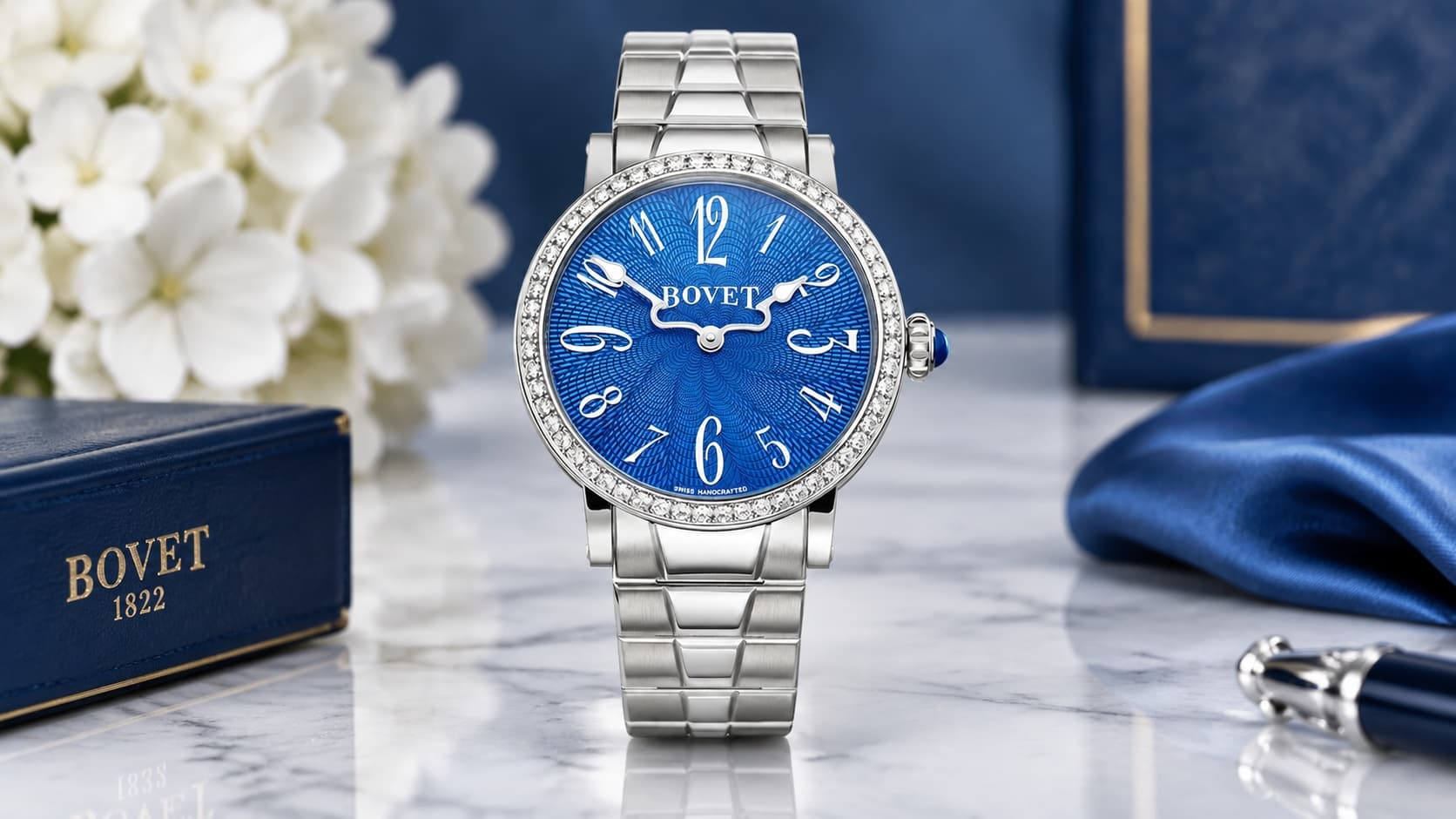
Bovet Fleurier is one of the oldest names in Swiss watchmaking, yet it stays quiet compared to giants like Rolex or Omega. That’s partly because the brand never chased mass production. Instead, it built its reputation on hand-painted dials, secret mechanical tricks, and a case that can turn a wristwatch into a pocket watch without a single tool. Anyone curious about serious, artistic watchmaking eventually runs into the Bovet name, and understanding what the brand actually does helps explain why collectors and museums still talk about it two centuries later.
Why Collectors Value Bovet Fleurier Watches
Bovet Fleurier stands out because of its patented Amadeo case and its focus on hand-decorated dials rather than mass-market designs. The brand builds almost everything in-house, from movements to enamel paintings, in a small workshop housed inside an actual 14th-century castle in Switzerland.
Most watch brands pick one lane: sports watches, dress watches, or complicated mechanical pieces. Bovet tries to do all three inside a single case design. A single Bovet watch can be worn on the wrist, flipped over to show a second face, detached and carried in a pocket, or set on a desk as a small clock. That versatility, paired with old-world artistic techniques like miniature painting and hand engraving, is what separates Bovet from almost every other manufacturer working today.
Scale is another part of the story. Rather than chasing volume, the workshop turns out only a few hundred to under two thousand pieces a year, and a large share of those are custom orders built for a single client instead of repeated across a catalog. A notable share of the people doing the painting and engraving are women, a detail that stands out in an industry historically dominated by men, and it says something about how much of Bovet’s output depends on individual artistic skill rather than assembly-line production. The brand is also credited as one of the first to put a transparent panel on the back of a pocket watch, letting owners see the moving parts inside long before that became a common feature across the industry.
The Story Behind Bovet Fleurier
Bovet was founded in 1822 in London by Édouard Bovet, a Swiss watchmaker who saw an opportunity most European brands ignored: China. Born in the small Swiss village of Fleurier, Édouard trained under his father before traveling to London to study watchmaking with two of his brothers.
In 1818, Édouard sailed to Canton, China, working for a British trading firm as a watch repairer. He brought four pocket watches with him and sold them for a huge sum of money at the time. That sale alone was worth roughly the equivalent of a million dollars in today’s money, and it convinced Édouard that Chinese buyers wanted exactly what Bovet could make.
The brothers split responsibilities across three locations to make the plan work. Édouard ran the Chinese side of the business from Canton, two of his brothers, Alphonse and Frédéric, worked out of England to handle shipping and correspondence, and a third brother stayed behind in Fleurier to run the actual watchmaking. This global setup was unusual for the era and let Bovet ship enamel-painted, pearl-decorated pocket watches straight to Chinese merchants, who often accepted them as a form of currency instead of cash.
The brand’s fortunes rose and fell over the following century. Demand cooled as the Opium Wars disrupted trade routes, French and American watchmakers moved into the same market, and knockoffs of Bovet’s own watches began circulating widely. Facing that pressure, the family sold the business in 1864 to a group of its own manufacturing inspectors. By around 1950, the Bovet name had all but vanished from watchmaking, and it stayed dormant for decades until a small group brought it back as an independent brand in 1997.
The modern chapter began when Swiss entrepreneur Pascal Raffy stepped in and bought the brand in 2001, steering it away from ordinary production toward one-of-a-kind, artistic pieces. In 2007, he went a step further and bought back the family’s own château, a property the Bovets had once called home, and reestablished the brand’s physical base in the village of Môtiers, where its headquarters remain today.
Raffy spent the following decade adding pieces to the business rather than pausing after that first purchase. A 2004 deal gave Bovet a minority interest in another complications workshop, and two years later he took full ownership of a small manufacturing firm in Tramelan that would go on to operate as the Dimier 1738 workshop, supplying many of the movements found in Bovet’s watches today. Ownership shifted again in 2012, when DKSH — the firm that had long handled Bovet’s distribution across Asia — came in as a minority shareholder, tying the company more formally to the region where its story began two centuries earlier. The following year, Bovet dropped “Fleurier” from its branding and started operating under the name Bovet 1822, a direct nod to its founding date.
Best Bovet Fleurier Watch Collections
Bovet organizes its watches into a handful of collections, each shaped by a different priority, from hand-painted artwork to competition-level mechanics.
Amadeo Fleurier
The Amadeo Fleurier collection is built around the brand’s signature convertible case, and it best represents the artistic, old-world side of Bovet. These watches usually feature hand-painted miniature scenes, guilloché dials, or engraved gold surfaces, all wrapped inside a case that converts between wristwatch, pocket watch, and table clock.
Because so much handwork goes into each dial, no two Amadeo Fleurier pieces look quite the same, even within the same reference number. This collection suits someone who wants a wearable piece of decorative art rather than a purely tool-like sports watch.
Récital
The Récital line, produced under Bovet’s Dimier workshop, is where the brand shows off its most complicated mechanics. Grand complications, astronomical displays, and unusual dial layouts live here, including the Récital 22 Grand Récital, which won the prestigious Aiguille d’Or at the Grand Prix d’Horlogerie de Genève in 2018 — essentially the watch industry’s biggest award.
Récital watches tend to prioritize function and technical achievement over painted artwork, though Bovet’s decorative touches still show up in the finishing and engraving. Collectors who care about horological complexity, like moon phases, world timers, or multi-axis tourbillons, usually gravitate toward this line. The Récital models are numbered rather than named, so the Récital 22, Récital 20, and others each represent a different combination of complications rather than a simple upgrade in sequence.
Virtuoso
The Virtuoso series sits inside the Fleurier collection and pushes the Amadeo case to its technical limit. The Virtuoso IX, for example, combines a double-face flying tourbillon with two time zones, a large date display, and a ten-day power reserve, all inside the same convertible case used across the Fleurier range.
These watches are built for people who want the Amadeo party trick — wristwatch to pocket watch to desk clock — combined with genuinely advanced watchmaking underneath the dial. Earlier Virtuoso models used Bovet’s first fully in-house movement, built by the Dimier manufacture that Pascal Raffy purchased along with Bovet in 2001.
Pininfarina Sportster
Not every Bovet watch looks like a museum piece. The brand partnered with the Italian design house Pininfarina, known for shaping Ferrari sports cars, to create a sportier collection aimed at buyers who want Bovet’s quality without the ornate, historic styling.
The Sportster models use steel and titanium cases, bolder proportions, and simpler dials compared to the Fleurier and Récital lines. This is usually the entry point for people who like the brand’s story but want a watch they can wear casually, day to day.
That collaboration began in 2007, and it produced one of Bovet’s more unusual pieces in 2010: the Pininfarina Ottantasei, built to mark eight decades since Pininfarina’s founding. Instead of hiding the mechanics behind a solid case, the design uses sapphire crystal across nearly every surface — front, back, and sides — so the tourbillon and power reserve mechanism stay visible no matter which way the watch turns. It sums up what the Pininfarina line is going for: Bovet’s engineering wrapped in a look borrowed from car design instead of historic dial art.
19Thirty
The 19Thirty collection is Bovet’s tribute to 1930s watch design, built around a rounder, more classic dress-watch case shape rather than the convertible Amadeo. These pieces skip the pocket watch transformation and focus purely on elegant wrist-wearing, often featuring detailed guilloché patterns on the dial.
It’s a good option for someone who loves Bovet’s craftsmanship but wants a simpler, more traditional daily watch rather than a multi-function showpiece.
How Bovet Creates Its Hand-Painted Dials
Bovet’s miniature-painted dials take an average of about 40 hours of an artisan’s time to complete, and the process is closer to fine art than typical watch manufacturing. Painters usually work on a mother-of-pearl base, since its natural shimmer makes finished portraits, animals, or floral scenes look more alive under light.
That work starts with a design problem: source images are almost always rectangular, while a Bovet dial is round and interrupted by a hole at the center for the hands, so an artist has to work out how to adapt the scene to that shape before any paint goes down. After painting, the dial often gets several thin layers of lacquer, sometimes using techniques adapted from traditional Chinese lacquerwork, followed by drying, smoothing, and polishing until the surface reaches full brilliance. Some of the most elaborate pieces, such as full-scene horse or wildlife portraits, can take well over 100 hours of combined painting and lacquering.
Because every dial is painted freehand, no two finished watches are ever perfectly identical, even when they’re built to the same design brief. That’s part of why Bovet describes many of its artistic pieces as one-of-a-kind rather than standard production models.
Notable Bovet Fleurier Models to Know
Bovet’s catalog includes many one-off and limited pieces, but a handful of models define the brand’s reputation and turn up repeatedly in discussions of its history and craftsmanship.
- Récital 22 Grand Récital — An astronomical showpiece that won the Aiguille d’Or, the top overall prize, at the 2018 Grand Prix d’Horlogerie de Genève. It’s often cited as the clearest proof of Bovet’s technical ambition.
- Virtuoso IX — A double-faced Fleurier model combining a flying tourbillon, two time zones, and a ten-day power reserve, all inside the Amadeo convertible case.
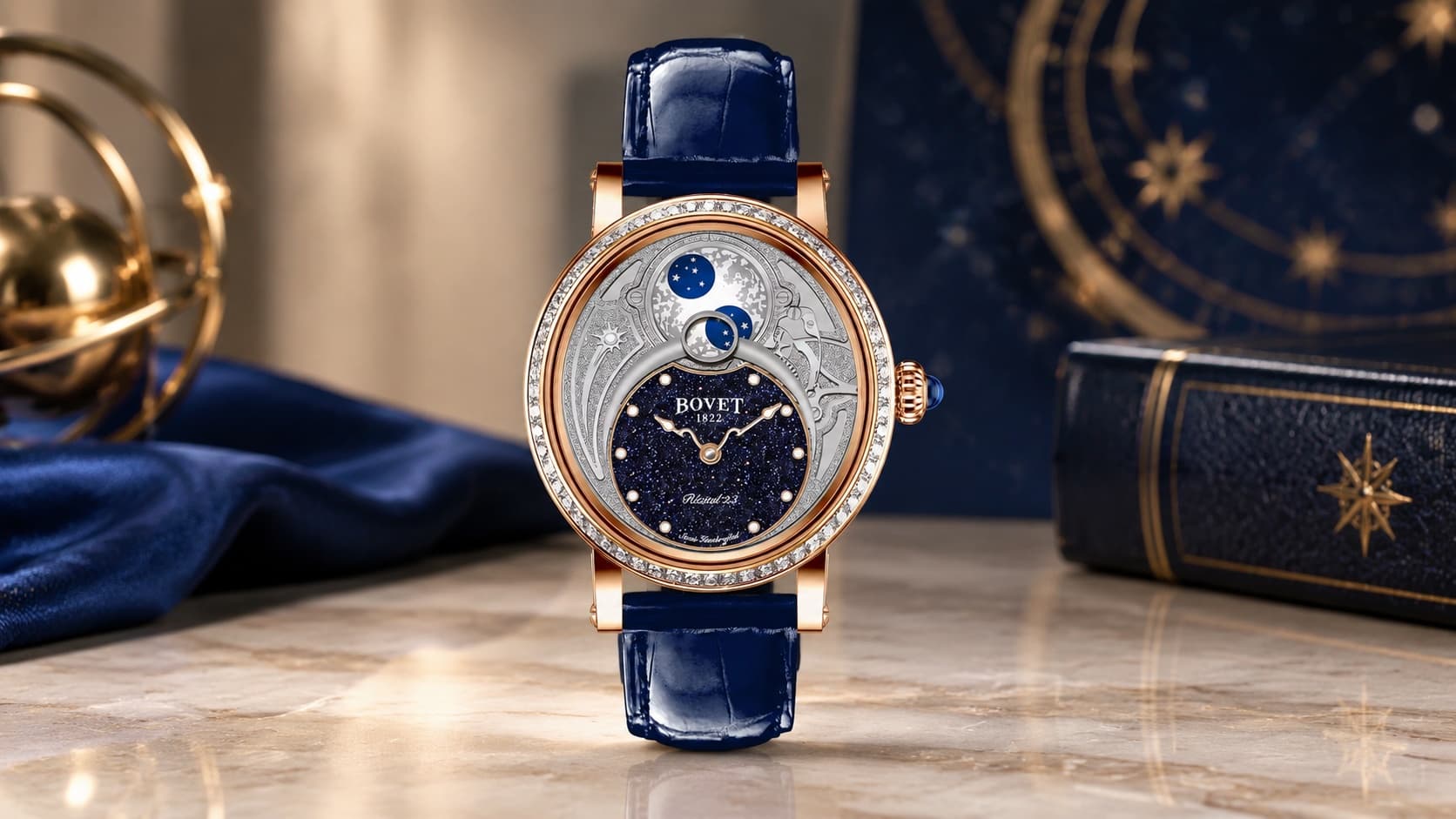
- Miss Audrey — Bovet’s flagship women’s watch, launched in 2015 and later awarded the Ladies’ Watch prize at the 2020 Grand Prix d’Horlogerie de Genève. It comes in a compact 36mm Amadeo case with a diamond-set bow and bezel, and its dial has appeared in guilloché, hand-painted, and even sugar-crystal finishes.
- Pininfarina Ottantasei — Released in 2010 to mark Pininfarina’s 80th anniversary, this model wraps its flying tourbillon in sapphire crystal on nearly every surface, giving an almost fully open view of the movement.
- Amadeo Fleurier Tourbillon — A recurring reference across the Fleurier line pairing a single-minute tourbillon with hand-painted or engraved dial artwork, usually seen as the most traditional expression of what Bovet does best.
Together, these five models span the full range of what Bovet builds, from record-setting mechanics to wearable art.
Bovet’s Amadeo Case, Explained
The Amadeo case is Bovet’s patented system that lets one watch change into three different forms: a wristwatch, a pocket watch, and a small table clock. The change happens without any tools — the owner simply detaches the case from its bracelet or chain by hand.
The Amadeo system doesn’t just look clever. It solves a real design problem, since Bovet’s dials are often busiest and most detailed on the reverse side, which most watches never show off at all.
On many Amadeo models, flipping the case over reveals a second dial entirely, showing a different display like a power reserve indicator or a second time zone. A coaxial seconds mechanism keeps the seconds hand turning correctly in the same direction no matter which side faces up, which took real engineering effort to pull off. Bovet has continued refining the mechanism over the years, including simpler ways to open the caseback with light pressure on the crown.
What to Expect to Pay for a Bovet Fleurier
Bovet Fleurier watches generally range from around $13,000 for older or simpler pieces up to well over $500,000 for the brand’s most complicated limited editions. Bovet’s own pricing for its artistic high-end pieces typically runs between $18,000 and $2.5 million, depending on materials, complications, and how much hand-decoration goes into the piece.
| Collection | Typical Starting Price | Best For |
|---|---|---|
| Pininfarina Sportster | Roughly $8,000–$36,000 | Everyday, casual wear |
| Amadeo Fleurier | Roughly $13,000–$76,000 | Artistic dials, convertible case |
| 19Thirty | Similar range to Fleurier models | Classic dress-watch styling |
| Virtuoso | Roughly $70,000–$230,000+ | Advanced mechanics plus Amadeo case |
| Récital | Often $150,000 and up | Grand complications, record-setting mechanics |
Prices shift constantly based on gold weight, gem-setting, and whether a piece is part of a limited run, so these figures are only a general guide rather than a fixed price list.
How to Buy a Bovet Fleurier Watch
Buying an independent luxury brand like Bovet takes a bit more homework than picking up a mainstream Swiss watch, mostly because production numbers are small and resale markets are thin.
- Buy from an authorized dealer or the brand directly. Because Bovet makes relatively few watches each year, verifying authenticity matters more than with mass-produced brands.
- Check whether the case actually converts. If buying a pre-owned Amadeo model, test the pocket watch and table clock functions in person, since repairs to the conversion mechanism can be costly.
- Ask about servicing history. Complicated movements like tourbillons and perpetual calendars need specialized servicing, and Bovet’s independent status means fewer service centers exist worldwide compared to bigger brands.
- Consider resale value carefully. Independent brands with small production runs don’t always hold value the same way as Rolex or Patek Philippe, so buy a Bovet because of what it is, not purely as an investment.
- Compare Fleurier versus Récital versus Sportster before deciding, since the three lines feel like different watches entirely despite sharing a maker.
- Expect fewer boutiques than mainstream brands. Bovet has historically leaned on Asian distribution partnerships, so availability and service support can vary more by region than with globally distributed brands.
Frequently Asked Questions
Is Bovet a luxury watch brand?
Yes. Bovet Fleurier is considered a high-end independent luxury watchmaker, with most models priced well into five and six figures due to the hand-finishing, in-house movements, and complicated mechanics involved.
Who owns Bovet Fleurier?
Swiss entrepreneur Pascal Raffy has owned and led Bovet Fleurier since 2001, and he has focused the brand on artistic, high-complication watchmaking rather than mass production.
What is Bovet Fleurier known for?
Bovet is best known for its patented Amadeo convertible case, which turns a single watch into a wristwatch, pocket watch, and table clock, along with hand-painted miniature dials and historic ties to 19th-century trade with China.
Are Bovet watches a good investment?
Bovet watches hold appeal mainly for collectors who value rare craftsmanship rather than guaranteed resale gains, since independent brands with limited production don’t always appreciate as predictably as major names like Rolex or Patek Philippe.
Where are Bovet Fleurier watches made?
Bovet Fleurier watches are made in Switzerland, primarily in the Val-de-Travers region, including workshops housed in a historic château in the village of Môtiers that once belonged to the Bovet family.
Conclusion
Bovet Fleurier earns its reputation the hard way: through two centuries of hand-finished dials, a genuinely clever convertible case, and a willingness to build watches that prioritize craftsmanship over mass appeal. Whether someone gravitates toward the artistic Amadeo Fleurier line, the technically stacked Récital and Virtuoso pieces, or the more wearable Pininfarina Sportster, the common thread is a brand that still builds watches the way it did when Édouard Bovet first sailed to China with four timepieces in his luggage. For anyone drawn to independent watchmaking with real history behind it, Bovet remains one of the few brands where the story and the mechanics genuinely match up.