Dodane is not a name you will find in airport boutiques or on celebrity wrists. It is a French watchmaking family that spent over a century building chronographs for military pilots, supplying the French Air Force through two World Wars, the Cold War, and beyond. The watches they made were not designed to impress — they were designed to work, built to strict government specifications inside real cockpits aboard Mirage and Rafale fighter jets. Today, with the brand in liquidation following a 2022 bankruptcy, the watches Dodane produced across 165 years have become some of the most historically significant pilot chronographs available to collectors. What follows covers the full brand history, every model worth knowing, what to look for when buying, and how to take care of one once you own it.
The Story Behind Dodane Watches
Dodane’s story starts in 1857 in a small village called La Rasse, right on the border between France and Switzerland. The company was founded by Alphonse Dodane and his father-in-law François-Xavier Joubert. That border region was one of the most concentrated watchmaking areas in the world at the time, so the location made perfect sense for a family getting into the trade.
The early decades were spent making precision instruments and pocket watches, building a quiet reputation for accuracy among professionals who needed tools they could rely on.
How Aviation Changed Dodane Forever
In 1905, the company relocated to Morteau, another French watchmaking town. It was there, in 1917, that the second generation — Alphonse Gabriel Dodane — perfected a flyback chronograph mechanism. That single development changed the entire direction of the brand. Dodane shifted its focus to onboard chronographs built specifically for aircraft, a niche that very few watchmakers were equipped to serve properly.
In 1929, the company moved again and settled in Besançon, which had by then established itself as the center of French watchmaking.
How Dodane Became a NATO Supplier
Under the third generation, Raymond Dodane, the brand secured one of its most significant milestones: becoming an approved supplier to NATO. Between 1954 and 1994, Dodane produced roughly 5,000 Type 20 and Type 21 chronographs for military pilots, built to strict French Ministry of Defence specifications.
In 1983, the German Army commissioned Dodane to develop the Type 211, a chronographic instrument that was later installed in the Tigre helicopter and the Mirage 2000 and Rafale fighter jets. By the 1980s, under the fourth generation — Laurent and Michel Dodane — the company had scaled up to produce as many as 100,000 watches per year, with distribution reaching across the globe.
Dodane’s Collapse and Comeback
Despite that growth, the early 1990s brought serious financial trouble. Dodane went into receivership in 1992 and was formally dissolved in 1994. For a brand with that depth of history, it was a difficult end.
It didn’t stay that way. In the early 2000s, Cédric Dodane, the fifth generation of the founding family, re-registered the Dodane 1857 name and restarted production. By 2005, a new version of the Type 21 was released. In 2012, Cédric collaborated with designer Julien Thiébaud to produce the Type 23, once again built to French Ministry of Defence technical specifications.
The Current State of Dodane Watches
In September 2022, Cédric Dodane filed for bankruptcy a second time, with the company entering liquidation proceedings. Multiple potential buyers expressed interest in acquiring the brand. Cédric has stated publicly that any future ownership must involve the Dodane family in some capacity — he is not willing to hand over five generations of history without conditions attached.
Whatever happens with ownership, the watches Dodane produced across more than 160 years remain some of the most historically significant pilot chronographs ever made in France.
What Makes Dodane Watches Different
Most pilot watch brands today borrow the aesthetic of aviation without ever having supplied a real cockpit. Dodane did not borrow anything. Its watches were purpose-built tools that actual military pilots wore on active duty, and that history runs through every design decision the brand ever made.
The Feature That Built Dodane’s Reputation
The feature most associated with Dodane is the flyback chronograph. On a standard chronograph, stopping and resetting the timer takes three separate button presses. A flyback does all of that in one. Press the button while the chronograph is running and it instantly resets to zero and starts counting again.
For a pilot timing a navigation leg, calculating fuel burn, or tracking elapsed time on a mission, saving those extra seconds is not a small thing. The French Ministry of Defence made the flyback function a non-negotiable requirement in their Type 20 and Type 21 specifications, and Dodane built it into its watches accordingly.
Why Dodane Was Held to Strict Government Rules
When the French Ministry of Defence commissioned the Type 20 in the 1950s, they handed watchmakers a strict list of requirements: a black dial with luminous Arabic numerals for instant readability, accuracy within eight seconds per day, a minimum power reserve of 35 hours, and the flyback function. There was no flexibility on these points.
Dodane was eventually selected as the sole supplier of the Type 21 when the Ministry tightened those specifications further and required a more durable movement with lower maintenance costs. Breguet’s watches had become too expensive for the armed forces at that scale. Dodane stepped up and delivered.
That discipline of being held to zero tolerance by a government client shaped how the brand built every watch. There was no room for decorative compromise.
Made in France: The Dodane Production Story
Dodane’s modern watches are assembled in France, with components sourced from both France and Switzerland. The Dubois-Dépraz chronograph modules used in the revived models are widely respected within the industry. While the movements are not made fully in-house, the assembly and regulation happens in Besançon, keeping the French manufacturing identity intact.
Dodane’s Unique Accuracy Certification
One thing that genuinely sets Dodane apart from most watch brands is the option to have your watch certified by the Besançon Astronomical Observatory. This is a stricter and rarer standard than the more commonly known COSC certification from Switzerland.
The key difference is that the Besançon observatory tests the fully assembled watch, including the case, rather than just the bare movement. COSC tests movements before they are cased. A watch that passes the Besançon testing over 15 consecutive days, across five different positions and multiple temperature settings, earns an observatory chronometer certificate. Dodane offered this as an option on its modern Type 21 and Type 23 models.
The Reason Behind Dodane’s Bold Dial Design
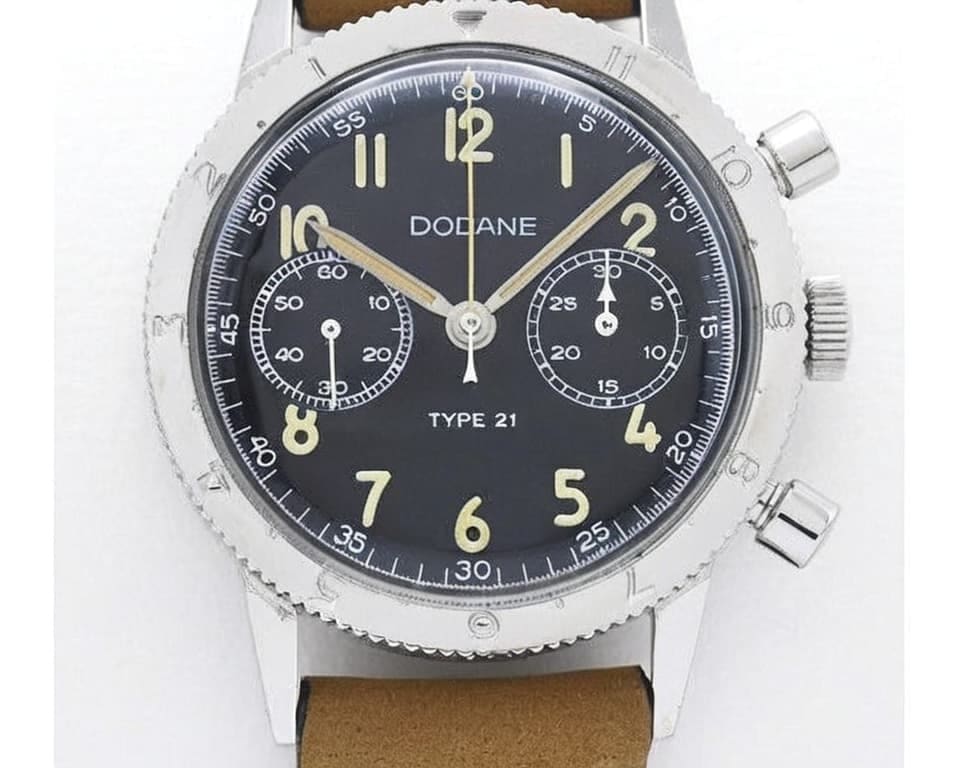
Every design choice on a Dodane watch comes back to legibility. The dials are black. The numerals are large Arabic figures with luminous filling. The hands are long and clearly shaped. The tachymeter on the Type 23 is angled to give the dial visual depth while keeping the scale readable in flight conditions.
This is not a minimalist aesthetic choice. It is a direct result of designing for cockpit conditions where a pilot might need to read the watch in low light, under vibration, or while wearing gloves.
Why Almost No Other Brand Can Match Dodane’s History
Dodane sat alongside Breguet and Auricoste as one of the official suppliers of Type 20 and Type 21 chronographs to the French military. Breguet is a well-known luxury name. Auricoste is obscure. Dodane sits in an interesting middle ground — historically significant, genuinely military-issued, and still small enough that most people outside serious watch collecting have never heard of it.
That obscurity is part of the appeal for collectors who value substance over brand recognition. A vintage Dodane Type 21 with original military engravings and FG markings — the French abbreviation for “Fin de Garantie” or end of warranty, stamped on the caseback to record the next scheduled service — tells a story that no lifestyle watch brand can manufacture.
The Full Dodane Watch Lineup
Dodane was never a brand with a sprawling catalog. The entire lineup revolves around a small number of models built around one core purpose: aviation chronographs. That focus is a strength, not a limitation. Every watch the brand produced or re-issued has a real reason for existing.
1. Dodane Type 20 (Vintage, 1950s-1960s)
The Type 20 is where Dodane’s military watch legacy began in earnest. The French Ministry of Defence issued specifications in the early 1950s calling for a black dial, a flyback chronograph, Arabic luminous numerals, and accuracy within eight seconds per day. Dodane became one of the official suppliers in 1960, alongside Breguet, Auricoste, and Vixa. The watch used a manually wound Valjoux Caliber 222 movement inside a 37mm stainless steel case, with a 40-hour power reserve and a flyback chronograph counting 60 seconds and 30 minutes.
The Type 20 is rarer than the Type 21 because fewer were produced, and many pilots kept their watches at the end of their careers rather than returning them to the military. That reduced the number of surviving examples significantly, which is a big part of why collector interest runs high. Vintage examples in solid condition regularly sell in the $2,500 to $3,500 range, sometimes more depending on overall condition and whether the dial has developed the kind of natural patina that collectors prize.
2. Dodane Type 21 (Vintage, 1960s-1980s)
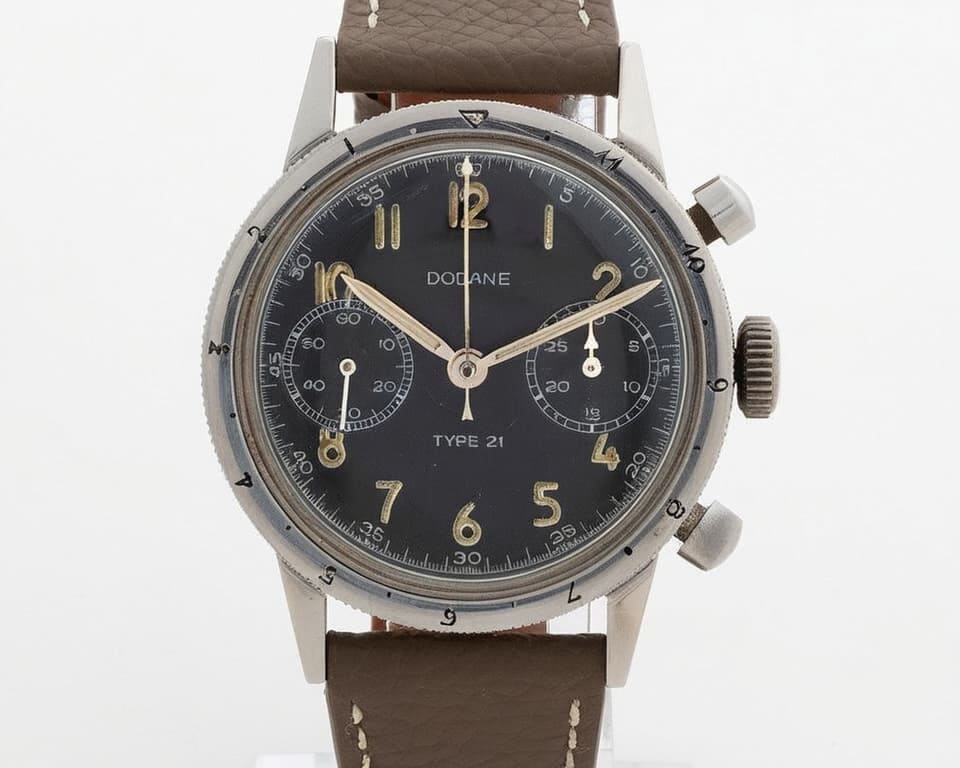
When the Ministry of Defence updated its requirements in the 1960s and demanded a more durable movement with lower servicing costs, Breguet’s pricing made them impractical at the volume required. Dodane became the sole supplier of the Type 21, which went on to serve French Air Force helicopter pilots, particularly those flying the Alouette, through the 1980s. The watch ran on a Valjoux 231 or 235 movement depending on generation, housed in a 37-38mm screwed-caseback steel case, with a matte black dial, luminous Arabic numerals, bidirectional rotating bezel, and sub-registers for 30 minutes and running seconds.
Genuine military-issued examples carry FG markings on the caseback — the French abbreviation for Fin de Garantie, meaning end of warranty — followed by dates recording when the watch was next due for a service inspection. Those engravings are a direct paper trail of operational use and a key part of what makes issued examples more desirable than civilian versions. Vintage Type 21s in good shape are generally found in the $2,000 to $3,500 range, with tropical dials — where the original black finish has shifted to brown or reddish tones from age and light — commanding noticeably higher prices.
3. Dodane Type 21 Reissue (Modern, from 2005)
When Cédric Dodane relaunched the brand in the early 2000s, the Type 21 was the first model he brought back. The reissue launched in 2005 and stayed faithful to the original visual identity while updating the movement to an ETA 2892 base with a Dubois-Dépraz 42030 flyback module, making it automatic rather than manually wound. The case grew slightly from the original 37mm to 41.5mm, a consequence of the added module thickness, and buyers could choose between a bi-compax dial layout with two sub-dials measuring up to 30 minutes, or a tri-compax layout with three sub-dials capable of tracking up to 12 hours.
One genuine advantage of the modern reissue over most watches at its price point was the option to send it to the Besançon Astronomical Observatory for full chronometer certification. Unlike the Swiss COSC standard, which tests movements before they are cased, Besançon tests the complete assembled watch across 15 consecutive days in multiple positions and temperatures. Buyers who wanted that level of verified accuracy could request it directly from Dodane. Buyers who preferred the original proportions, however, often found the vintage examples more satisfying, since the reissue’s slightly larger and thicker case is a noticeable departure from the original tool watch dimensions.
4. Dodane Type 23 (Modern, from 2012)
The Type 23 arrived in 2012 through a collaboration between Cédric Dodane and designer Julien Thiébaud, and unlike many brand redesigns, it had genuine military backing behind it. France’s SIRPA AIR — the French Air Force’s official communications service — requested the model, and the technical specifications were provided directly by the French Ministry of Defence. The result was a 42.5mm brushed stainless steel case running the same ETA 2892 with Dubois-Dépraz flyback module as the reissued Type 21, but with a cleaner bi-compax dial, an angled tachymeter on the chapter ring, and lugs with hollowed sides shaped to reference an aircraft wing profile. The crown carries the eagle from the coat of arms of Besançon.
The Type 23 also came in a quartz BNL variant — BNL standing for bas niveau de lumière, meaning low light — developed specifically for French Air Force pilots using night vision equipment. Standard luminous dials interfere with night vision goggles, so this version uses a specially calibrated low-luminosity treatment. It is one of the most operationally specific watches Dodane ever produced, and one of the more unusual pieces in the entire pilot watch category. Like the reissued Type 21, the automatic Type 23 could be submitted for Besançon Observatory chronometer certification on request.
5. Dodane Type 211 (Cockpit Instrument)
The Type 211 is not a wristwatch. It is the onboard chronographic instrument Dodane developed in 1983 at the request of the German Army, and it has been fitted in the Tigre helicopter and the Mirage 2000 and Rafale fighter jets. Dodane also offered civilian versions as a dashboard-mounted instrument, making it one of the very few watch companies in the world to have produced both a wrist chronograph and a certified cockpit instrument for active military aircraft.
For most buyers this is background knowledge rather than a purchase consideration, but it matters for anyone trying to fully understand what Dodane actually built. The Type 211 is the proof that Dodane’s aviation credentials went beyond putting wings on a dial — the brand was literally inside the cockpits of some of the most advanced fighter jets in the world.
Dodane’s Watch Range: Quality Over Quantity
If you were expecting a wide variety of watches, Dodane is not that kind of brand. The entire wristwatch lineup is essentially the Type 20, Type 21, and Type 23 in their vintage and modern forms, with variations in dial layout, bezel finish, and movement configuration. The brand’s value was never in variety. It was in doing one thing with documented military credibility and not diluting it. For buyers looking at modern pieces, the Type 21 reissue and Type 23 were the two real choices. For collectors, the vintage military-issued Type 20 and Type 21 are where most of the serious interest lives.
Before You Buy a Dodane Watch
Buying a Dodane is not like buying a mainstream Swiss watch. The brand operated in a very specific niche, produced relatively small numbers, and is currently in a complicated position following the 2022 bankruptcy. All of that shapes what you need to think about before spending money on one — whether you are looking at a vintage piece or a modern reissue.
Should You Buy a Vintage or Modern Dodane
The first decision is whether you want a vintage military-issued piece or one of the modern reissues. These are genuinely different purchases. A vintage Type 20 or Type 21 comes with real operational history — those FG markings on the caseback, the tritium dial, the manually wound Valjoux movement — and that history is a large part of what you are paying for. A modern reissued Type 21 or Type 23 gives you a new watch with contemporary finishing, an automatic movement, and the option for Besançon Observatory certification, but it will not have that same provenance.
Neither choice is wrong, but mixing up the two categories is a common mistake for buyers who are new to the brand. Someone expecting a vintage feel from a modern reissue will be disappointed by the larger case and thicker profile. Someone expecting modern reliability from a vintage piece needs to budget for a proper service before wearing it regularly.
How to Check the Condition of a Vintage Dodane
Because Dodane produced relatively small numbers of military watches across several decades, finding examples in genuinely good, original condition takes patience. The things to pay close attention to are the dial, the case geometry, and the caseback.
Dials should be checked for repainting, which is a common issue with vintage military watches that were touched up during service. Original tritium numerals will show some age and that is normal and expected. Cases that have been polished lose their original geometry and sharpness, which reduces both aesthetic and collector value. The caseback on a genuine military-issued example should carry FG engravings with dates. Multiple FG markings are actually a positive sign — they show the watch went through regular military service inspections, which confirms its operational history. A caseback with no markings at all on a supposedly military-issued piece is worth questioning.
What Movement Is Inside a Modern Dodane?
The modern Dodane reissues use an ETA 2892 base movement with a Dubois-Dépraz chronograph module on top. This is a well-regarded and widely serviced combination, so finding a watchmaker who can work on it is not difficult. However, it is worth knowing that this is not an in-house movement — it is a bought-in Swiss base paired with a specialist module. At the price point Dodane’s modern watches commanded, some buyers felt this was a limitation. Others simply appreciated that the Dubois-Dépraz flyback module is genuinely excellent at what it does, and that the overall package was assembled in France with real care.
One specific thing to check on modern pieces is whether the caseback is solid or exhibition. Dodane offered both options. The original Type 21 military specification required a solid caseback partly because cockpit environments produce magnetic fields, and a solid steel back offers better protection. An exhibition caseback looks appealing but is technically a departure from what the original military specification required.
How Dodane Watches Wear on the Wrist
Vintage Type 20 and Type 21 watches are small by today’s standards — 37mm to 38mm cases built for cockpit use, not fashion. They wear very differently from modern pilot watches and suit smaller wrists well. If you are used to wearing 40mm or larger watches, the vintage pieces may feel more modest on the wrist than you expect, which for many buyers is actually a welcome change.
The modern Type 21 reissue grew to 41.5mm and the Type 23 to 42.5mm, both closer to contemporary sizing. The Type 23 is reported to wear slightly smaller than its measurements suggest due to the case shape, but it is still a substantial watch. If possible, try the size on your wrist before committing — or look up the lug-to-lug measurement, which tells you how far the watch extends across your wrist more accurately than the diameter alone.
How to Buy a Dodane Watch After the Bankruptcy
Given that Dodane entered liquidation proceedings in 2022, buying a new modern Dodane directly from the brand is no longer straightforward. The pre-owned and vintage market is where most transactions now happen. When buying vintage, always ask for detailed photographs of the caseback, the dial under magnification if possible, and the movement. For modern pieces, confirm the watch comes with its original box and papers, as these matter for future resale. Buying from a reputable specialist in vintage military watches rather than a general marketplace will reduce the risk of acquiring a piece that has been tampered with or misrepresented.
Where to Buy a Dodane Watch
The honest answer to this question changed significantly in 2022. Before the bankruptcy, Dodane operated a small network of authorized retailers across Europe and had limited availability in the United States. That structure no longer exists in the same way. The brand is currently in liquidation and is not actively selling new watches through a functioning retail network. What that means practically is that anyone looking to buy a Dodane today is shopping in the pre-owned and vintage market, and that requires a different approach than buying from an authorized dealer.
Why the Pre-Owned Market Is Your Only Option
Because new Dodane watches are not currently being produced or sold through active retail channels, the pre-owned market is where almost all transactions happen. This includes both vintage military-issued pieces from the 1950s through the 1980s and modern reissued examples from the Cédric Dodane era that are now circulating second-hand.
The pre-owned watch market in general works best when you use sellers who specialize in the category you are buying in. For vintage military watches specifically, a dealer who focuses on that niche will be far better equipped to verify authenticity, assess condition accurately, and price the piece fairly than a general second-hand marketplace where sellers may not fully understand what they have. Dodane is an obscure enough brand that generalist sellers sometimes misprice examples in both directions — overvaluing a common Type 21 because of the military association, or undervaluing one in genuinely exceptional condition because they cannot tell the difference.
Finding Dodane Watches Through Auction Houses
Established watch auction houses occasionally bring Dodane pieces to market, particularly vintage Type 20 and Type 21 examples in notable condition. Auction is one of the more reliable ways to buy a vintage military watch because reputable houses have authentication processes, provide detailed condition reports, and create a competitive environment that tends to produce fair market pricing. The downside is that timing is unpredictable — a specific example you want may not surface for months, and bidding can push prices above what you might pay through a private transaction for an equivalent piece.
Buying a Dodane Through Collector Communities
A significant portion of Dodane transactions, particularly for vintage pieces, happens through dedicated watch collector communities and forums. These are places where people who genuinely know the brand buy and sell between themselves, often with a level of transparency about condition and history that you would not get from an anonymous listing. The trade-off is that private sales typically come with no buyer protection and require you to do your own due diligence on authenticity. If you are not yet confident identifying what makes a genuine military-issued Type 21 different from a modified or misrepresented example, a private purchase from an unknown seller is a higher risk transaction than buying through a reputable dealer or auction house.
The Non-Negotiables When Buying Any Dodane
No matter which route you take, there are a few things worth insisting on. Request photographs of the movement if you are buying a vintage piece, even if the seller needs to open the caseback to provide them. Confirm that the dial has not been repainted or restored, which is one of the most common ways vintage military watches are altered and one of the most significant factors in value. For modern Dodane reissues, original paperwork and box matter considerably — not just for provenance but because the Besançon Observatory chronometer certificate, if the watch has one, adds meaningful documentation of the watch’s accuracy and history.
Also worth noting: because the brand’s future ownership is unresolved, there is currently no authorised service network operating under the Dodane name. Anyone buying a Dodane today, vintage or modern, should factor in the cost of having the movement serviced by an independent watchmaker experienced with Valjoux movements for vintage pieces, or ETA-based chronograph modules for the modern reissues. Neither is a difficult service job, but it is an expense to plan for.
Dodane Watches as an Investment
Dodane is not an investment watch in the way that certain Rolex or Patek Philippe references are. Nobody is buying a Dodane expecting to flip it for a quick profit six months later. The market for these watches is too small and too specialised for that kind of speculation. What Dodane offers instead is something more honest: stable value driven by genuine scarcity, verified military history, and a collector base that understands exactly what it is buying.
Why Vintage Dodane Watches Hold Value Best
The strongest value proposition within the Dodane world sits firmly with the vintage military-issued pieces. A genuine Type 21 with original dial, unpolished case, and FG service markings on the caseback is a finite object. No more are being made. The total production run across the entire military contract period was roughly 5,000 Type 20 and Type 21 watches combined, and a meaningful number of those were kept by pilots at the end of their service careers, never re-entering the market. What remains is genuinely limited supply chasing slowly growing demand as more collectors discover the category.
Current asking prices for vintage Type 21 examples in solid condition sit broadly in the $3,000 to $5,500 range depending on condition, generation, and whether the watch has particularly desirable characteristics. Rarer pieces, such as those with documented Centre d’Essais en Vol markings — the French flight test centre — have appeared at prices significantly above that. Tropical dial examples, where the original black dial has developed a brown or reddish patina through age, consistently attract more attention and higher prices than standard dials in equivalent condition. The Type 20 is rarer than the Type 21 overall, and well-preserved examples are priced accordingly.
Dodane vs Breguet: Which Is Better Value?
One useful way to think about Dodane’s value is its relationship to Breguet within the same collector category. Both brands supplied Type 20 and Type 21 chronographs to the French Air Force. Breguet commands significantly more money — a military-issued Breguet Type XX in comparable condition will cost several times what a Dodane equivalent fetches. For the collector who cares about the operational history and the physical watch rather than the prestige of the name on the dial, Dodane represents genuine value. The movement, the case construction, the military specification it was built to — all of it is the same category of object. The price differential reflects brand recognition, not a meaningful difference in historical significance.
Do Modern Dodane Reissues Hold Their Value?
The modern Type 21 and Type 23 reissues from the Cédric Dodane era are in a more complicated position from an investment standpoint. These watches were produced in limited numbers during a period when the brand was trying to rebuild its presence, and they used well-regarded but third-party movements rather than anything proprietary. They were never cheap — modern Type 23 examples with flyback modules were priced above $5,000 in some configurations — and at that price they were competing against established names with stronger secondary market liquidity.
The 2022 bankruptcy adds a further layer of uncertainty. Modern Dodane reissues now have no active manufacturer behind them, no authorised service network, and no new production keeping the brand visible in the market. These factors generally work against resale value in the short term. That said, if the brand name is eventually acquired and relaunched in a credible way — which remains a possibility given Cédric Dodane’s stated conditions around preserving family involvement — earlier modern pieces could benefit from renewed interest. That is speculation rather than a reliable basis for buying, but it is worth keeping in mind.
How Original Condition Affects Dodane Resale Price
Across both vintage and modern Dodane pieces, the single biggest factor in resale value is originality. A vintage Type 21 with a repainted dial, polished case, or replaced hands is worth considerably less than one in original condition with honest wear. For modern pieces, having the original box, papers, and any Besançon Observatory certificate that was issued with the watch makes a tangible difference when selling. The Dodane collector market is small and knowledgeable — buyers in this space tend to know exactly what they are looking at, which means anything that deviates from original specification will be noticed and priced accordingly.
Dodane Watch Servicing and Care
A Dodane watch is a mechanical instrument first and a collector piece second. Keeping one running well and preserving its condition over the long term requires some basic knowledge about what is inside it and how to treat it. The approach differs meaningfully between vintage pieces and modern reissues, so it is worth covering both.
How to Service a Vintage Dodane Watch
The vintage Type 20 and Type 21 watches run on Valjoux movements — the Caliber 222 in the Type 20 and various Valjoux calibers including the 231, 235, and 72 in Type 21 variants depending on generation. These are well-regarded manually wound chronograph movements that experienced watchmakers are familiar with. The general recommendation for mechanical watches is a service every four to five years, but vintage pieces that have not been serviced in many years should be seen by a watchmaker before being worn regularly. Old lubricants dry out and degrade over time, and running a movement on dried-out oils accelerates wear on the parts.
Finding a watchmaker comfortable with vintage Valjoux chronographs is not particularly difficult — these movements were widely used across many brands throughout the mid-twentieth century, and any watchmaker who specialises in vintage Swiss pieces should have experience with them. That said, spare parts for some specific Valjoux calibers are becoming harder to source as surviving stocks thin out. The chronograph centre wheel for the Valjoux 72 in particular is one component that has become difficult to find in recent years. Before committing to a watchmaker, it is worth asking whether they have experience with flyback chronograph mechanisms specifically, since the flyback function adds complexity beyond a standard chronograph service.
One important point about vintage Dodane cases: the water resistance of a sixty-year-old watch should not be assumed. The original gaskets will have hardened and lost their seal long ago. A vintage Type 21 should not be worn in water or rain without having the seals replaced and the case pressure tested by a watchmaker first. This is a straightforward job but one that is easy to overlook if you are used to modern watches.
How to Service a Modern Dodane Watch
The modern Type 21 and Type 23 reissues use an ETA 2892 base movement with a Dubois-Dépraz chronograph module. The ETA 2892 is one of the most widely serviced automatic movements in the world, so finding a watchmaker for the base movement is simple. The Dubois-Dépraz module is the more demanding part of the job. These modular chronograph mechanisms are more complex to work on than integrated movements, and not every watchmaker will want to take on a full disassembly and service of the module itself. Some prefer to replace the module entirely rather than service it in place, which can be a practical solution if a replacement can be sourced.
For normal use, the modern reissues should be serviced every five years or so. The ETA 2892 is a robust movement and the Dubois-Dépraz module is reliable in regular use, so there is no need for more frequent attention as long as the watch is running well. If the chronograph starts behaving inconsistently — the flyback not resetting cleanly, the sub-dials jumping erratically, or the sweep seconds losing accuracy — those are signs the module needs attention.
How to Store and Handle a Dodane Watch
For vintage pieces, the manually wound movement needs to be wound by hand each day. Wind it gently in the morning, stopping when you feel resistance rather than forcing it further. The Type 20 and Type 21 both have a power reserve of around 40 hours, so a watch wound in the morning will still be running the following day, but for accuracy it is better to wind it daily.
Avoid exposing any Dodane — vintage or modern — to strong magnetic fields. The original military specifications for the Type 21 required resistance to magnetic interference because cockpit environments generate significant magnetism, but that was a design requirement for the movement’s robustness rather than a guarantee that the watch is immune. Placing a mechanical watch near loudspeakers, magnetic closures on bags, or certain electronic devices can affect the regulation of the movement over time.
When storing a Dodane you are not wearing regularly, keep it in a dry environment away from direct sunlight. For vintage pieces with tritium dials, there is nothing to worry about from a handling perspective — tritium was commonly used in military watch dials through the 1960s and 1970s, and at the quantities used in watch dials it poses no meaningful risk in normal handling. The luminous material will have decayed significantly over the decades and may no longer glow visibly, which is normal for a watch of this age.
Keeping the Case and Dial in Original Condition
The single biggest thing you can do to preserve the value and integrity of a vintage Dodane is to resist the temptation to have the case polished. Polishing removes metal, rounds off the sharp edges and angles of the original case design, and permanently erases the honest wear that collectors find appealing. A case with original surface finish and natural wear tells a more honest story than a polished one, and the market consistently values originality over cosmetic perfection. If the crystal is scratched on a vintage piece, replacing it with an equivalent acrylic crystal is a straightforward and reversible intervention that does not affect the watch’s integrity.
For modern reissues with sapphire crystals, the crystal itself is extremely scratch-resistant and needs no special attention beyond normal cleaning with a soft cloth.
Dodane Watch FAQs
Dodane is a brand that generates genuine questions from people who are new to it — partly because it is so rarely covered alongside the mainstream watch names, and partly because its current status after the 2022 bankruptcy leaves a lot of practical questions unanswered. The questions below cover what most people actually want to know before buying or researching a Dodane watch.
Is Dodane a luxury brand?
Not in the fashion sense. It was a working military supplier that made genuinely excellent tools. The watches have become collectible, but the brand was never about prestige.
Is Dodane still making watches?
No. The company filed for bankruptcy in September 2022 and entered liquidation. Cédric Dodane retains personal ownership of the name, but no new watches are being produced.
How does Dodane compare to Breguet in the Type 20 and Type 21 category?
Both brands supplied chronographs to the French Air Force under identical government specifications. The functional difference is minimal. Breguet commands higher prices due to broader name recognition, not superior military credentials.
What is the difference between the Type 20 and Type 21?
The Type 21 was an updated specification introduced in the 1960s requiring a more durable movement, improved water resistance, and a countdown bezel configuration. Dodane became the sole military supplier of the Type 21 after Breguet’s pricing became impractical at scale.
Why did Dodane sell watches under different names?
Dodane produced chronographs under the names Airain, Airan, and Chronofixe, which was a common practice for manufacturers of that era. Some military-issued examples were also made with sterile dials carrying no brand name at all.
Is the tritium on vintage dials dangerous?
No. At the quantities used in watch dials, tritium poses no meaningful health risk in normal handling. The material has also decayed significantly over the past fifty-plus years and will no longer glow visibly on most examples.
Can a vintage Type 21 be worn every day?
Yes, if it has been recently serviced and the seals have been replaced. It requires daily hand winding and should be kept away from water until a watchmaker has pressure-tested the case.
What straps work well on a Dodane?
The vintage Type 21 and modern reissues both use an 18mm lug width. A plain leather pilot strap or NATO-style strap suits the character of the watch well.
Is a Dodane a good investment?
Vintage military-issued pieces with original dials and unpolished cases hold value well within a small but knowledgeable collector market. It is not a liquid investment like major Swiss brands, but genuine examples in good condition have shown steady appreciation.
How do I know if a vintage Dodane is genuine?
Look for the correct Valjoux movement for the generation, original tritium dial without signs of repainting, unpolished case geometry, and FG service markings on the caseback for military-issued examples. If any of those elements are missing or inconsistent, ask detailed questions before buying.
Dodane is not a brand that rewards casual curiosity. The more you learn about it, the more interesting it becomes — and that is true of very few watch brands at any price point. If these answers have raised more questions than they resolved, that is probably a good sign.
Conclusion
Dodane spent over a century doing something most watch brands only pretend to do — making watches that real pilots actually depended on. From the flyback chronographs that equipped French Air Force pilots in the 1950s through to the Type 23 built to Ministry of Defence specifications in 2012, every watch the brand produced existed because someone with a professional need for accuracy asked for it. That is a rarer foundation than most people realise when they first encounter the name, and it is why Dodane earns genuine respect from collectors who have taken the time to understand what they are looking at.
The 2022 bankruptcy was a sad end to a remarkable run, but it does not diminish what the watches represent. A vintage Type 21 with FG markings on the caseback is a direct physical connection to French military aviation history — it flew in cockpits, it was inspected and serviced on military schedules, and it ended up in the hands of collectors who value exactly that kind of documented, unembellished provenance. The modern reissues from the Cédric Dodane era may lack that depth of history, but they were honest watches built by a family that took its heritage seriously rather than using it as a marketing shortcut.
If you are researching Dodane for the first time, the best place to start is a vintage Type 21 in honest condition. Hold one, look at the caseback engravings, wind the movement, feel the flyback reset. Everything that makes this brand worth knowing is right there in that one object.