Harry Winston is a name most people connect with diamonds first, but the brand has also built a genuinely respected watchmaking side, one that arrived late to the game and then surprised everyone by pushing the boundaries of what a watch could do. Rather than simply putting the Harry Winston name on someone else’s movement, the house teamed up with some of the most talented independent watchmakers on the planet to create pieces that mix serious mechanical engineering with the kind of gem-setting only a top jeweler can pull off. From its earliest days in fine jewelry to the boundary-pushing Opus series and beyond, each collection reveals a different side of the brand’s watchmaking identity.
The History of Harry Winston
Harry Winston started as a jewelry company, not a watch company, and that history still shapes every watch it makes today. The man himself, born in 1896, opened Harry Winston, Inc. in New York City in 1932 after years of trading estate jewelry. He became known as the “King of Diamonds” for his ability to source, cut, and sell some of the most famous stones in the world, including the Hope Diamond, which he donated to the Smithsonian Institution on November 10, 1958, after acquiring it a decade earlier from the estate of Evalyn Walsh McLean.
That reputation for handling extraordinary gemstones is exactly why, when Harry Winston finally entered watchmaking decades later, it did so with jewelry-first thinking. The brand launched its first watch collection, the Premier, in 1989, more than fifty years after the company itself was founded. In 2013, the Swatch Group, the world’s largest watch manufacturer, acquired Harry Winston in a deal worth around one billion dollars, giving the brand access to Swiss manufacturing muscle while keeping its New York jewelry roots and its own design identity intact.
The Opus Collection: Harry Winston’s Most Famous Watches
The Opus series is the reason serious watch collectors take Harry Winston seriously, and it answers a simple question fast: what happens when a jeweler lets independent watchmakers do whatever they want? Starting in 2001, Harry Winston invited a different independent watchmaker each year to design a completely original, limited-edition watch under the Opus name. Fourteen Opus watches were released in total between 2001 and 2015, each one wildly different from the last.
The idea came from Max Büsser, who ran Harry Winston’s watch department at the time and later went on to found his own well-known brand, MB&F. He is said to have come up with the concept after running into watchmaker François-Paul Journe on an escalator at a Swiss watch fair. Journe designed Opus 1, and later editions brought in other respected names in the field, including Greubel Forsey for Opus 6, along with Vianney Halter, Urwerk, and Ludovic Ballouard on other entries. Each collaborator got equal billing with Harry Winston on the finished piece, which was almost unheard of at the time and gave the brand instant credibility in a field it had no real history in.
The Opus series proved that a jewelry house could produce watches complicated and creative enough to stand next to work from the most respected independent watchmakers in Switzerland.
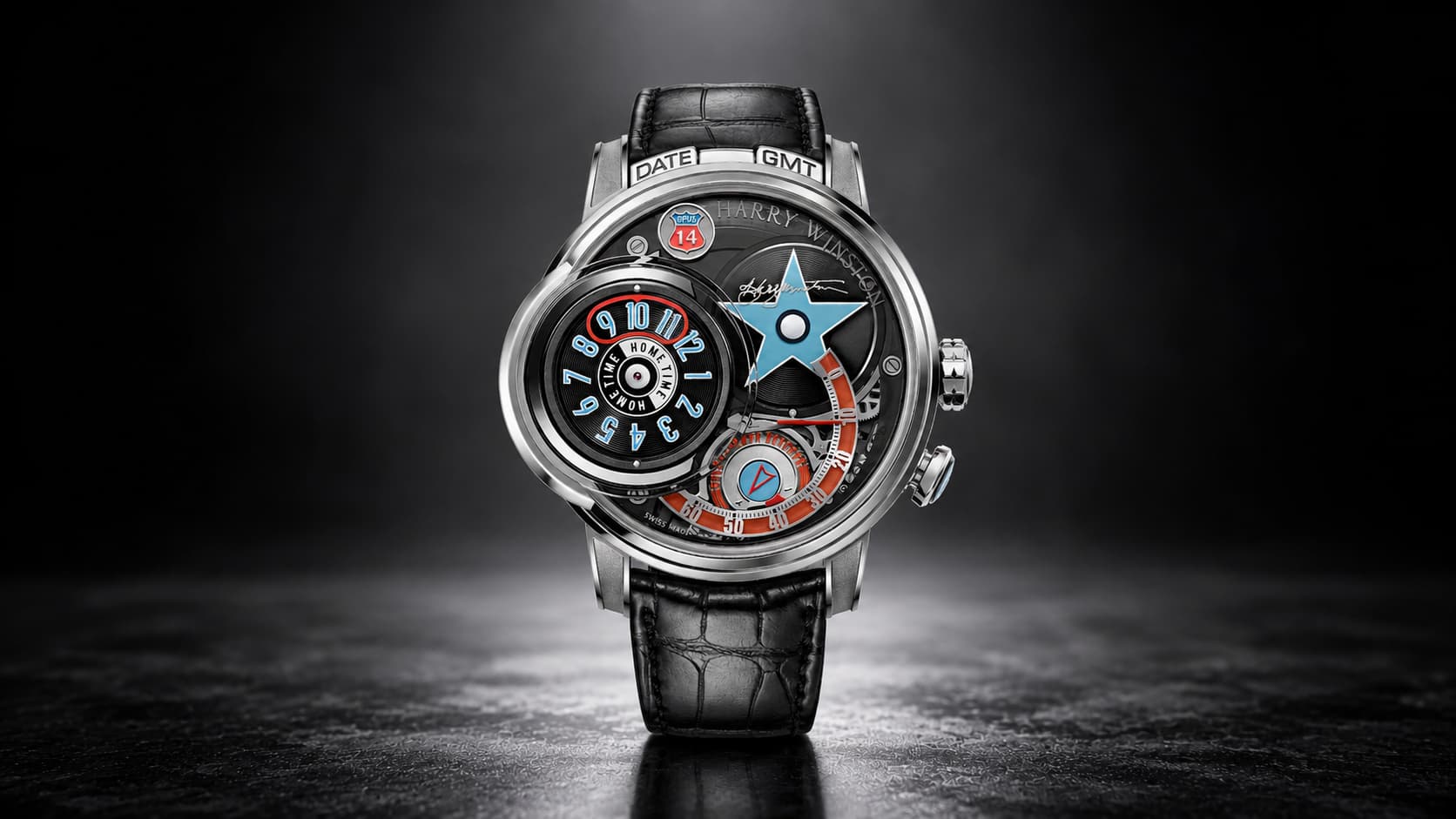
Because most Opus watches were made in extremely small numbers, sometimes fewer than fifty pieces, they rarely show up for sale and tend to sell for well into six figures at auction when they do. The final piece in the series, Opus 14, closed things out in 2015 with a large 55mm white gold case and an original list price of around 428,000 Swiss francs, or roughly $407,000. These aren’t watches most people will ever own, but they’re the clearest example of what Harry Winston is capable of when it isn’t holding back.
The Premier Collection: Harry Winston’s First Watches
The Premier is Harry Winston’s very first watch line, and it’s built for women who want a dressy piece with a distinctive shape. Launched in 1989, the Premier has a rounded case with three small lugs connecting to the strap, plus dials often decorated with flowers, animal motifs, or lace-like patterns rather than plain numbers.
The Premier comes in several variations, including simple two-hand models, small-seconds versions, moon phase editions, and chronographs with subdials for timing events. Harry Winston designs the Premier exclusively for women, and it remains the collection the brand most often points to when describing its own house style, since the shape and decoration have stayed recognizable across more than three decades. New Premier watches typically sell for somewhere between roughly $15,000 and $40,000 depending on the metal, complications, and how much diamond-setting is involved, with rarer limited editions running well beyond that. Because it’s the oldest watch line the brand makes, it’s also the collection that best represents the original Harry Winston approach: treat the watch like a piece of jewelry first, and a timekeeping instrument second.
The Avenue Collection: Harry Winston’s Art Deco Watches
The Avenue collection stands out because of its shape, and that’s the fastest way to answer what makes it different: instead of a round case, Avenue watches are rectangular or square, inspired by the elegant, geometric look of Art Deco New York. Mother-of-pearl dials, precious metal cases, and diamond accents are common throughout the line.
Avenue watches are offered on both straps and bracelets, and the collection includes small-seconds, two-hand, and moon phase versions. There’s also a variant called Avenue Squared A2, which leans even further into a bold, architectural case shape. Prices for Avenue watches tend to be more approachable than some of Harry Winston’s other lines, often starting in the $5,000 to $10,000 range on the pre-owned market, making it one of the more accessible entry points into the brand.
The Ocean Collection: Harry Winston’s Sport Watches
The Ocean collection answers a straightforward need: a Harry Winston watch that can handle an active lifestyle without giving up the brand’s jewelry-making expertise. Harry Winston positions Ocean as its sport-focused line, and the collection spans both men’s and women’s designs, pairing solid mechanical engineering with the same gem-setting standards found across the rest of the catalog.
Some Ocean models use a lightweight, hypoallergenic metal alloy called Zalium, which Harry Winston introduced in 2004 through a related sub-line called Project Z. Zalium is a zirconium-based alloy that is scratch-resistant, corrosion-resistant, and considerably lighter than steel, and it has since become one of the more distinctive materials associated with the brand’s sportier watches. Standout Ocean pieces include chronographs, dual-time watches for tracking two time zones, and even a triple retrograde chronograph, where the hands sweep back to zero instead of ticking around a full circle. Project Z itself has continued as a limited-edition line built around the same material, developing a following among collectors who want something technical but still unmistakably Harry Winston.
The Midnight Collection: Harry Winston’s Classic Dress Watches
The Midnight collection is Harry Winston’s answer to a simple, timeless dress watch, and its designs cross over comfortably between men’s and women’s wrists. Unlike the heavily gem-set Premier or the architectural Avenue, Midnight watches lean into clean, round cases and traditional dial layouts, making them the most classically “watch-like” pieces in the lineup.
The Midnight family includes automatic movements, big date displays, moon phase complications, skeleton dials that show off the moving parts inside, and even a tourbillon chronograph, one of the most difficult combinations to engineer in fine watchmaking. Because the design language is more restrained, Midnight watches are often considered the pick for someone who wants Harry Winston’s build quality and pedigree without the maximalist look of some of its other collections.
The Emerald Collection: Shaped Like Harry Winston’s Favorite Cut
The Emerald collection answers a design question specific to this brand: what would a watch look like if it were shaped like Harry Winston’s signature diamond cut? Launched in 2016, the Emerald collection takes its octagonal, faceted case shape directly from the emerald cut, the gem shape Harry Winston himself favored throughout his career for showing off a stone’s clarity.
The collection comes in a smaller 18mm case and a larger 33mm size introduced in 2019, available in white, rose, or yellow gold, with both quartz and automatic movements depending on the model. Dials and cases are typically set with brilliant-cut diamonds, and some versions add colored gemstones like pink sapphires. Because the whole design concept ties directly back to the founder’s personal taste in stones, the Emerald line is arguably the most literal expression of Harry Winston’s jewelry heritage translated into a wristwatch.
Talk to Me, Harry Winston: The Diamond Watch With a Story
Talk to Me, Harry Winston is a diamond-focused watch line whose name comes from a real place: “Diamonds Are a Girl’s Best Friend,” the song written for the 1949 Broadway musical Gentlemen Prefer Blondes and later made famous by Marilyn Monroe in the 1953 film version, contains a line in which the singer addresses Harry Winston by name and asks him to talk to her about diamonds. The brand turned that pop culture reference into an oval-shaped, heavily diamond-set watch collection built almost entirely around showcasing stones rather than technical complications.
Typical pieces feature an oval white or rose gold case set with hundreds of brilliant-cut diamonds, a mother-of-pearl dial, and a decorative rotating wheel near the crown engraved with the collection’s name. Functions are usually kept simple, just hours and minutes on a quartz movement, because the point of the watch is the diamonds, not the mechanics. It’s one of the clearest examples in Harry Winston’s catalog of a watch designed the way a piece of high jewelry would be.
Histoire de Tourbillon: Harry Winston’s Most Complex Watches
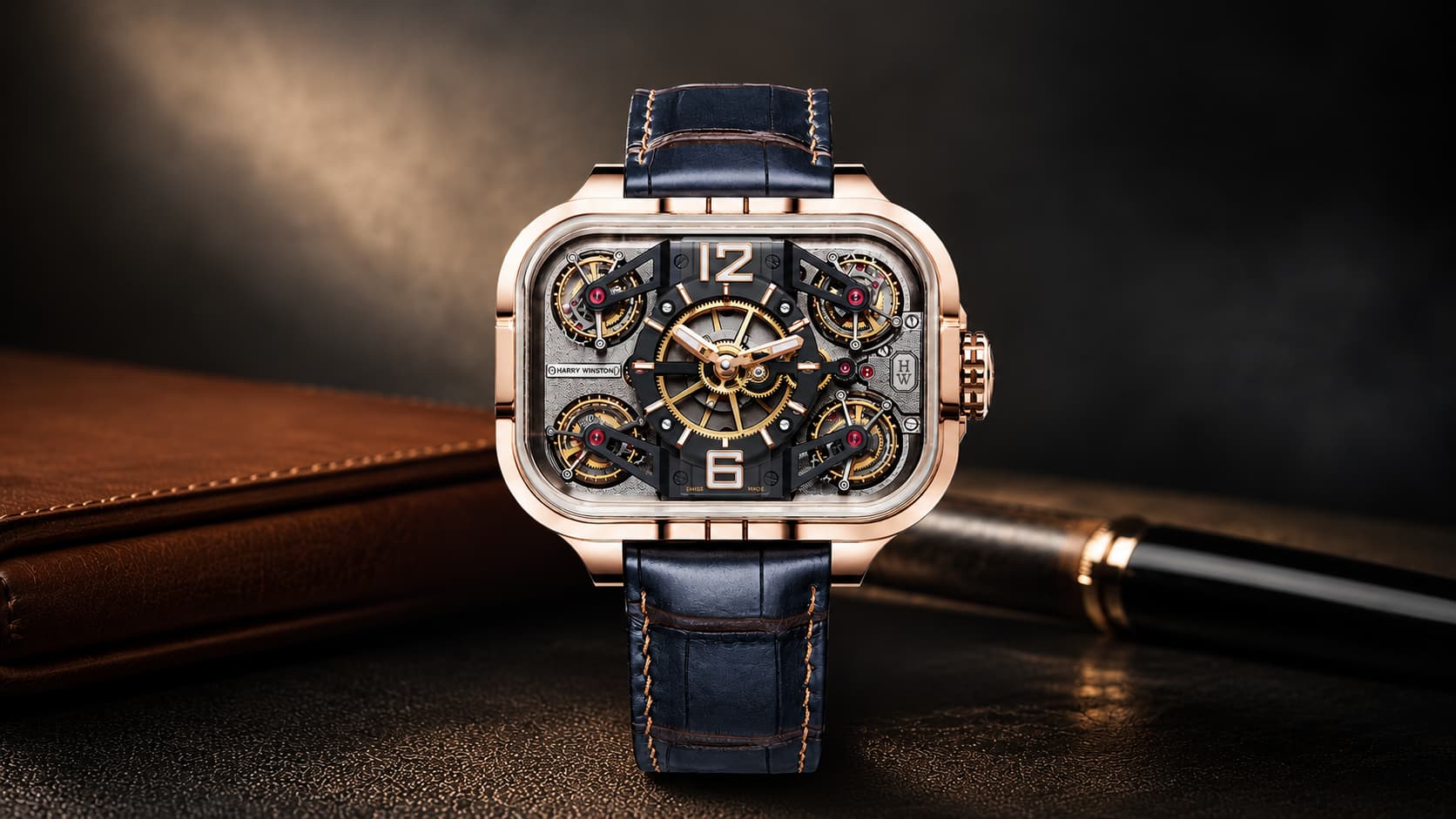
If the Opus series first proved Harry Winston could do serious high-end watchmaking, the Histoire de Tourbillon collection is what happened next. Growing out of the same spirit of collaboration with outside watchmakers, this series focuses specifically on tourbillons, a complex mechanism designed to counteract the effects of gravity on a watch’s accuracy, along with other advanced complications.
The line launched under the same creative direction as the later Opus watches and continued even after the Opus series wound down in 2014, with the Histoire de Tourbillon 10 arriving in 2019. These watches are less well known among casual watch fans than the Opus pieces, but among people who care about mechanical complexity, they’re considered every bit as impressive. Cases have used unusual material combinations, including 18k white gold paired with Zalium, and pieces from this collection regularly sell at auction for over $100,000.
Notable Harry Winston Watches Worth Knowing
Across all these collections, a handful of individual watches stand out even within the world of Harry Winston, either for what they proved was mechanically possible or for how much jewelry-making went into a single piece. A few of the most notable pieces include:
- Opus 1 (2001) — The watch that started the whole series, designed with François-Paul Journe and built around the physics of resonance. It set the tone for every Opus collaboration that followed.
- Opus 14 (2015) — The final Opus release, with a large 55mm 18k white gold case, limited to 50 pieces, and an original list price of roughly $407,000. It closed out fourteen years of collaboration with independent watchmakers.
- Histoire de Tourbillon 10 (2019) — The most recent entry in this series, notable for becoming the world’s first watch built with four separate tourbillons in a single movement, a genuine mechanical milestone.
- Premier Ladies 36mm, fully diamond-set — A version of the Premier built with more than 600 baguette-cut diamonds and 5 brilliant-cut diamonds across an 18k white gold case, priced around $545,000 when new. It’s a good example of how far Harry Winston will push a “regular” collection when a client wants maximum sparkle.
- Signature 7 — A high jewelry timepiece carrying a total of nearly 35 carats of diamonds, designed to look more like a diamond bracelet that happens to tell time than a conventional watch.
These aren’t pieces most collectors will ever handle in person, but they show what Harry Winston is willing to attempt at the very top of its range, and they serve as a useful reference point when comparing more attainable models within the same collections.
Where Are Harry Winston Watches Made?
Harry Winston’s watches are designed and produced in Geneva, Switzerland, even though the brand’s jewelry business and corporate headquarters remain in New York City. The company opened its own dedicated watch manufacture in Geneva in 2007, a move that let it bring more design and quality control in-house rather than relying entirely on outside partners for every step.
That said, Harry Winston has always been open about working closely with independent watchmakers and specialist suppliers rather than claiming to build every component from scratch, which is part of why the Opus series worked so well in the first place. The jewelry-setting itself is still handled by craftspeople trained in the house’s Fifth Avenue traditions, while the mechanical side benefits from being based in the city most associated with fine watchmaking anywhere in the world.
How Much Do Harry Winston Watches Cost?
Harry Winston watch prices vary enormously depending on the collection, materials, and how much diamond-setting is involved, but as a general guide, entry-level pieces start around $5,000 to $10,000 and climb well past six figures for complicated or limited-edition models. A rough breakdown by collection:
| Collection | Style | Typical New Price Range |
|---|---|---|
| Avenue | Rectangular, Art Deco-inspired | $5,000 – $15,000 |
| Emerald | Octagonal, emerald-cut inspired | $8,000 – $20,000 |
| Ocean | Sporty, unisex | $8,000 – $70,000 |
| Midnight | Classic, round dress watch | $10,000 – $40,000 |
| Premier | Feminine, decorative dials | $15,000 – $60,000 |
| Talk to Me | Oval, diamond-focused | $20,000 – $50,000 |
| Histoire de Tourbillon / Opus | High complication, limited edition | $100,000 and up |
These figures shift with market conditions and specific references, especially on the pre-owned market where scarcity can push certain models well above their original retail price.
Why Harry Winston Watches Are Unique
The short answer is that Harry Winston builds watches the way a jeweler builds jewelry, not the way a traditional watch manufacturer builds a watch. Most Swiss watch brands started with movements and mechanics and added decoration later. Harry Winston did the opposite: it spent decades mastering rare gemstones and only started making watches in 1989, more than fifty years after the company was founded.
That order of operations shows up in the finished product. Even the brand’s most mechanically complex watches, like the Opus and Histoire de Tourbillon pieces, grew out of close partnerships with outside watchmaking specialists rather than being developed entirely in isolation. The result is a lineup where gem-setting, case design, and mechanical ambition all get equal attention, a different balance than most watch-first Swiss houses strike.
Frequently Asked Questions
Is Harry Winston a good watch brand?
Yes. Harry Winston is respected both for its jewelry-level gem-setting and for genuinely complicated watchmaking, especially through the Opus and Histoire de Tourbillon collections, which involved collaborations with some of the most skilled independent watchmakers in the industry.
Who owns Harry Winston now?
The Swatch Group, the largest watch manufacturer in the world, has owned Harry Winston since 2013, when it completed an acquisition worth roughly one billion dollars. The brand kept its own design team and New York jewelry heritage after the deal.
What is the most famous Harry Winston watch?
The Opus series is the most famous line of Harry Winston watches among collectors, largely because of its unusual collaborations with outside independent watchmakers and the extremely limited production numbers, which have driven strong demand at auction.
Are Harry Winston watches a good investment?
Limited-edition pieces from the Opus and Histoire de Tourbillon collections have held or increased their value at auction over time, but like most luxury watches, this depends heavily on the specific reference, condition, and market demand at the time of sale, so it shouldn’t be treated as a guaranteed return.
What’s the difference between the Opus and Histoire de Tourbillon collections?
The Opus series ran as fourteen distinct, standalone watch designs from 2001 to 2015, each created with a different outside watchmaker, while the Histoire de Tourbillon collection focuses specifically on tourbillon movements and has continued as an ongoing numbered series past the point where Opus concluded.
Conclusion
Harry Winston’s watchmaking story is really a story about a jeweler refusing to make ordinary watches. From the boundary-pushing Opus series to the quietly classic Midnight line, every collection reflects the same starting point: decades of expertise in rare stones applied to timekeeping rather than the other way around. The Opus and Histoire de Tourbillon pieces are where the brand’s reputation in serious mechanical watchmaking was actually earned, while the Avenue, Ocean, and Midnight collections carry that same jewelry-house DNA into more wearable, attainable territory. Either way, a Harry Winston watch is never just a watch, it’s a jeweler’s take on one.