Department store watch counters often carry pieces with the word “Valentino” written across the dial, and it’s easy to assume they came straight from the same design house that dresses Hollywood’s biggest stars. The truth is a lot more tangled than that. The name “Valentino” has been licensed, shared, and fought over by more than one company over the decades, but there was one short, well-documented chapter when the actual fashion house — the one founded by designer Valentino Garavani — put its name on a genuine luxury watch collection. That chapter is worth understanding on its own, separate from the wider question of who else makes watches carrying the Valentino name today.
Did Valentino Ever Really Make Watches?
Yes, but only for a few years. Between 2007 and 2011, Valentino S.p.A. — the actual Rome-based fashion house — partnered with the American watchmaker Timex Group to design, produce, and sell a genuine luxury collection called Valentino Timeless.
This wasn’t a case of a factory somewhere slapping a famous name onto a cheap movement. Timex Group had a dedicated luxury division, and it built Valentino Timeless as a proper high-end product, with pieces retailing anywhere from around $1,000 up to $15,000. The watches were sold in Valentino’s own boutiques around the world, not just at random retailers, a sign the fashion house treated the category seriously while it lasted.
How Valentino Started Making Watches
Valentino’s relationship with watches actually started a few years before Timeless, though most people have never heard of the first attempt. Both chapters matter, since collectors sometimes confuse the two.
The First Try: A Deal With Sector Group
In 2002, Valentino signed a five-year licensing agreement with the Sector Group to produce watches under its name. This earlier venture never became a major part of the brand’s identity and gets far less attention today than what came after it. It mostly served as a warm-up act, proving there was appetite for a Valentino-branded timepiece before the fashion house tried again with a bigger partner a few years later.
The Real Deal: Timex Group and the Timeless Collection
The partnership that actually mattered began in 2007, when Valentino signed a licensing contract with Timex Group specifically aimed at high-end watchmaking. The plan combined Valentino’s fashion design sensibility with Timex’s manufacturing and development capabilities, with the stated goal of building lasting leadership in the global watch market.
The collection quietly debuted at Baselworld, the major Swiss watch fair, in April 2008, then rolled out to boutiques that fall. Timex Group’s luxury division — which handled production through a Swiss-based subsidiary — put real investment behind it. At its peak, Valentino Timeless reached roughly 50 countries and was stocked in 52 Valentino boutiques worldwide.
A watch collection carried in a fashion house’s own boutiques, alongside its clothing and handbags, is a strong signal that a brand sees the category as core to its identity rather than a side project.
What Did Valentino Timeless Watches Look Like?
The Timeless collection leaned into elegance over sport, which made sense given Valentino’s reputation for eveningwear and red-carpet glamour. Retail prices ranged from about $1,000 to $15,000, positioning the line firmly in luxury territory rather than the accessible fashion-watch space that most licensed brands occupy.
Stefano Sassi, Valentino’s chairman and CEO at the time, described watches as an extension of the same evening look the brand was known for in clothing and jewelry, meant to complete the full Valentino wardrobe rather than exist as a separate accessory line. That framing matters, because it explains why the watches were designed to be worn as jewelry-adjacent pieces, often paired with diamonds and precious metals, rather than as tool watches built around a particular sport or activity.
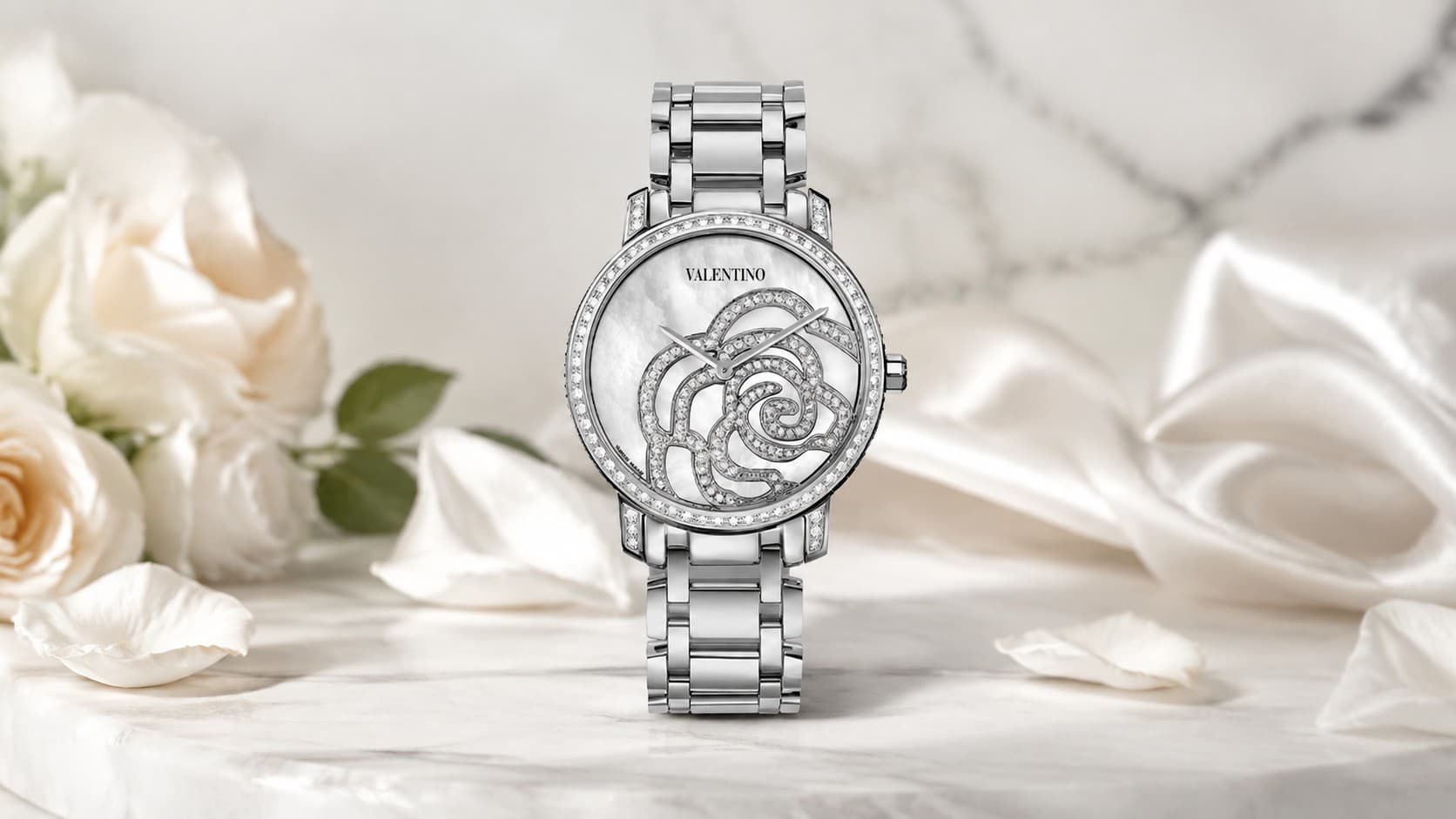
One standout piece shows how far the collection leaned into that jewelry-first approach: the Timeless “Rose” model, a round watch built around a mother-of-pearl dial carrying Valentino’s signature floral motif, with diamonds worked into the flower shape itself, the bezel, and the lugs. It came in more than one finish: an all-white steel edition, a rose-gold-plated edition, and a darker version using a black case and strap paired with black diamonds instead of white ones. The Rose was distinctive enough to earn a place among the watches submitted to the Grand Prix d’Horlogerie de Genève, the watch industry’s most prestigious annual awards, which is a detail collectors sometimes point to as proof the collection was taken seriously by people inside watchmaking, not just by fashion buyers.
The collection wasn’t only dresswatches for women, either. A separate model called Timeless “Prestige” was also entered into the GPHG. Buyers could choose between a chronograph version for added functions or a simpler time-and-date version, both built around the same sophisticated dial design. That split matters for anyone trying to size up a Timeless watch today: some surviving pieces from the line turn up described as Swiss quartz and others as Swiss automatic (self-winding), so a Valentino Timeless watch running without a battery isn’t automatically suspicious on its own. It would, however, be worth confirming against the caseback and paperwork rather than taken on faith, since movement claims on resale listings aren’t always reliable.
Why Did Valentino Stop Making Watches?
The short answer is that Valentino exited the watch category entirely around 2011, and the brand has not returned to making its own watches since. Neither Valentino nor Timex Group publicly detailed a dramatic falling-out, and the most likely explanation is a mix of ordinary business reasons: licensing deals in fashion routinely run their course, get renegotiated, or simply aren’t renewed once both sides evaluate performance.
It’s also worth remembering the timing. Valentino Garavani himself stepped back from the fashion house’s creative direction in 2007, right as the Timeless deal was getting underway, and the years that followed brought new ownership and new creative leadership to the brand. A period of that much internal change is exactly when a smaller category like watches tends to get quietly wound down, even if it was performing reasonably well.
How to Spot a Real Valentino Timeless Watch
The fastest way to check a Valentino watch’s origin is the caseback and paperwork. Genuine Timeless pieces from the Timex Group era typically carry markings referencing Timex Group’s production, along with a certificate of authenticity issued at the time of sale.
Several details separate a genuine piece from a guess:
- Caseback markings referencing the manufacturer, rather than a blank or unbranded caseback.
- Original paperwork or a warranty booklet, since these were sold as luxury items and typically came with documentation.
- Boutique or authorized dealer provenance, since Valentino sold Timeless directly through its own stores rather than mass retailers.
- A production window of 2008 to 2011, since anything claiming to be “new” Valentino Garavani watch stock outside that window deserves a closer look.
A watch missing those signs, especially one bought somewhere that mostly sells fashion accessories rather than fine watches, is worth treating with skepticism, since other companies unrelated to the fashion house have also used the Valentino name on watches over the years.
Valentino Garavani’s Personal Watch Style
Away from his own brand’s short-lived watch line, Valentino Garavani was known personally as a serious watch and jewelry enthusiast, often layering pieces together rather than sticking to one at a time. Photos from throughout his career show him wearing classics from Cartier, including a Cartier Tank captured on his wrist in 1968, along with gold jewelry-style watches from houses like Piaget. He was known for pairing bold jewelry with otherwise restrained, tailored clothing, treating watches as part of the same statement his suits and scarves made.
Valentino Garavani passed away in January 2026 at his home in Rome at the age of 93, closing the chapter on one of fashion’s most recognizable personal legacies. His personal taste in watches — glamorous, layered, unapologetically dressy — lines up closely with how the Timeless collection under his name was designed a decade earlier.
Is a Valentino Timeless Watch Worth Buying?
For a collector or fan of the brand, a genuine Valentino Timeless piece can be an interesting curiosity: a real, verified product from a major fashion house’s only real attempt at luxury watchmaking. Because production only ran for about four years, total volume is relatively limited compared to brands that have made watches continuously for decades.
That said, buyers should go in with realistic expectations. Timeless watches weren’t built by an in-house Swiss manufacture with its own movements; they were produced through Timex Group’s luxury division, which is a very different pedigree from a brand like Cartier or Piaget that Valentino Garavani personally wore. The collection’s GPHG entry shows the design side was genuinely ambitious, but that’s a separate thing from the kind of in-house mechanical engineering that drives long-term value in the watch world. The real value in owning one comes from its rarity and its connection to the fashion house’s brief history in the category, not from mechanical complexity or investment-grade resale potential.
Frequently Asked Questions
Does Valentino still make watches?
No. The fashion house’s only genuine watch line, Valentino Timeless, ended around 2011, and Valentino has not launched another in-house watch collection since. Any current watches using the Valentino name come from separate, unrelated companies rather than the fashion house itself.
Who owns Valentino now?
Valentino S.p.A. is majority owned by Mayhoola for Investments, a Qatari investment fund that acquired the brand in 2012. Alessandro Michele has served as creative director since 2024, following Pierpaolo Piccioli’s exit from the role.
Are Valentino Timeless watches considered luxury watches?
They were positioned and priced as luxury pieces at the time, retailing between roughly $1,000 and $15,000 and sold through Valentino’s own boutiques. They weren’t built with the kind of in-house Swiss watchmaking that defines the very top tier of the industry, but they were a legitimate, well-documented luxury fashion watch line rather than a cheap knockoff.
What happened to Valentino Garavani, the designer?
Valentino Garavani retired from his fashion house’s creative direction in 2007 and passed away in January 2026 at the age of 93. He remained a visible public figure in fashion for years after retirement, known for his personal style and long partnership with Giancarlo Giammetti.
Where were Valentino Timeless watches made?
Production was handled through Timex Group’s luxury watch division, operating through a Swiss-based subsidiary, Timex Group Luxury Watches B.V., which managed manufacturing for the collection.
Conclusion
Valentino’s story in watchmaking turns out to be short but real: a genuine four-year run built through a serious partnership with Timex Group, sold in the brand’s own boutiques, and priced like the luxury eveningwear house it was designed to complement. It ended quietly around 2011 and was never revived, which makes any authenticated Timeless piece today a small, verifiable window into a fashion house’s one real attempt at horology, rather than a mass-produced accessory with a famous name stamped on top.