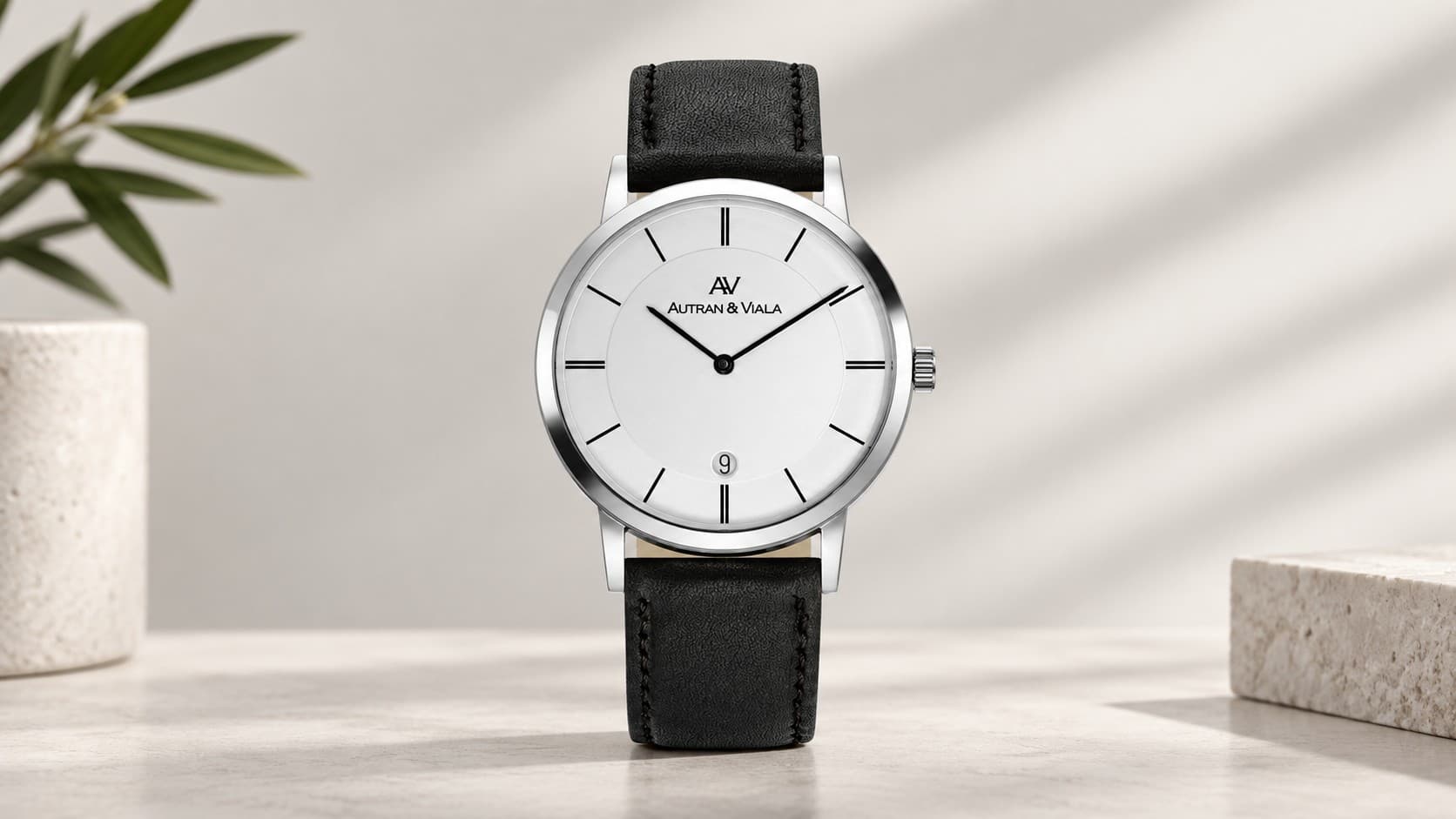
Autran & Viala is not a household name like Rolex or Omega, but that is kind of the point. This small German brand builds simple, clean watches in the same town that has made watches and jewelry for over 250 years. It offers well-made timepieces that skip the loud logos and the heavy price tags of bigger luxury names, built instead around honest German case-making and dependable Swiss movements.
The Company Behind Autran & Viala Watches
Autran & Viala is made by Ickler, a family-run watch case manufacturer based in Pforzheim, Germany. Karl Ickler started the company in 1924 as a maker of watch cases for other brands, and the business stayed in family hands from there. Today it sits under the direction of the third generation, Thomas Ickler, with his children Lisa and Raphael helping run the group’s different watch labels.
Ickler makes several brands under one roof, and Autran & Viala is one of four. The others are Archimede, known mostly for pilot watches, Limes, and Defakto. Because they all come out of the same factory, they share the same case-making know-how, even though each brand has its own personality. Autran & Viala leans toward dressier, quieter designs, while Archimede is the more adventure-and-aviation focused sibling.
The brand name is a nod to Pforzheim’s own watchmaking origin story. In 1767, the Grand Duke of Baden gave a watch entrepreneur named Jean-François Autran permission to open a factory in the town, and that single decision helped turn Pforzheim into one of Germany’s most important centers for watches and jewelry. Autran & Viala, as a modern brand, was launched by Ickler in 2009, borrowing that history for its name while building genuinely new watches.
Pforzheim earned the nickname “Goldstadt,” or Gold City, because of how much of Germany’s fine jewelry and watch case production has come out of its workshops since the 1700s.
Before Ickler built its own brands, it spent decades as a supplier, making watch cases for other companies rather than selling watches under its own name. That changed in the 1990s, when the family started putting its own name on finished watches, first with Limes and later with Archimede, Autran & Viala, and Defakto. This background matters for buyers, because it means Autran & Viala’s case-making experience did not start in 2009. It goes back to a factory that has been shaping steel and stamping cases for a full century.
Why Autran & Viala Uses Bauhaus Design
Bauhaus design means a watch dial that only shows what you actually need. No extra decoration, no clutter, no busy patterns. Just clear numbers, clean hands, and enough contrast to read the time at a glance.
The Bauhaus art and design movement started in Germany in 1919, founded by the architect Walter Gropius, and it followed one simple rule: form should follow function. A century later, that idea still shows up clearly in watches like Autran & Viala’s Plano Bauhaus, which uses a plain black-and-silver dial, a small seconds hand, and classic Bauhaus-style lettering instead of fancy numerals. There is nothing on the dial that does not need to be there, which is exactly the goal.
This style works well for a watch because a watch has one main job: showing the time quickly and clearly. A cluttered dial can actually get in the way of that job, so Bauhaus design and watchmaking make a natural pair. That is also why other German brands, including Ickler’s own Defakto, and famous names like Junghans and Nomos, keep returning to this same stripped-down look decade after decade. It rarely goes out of style because it was never really a trend to begin with, more of a permanent design principle.
The Best Autran & Viala Watch Collections
Autran & Viala’s lineup is small compared to big brands, which makes the collections easier to tell apart at a glance.
Plano
The Plano is the brand’s flagship minimalist line, built around the idea that a dial should show only what a wearer actually needs and nothing more. Within the family, the Plano Bauhaus sticks to the strict black-and-silver, no-frills look, the Plano Pur pares things back even further to little more than hands and a date window, and a third variant aims for a touch more formality with slim tapered hands and applied numerals instead of printed ones, offered in either plain steel or a warmer rose-gold-finished case. All of them share one practical detail: a Swiss quartz engine inside, so none of them ever need winding or thought given to accuracy.
Cartouche
Where the Plano looks forward, the Cartouche looks back. Its face is stamped with a fine engine-turned pattern, the crown has the rounded, old-fashioned shape often called an “onion” crown, and the bezel edge is milled with small ridges rather than left smooth, three touches lifted straight from mid-century watch design. It is also the one model in the lineup that swaps the usual quartz battery for a self-winding Swiss mechanical engine, and the maker leaves a window in the case back so that mechanism is visible rather than hidden away. At 38mm across, it sits at a size that suits most wrists without looking oversized.
NightFlight
The NightFlight exists for one job: staying legible when the light is bad. Its face carries oversized, heavily lumed markers rather than delicate printing, the kind of dial built for a cockpit or a dark trail rather than a boardroom. Ickler builds the 38mm case in-house and tops it with scratch-resistant sapphire, and buyers can choose between a version that runs on a self-winding mechanism or one built around a battery-powered quartz engine, depending on which listing is selected.
Opera
The Opera trades practicality for polish, aimed at someone who wants a watch for a suit rather than a hike. The dial layout puts the day’s date in its own window near the top and tucks a small running-seconds indicator near the bottom, a classic arrangement that dates back to pocket watches, while tall Roman numerals and thin pointed hands keep the whole thing legible despite the extra busy-ness compared to the Plano. The case itself is polished steel, finished with a crystal treated to cut down on glare so the dial stays readable indoors under bright lighting.
Sport
The Sport is the one model built with rougher treatment in mind. Ickler rates its case to 10 ATM of water resistance, roughly the same as 100 meters, which covers swimming, showering, and being caught in the rain without a second thought, though it stops short of scuba-level protection. Inside sits a self-winding Swiss movement, and the case ships ready for either a softer leather band or a metal bracelet fitted with a clasp designed not to pop open by accident.
Autran & Viala Watch Movements Explained
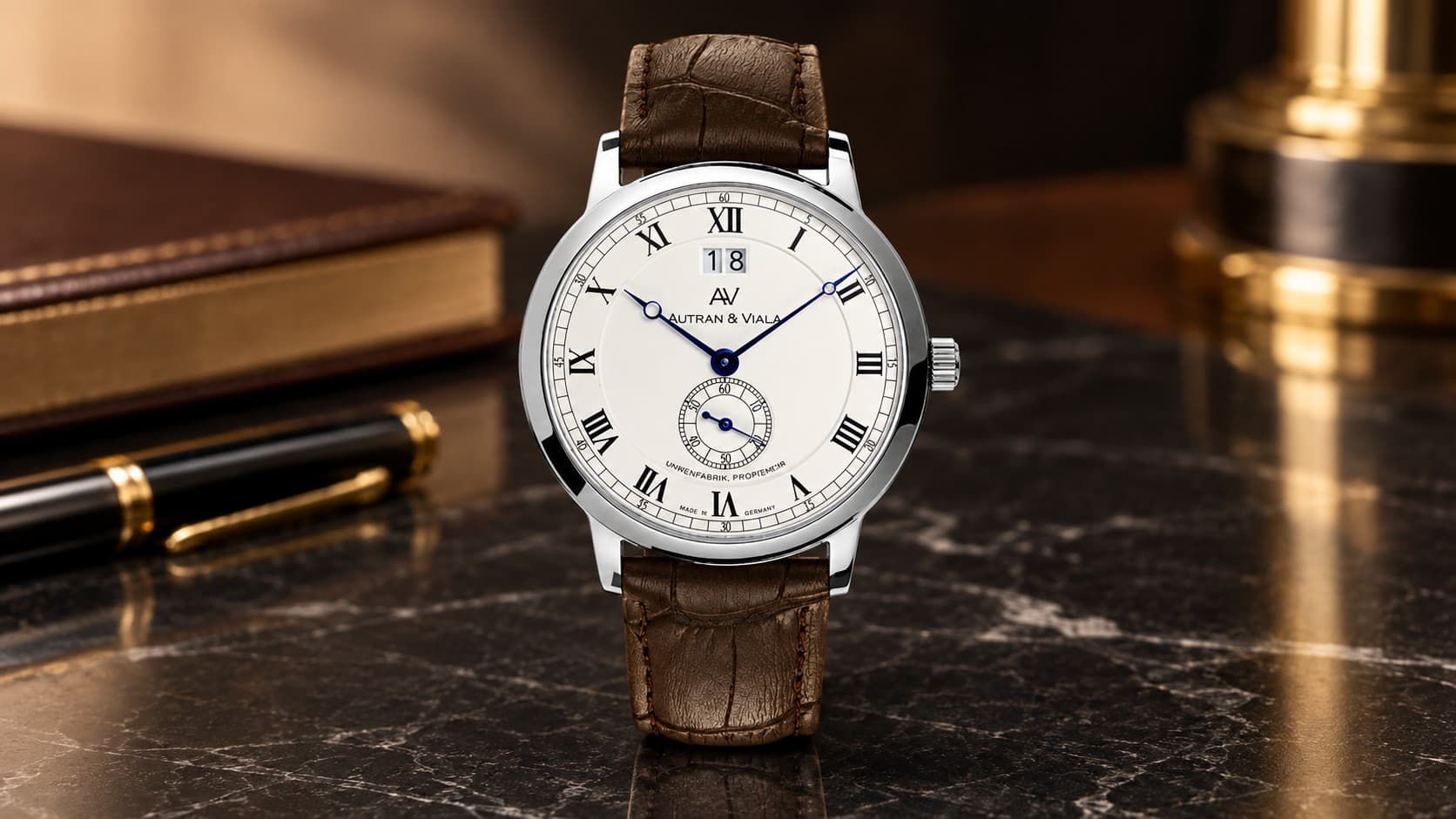
Autran & Viala watches use Swiss-made movements, not movements made in-house in Germany. Depending on the model, that means either a Swiss quartz movement, often from Ronda, or a Swiss automatic movement, most commonly the SW200 made by Sellita.
This matters because the movement is the engine of a watch. Swiss quartz movements are known for being accurate and low-maintenance, needing only a battery change every couple of years. Swiss automatic movements, on the other hand, wind themselves using the natural motion of your wrist and are a favorite among people who enjoy traditional mechanical watchmaking. Autran & Viala pairs these proven Swiss engines with cases built entirely in its own German factory, which is a common and sensible approach among smaller watch brands that focus their in-house resources on case-making rather than movement production.
The SW200 used in models like the Cartouche is a movement that shows up in watches from dozens of independent brands, not just Autran & Viala. Sellita, the company that makes it, built the SW200 as an alternative to the ETA 2824-2 movement after ETA’s parent company grew reluctant to keep supplying movements to brands outside its own group. The SW200 typically runs at 28,800 vibrations per hour, holds 26 jewels, and offers a power reserve of roughly 38 to 41 hours, meaning a fully wound watch keeps running for about a day and a half after it comes off the wrist. It has become such a standard choice that it now powers watches ranging from a few hundred dollars up to some priced well over a thousand.
The quartz side of the lineup typically relies on movements from Ronda, another well-known Swiss movement maker that focuses on precision battery-powered calibers. These are simpler mechanically, but they trade a small amount of horological romance for excellent long-term accuracy and very little upkeep, which suits watches like the Plano that are meant to be worn daily without a second thought.
How Much Does an Autran & Viala Watch Cost?
Confirmed pricing is limited to a handful of models, but it shows a clear pattern: simple quartz pieces sit well under €200, while the automatic Cartouche runs closer to €560. The Plano Pur, a quartz model, has been listed at around €140 including VAT. The Cartouche, with its Swiss automatic movement, was priced at €560 including VAT (€470.59 before tax) when it launched, though that figure is several years old and current pricing should be checked directly with the brand rather than assumed.
| Collection | Movement Type | Confirmed or Reported Price (EUR) |
|---|---|---|
| Plano Pur | Swiss quartz | Around €140 (incl. VAT) |
| Cartouche | Swiss automatic (SW200) | Around €560 (incl. VAT), as of its launch |
Reliable current pricing was not available for the Plano Bauhaus, Opera, NightFlight, and Sport models at the time of writing, so no specific figures are given for them here. Based on the confirmed prices above and the brand’s general market position, they are likely to fall somewhere in that same rough band between simple quartz pricing and the Cartouche’s automatic price point, but that is an estimate rather than a confirmed number, and anyone comparing exact prices should check the brand’s own site for current figures.
Autran & Viala prices are displayed on the brand’s site including EU VAT, so the pre-tax figure for buyers outside the European Union tends to run somewhat lower than the sticker price, before import duties or shipping costs are added.
Is Autran & Viala a Good Watch Brand?
Yes, for the right kind of buyer. Autran & Viala suits anyone looking for a genuinely German-made watch case, a reliable Swiss movement, and a clean design, without paying the premium that bigger heritage brands charge for their name.
It is a weaker fit for buyers chasing strong resale value or wide recognition, since Autran & Viala is still a niche name even among watch enthusiasts, and it does not have the collector following that brands like Rolex or even sibling brand Archimede have built up. It is best thought of as a well-made watch to enjoy wearing, not an investment piece.
Autran & Viala vs. Its Sister Brands
Autran & Viala shares a factory and case-making standards with Archimede, Limes, and Defakto, but each brand has a different focus. Archimede is best known for pilot and field watches built for outdoor and aviation use. Limes leans toward robust, sporty designs with a slightly bolder look. Defakto focuses on minimalist, Bauhaus-driven designs similar in spirit to Autran & Viala’s Plano line, but with its own case shapes and finishing choices.
For anyone drawn to Bauhaus-style German watches specifically, Autran & Viala and Defakto are the closest comparison within the Ickler family, since the two brands overlap the most in design philosophy while still offering different case styles and price points.
Frequently Asked Questions
Is Autran & Viala a real German watch brand?
Yes. Autran & Viala’s watch cases are designed and manufactured in Pforzheim, Germany, by the Ickler family company, which has been making watch cases since 1924. The movements inside come from Swiss suppliers, which is a common and accepted practice even among many well-known Swiss watch brands.
Does Autran & Viala make automatic watches?
Yes. Several models use Swiss automatic movements: the Cartouche runs on the widely used SW200 caliber, and Sport variants have used automatic movements such as the ETA 2824-2, depending on the exact listing. Models in the Plano collection, by contrast, run on Swiss quartz movements.
Where can I buy Autran & Viala watches?
Autran & Viala sells watches through its own website and through a small number of authorized retailers, since it is a boutique brand rather than a mass-market one. Availability can vary by country, so checking directly with the brand is the most reliable way to confirm current stock and pricing.
How big are Autran & Viala watch cases?
Case sizes vary by collection, generally landing between 28mm and 40mm depending on the model and whether it is designed for a man or a woman. The Cartouche and NightFlight, for example, use 38mm cases, while Plano models are typically offered in both a larger size for men and a smaller size for women.
Is Autran & Viala related to Archimede watches?
Yes. Both brands are made by the same German family company, Ickler, along with Limes and Defakto. They share manufacturing standards and case-making expertise, but each brand has its own design direction and target style.
The Bottom Line
Autran & Viala earns its place in the conversation about affordable German watchmaking by sticking to a clear formula: cases built in its own Pforzheim factory, dependable Swiss movements, and dial designs that trace straight back to the Bauhaus idea of function first. The Plano line covers anyone who wants clean, quiet minimalism, the Cartouche brings genuine vintage character with an automatic movement, and the Sport and NightFlight models cover more active, practical needs. None of these watches will carry the resale value of a big Swiss name, but for buyers who care more about honest German manufacturing and everyday reliability than brand status, Autran & Viala delivers exactly what it promises.