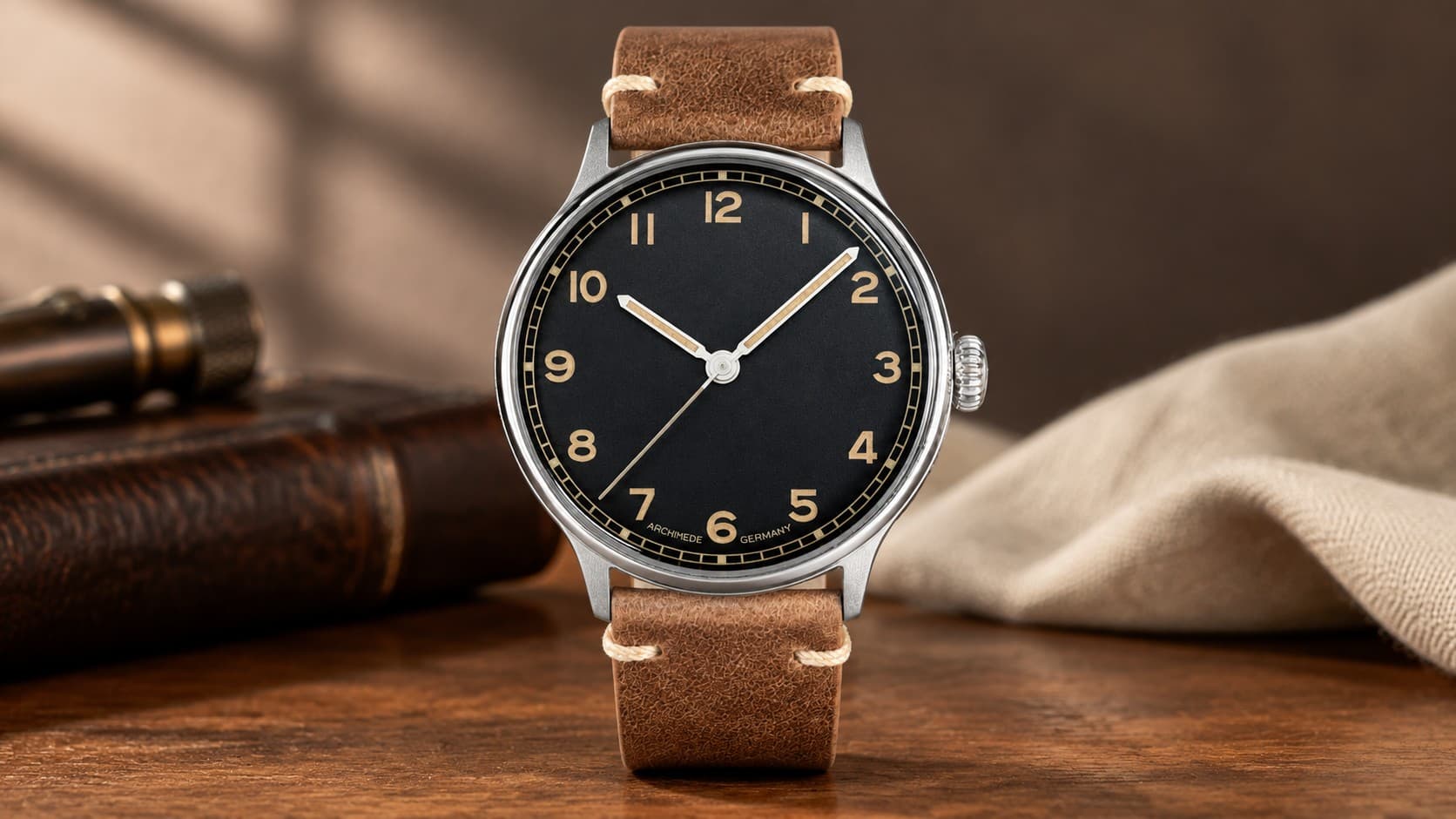
Most people have never heard of Archimede, but watch collectors know the name well. This small German brand builds sturdy, good-looking watches without a huge price tag, and it does something almost no other watchmaker does: it makes its own cases from scratch, in its own factory, in the same German city where the company has worked since 1924. That backstory explains why Archimede watches feel more solid and more carefully made than many other watches at similar prices, from the classic pilot models to the brand’s dive and dress collections.
The Secret Behind Archimede’s Quality
Archimede stands out because it makes its own watch cases in-house instead of buying them from an outside factory. Most small watch brands order pre-made cases from a supplier and just add their name to the dial. Archimede is different because the company behind it, Ickler, has been a professional case-maker since 1924, long before Archimede watches existed.
That difference matters more than it might seem. A watch case protects the delicate machinery inside, and it’s also the part a wearer touches and sees every day. When one company designs, cuts, polishes, and assembles the case itself, it can control the fit and finish far more tightly than a brand that just orders parts from a catalog. Archimede is part of the German company Ickler, which also produces Limes Watches, Autran & Viala, and Defakto, and being the house brand of a case-maker gives Archimede a real head start on quality.
Pforzheim, the city where all of this happens, has been linked to watches and jewelry since long before Archimede existed. Back in 1767, a local duke helped set up a watch factory in an orphanage so the children there could learn a trade, and the city grew into a hub for the craft from that point on. Archimede’s cases are built on top of centuries of local know-how, not invented from nothing.
Archimede’s History and Origins
Archimede watches are made by the Ickler family business in Pforzheim, Germany, a city known for centuries as a center of watch and jewelry making. Karl Ickler founded the family business in Pforzheim in 1924, building watch cases for other brands long before Archimede itself existed.
The company almost stopped during World War II, but it didn’t disappear. Karl’s sons, Heinz and Kurt Ickler, took the business back over in 1947 and worked to get the factory running again after the wartime shutdown. Ickler didn’t start making its own branded watches right away, though. For decades the company’s business was building cases for other watch brands, and it wasn’t until 1990 that it took on outside clients as a watch manufacturer in its own right, a step that eventually led to launching Limes and, later, Archimede.
Today the company is on its fourth generation of family ownership, and it still keeps nearly every step of watchmaking under one roof. Design, construction, prototypes, parts production, surface finishing, laser engraving, assembly, and quality control almost all happen in-house in Pforzheim. The Archimede brand itself is much younger than the company that builds it: the first watches carrying the Archimede name launched in 2003, as a way for Ickler to sell finished watches directly to customers instead of just supplying cases to other brands.
Archimede doesn’t design flashy showpieces. It builds honest tool watches meant to be worn, used, and passed down — not locked in a safe.
Best Archimede Pilot Watches
Archimede’s pilot watches, called “Flieger” watches, are the brand’s most famous and most popular line. They copy the clean, easy-to-read look of German aviator watches from the 1930s and ’40s, with big numbers, a large crown, and a simple black dial.
Archimede Pilot 42
The Pilot 42 is the classic starting point for the whole collection, built as a no-nonsense watch meant for daily wear rather than display. It comes in a 42mm stainless steel case built by Ickler, and depending on the version, it can be powered by different movements, including the ETA 2824-2 automatic movement. This is a movement watchmakers trust because it winds itself with wrist motion and keeps good time year after year.
One owner reviewing the Pilot 42 pointed out something refreshing about the brand: Archimede doesn’t rename the movements inside its watches to make them sound like something the company built itself. That honesty is rare in the watch world, where some brands try to obscure which parts they actually made.
A hand-wound version, called the Pilot 42 KS (“kleine sekunde,” or small seconds), also exists for enthusiasts who prefer the ritual of winding a watch by hand each morning. It uses the Unitas/ETA 6498, a large pocket-watch caliber dating back to the 1950s, sits in a slimmer 9.9mm case, and is priced around $600 to $650 before tax. A bronze version is also available, which slowly changes color and develops a unique patina the longer it’s worn.
Archimede Pilot 42 GMT
The Pilot 42 GMT adds a second time zone hand, aimed at travelers or anyone who needs to track time in a different part of the world. A red arrow-shaped hand points to a 24-hour scale printed around the edge of the dial, allowing a second time zone to be read at a glance without pressing any buttons.
Inside sits the ETA 2893-2, a movement long used in GMT watches for its mix of quality, reliability, and easy availability of parts. Reviewers have praised the watch’s slim build, noting the case measures only around 9.2 to 10.2mm thick despite housing the extra GMT function, which keeps it comfortable to wear under a shirt cuff.
Pricing generally runs from about $1,000 to $1,300 before tax, depending on the strap or bracelet chosen, whether leather, an engineer-style bracelet, or Milanese mesh. That price range is notable because GMT watches with a genuine Swiss movement and an in-house German case are hard to find for less anywhere else.
Archimede Pilot Chronograph
The Pilot Chronograph takes the classic Flieger look and adds stopwatch functions for timing anything from a workout to a commute. It keeps the same 42mm case width as the standard Pilot 42 but grows to about 13.6mm thick and 51mm lug-to-lug to fit the larger chronograph movement inside.
That movement is the ETA 7750, one of the most trusted automatic chronograph calibers in the industry, arranged in a three-register “tricompax” layout for hours, minutes, and running seconds. Reviewers have pointed out that the dial design avoids a common chronograph mistake, where the sub-dials cover up the hour numbers, keeping the watch just as legible as Archimede’s simpler pilot models.
This is the most expensive watch in the Pilot lineup, with base versions starting near $1,300 before tax. The dressier TriKompax edition, which adds blued hands and a decorated oscillating rotor, costs meaningfully more and can run past $2,000 once VAT and options like engraving are added. Even fully loaded, it tends to sit below comparable Swiss and German pilot chronographs from other brands, which commonly start at $2,000 and climb from there.
Best Archimede Dive Watches
Archimede SportTaucher
The SportTaucher is Archimede’s main diving watch, and its name literally means “sport diver” in German. It has a rotating bezel for timing dives, a screw-down crown to keep water out, and a case built for real underwater use, with water resistance rated up to 300 meters.
The case measures 41.5mm wide and only 12mm thick, a slim profile for a 300-meter diver that makes it just as easy to wear at a desk as underwater. It’s powered by either the Sellita SW200-1, a Swiss automatic movement with a 38-hour power reserve, or the closely related ETA 2824-2, depending on the batch. Long-term owners tend to describe the appeal in similar terms: it’s a plain, functional tool rather than a showpiece, and that restraint is exactly the point.
The lineup has changed gradually rather than being overhauled. A GMT-style bezel option arrived in 2014, and bronze cases were introduced later on, giving buyers a metal that darkens and develops character with wear instead of staying uniformly bright. Straps also vary by version, including genuine sharkskin leather strap options, rubber, or a stainless steel bracelet with a fold-out extension that fits over a wetsuit sleeve. Prices typically fall between about $900 and $1,250 before tax, depending on the case material and bracelet choice.
Best Archimede Dress and Marine Watches
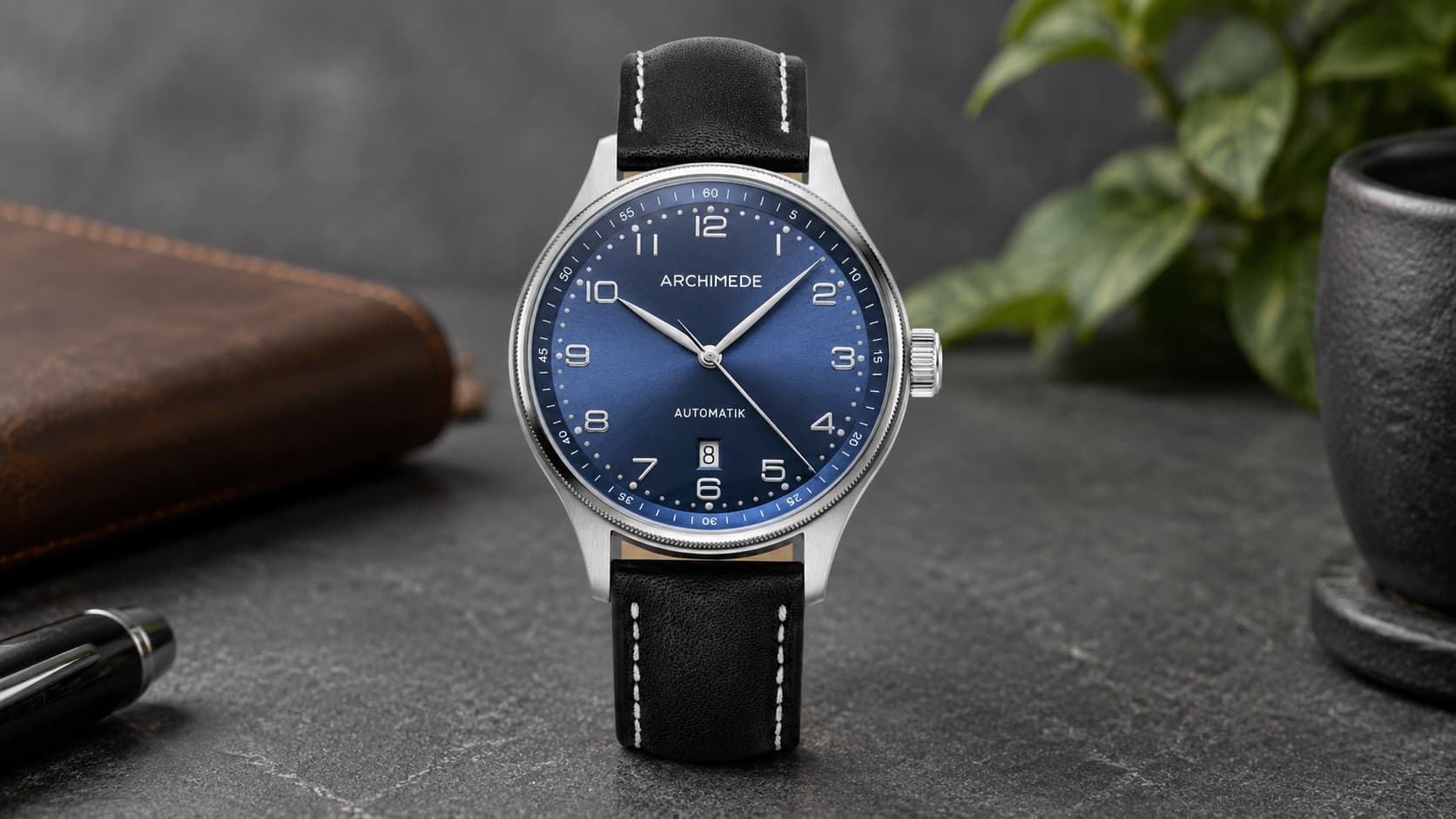
Archimede DeckWatch
The DeckWatch collection is built as a modern homage to old naval deck watches, the large hand-wound clocks that ship navigators once relied on. It has a clean, elegant face with a large crown and blued steel hands, giving it a dressier look than the Pilot or SportTaucher lines.
The DeckWatch runs on the ETA 6498 hand-wound caliber, which beats at 18,000 vibrations per hour and offers a 46-hour power reserve. It’s built in a 42mm 316L stainless steel case with a sapphire crystal on the front and a see-through case back that displays the movement in motion. One reviewer called it simply “the most beautiful watch” available for under $1,000 at the time.
The heat-blued hands on this model, a traditional technique where steel hands are heated until they turn a deep blue color, make it one of the more affordable ways to get that finish on a German-made watch. Pricing generally starts around $620 on a leather strap, drops slightly on a nylon strap, and rises to roughly $736 with a stainless steel bracelet. A black-dial version with plain luminous hands instead of blued ones is usually priced a little lower still.
Archimede Klassik
The Klassik line leans further into elegance, built for a timeless dress watch rather than a tool watch. It’s made with clean dials and polished cases, suitable for both formal occasions and daily wear.
Some newer Klassik models, like the Klassik 200, add water resistance up to 200 meters, which is unusual for a dress watch and gives it more everyday flexibility than most watches in this style category. Dial choices on the Klassik 200 run to silver, blue, and black, and the brushed-and-polished case finish keeps the classic dress-watch look intact while adding sturdier daily-wear durability.
Best Archimede Field and Outdoor Watches
Archimede OutDoor
The OutDoor line is built for rough treatment. Its standout feature is a hardened steel case, which resists scratches far better than regular stainless steel; independent testing has measured the case hardness at roughly 1,200 on the Vickers scale, well above what a typical brushed stainless case achieves. The smaller 39mm Protect version stays notably light on the wrist, with a total weight in the 75 to 125 gram range depending on the strap fitted.
Some OutDoor models also protect against magnetism, which can throw off a mechanical watch’s accuracy when it sits too close to a phone, laptop, or magnetic clasp. In these versions, a second case built into the watch shields the movement from outside magnetic fields, working on the same principle as a Faraday cage, a level of protection normally found only on watches costing several times more.
The OutDoor family also includes variety in looks, from the darker “Sahara” dial finish with a muted, vintage lume color to the fully blacked-out “OutDoor Black” with a PVD-coated case and strap. Prices generally sit between about $1,000 and $1,150 before tax, depending on the dial, bezel, and strap combination.
Which Archimede Watch Should You Choose?
Each Archimede collection serves a different kind of daily use, which makes the lineup easier to narrow down by function rather than by looks alone.
- Classic, simple aviator look: the Pilot 42, especially the hand-wound KS version, covers the traditional Flieger style at the lowest entry price in the lineup.
- A second time zone for travel or work: the Pilot 42 GMT reads two time zones at once without adding bulk to the case.
- Stopwatch functions with the pilot aesthetic: the Pilot Chronograph adds timing registers while staying just as legible as the simpler models.
- Genuine underwater use: the SportTaucher is built and rated for real diving, up to 300 meters.
- A dressier look for the office or formal events: the DeckWatch and Klassik lines trade tool-watch ruggedness for a cleaner, more elegant design.
- Heavy daily use or outdoor work: the OutDoor line’s hardened case and optional magnetic protection are built to withstand rough handling.
How Much Does an Archimede Watch Cost?
Archimede sits in a comfortable middle ground: expensive enough to include real Swiss movements and hand-finished German cases, but far cheaper than big Swiss luxury names offering similar specs. Most models fall roughly into these price ranges before tax:
| Collection | Typical Price Range (excl. VAT) | Movement Type |
|---|---|---|
| Pilot 42 (hand-wound) | ~$600–$650 | Manual wind |
| Pilot 42 GMT | ~$1,000–$1,300 | Automatic |
| Pilot Chronograph | ~$1,300–$2,000+ | Automatic |
| SportTaucher | ~$900–$1,250 | Automatic |
| DeckWatch | ~$620–$740 | Manual wind |
| Klassik | ~$700–$1,100 | Automatic |
| OutDoor | ~$1,000–$1,150 | Automatic |
Prices shift over time and depend on the strap, dial, and extra features chosen, such as a domed sapphire crystal or a metal bracelet instead of leather. Buyers outside the European Union typically pay the listed price minus VAT, though shipping and import duties can add to the final cost depending on the destination country.
Are Archimede Watches Good Quality?
Yes, and the brand’s reputation among collectors backs that up consistently. Because Ickler has manufactured watch cases professionally for a century, Archimede watches tend to have tighter tolerances and better finishing than most brands at similar prices. Independent reviewers have rated SportTaucher models a perfect five out of five for build quality, usability, legibility, and overall value for money.
The movements used across the lineup, mainly from ETA and Sellita, are proven, widely serviced calibers rather than untested house-made mechanisms. That makes finding a watchmaker to service an Archimede years down the road far easier than with a brand using rare, proprietary parts. It also means spare parts, like replacement crystals or crowns, are usually easy to source, since these movements appear across thousands of watch models worldwide.
Frequently Asked Questions
Where are Archimede watches made?
Archimede watches are made in Pforzheim, Germany, at the Ickler family factory, which has manufactured watch cases in the same city since 1924.
What movements do Archimede watches use?
Archimede mainly uses Swiss movements from ETA and Sellita, including automatic calibers like the ETA 2824-2 and ETA 2893-2, and hand-wound calibers like the ETA 6498, depending on the model.
Is Archimede owned by another watch company?
Archimede is owned by Ickler GmbH, the same German family business that also owns the Limes, Autran & Viala, and Defakto watch brands.
How much does an Archimede watch cost?
Most Archimede watches cost between roughly $600 and $1,300 before tax, with the fully optioned Pilot Chronograph TriKompax running higher, sometimes past $2,000 depending on the options selected.
Are Archimede watches water resistant enough for diving?
The SportTaucher line is built for real diving, with ratings up to 300 meters and features like a screw-down crown and a rotating timing bezel, meeting the standards divers actually rely on.
The Bottom Line
Archimede earns its reputation the unglamorous way, by making solid, honestly built watches in a real factory instead of chasing hype. The Pilot line delivers a classic aviator look at a fair price, the SportTaucher provides genuine dive-watch toughness, and the DeckWatch and Klassik lines cover anyone seeking something dressier, while the OutDoor line handles rough treatment better than most tool watches at its price. Whichever collection a buyer chooses, the case underneath comes from a company that has done nothing but make watch cases, carefully and in-house, for a full century.