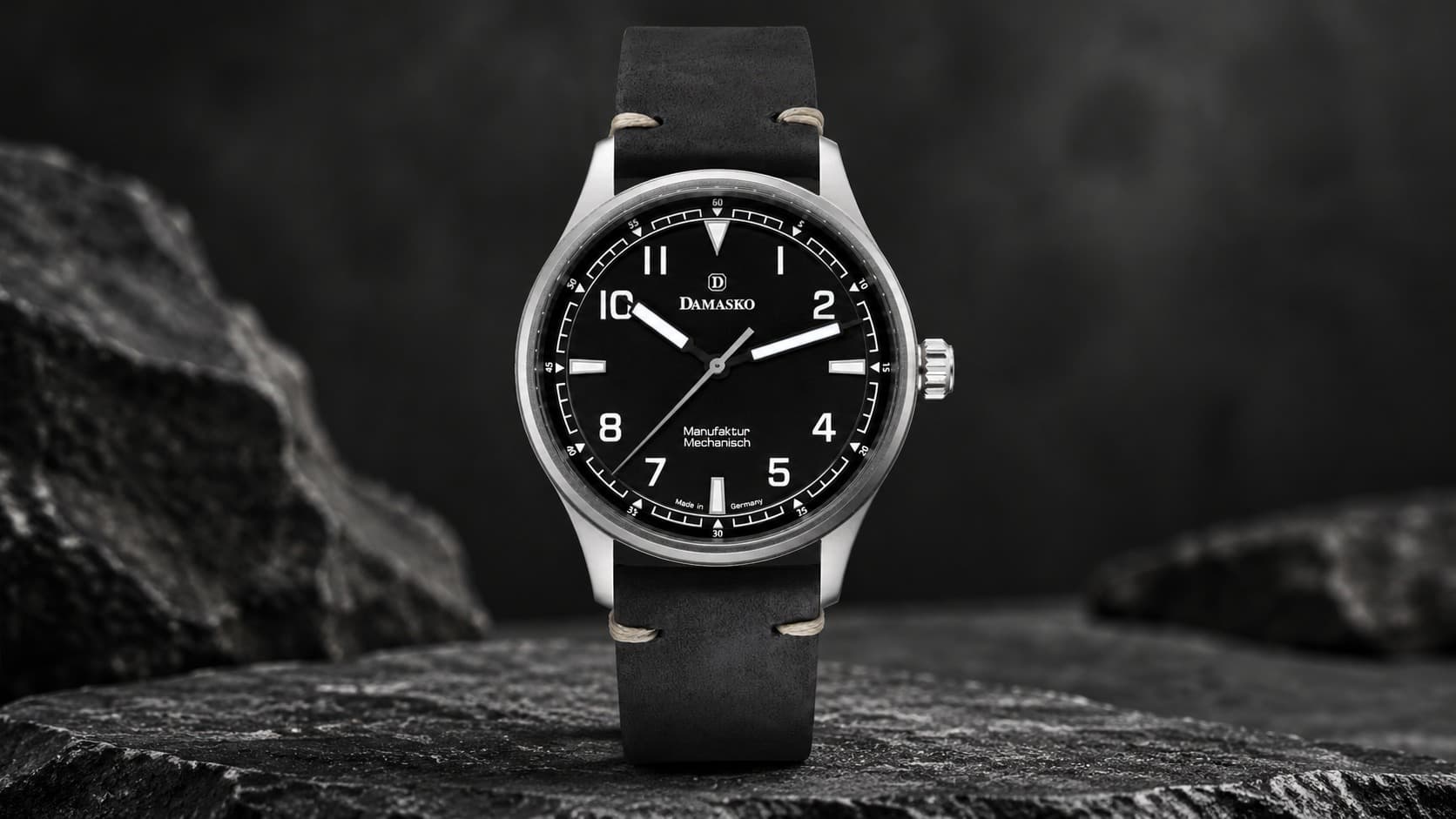
Most watch brands talk about beauty first and toughness second. Damasko flips that order. This small family company from Barbing, Germany, builds watches the way an engineer builds a tool: strong first, pretty second. That approach has earned it a loyal following among pilots, divers, and anyone who dislikes the thought of scratching an expensive watch within the first week of wearing it. Damasko’s most notable watches each solve a different problem, and the steel technology behind them explains why the brand has stayed relevant for three decades without ever chasing trends.
Damasko Watches: History and Technology
Damasko watches stand out because of a special steel the company hardens in-house, called ice-hardened steel. This metal reaches a hardness of roughly 60 to 64 on the Rockwell C scale, about four times harder than the standard 316L steel used in most watches. That extra hardness means the case resists scratches, dents, and everyday knocks far better than typical stainless steel.
The company was founded in 1994 by Konrad Damasko, an engineer who first built precision metal parts for industries like aerospace before turning his hardening process toward watches. For years, Damasko supplied hardened watch cases to the German brand Sinn, a partnership that ended in 2002 when Damasko began building and selling watches fully under its own name. The brand completed its first in-house automatic movement, the A35, in 2010, and used it in its first fully in-house watches starting in 2014, ending its full reliance on outside movement makers like ETA.
Because Damasko treats its own steel, builds many of its own components, and now runs its own movement, the brand controls almost every part of the watch. That level of control is unusual for a company its size, and it explains why Damasko watches often feel more like precision instruments than fashion accessories. The operation remains genuinely small, still run out of one factory in Barbing by a close team of family members and machinists rather than a large corporation with outsourced departments.
Damasko’s founder started out solving industrial hardening problems, not designing watches. The watches came later, almost as a side effect of solving a materials problem the right way.
Best Everyday Damasko Watch: DS30
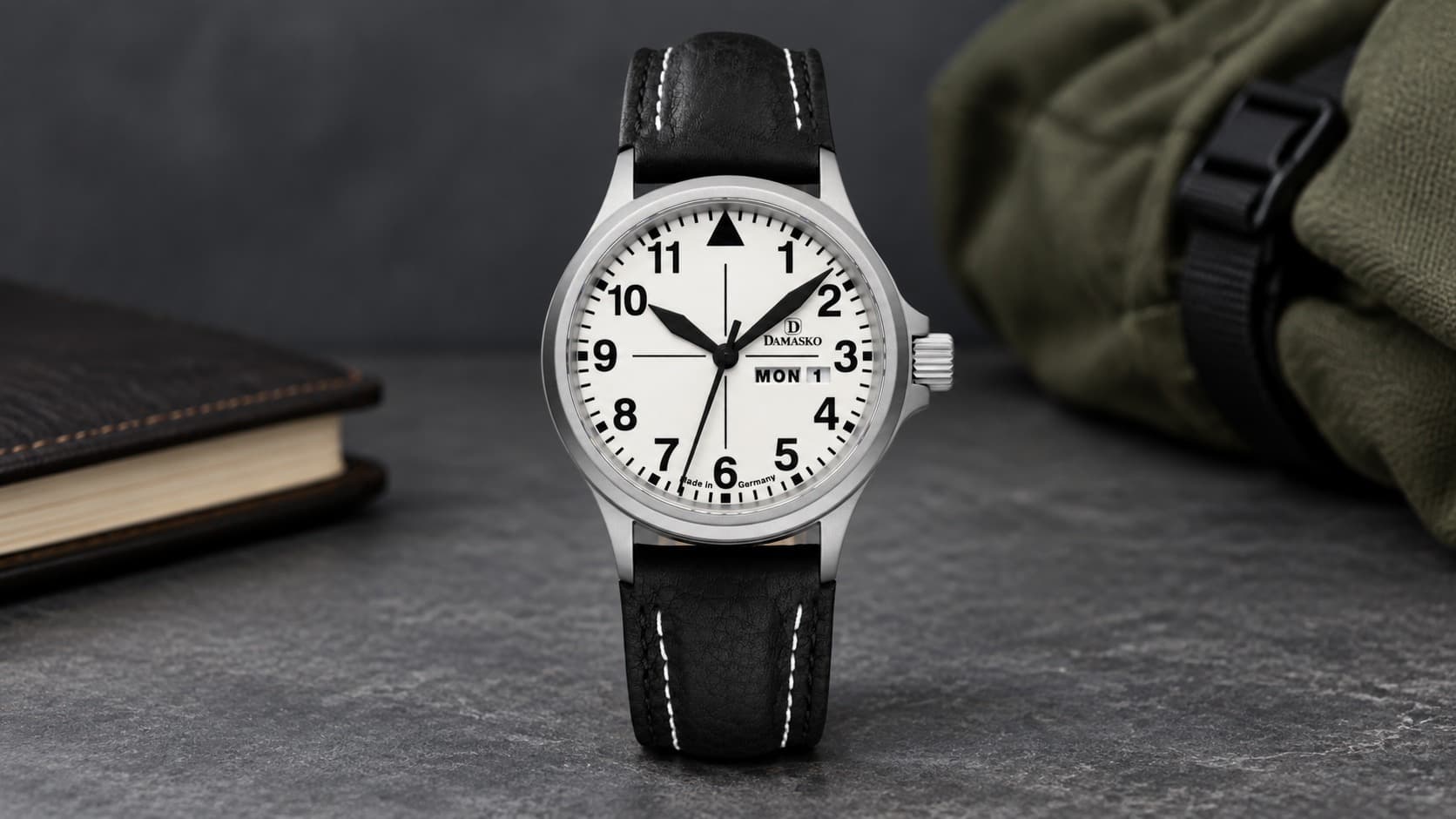
The DS30 is the most sensible entry point into the brand. It is a simple three-hand watch with a date window, sitting at the more affordable end of the Damasko lineup, with prices usually starting around $1,000.
Its appeal comes down to size and balance. The case measures a compact 39mm across and under 10mm thick, made from Damasko’s bead-blasted, surface-hardened steel, which keeps the watch scratch-resistant while still fitting comfortably under a shirt cuff. A screw-down crown and screwed case back give it roughly 200 meters of water resistance, more than enough for daily life, swimming, or showering.
The watch also skips complicated features like chronograph pushers or extra sub-dials, keeping the dial easy to read and the movement easier to service over time. It suits daily wear well precisely because it asks nothing extra of its owner.
Best Damasko Pilot Watch: DC56
The DC56 earns its reputation honestly. It became known as a watch trusted by German Eurofighter and Airbus Defence & Space test pilots, professionals who need a chronograph that will not fail under stress, vibration, or sudden temperature swings.
At its core sits the Valjoux 7750, a Swiss chronograph movement first designed in 1973 and still considered one of the most dependable stopwatch movements ever built. Damasko fits its version with a silicon escape wheel, a small part that barely wears down and stays accurate even after years of use. The 40mm case is built from the brand’s ice-hardened steel, rated to roughly 100 meters of water resistance, and shielded against magnetic fields up to 80,000 A/m, far beyond what everyday electronics could ever produce.
That reliability matters most in aviation, where a chronograph that stops mid-flight is more than a minor inconvenience. The DC56’s connection to real test pilots gives it credentials that most chronographs only claim through marketing.
Best Damasko Dive Watch: The DSub Series
The DSub line is Damasko’s answer to serious underwater use, built from what the brand calls German submarine steel and rated for deep-water pressure.
Notably, this is not the same ice-hardened steel used in Damasko’s DA and DC watches. Submarine steel is a different alloy, the same type used in real naval submarines, chosen because it stays fully non-magnetic even after long periods in seawater and resists corrosion better than standard 316L steel. Most DSub models measure around 42 to 43mm across, use a unidirectional dive bezel with ceramic ball bearings to prevent it from slipping out of position, and carry a water resistance rating of 300 meters, deep enough for any recreational or technical dive.
A standout detail is Damasko’s screw-down crown system: on most DSub models, the crown stays watertight even if it comes unscrewed by accident underwater, a safety feature few other dive watch brands can claim. Combined with the brand’s corrosion-resistant metal, the DSub also shrugs off the scratches and bangs that come from boat decks, dive gear, and rocky shorelines.
Best Damasko Chronograph Watch: DC86
The DC86 sits at the top of Damasko’s chronograph lineup. Rather than tracking elapsed minutes on a small sub-dial, its stopwatch hand sweeps around the full dial from the center, so an elapsed time under an hour can be read at a glance without checking a separate corner of the watch.
That design traces back to a legendary movement called the Lemania 5100, once used by brands like Sinn, Omega, and Heuer before it was discontinued in the early 2000s. Damasko built its own in-house C51 caliber, based on the reliable Valjoux 7750 architecture, specifically to recreate that easy-to-read center-minute layout without depending on a discontinued part that has since become hard to source. The result is a chronograph legible at a glance, even mid-timing. Housed in a 42mm ice-hardened steel case with 100 meters of water resistance and roughly 48 to 50 hours of power reserve, the DC86 sits near the top of Damasko’s price range, a reflection of the engineering behind that movement.
For collectors who already understand what Damasko does well, the DC86 represents the brand’s most refined chronograph currently offered.
Best Value Damasko Watch: The DA36
The DA36 has a strong reputation among long-time collectors for offering serious engineering at a lower price than most of Damasko’s other models. It belongs to the brand’s classic pilot-watch family, built around a simple day-and-date dial rather than a busy chronograph layout, and it wears smaller and lighter than most of Damasko’s other watches.
It also proves that Damasko does not save its best ideas only for expensive pieces. The 40mm case is still made from the brand’s ice-hardened, nickel-free steel, powered by a Swiss ETA 2836-2 movement with a 38 to 41-hour power reserve, and protected by the same screw-down crown and internal anti-magnetic cage found on pricier models. Water resistance sits at 100 meters, enough for washing hands, rain, or an accidental splash.
Because Damasko has updated and retired versions of this watch over the years, older DA-series models can sometimes be found on the secondhand market for less than newer models with similar specs, making the line a natural starting point for a tighter budget. Damasko also sells a DK-series (DK30, DK32, DK36) built on the same design language as the DA and DS watches but powered by the brand’s own in-house A26 movement instead of an ETA caliber. The higher price of the DK models reflects that in-house engineering rather than a difference in build quality.
Damasko’s Ice-Hardened Steel Explained
Ice-hardened steel is not a marketing name for regular steel. It refers to a specific heat-treatment process in which Damasko heats the steel in a vacuum, then cools it rapidly using nitrogen, a method the company developed itself rather than licensed from elsewhere.
This process lets the steel reach extreme hardness without becoming brittle, which is the hard part of hardening metal. Steel that gets too hard usually becomes easy to crack, but Damasko’s version stays tough enough to absorb impacts instead of shattering, reaching about 800 Vickers of hardness compared to roughly 200 Vickers for the standard 316L steel used in most watches. The steel is also nickel-free, which matters for people with metal allergies, since nickel is a common cause of skin reactions in jewelry and watches.
Because the hardening happens all the way through the metal rather than as a thin surface coating, the scratch resistance does not wear off over time the way a plated surface eventually can. Similar hardened alloys show up in demanding industrial applications too, including jet engine bearings and surgical instruments, a fair indication of how much abuse this material is designed to withstand.
Damasko Watch Specs Compared
| Model | Case Size | Water Resistance | Movement | Starting Price |
|---|---|---|---|---|
| DS30 | 39mm | 200m | Swiss automatic | ~$1,000 |
| DA36 | 40mm | 100m | ETA 2836-2 | ~$800 (pre-owned) |
| DC56 | 40mm | 100m | Valjoux 7750 | ~$2,000 |
| DSub series | 42–43mm | 300m | ETA 2824-2 or in-house A26 | ~$1,500 |
| DC86 | 42mm | 100m | In-house C51-6 | ~$3,500 |
These figures shift somewhat depending on the exact reference and whether a watch is purchased new or pre-owned, but the table reflects where each model generally sits within the lineup.
How to Pick the Best Damasko Watch for You
Choosing a Damasko watch comes down to matching the model to its intended use rather than to appearance alone.
| For this need… | The better choice is |
|---|---|
| A simple, tough everyday watch | DS30 |
| A chronograph with real aviation history | DC56 |
| A dedicated dive watch | DSub series |
| The most precise chronograph available | DC86 |
| The best value for the money | DA36 |
Whether a stopwatch function is actually necessary matters more than most buyers realize. A three-hand model like the DS30 or DA36 offers the same tough case without paying for buttons that go unused. Serious swimmers and divers benefit most from the DSub’s higher water resistance rating, while anyone drawn to a genuine professional backstory will find the DC56’s link to test pilots hard to match at its price point.
Frequently Asked Questions
Are Damasko watches good quality?
Yes. Damasko is respected in the watch community for building its own hardened steel cases and, since 2014, its own movements. The brand focuses on durability and precision engineering rather than flashy branding, which has earned it a loyal following among people who want a genuine tool watch.
What is special about Damasko’s steel?
Damasko uses a proprietary ice-hardening process that treats steel in a vacuum and cools it with nitrogen. This creates a nickel-free steel that reaches roughly 60 to 64 on the Rockwell C hardness scale, about four times harder than the standard steel used in most other watches.
How much do Damasko watches cost?
Prices generally start around $1,000 for simpler three-hand models like the DS30 and rise toward $4,000 for advanced chronographs like the DC86. Pre-owned models, especially older DA-series watches, can sometimes be found for less.
Does Damasko make its own movements?
Yes, but only since 2014. Before that, Damasko relied on movements from outside suppliers, similar to many independent watch brands. Its first in-house movement was the A35, and the brand later added the A26 as a second in-house caliber, both of which now power several of the brand’s current models.
Is Damasko a good brand for diving?
Yes, particularly the DSub series, which is built with submarine steel and designed for real underwater pressure. Combined with the brand’s scratch-resistant case technology, it holds up well against the bumps and scrapes that come with dive gear and boat decks.
The Bottom Line
Damasko has built its entire identity around one simple idea: a watch should survive real life, not just sit safely in a drawer. Whether that means the everyday toughness of the DS30, the aviation pedigree of the DC56, or the underwater readiness of the DSub, each model traces back to the same ice-hardened steel and in-house engineering that started with one frustrated engineer in 1994. Durability, more than any famous name on the dial, is the promise Damasko backs with real materials science.