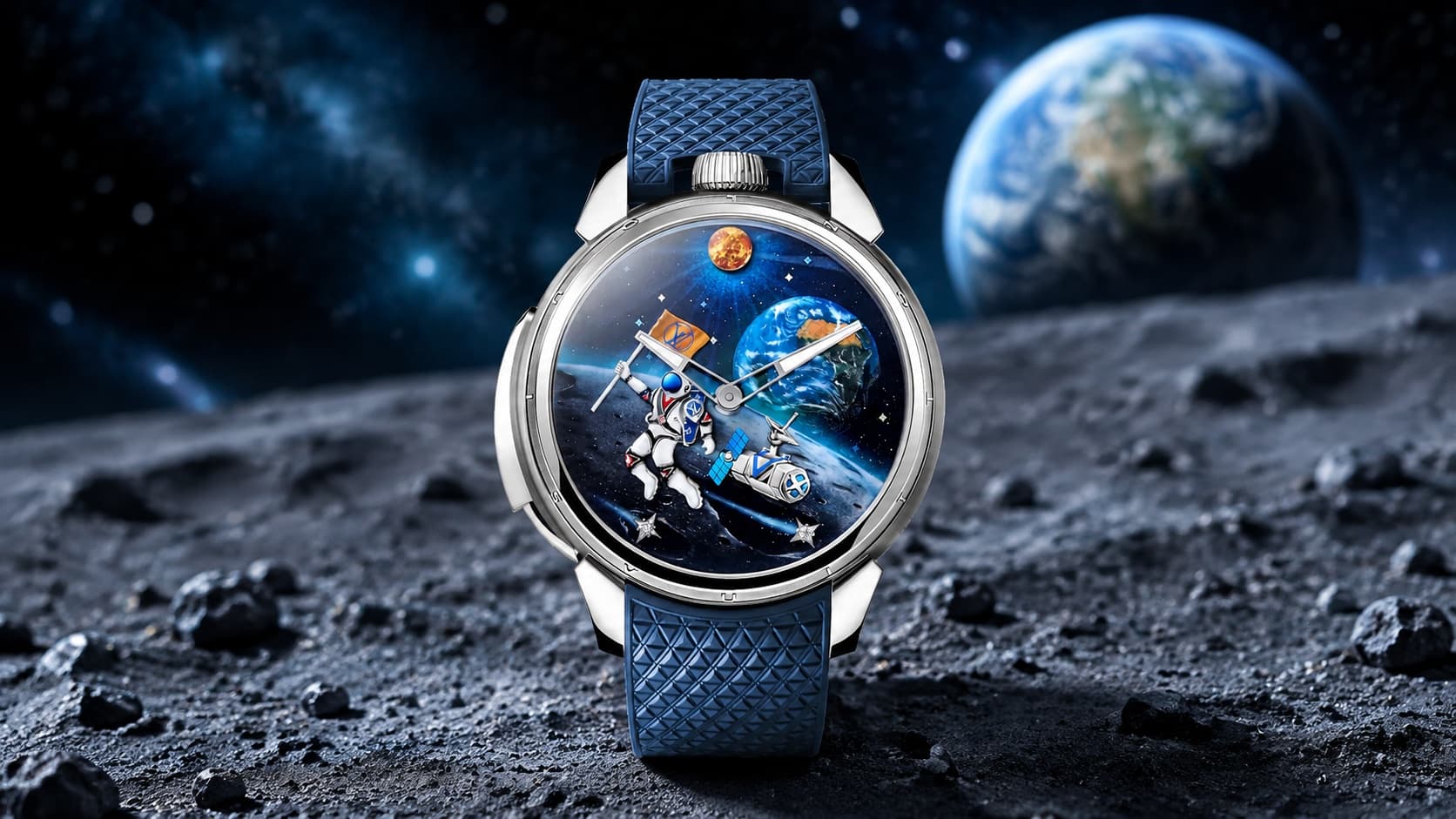
Louis Vuitton is famous for trunks, handbags, and that unmistakable monogram, so it surprises a lot of people to learn the brand also makes serious watches. Unlike some fashion houses that slap a logo on a cheap quartz movement and call it a day, Louis Vuitton actually owns a Swiss watchmaking workshop and has picked up real recognition from the watch world, including the prestigious Geneva Seal. The brand’s watch story covers which models matter, what they actually cost, and how a 170-year-old luggage maker turned into a legitimate Swiss watchmaker in just over two decades.
Is Louis Vuitton a Real Watch Brand?
Yes, and it earned that reputation the hard way. Louis Vuitton was founded in 1854 in Paris as a leather goods and luggage house, and it didn’t start making watches until 2002, when it released its first Tambour model.
That’s a short history compared to Swiss names like Patek Philippe or Rolex, which go back over a century. But Louis Vuitton didn’t try to fake its way into horology. In 2011, the brand bought La Fabrique du Temps, a small but highly respected watch workshop in Geneva, partly because owning a Swiss manufacturing base was a requirement for earning the Geneva Seal, one of the toughest quality certifications a watch can carry. By 2016, Louis Vuitton had earned that Geneva Seal for its Voyager Flying Tourbillon, putting it in genuinely elite company.
So while Louis Vuitton is younger in watchmaking than most luxury houses, its watches are designed and built by the same team of watchmakers who ran an independent Geneva workshop before LV bought them out. That background is what separates its mechanical watches from a fashion accessory with a price tag attached.
A lot of that credibility comes down to one person: Jean Arnault, the youngest son of LVMH chairman Bernard Arnault, who took over as director of Louis Vuitton Watches in 2022 after joining the division the year before. He made a bold move almost immediately, retiring roughly 130 existing watch lines in 2023 so the brand could focus entirely on two collections, the Tambour and the Escale, and build both to a much higher mechanical standard. Under his direction, Louis Vuitton has also started collaborating with respected independent watchmakers like Rexhep Rexhepi and Denis Flageollet of De Bethune, and it launched its own Louis Vuitton Watch Prize to support up-and-coming independent watchmakers, both signs the brand wants to be taken seriously by the wider watch community, not just by fashion buyers.
What Is the Louis Vuitton Tambour?
The Tambour is Louis Vuitton’s flagship watch line, named after the French word for “drum” because of its case shape. The first Tambour appeared in 2002 as a traveler’s watch with a GMT function, which made sense given the brand’s long history with travel and luggage.
The design stood out immediately. The case was sculpted from a single block of metal, wider at the base than near the dial, giving it a rounded, sloped shape that resembled a drum. The word “Louis Vuitton” was spelled out in twelve letters running around the middle of the case, one for each hour marker.
Over the years, the Tambour name has covered everything from simple three-hand watches to some of the most complicated timepieces the brand makes. In just two decades, Louis Vuitton built a real name for itself in the watch industry through this collection alone, and today the Tambour acts almost like a creative platform, ranging from connected smartwatches all the way up to award-winning high-horology pieces.
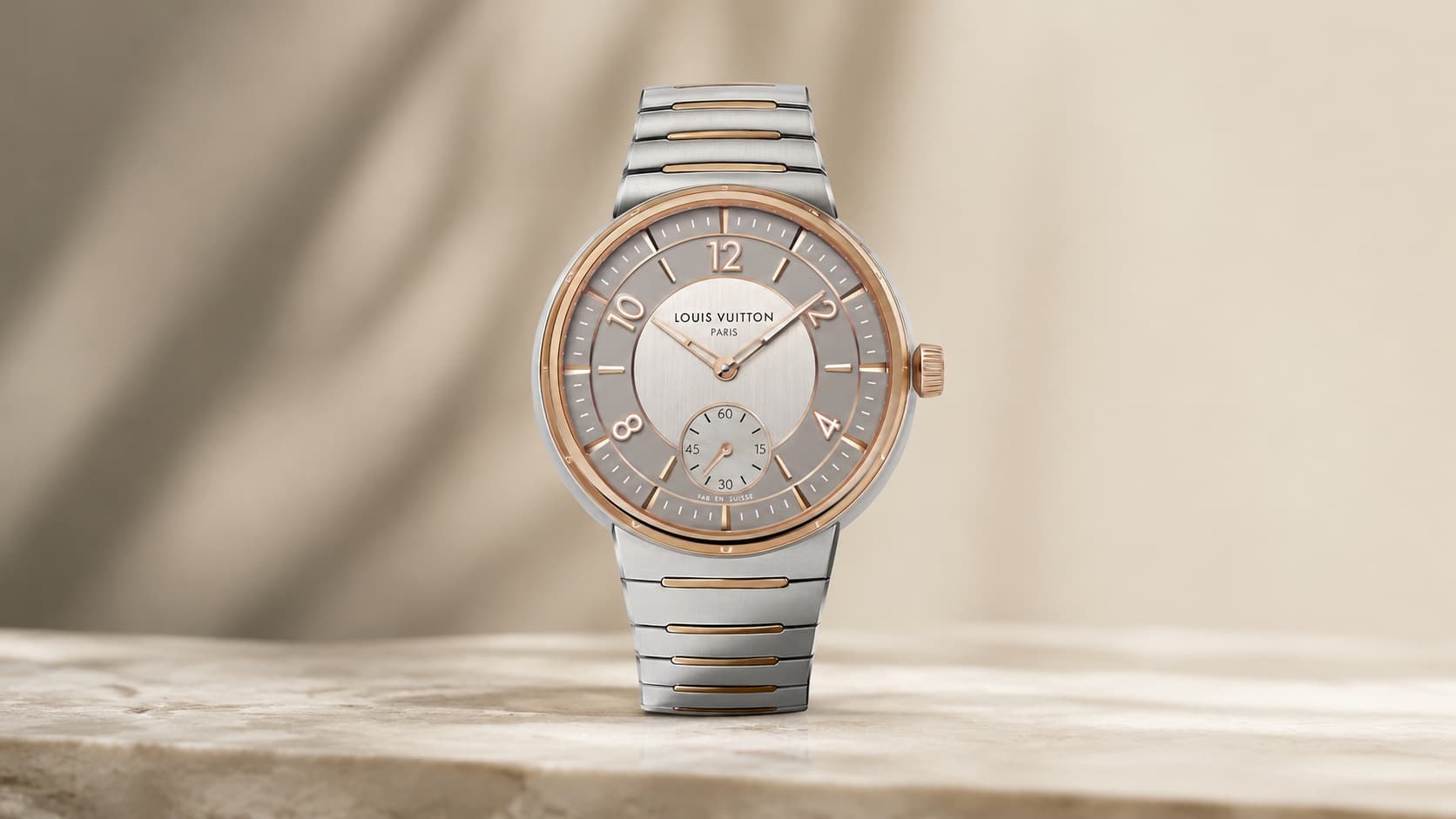
In 2023, the Tambour line went through a major redesign. The updated case measures 40mm across and just 8.3mm thick, giving it a slim, unisex feel, and it comes with an integrated bracelet that has no visible lugs, so the bracelet flows directly into the case. That version currently sells for around $18,500 in stainless steel, positioning it directly against other steel luxury sports watches from established Swiss brands.
The Tambour name has also stretched into travel-instrument territory. The Tambour Orientation, for example, runs on an in-house LV122 movement that lets the wearer work out which direction is north based on where the sun sits in the sky, a useful trick for travelers no matter which hemisphere they’re in. It’s a playful, slightly old-fashioned complication, but it fits a brand built on the idea of exploration.
What Is the Louis Vuitton Escale?
The Escale is Louis Vuitton’s dress watch collection, and its name says a lot about it: “escale” is the French word for stopover, a nod to the brand’s roots in travel and luggage. The line began in 2014 with the Escale Worldtime, a watch built around a hand-painted dial and a world-time function that let travelers read the time in different cities just by turning the crown.
For years, the Escale was known mainly for those colorful, flag-inspired dials rather than for serious mechanics. That changed in 2024, when Louis Vuitton relaunched the Escale as a minimalist, time-only dress watch for the first time in its history, matching the more grown-up direction the brand had already taken with the Tambour a year earlier. Then in 2026, Louis Vuitton brought the original Escale Worldtime back for its Watch Week presentation, this time rebuilt with new in-house calibers and finishing to match the collection’s higher ambitions, alongside new tourbillon versions built on the same travel theme.
The Escale relaunch left the collection with two clear identities side by side: colorful, complicated Worldtime pieces that tell the collection’s original travel story, and plain time-only versions built for daily wear.
If the Tambour is Louis Vuitton’s sports watch, the Escale is its answer to a classic, elegant timepiece suited for a suit, one with a story about travel built into the dial itself.
What Is Louis Vuitton’s Spin Time?
Spin Time is Louis Vuitton’s signature party trick, and it’s genuinely unusual. Instead of hour hands, the watch uses twelve small rotating cubes arranged around the dial. One cube flips over to show the current hour, while a separate hand or sub-dial tracks the minutes.
The Spin Time was designed by Michel Navas and Enrico Barbasini and was first introduced in the Tambour collection in 2009. The concept itself was actually dreamed up back in 2007, before Louis Vuitton had even acquired the two watchmakers’ workshop.
The idea kept evolving after that first launch. A later version called the Tambour Spin Time Air shrank the movement down so the cubes seemed to hover and turn in mid-air, held between two thin panes of sapphire crystal, which was a genuine engineering challenge to pull off. Other versions have gone even further with materials, including a limited edition with a dial made from a slice of Gibeon meteorite, a fragment of rock that landed in Namibia thousands of years ago.
More recently, in 2025, Louis Vuitton relaunched the whole family as the Tambour Taiko Spin Time collection, with six new versions including a flying tourbillon and a world-time model called the Spin Time Antipode. Prices on that current generation run from roughly $72,500 up to $172,000, and the most expensive Spin Time piece Louis Vuitton currently sells, a white gold flying tourbillon version, runs about $315,000. That puts the collection firmly in the high-horology category rather than the accessible end of the brand’s lineup.
Does Louis Vuitton Make a Smartwatch?
Louis Vuitton also makes a connected watch, the Tambour Horizon, and it’s actually the most affordable way into the brand’s watch lineup. The first version launched in 2017 running Android Wear software, starting at $2,450, a price that dwarfed what most mainstream smartwatch makers were charging at the time.
The current version, called the Tambour Horizon Light Up, runs on a custom operating system built by Louis Vuitton rather than off-the-shelf Google or Apple software, and starts at around $3,450. It comes with a 1.2-inch AMOLED touchscreen, 24 LEDs built into the ring around the display that light up for notifications, and a rotating crown with two extra push buttons for shortcuts. It skips fitness features like a heart rate monitor, so it’s built more for style and notifications than for tracking workouts.
For anyone drawn to the Tambour design but not ready for mechanical watch prices, the Horizon Light Up is the accessible route into the brand. It is, however, a genuinely different kind of product from the rest of the lineup: it runs on a battery, needs charging, and won’t hold value the way a mechanical Tambour or Escale might.
How Much Do Louis Vuitton Watches Cost?
Prices vary enormously depending on the collection and materials.
| Collection | Typical Price Range | What It’s For |
|---|---|---|
| Tambour (steel, time-only) | Around $18,500 | Everyday luxury sports watch |
| Escale (dress watches) | Roughly $3,000–$15,000 | Classic, elegant daily wear |
| Tambour Spin Time / Taiko | $67,000–$172,000+ | High-complication collector pieces |
| Flagship flying tourbillon (white gold) | Around $315,000 | The most expensive watch Louis Vuitton currently sells |
| Tambour Horizon Light Up (smartwatch) | From about $3,450 | The most accessible way into the brand |
| Pre-owned Tambour Moon models | $1,400–$2,200 | Older, discontinued fashion-forward models |
Older Tambour Moon models from the 2000s and 2010s tend to sell secondhand for a fraction of current retail prices, which explains the appeal of the design without the price tag of the newer collection.
Louis Vuitton’s watch pricing has shifted significantly since 2023. The brand has been deliberately moving upmarket, away from playful fashion pieces and toward serious mechanical watchmaking, which has pushed prices on new releases noticeably higher than they were a decade ago.
Are Louis Vuitton Watches a Good Investment?
Probably not, at least not in the way collectors mean when they talk about watches like the Rolex Daytona or Patek Philippe Nautilus holding or gaining value. Louis Vuitton’s watchmaking history is still short, and the secondary market hasn’t built the same track record of strong resale demand that century-old Swiss brands enjoy.
That said, the brand’s move into serious high horology, backed by La Fabrique du Temps and the Geneva Seal, could change that reputation over time. Limited, highly complicated pieces like the Spin Time Flying Tourbillon are more likely to hold interest among collectors than mass-produced fashion watches from two decades ago. A Louis Vuitton watch is safest treated as a purchase made for the pleasure of wearing it rather than one expected to turn a profit.
Frequently Asked Questions
Does Louis Vuitton make its own watch movements?
Yes, for its higher-end pieces. Movements for collections like the Tambour and Spin Time are developed and assembled at La Fabrique du Temps Louis Vuitton in Geneva, the workshop the brand acquired in 2011 specifically to build in-house Swiss movements.
What does “Tambour” mean?
Tambour is the French word for drum. The name refers to the case shape of Louis Vuitton’s main watch collection, which is wider at the base than near the dial, similar to the sloped sides of a drum.
When did Louis Vuitton start making watches?
Louis Vuitton released its first true watch collection, the Tambour, in 2002. The brand had experimented with a single quartz watch design back in the late 1980s, but the Tambour marked its real entry into serious watchmaking.
Are Louis Vuitton watches Swiss made?
Many of them are. Since acquiring La Fabrique du Temps in Geneva in 2011, Louis Vuitton has built and assembled its higher-end mechanical movements in Switzerland, which allows those pieces to carry genuine Swiss Made credentials.
What is the most expensive Louis Vuitton watch?
The priciest pieces come from the Spin Time and Tambour Taiko Spin Time collections, where flying tourbillon and world-time versions can run well past $150,000. Highly decorated pieces set with diamonds or made from exotic materials push prices even higher.
Conclusion
Louis Vuitton’s watch story is a lot younger than most of the names found in a typical jewelry case, but it’s also a lot more serious than most people assume. The Tambour gave the brand its identity, the Escale gives it elegance, and the Spin Time complication gives it genuine bragging rights among collectors who care about mechanical creativity. Behind the monogram sits real watchmaking, and La Fabrique du Temps in Geneva is where Louis Vuitton actually earned its place in the watch world.