Van Cleef & Arpels is famous for jewelry first, but its watches tell just as good a story. Instead of chasing the loudest complication or the biggest name in horology, this Paris maison builds tiny scenes onto watch dials — lovers meeting on a bridge, fairies casting spells, butterflies hiding in enamel clouds. That approach has made its timepieces some of the most distinctive on any wrist, and it’s why collectors and casual admirers alike keep asking the same question: which Van Cleef & Arpels watches are actually worth knowing about, and what makes them special?
The History Behind Van Cleef & Arpels Watches
Van Cleef & Arpels traces its beginning to 1896, when Alfred Van Cleef, the son of a diamond broker, married Estelle Arpels, whose father dealt in precious stones. Ten years later, following the death of Estelle’s father, Alfred and two of her brothers, Charles and Julien, opened the maison’s first boutique at 22 Place Vendôme in Paris, directly across from the Hôtel Ritz. The 1906 boutique opening is the date most commonly used as the brand’s founding, since it marks the point the business actually began trading under the Van Cleef & Arpels name, though the family connection goes back a decade earlier.
The brand didn’t start out making full watch collections the way a traditional watchmaker would. Branded watches existed as early as 1923, but it took until 1949, with the introduction of a rounded case built around a single central lug, for Van Cleef & Arpels to be recognized as a source of genuinely original watch designs. Creative direction during those early decades stayed close to the family. In 1926, Alfred Van Cleef took over the company’s artistic direction, working alongside his daughter Renée Puissant and craftsman René Sim Lacaze for the next twenty years. That close, family-run approach to design is part of why the maison’s watches still resemble small jewelry sculptures more than instruments built purely for timekeeping.
From there, the maison kept treating watches the way it treated jewelry: as small, wearable pieces of storytelling. That habit is still the whole personality of the brand today, and it’s the reason Van Cleef & Arpels watches don’t look, feel, or behave like typical luxury watches from Switzerland’s big horology houses.
Van Cleef & Arpels doesn’t just tell time. Its watches tell a tiny story with every glance at the dial.
The Cadenas Watch: Van Cleef & Arpels’ Original Icon
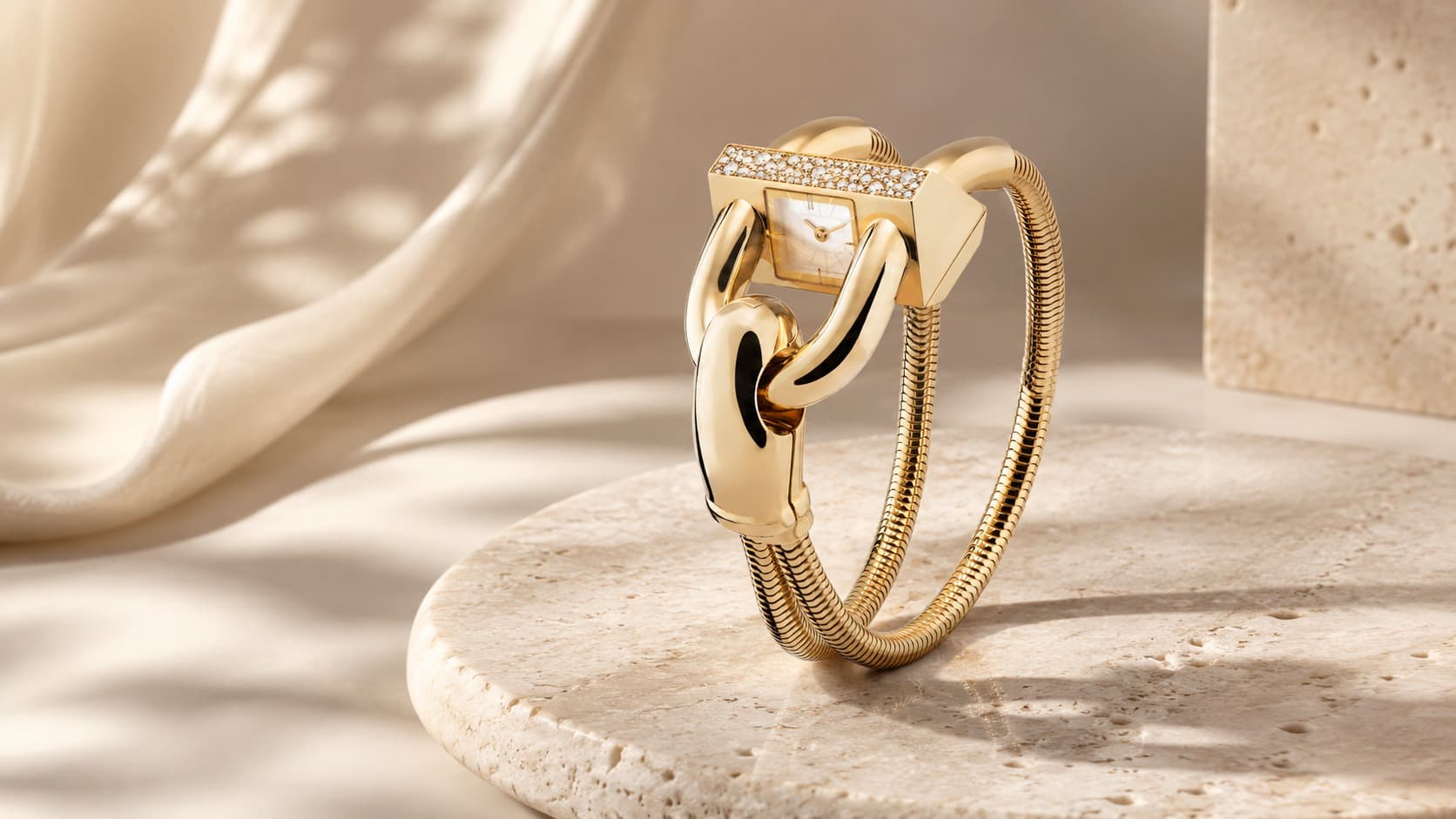
The Cadenas, first released in 1935, is the closest thing Van Cleef & Arpels has to a founding watch icon, and it’s still sold today almost unchanged. One of the maison’s most iconic pieces, the Cadenas watch debuted in 1935, standing out for its angled dial and loop-shaped clasp that evokes the image of a padlock.
The story behind its odd, sideways dial is genuinely charming. At the time the watch was created, it was considered improper for a woman to check the time in public, so Van Cleef & Arpels solved that problem with an angled dial that could only be read by the person wearing it. That’s a clever bit of design thinking dressed up as etiquette, and it still makes the Cadenas feel unlike anything else on the market.
The name itself has an interesting backstory too. The watch was initially called a “staple” watch, and only started being called “padlock” (cadenas in French) in 1946. It debuted in yellow gold before going through many color changes, including a calibrated sapphire or ruby pavé added in December 1936, and diamonds joining the lineup in 1938, followed occasionally by emeralds after 1943. Today’s Cadenas keeps that same silhouette: a rectangular case on a hinge, connected to a double snake-chain bracelet that loops around the wrist like a bracelet first and a watch second.
Renée Puissant, Alfred and Estelle’s daughter, is the figure most credited with the Cadenas’ bold silhouette, though her design work at the maison has historically received far less recognition than it deserves. The watch is also tied by legend to the Duchess of Windsor, an avid jewelry collector and longtime client of the Place Vendôme boutique, in the same way she is often connected to the maison’s 1950 Zip necklace. There’s also an unexpected art-world parallel: turning an everyday object, a padlock, into a watch case put the Cadenas in step with the “readymade” idea Marcel Duchamp introduced in 1914, later written into the Surrealists’ 1938 Abridged Dictionary. A watch built to be read in secret and worn like a bracelet ended up, almost by accident, aligned with one of the defining art movements of its decade.
Why the Cadenas Is Still a Collector Favorite
- Its case shape has barely changed since 1935, so vintage and modern versions share real design DNA
- It works equally well as a bracelet and a watch, since the case sits almost flush against the wrist
- Original pieces from the 1930s and 1940s are genuine collectibles, not just old watches
Poetic Complications: Van Cleef & Arpels’ Most Unique Watches
If there’s one thing that separates Van Cleef & Arpels from every other watch brand, it’s the Poetic Complications collection. These watches use retrograde mechanisms, automaton figures, and hand-painted enamel to act out a small scene instead of simply displaying numbers.
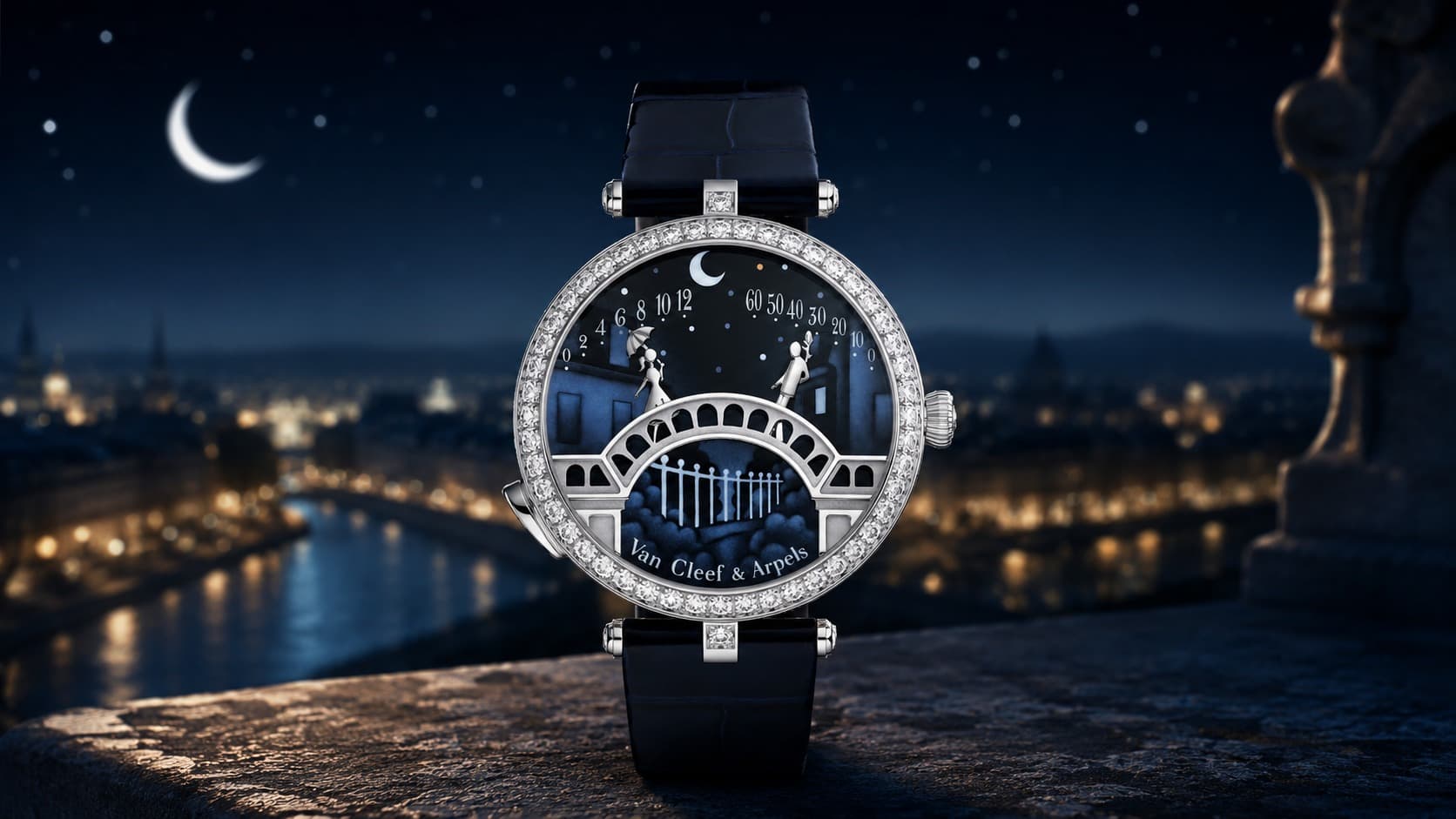
The best-known example is the Lady Arpels Pont des Amoureux. As a watchmaker, Van Cleef & Arpels is known as the champion of poetic complications — elaborate functions designed to delight — built around fanciful, story-driven motifs. On the Pont des Amoureux dial specifically, two tiny lovers move closer together hour by hour and minute by minute until they finally meet and embrace on a miniature Parisian bridge. Underneath that sweet, simple story sits a genuinely complex mechanism — a double retrograde system with automaton figures that move along a single arc, hours on the left and minutes on the right.
The technical specs back up how much work goes into one of these pieces. One reference version of the watch runs on a self-winding mechanical movement with a retrograde and on-demand animation module developed exclusively for Van Cleef & Arpels, offering a 36-hour power reserve. These aren’t mass-produced calibers pulled off a shelf; the animation modules are built specifically to make each scene move correctly.
The Pont des Amoureux has also been reinterpreted across the seasons, each version swapping in different stones, enamel colors, and tiny scenery details to match spring, summer, autumn, and winter settings, plus moonlit and daytime variations. The story continued with the Lady Arpels Bal des Amoureux Automate, which sets the same couple’s rendezvous in a new decor. The result is a watch that behaves more like a miniature theater set than a conventional timekeeping tool.
Poetic Complications as a formal collection is younger than its old-world aesthetic suggests. It was actually born in 2006, when Van Cleef & Arpels celebrated its centenary with an innovative watch that let time flow in harmony with the seasons, and the maison committed to a new vision built around technical prowess paired with a genuine sense of wonder. Since then the collection has expanded well beyond romance-themed dials. One standout is the Midnight Planétarium, which turns the solar system into a working watch face. This piece recreates the orbit of a selection of planets around the sun using a highly complex self-winding mechanical movement, and the wearer tells time simply by looking to where a shooting star sits on its circuit. The men’s Midnight Planétarium reproduces the sun in miniature with the five planets visible to the naked eye from Earth — Mercury, Venus, Mars, Jupiter, and Saturn — with each planet moving on its own disc according to its real rotation time, meaning Saturn alone takes decades to complete a full circuit of the dial. A women’s version, the Lady Arpels Planétarium, later scaled the same idea down to a smaller case, with an exclusive module developed in collaboration with watchmaker Christiaan van der Klaauw, and each planet orbiting the dial at its true relative speed — Mercury in 88 days, Venus in 224, and Earth in 365.
It’s worth clearing up a common assumption: Van Cleef & Arpels does make watches for men, even though the brand’s reputation for women’s pieces tends to overshadow them. The maison’s offerings for women are strong enough that they tend to overshadow the men’s side of the catalog, but Van Cleef & Arpels certainly does produce men’s watches, and the Midnight collection is where most of them live. Alongside the Midnight Planétarium, the men’s Midnight range includes moon-phase and day/night pieces built on the same storytelling philosophy. The Midnight Jour Nuit Phase de Lune, for example, houses two overlapping complications in one case — a Jour/Nuit day-and-night display, plus a moon-phase complication that first entered Van Cleef & Arpels’ watchmaking history back in 1929. So while the maison’s most famous poetic pieces skew feminine, men looking for the same handcrafted storytelling do have a real, well-developed lane to choose from.
Lady Arpels: Van Cleef & Arpels’ Most Artistic Watches
Lady Arpels is the broader family that houses most of the maison’s poetic and artistic watches, built from techniques borrowed straight from Van Cleef & Arpels’ jewelry workshops — miniature painting, grisaille enamel, and gem-setting so precise it takes hundreds of hours per piece.
That level of craft isn’t unique to watches at Van Cleef & Arpels — it comes from the same jewelry-making tradition that built the brand’s whole reputation. A French patent from 1933 protects a gem-setting method the maison calls “Serti Mystérieux,” or Mystery Setting, built so that the metal prongs normally used to hold a stone in place disappear entirely from view. Each gem instead rests on gold rails under two-tenths of a millimeter thick, a process demanding upward of 300 hours per piece, which is why only a small number are finished each year. That same level of obsession over hidden, hand-built detail carries over to Lady Arpels dials, just applied to enamel painting and tiny automaton figures instead of stone-setting.
Because so much of the work is done by hand, no two Lady Arpels pieces in a themed series look quite identical — the enamel painting shifts slightly from piece to piece, the way a real painting would.
Van Cleef & Arpels vs Other Luxury Watch Brands
A watch collector picking up a Van Cleef & Arpels piece for the first time will notice it doesn’t behave like a typical Swiss sports or dress watch, and that’s intentional.
Most luxury watch brands compete on precision, power reserve, or how many complications they can pack into one case. Van Cleef & Arpels competes on storytelling and jewelry craftsmanship instead. Its movements are often supplied and finished in partnership with Richemont’s watchmaking network — the maison is part of the Richemont group today, operating under CEO leadership with boutiques stretching from China to Germany — but the artistic direction, the enamel work, the automaton animation, and the gem-setting all come from Van Cleef & Arpels’ own ateliers.
That’s why prices vary so widely across the catalog. Simpler quartz pieces like some Cadenas models sit at a more accessible price point, while a hand-painted, automaton Poetic Complications piece can run into six figures. Van Cleef & Arpels watches typically range from around $5,050 to $199,300, with pricing driven by the use of precious metals, intricate complications, and the limited availability of certain models.
Comparing the Main Van Cleef & Arpels Collections
| Collection | Known For | Best For |
|---|---|---|
| Cadenas | Angled dial, padlock-shaped case, 1935 origin | Vintage-inspired daily wear |
| Poetic Complications | Automaton scenes, retrograde mechanisms | Statement, story-driven pieces |
| Lady Arpels | Enamel artistry, miniature painting | Art and craftsmanship lovers |
Frequently Asked Questions
When was Van Cleef & Arpels founded?
Van Cleef & Arpels traces back to 1896, when Alfred Van Cleef married Estelle Arpels, whose father was a diamond dealer. The maison’s first boutique opened in 1906 at 22 Place Vendôme in Paris, across from the Hôtel Ritz. Both dates get cited depending on whether the count starts from the family union or the first store opening.
What is the most famous Van Cleef & Arpels watch?
The Cadenas, first released in 1935, is generally considered the maison’s most iconic watch design because of its angled, discreetly readable dial and padlock-shaped case. The Lady Arpels Pont des Amoureux, with its automaton lovers meeting on a tiny Parisian bridge, is the most famous of the more recent, story-driven pieces.
Are Van Cleef & Arpels watches considered good investments?
Prices for Van Cleef & Arpels watches are generally driven by rarity, hand-craftsmanship, and precious materials rather than by mass demand the way some sports watches are. Limited or numbered Poetic Complications pieces tend to hold interest among collectors because so few are made each year, but as with any luxury watch, value depends heavily on the specific model, its condition, and the current collector market.
Who makes the movements inside Van Cleef & Arpels watches?
Van Cleef & Arpels is part of the Richemont luxury group, which includes watchmaking specialists that help produce and finish movements for the brand, including the self-winding calibers used in automaton pieces. The artistic elements — enamel painting, automaton animation, and gem-setting — are developed and finished by Van Cleef & Arpels’ own workshops.
What does “Poetic Complications” mean?
It’s the name Van Cleef & Arpels gives to its collection of watches built around a narrative scene rather than a standard technical complication like a chronograph or perpetual calendar. These pieces use retrograde hands, automaton figures, and hand-painted dials to act out a small story — a couple meeting on a bridge, a fairy waving a wand, a butterfly emerging from a flower — as the hours and minutes pass.
Does Van Cleef & Arpels make watches for men?
Yes. The maison’s men’s watches live mainly in the Midnight collection, which uses the same storytelling philosophy as the women’s Lady Arpels pieces but in larger, more classically masculine cases. The Midnight Planétarium and Midnight Jour Nuit Phase de Lune are two of the best-known examples, both built around astronomical themes like planetary orbit and moon phase.
Conclusion
Van Cleef & Arpels earned its reputation as a jeweler first, and its watches carry that heritage on every dial, whether it’s the padlock-shaped Cadenas that’s barely changed since 1935 or a Lady Arpels piece with hand-painted enamel and a moving automaton scene. What ties the whole catalog together is craftsmanship measured in hours of handwork rather than in complications per square centimeter. A Van Cleef & Arpels watch is best judged the way the maison intended: not just by what it does, but by the story it tells.