Most people think of Switzerland, Japan, or Germany when someone mentions watchmaking countries. The Netherlands rarely comes up, yet a Dutchman built the mechanism that made accurate timekeeping possible in the first place. That invention didn’t just start a company. It kicked off a chain of ideas that Dutch watchmakers are still building on today, from tiny workshops making a handful of watches a year to global brands selling hundreds of thousands of pieces. The story is smaller than Switzerland’s, but it’s stranger, older, and more personal than most people expect.
Why the Netherlands Has a Watchmaking History
Dutch watchmaking traces back to a single breakthrough: the pendulum clock, invented in the 1650s by Christiaan Huygens. Huygens was a Dutch mathematician and astronomer, famous for discovering Saturn’s largest moon, Titan. He also solved a problem clockmakers had struggled with for centuries: how to keep a clock accurate. Before his invention, clocks could drift by fifteen minutes a day. His pendulum design cut that error down to about fifteen seconds a day.
Huygens finished his design in December 1656, but he wasn’t the one who actually built it. He handed the plans to a local clockmaker in The Hague named Salomon Coster, who constructed the first working pendulum clock and received the patent for it in June 1657. One of Coster’s earliest clocks still survives today, on display at the Museum Boerhaave in Leiden. Around this same time, an English clockmaker named John Fromanteel came to work under Coster to learn the new pendulum technique firsthand, then carried it back to London with him.
That connection between Huygens, Coster, and Fromanteel changed timekeeping everywhere in Europe, not just in Holland. Centuries later, the Fromanteel name would resurface as a modern Dutch watch brand, which shows how tightly connected this small country’s watch history really is. The Netherlands never became a manufacturing powerhouse like Switzerland, but it kept producing sharp, independent thinkers who solved problems their own way.
Christiaan van der Klaauw: The Netherlands’ Astronomy Watchmaker
Christiaan van der Klaauw makes watches that track the movement of planets, moons, and stars. The brand’s founder started out building astronomical clocks in 1974, before turning that same obsession toward wristwatches in 1996. Its watches show real-time planetary positions, moon phases, and tidal patterns instead of just hours and minutes.
One of the brand’s most meaningful pieces is the CVDK Planetarium, launched in 1999. It’s a working miniature version of a much bigger planetarium built into the ceiling of a house in the Dutch town of Franeker, constructed between 1774 and 1781 by an amateur astronomer named Eise Eisinga and still the oldest functioning planetarium in the world today. Shrinking that idea down to fit inside a wristwatch case is exactly the kind of technical puzzle the brand has built its reputation on, and it later applied the same thinking to the Real Moon Joure, a model recognized for having one of the most accurate 3D moon phase displays ever put in a watch.
The brand joined the Academy of Independent Creators (AHCI), a small group of watchmakers who design and build their own complications rather than buying parts off the shelf. That membership, earned in 1989, says a lot about how technical the work is. The brand’s astronomical focus has also earned it a spot on the Fondation Haute Horlogerie’s official Haute Horlogerie list, a distinction held by only a small number of watchmakers worldwide, and it won the Calendar and Astronomy prize at the Grand Prix d’Horlogerie de Genève in 2021, often described as the closest thing watchmaking has to an Oscar.
In 2022, Pim Koeslag became the brand’s majority shareholder. Koeslag previously served as technical director at Frederique Constant, where he helped build more than 30 in-house watch movements, including tourbillons. His arrival gave Christiaan van der Klaauw fresh momentum without changing what the brand is known for: watches that turn a wearer’s wrist into a tiny observatory.
Astronomical watchmaking is a narrow specialty. Very few brands anywhere in the world build moon phase, planetarium, and tide-tracking complications as their main focus. Christiaan van der Klaauw is one of them.
Grönefeld: The Netherlands’ Family Watchmaking Story
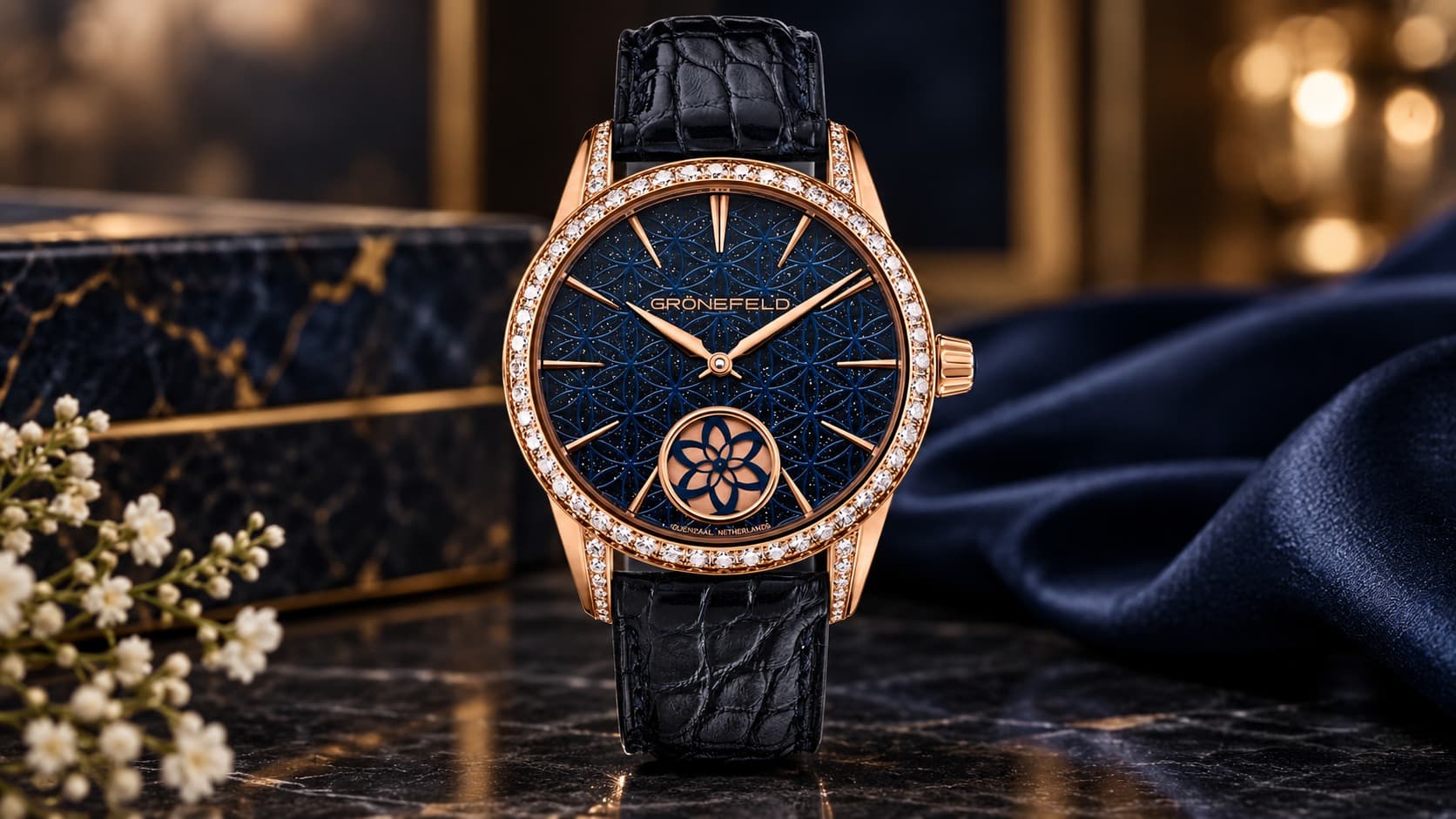
Grönefeld builds fewer than 50 watches per model, entirely by hand, in a small workshop in the eastern Netherlands. Brothers Bart and Tim Grönefeld grew up around watches literally their whole lives. Their grandfather opened a watch store in Oldenzaal, a Dutch town near the German border, back in 1912. That family history eventually turned into one of the most respected independent watch brands in the world.
Grönefeld watches often start above €20,000, and the brothers aren’t chasing volume. They launched the brand in 2008 with a tourbillon minute repeater, then followed it in 2010 with the watch that became their signature: the One Hertz, a mechanical solution to a problem that has bothered watchmakers for centuries, making a seconds hand tick with dead-accurate, one-second precision using a purely mechanical movement rather than a battery. Complications like tourbillons and minute repeaters also show up in their catalog.
The brothers also make a point of tying their watches back to family history. Their 1941 Remontoire, released in 2016, is named after the birth year of their father Sjef, who maintained the same church clock in Oldenzaal that their grandfather Johan once cared for. The model went on to win a Grand Prix d’Horlogerie de Genève award for best men’s watch that same year. Collectors who care about hand-finishing and small-batch production often mention Grönefeld in the same breath as top Swiss independents, which is a serious compliment for a brand most people outside watch circles have never heard of.
Dunselman: The Netherlands’ Newest Independent Brand
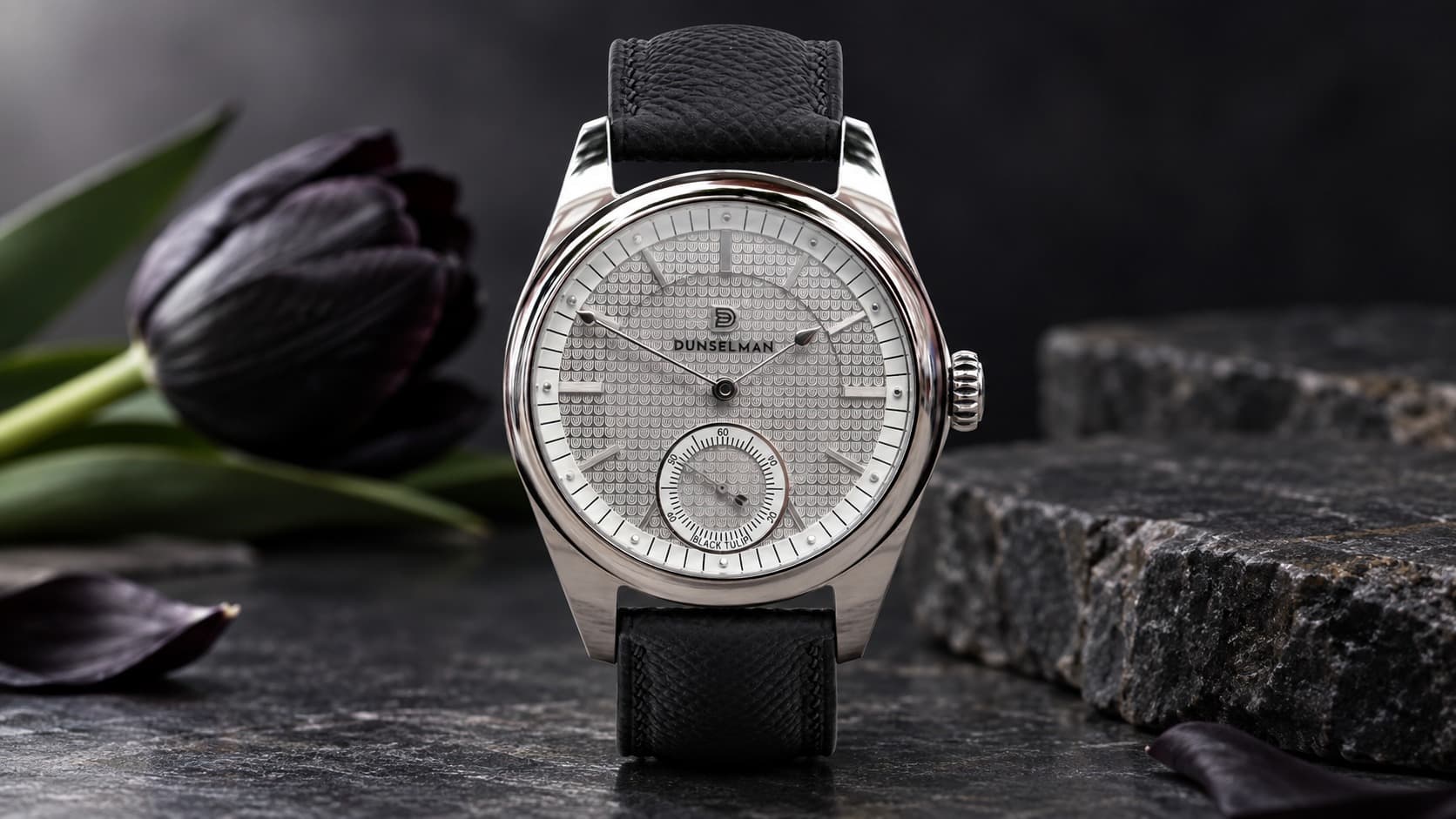
Dunselman is the youngest independent watch brand in the Netherlands, founded in 2025 by Annelinde Dunselman, a watchmaker based in the Dutch city of Zwolle. She trained at the Schoonhoven Vakschool, a Dutch school for goldsmithing and watchmaking, and later worked with names including Jaeger-LeCoultre, the Grönefeld brothers, and watchmaker Philippe Narbel before striking out to build watches under her own name.
Her first watch, the Black Tulip, launched in April 2025 at the Watches & Wonders fair in Geneva, the same event where the biggest Swiss houses reveal their new models each year. It runs on an in-house, hand-wound movement called the D202.5, built with a zero-reset mechanism that snaps the seconds hand back to zero the moment the crown is pulled out, a small but genuinely tricky feature to engineer. The dial carries a subtle micro-tulip pattern, a nod to the flower’s place in Dutch history and to the watch’s name.
What makes Dunselman worth watching isn’t scale, since she currently works largely on her own with a small circle of trusted suppliers. It’s that her arrival proves the tradition started by Huygens, carried forward by Grönefeld and van der Klaauw, hasn’t stopped producing new independent watchmakers in a country most people still don’t associate with the craft.
Holthinrichs: The Netherlands’ 3D-Printed Watch Brand
Holthinrichs is a Dutch independent watch brand built around 3D-printed metal cases, founded in 2016 by Michiel Holthinrichs, an architect from Delft who traded building design for watchmaking. His background shows in every piece he makes, since the cases lean on ornamental, architectural shapes that would be almost impossible to produce with a normal milling machine.
His debut piece, the Ornament 1, used a technique called selective laser melting to print a stainless steel case layer by layer, drawing inspiration from Dutch baroque architecture and Art Nouveau ornament. Holthinrichs calls his overall approach “Horlogerie Brut,” a nod to the architectural term “Béton Brut,” which celebrates raw, unpolished concrete left exactly as it comes out of the mold. His watches apply the same idea to metal, often leaving visible printing texture on the case rather than smoothing it away.
The brand has kept building on that foundation. In 2023, it introduced the Deconstructed collection, powered by an in-house caliber called the HW-M01 that’s roughly half Dutch-made, and by 2024 the Ornament Nouveau arrived with a fully in-house movement. Holthinrichs has also been accepted as a candidate member of the AHCI since 2021, the same organization that counts Christiaan van der Klaauw among its full members. Working out of a converted former armory in Delft, with windows that let passersby watch the process, Holthinrichs represents a side of Dutch watchmaking built less on tradition and more on rethinking what a watch case can even look like.
Fromanteel: The Netherlands’ Historic Watch Name
Fromanteel is a modern Amsterdam watch brand named after the 17th-century clockmaking family that helped spread Christiaan Huygens’ pendulum invention. Ahasuerus Fromanteel, the family patriarch, began building pendulum clocks in 1660, and the family’s pendulum expertise soon reached London and other cities, making Fromanteel one of the first multinational clockmaking businesses in history.
The current Fromanteel brand has nothing to do with the original family business. It was founded in 2009 by two Dutch entrepreneurs and friends, Alfredo Silva and Martijn van Hassel, who wanted to build affordable, well-designed watches with a story behind them. Their first collection was even called the Generations Pendulum, a direct nod to the clockmaking family the brand is named after. The brand designs its watches out of its headquarters overlooking one of Amsterdam’s canals and assembles them in Switzerland, near Biel, which lets it use the “Swiss Made” label while keeping its design identity firmly Dutch.
In 2017, Fromanteel’s classic styling caught the attention of the Dutch military, leading to special editions made for the Royal Dutch Air Force and the Dutch Marines. It’s a good example of how a Dutch brand can lean on history without pretending to be something it’s not.
TW Steel: The Netherlands’ Oversized Watch Brand
TW Steel is a Dutch brand built entirely around oversized watch cases, founded in Amsterdam in 2005 by father and son Ton and Jordy Cobelens. Ton had already spent decades in the watch industry, working as a distributor for other brands and designing private-label watches for companies like KLM. When he noticed a rising appetite for bigger, bolder watch faces, he and his son decided to build a brand around exactly that idea.
Their first release, called the TW1 through TW4, was a small four-model collection of 1,200 pieces, and it sold out in the Dutch market within six weeks, all before the brand even had a proper website or brochure. From there, the brand grew fast, eventually selling around 200,000 watches a year through roughly 5,000 retailers across more than 100 countries, mostly priced well under $1,500.
TW Steel leaned heavily into motorsport sponsorships over the years, putting its watches on the wrists of Formula One drivers and MotoGP riders, including working with figures like David Coulthard and Mick Doohan. The brand’s whole identity comes down to one clear idea: watches that are impossible to miss.
Kyboe: The Netherlands’ Colorful Watch Brand
Kyboe is a Dutch watch brand from The Hague built around oversized dials in loud colors, founded in 2007 by Dick Sijmons and Kees de Bruïne. The two friends started out selling watches from the trunk of a car, first in colorful plastic cases, before switching entirely to more durable stainless steel by 2008 once demand picked up in the Netherlands.
The brand’s cases range from 40mm up to a genuinely enormous 55mm, aimed at people who want a watch that reads as an accessory first and a timepiece second. Kyboe expanded into the United States in 2015 after partnering with American investors, landing shelf space at Saks Fifth Avenue, Lord & Taylor, and Nordstrom, and even appeared on a New York Fashion Week red carpet in 2016. Founder Dick Sijmons later regained full control of the brand in 2019 and now runs it from The Hague under a new company, keeping the same oversized, colorful identity that built its following in the first place.
Frederique Constant: The Netherlands’ Accessible Swiss Brand
Frederique Constant was founded in 1988 by a Dutch married couple, Peter Stas and Aletta Stas-Bax, even though the brand itself is based and manufactured in Geneva. Peter had studied business economics in Rotterdam and worked at Philips before deciding to build his own watch company with his wife. They named the brand after their great-grandparents, Frédérique Schreiner and Constant Stas, blending both names into one.
The company’s whole strategy centered on making genuine mechanical Swiss watches at prices regular people could actually afford, a niche that barely existed at the time. Their first collection launched in 1992, and the Heart Beat model that followed in 1994 became one of the brand’s signatures, cutting a window into the dial so wearers could watch the balance wheel move. By 2004, the brand had turned that idea into its first fully in-house movement, the Heart Beat caliber FC-910, engineered with help from a young Dutch watchmaker named Pim Koeslag, the same person who later took over Christiaan van der Klaauw.
Frederique Constant later acquired Alpina Watches in 2002, and in 2016 the whole group was purchased by Citizen Watch of Japan. Despite the change in ownership, the brand still builds its watches at its own manufacture in Plan-les-Ouates, on the outskirts of Geneva, alongside neighbors like Piaget and Vacheron Constantin. It remains one of the clearest examples of Dutch business thinking applied to a very Swiss industry.
Prisma: The Netherlands’ Everyday Watch Brand
Prisma is one of the oldest Dutch watch brands still running today, founded in 1948 by a group of watchmakers who wanted to sell good-looking, well-made watches at fair prices. The name comes from the shape of a cut diamond, chosen to represent variety and individual character rather than luxury pricing.
Prisma became a household name in the Netherlands over the following decades, worn by Dutch public figures including footballer Johan Cruijff. The brand was also among the first in the world to use quartz movements in the mid-20th century, a technical shift that made watches cheaper and more accurate at the same time. Even with that innovation, Prisma kept producing mechanical and gold watches too, especially as gift watches for employees marking long careers at Dutch companies.
Prisma is still a family business today, now run by its fourth generation of owners, who call themselves “The Dutchmen.” The brand still designs and produces its watches in the Netherlands, including its Einzeiger collection, a line of watches that tell time with just one hand instead of two. It’s not a brand built for watch collectors chasing rare complications. It’s a brand built for people who just want a reliable watch that looks good.
How Dutch Watch Brands Compare
Dutch watch brands tend to fall into three fairly distinct camps, and very few sit in the middle. The first is tiny independent workshops, like Grönefeld, Christiaan van der Klaauw, Dunselman, and Holthinrichs, building a handful of technically complex watches by hand each year. The second is commercially minded design brands, like TW Steel and Kyboe, built around one bold visual idea rather than in-house engineering. The third sits in between: brands like Frederique Constant and Fromanteel that were founded by Dutch entrepreneurs but manufacture in Switzerland to meet Swiss Made standards, and everyday brands like Prisma that have simply stayed close to home for over 75 years.
| Brand | Founded | Known For | Typical Price Range |
|---|---|---|---|
| Christiaan van der Klaauw | 1974 | Astronomical complications | €15,000 and up |
| Grönefeld | 2008 (as a brand) | Hand-finished independent watchmaking | €20,000 and up |
| Dunselman | 2025 | Newest Dutch independent watchmaker | Made to order, high-end |
| Holthinrichs | 2016 | 3D-printed architectural watch cases | €10,000 and up |
| Fromanteel | 2009 | Amsterdam design, Swiss assembly | €300–€1,500 |
| TW Steel | 2005 | Oversized cases | $150–$1,500 |
| Kyboe | 2007 | Oversized, colorful designs | $190–$530 |
| Frederique Constant | 1988 | Affordable Swiss mechanical watches | $1,000–$5,000 |
| Prisma | 1948 | Everyday Dutch timepieces | $100–$1,500 |
What ties Dutch watchmaking together across such different business models isn’t a shared factory or a shared style. It’s a shared willingness to work outside the traditional Swiss playbook, whether that means building a watch around planetary orbits, hand-finishing a movement alone in a home workshop, or building one that’s just really, really big.
Frequently Asked Questions
Is the Netherlands known for watchmaking?
Not in the way Switzerland or Japan are, but the Netherlands has a genuine watchmaking history dating back to Christiaan Huygens’ invention of the pendulum clock in the 1650s. Modern Dutch brands, from tiny independents to global names, have kept that tradition going in very different directions.
Are Dutch watch brands made entirely in the Netherlands?
Usually not entirely. Brands like Fromanteel and Frederique Constant design their watches in the Netherlands but assemble them in Switzerland, often to meet “Swiss Made” quality standards. Independent brands like Grönefeld, Christiaan van der Klaauw, Dunselman, and Holthinrichs, on the other hand, build their watches by hand in their own Dutch workshops, while brands like Kyboe and Prisma design, assemble, and sell their watches without leaving the Netherlands at all.
What is the most expensive Dutch watch brand?
Grönefeld is generally considered the most exclusive Dutch watch brand, with prices starting well above €20,000 and production runs under 50 pieces per model. Christiaan van der Klaauw also sits at the higher end because of its complex astronomical complications.
Who invented the pendulum clock?
Christiaan Huygens, a Dutch mathematician and astronomer, invented the pendulum clock in the 1650s. His design dramatically improved timekeeping accuracy and influenced clockmakers across Europe for centuries afterward.
What is TW Steel known for?
TW Steel is known for its oversized watch cases, often 45mm to 50mm wide, along with sponsorship ties to Formula One and MotoGP racing. It was founded in Amsterdam in 2005 by father and son Ton and Jordy Cobelens.
What is the newest Dutch watch brand?
Dunselman is currently the newest independent Dutch watch brand, founded in 2025 by watchmaker Annelinde Dunselman. Her debut watch, the Black Tulip, launched at Watches & Wonders Geneva and runs on a hand-wound, in-house movement she developed herself.
How many watch brands come from the Netherlands?
There is no official count, but the Netherlands is home to at least a dozen active watch brands ranging from one-person independent workshops to companies selling hundreds of thousands of watches a year. The most notable ones span the full range of what Dutch watchmaking looks like today, from astronomical complications to oversized fashion watches.
Conclusion
Dutch watchmaking never tried to compete with Switzerland on scale, and that’s exactly why it’s worth paying attention to. The country’s story starts with a genuine scientific breakthrough, the pendulum clock, and branches out into three very different modern paths: small workshops obsessed with hand-built precision, Dutch-founded brands manufacturing in Switzerland, and commercially sharp design brands built around one strong idea, whether that’s an oversized case or a splash of color. Whether the appeal is a €20,000 Grönefeld, a 3D-printed Holthinrichs case, or a Prisma watch that’s been in Dutch households for generations, the common thread is the same. Dutch watchmakers tend to build things their own way, and that independent streak goes all the way back to Huygens himself.