Picking up a leather bag in a store and wondering if it’s the real thing is one of the most common moments of doubt in shopping. Manufacturers have gotten so good at making faux leather look and even feel like the genuine article that a quick glance is no longer enough to know what’s being sold. The senses, though, are still better detectives than most marketing labels, and once the basic smell, touch, and look tests are known, telling real leather from faux leather takes less than a minute.
What’s the Fastest Way to Tell Real Leather From Fake?
The quickest test is smell: real leather has a warm, earthy, slightly musky scent, while faux leather usually smells like plastic or has almost no smell at all. This one test alone catches most fakes because there is no cheap way to fake the smell of tanned animal skin.
Smell alone isn’t foolproof, though. Some high-end faux leathers are treated with scented coatings to mimic that leathery smell, and some low-quality real leather has been so heavily processed and dyed that its natural scent is faint. That is why stacking a couple of tests together tends to work better than relying on just one.
How strong the smell is also depends on how the leather was tanned. Vegetable-tanned leather, treated with natural tree bark extracts, tends to have the richest, most noticeable leathery smell. Chrome-tanned leather, which uses chemical salts and makes up most of the leather produced worldwide, usually has a milder scent. A brand-new item also smells stronger than one that has been worn and aired out for a few years, so a fainter smell on an older piece doesn’t automatically mean it’s fake.
How Does Real Leather Feel Compared to Faux Leather?
Real leather feels soft, slightly warm, and a little stretchy, while faux leather feels cool, stiff, and rubbery to the touch. Genuine leather is skin, so it behaves a bit like skin: it has some give to it, it warms with body heat, and pressing a finger into it leaves a dent that slowly springs back with a faint wrinkle.
Faux leather, on the other hand, is a plastic coating, usually polyurethane or PVC, applied over a fabric backing. That plastic layer doesn’t hold onto warmth the way skin does, and it tends to feel uniformly smooth rather than slightly textured. Gently pinching and twisting a small section reveals a lot: real leather wrinkles and shows subtle color variation where it bends, because natural fibers respond unevenly to pressure, while faux leather usually folds cleanly and springs back to its original shape without much change.
The handle, strap, or any corner that gets folded or gripped often is the most useful spot to check on a bag or wallet, since those areas show the clearest read on how the material behaves under pressure. A light touch is all it takes to feel the difference between skin and plastic.
What Should Be Checked on the Leather’s Surface?
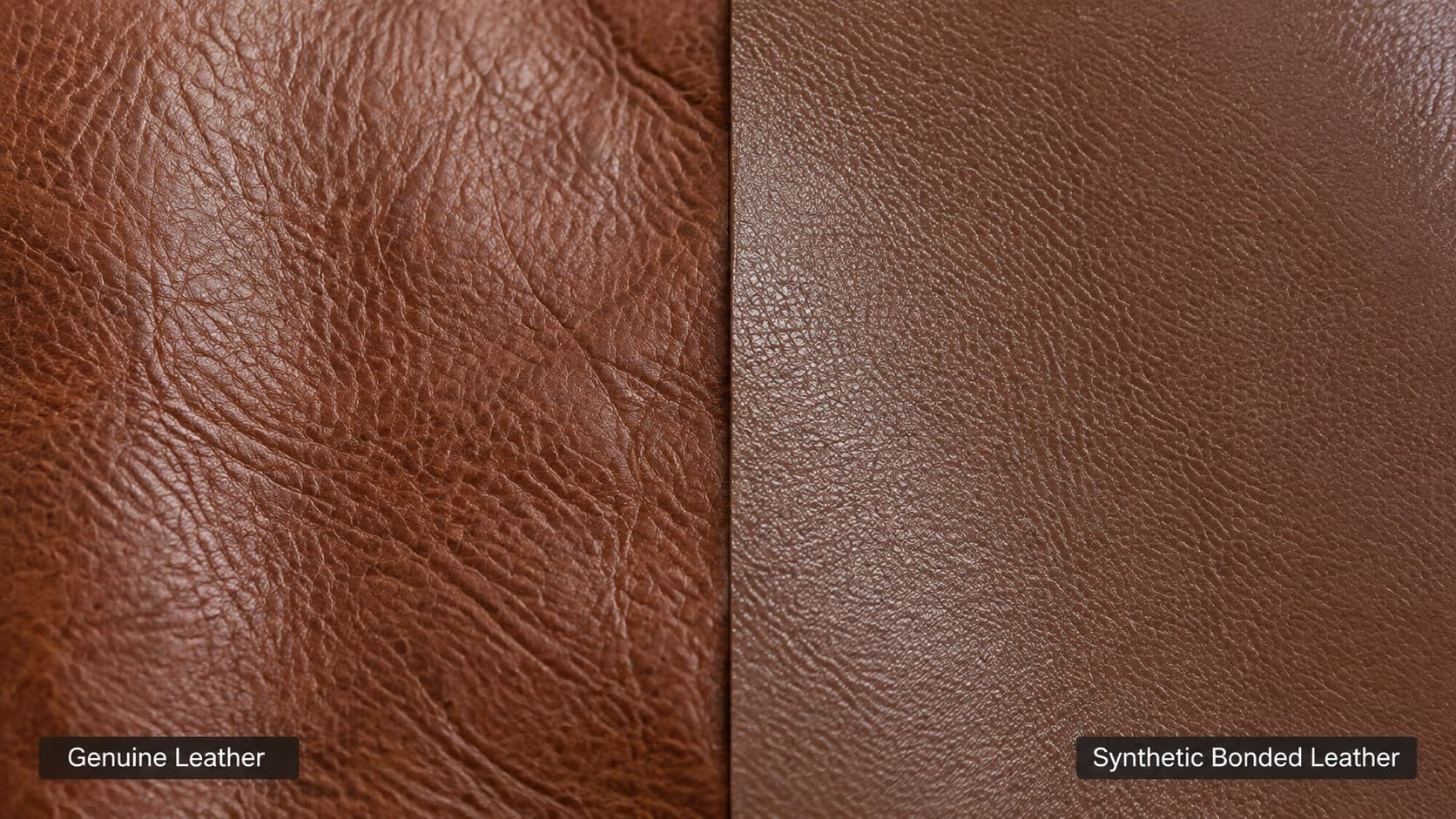
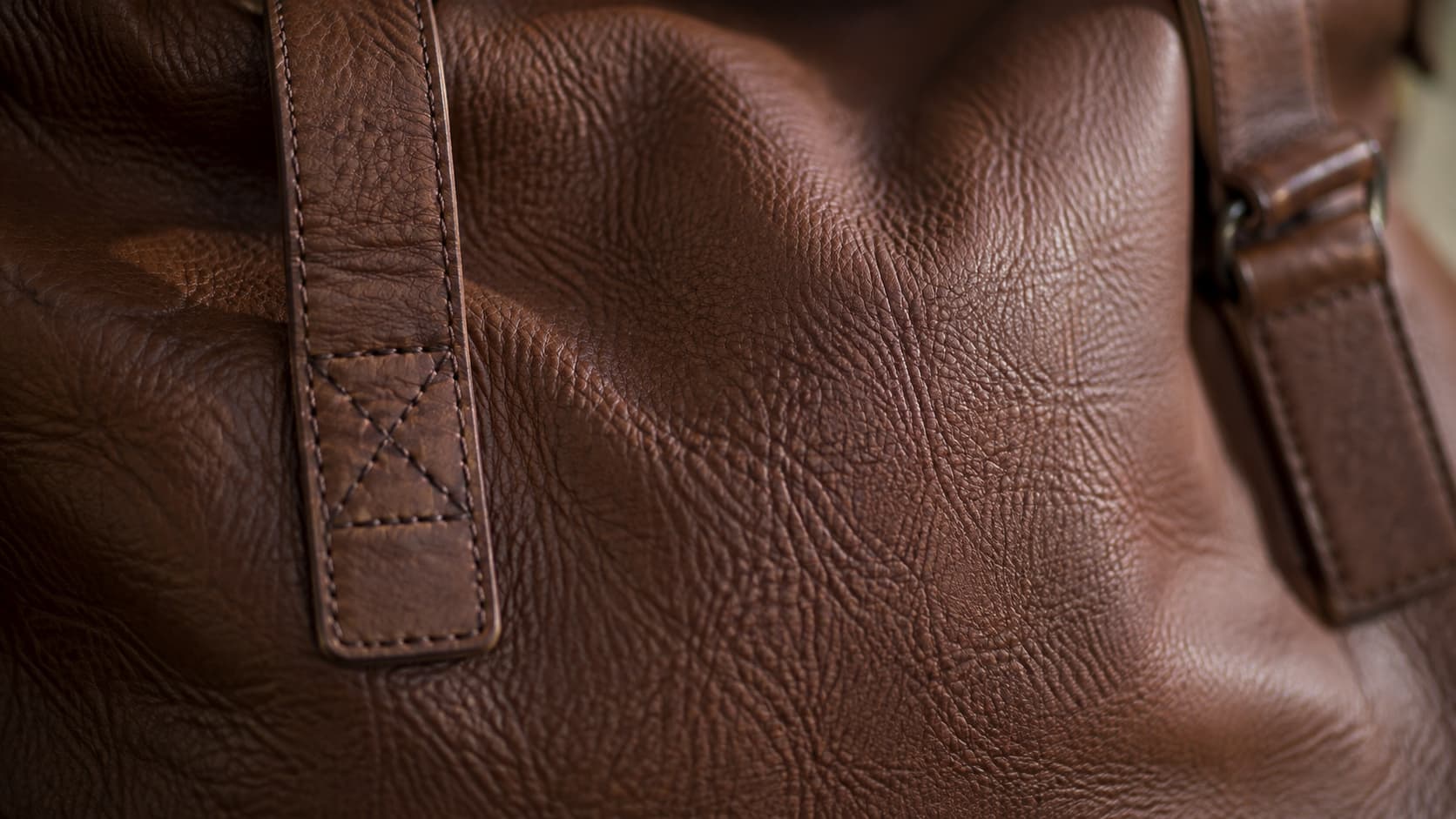
Real leather has small, irregular imperfections like faint scars, wrinkles, or pore patterns, while faux leather often has a grain pattern that repeats in a suspiciously perfect way. Since real leather comes from an actual animal hide, no two pieces are identical, and subtle variation usually shows up across a single item.
Faux leather is manufactured on rollers that stamp the same texture into the material over and over, so a close look across a large surface, like a handbag panel, often reveals the same swirl or grain pattern repeating at regular intervals. That kind of exact repetition almost never happens in nature. The edges of the material, where a strap connects to a bag or where a seam is sewn, are also worth checking. Genuine leather edges tend to look rough, fibrous, or slightly frayed, almost like the edge of a slice of meat, while faux leather edges are usually cut cleanly by a machine and look smooth and uniform, sometimes with a slightly shiny or plastic-like sheen where the material was sealed.
One exception is worth knowing about: corrected-grain leather. This is genuine leather that has been sanded down to remove natural scars and imperfections, then stamped with an artificial, uniform grain pattern for a flawless, consistent look. It is real leather, made from real hide, but it can look so perfect that it gets mistaken for faux leather on the grain-pattern test alone. A piece that looks suspiciously uniform but passes the smell and touch tests is likely corrected-grain rather than fake.
What Does the Underside of Real Leather Look Like?
The back of real leather looks suede-like and fibrous, while the back of faux leather looks like woven fabric or a smooth plastic backing. Peeking inside a bag, lifting a flap, or checking under a strap and flipping the material over often settles the question quickly.
Genuine leather, even when the front is polished and dyed, usually shows its natural fibrous texture on the reverse side, similar to suede. This happens because leather is a single, whole material all the way through, just with different finishing depending on which side faces out. Faux leather is built in layers: a base fabric like polyester or cotton mesh, topped with a plastic coating that’s textured and colored to look like leather. The reverse of faux leather typically shows the woven threads of that backing fabric, something real leather never has.
On items that are fully lined, with no way to see the back, this test simply isn’t available. The smell, touch, and edge checks cover that gap, since none of them require access to the underside of the material.
Can a Water Drop Test Spot Fake Leather?
A small drop of water slowly absorbs into real leather, while it tends to bead up and sit on the surface of faux leather. This happens because real leather is porous, with tiny natural openings that once allowed the animal’s skin to breathe, and those pores still let liquid soak in gradually.
Faux leather is essentially a sealed plastic surface, so water has nowhere to go and just sits there or slides off, similar to how rain beads on a raincoat. The test works best on an unfinished or lightly finished area of leather, since heavily coated or waxed genuine leather can also resist water to some degree. A drop or two in an inconspicuous spot is enough, since too much water can leave a mark on certain types of leather.
Some real leather is intentionally treated to resist water, such as oiled leather used in outdoor boots or waxed leather used in weatherproof bags. On these items, water beading up doesn’t necessarily signal a fake; it may just mean the leather was finished to handle rain and spills. The test is most telling on plain, untreated leather rather than items marketed as water-resistant.
A glossy, shiny finish doesn’t automatically mean fake. Patent leather gets that mirror-like shine from a lacquer or polyurethane coating applied over a leather base, though budget versions today are often made with a fully synthetic base instead. Either way, the smell test and the back-of-material check are far more reliable than surface shine for sorting out which is which.
Is the Flame Test Worth Trying on Leather?
Real leather reacts to an open flame the way skin or hair would, singeing slightly and giving off an odor close to burnt hair, while faux leather melts, curls at the edges, and gives off a chemical, plastic-like smell. This test works because leather is a natural protein fiber, so it responds to heat in a way that manufactured plastic simply can’t replicate.
It is also the most destructive test on the list, which makes it a last resort rather than a first move. Testing should be limited to a small, hidden section, such as the underside of a strap, and only on an item already owned or one a seller has agreed can be tested. A flame should never be held to anything still on display in a store, and even real leather can scorch or discolor if the flame touches a finished, visible surface.
What Do Leather Labels Like “Genuine” and “Full Grain” Mean?
“Full grain” and “top grain” describe real leather made from the actual hide, while “PU leather,” “faux leather,” and “vegan leather” describe synthetic materials made to imitate it. Confusingly, the term “genuine leather” doesn’t mean top quality. It is actually one of the lowest grades of real leather, made from the layers left over after the best part of the hide has been split away for full grain and top grain products.
| Label | What It Actually Means |
|---|---|
| Full grain leather | The entire hide, uppermost layer intact, with natural marks left visible. Most durable and expensive. |
| Top grain leather | The top layer sanded and refinished for a more uniform look. Still real leather, slightly less durable than full grain. |
| Corrected grain leather | Real leather that’s been sanded smooth and stamped with an artificial, uniform grain pattern. Real, but not top quality. |
| Genuine leather | Real leather, but from lower, weaker layers of the hide. Despite the name, it’s a budget-tier product. |
| Bonded leather | Scraps and leftover leather fibers glued together with a bonding agent, often coated in plastic. Barely counts as real leather. |
| PU leather / faux leather / vegan leather | No animal hide at all. A fabric base coated in polyurethane or PVC to look like leather. |
A term like “genuine leather” can sound reassuring while actually describing one of the weaker options on the shelf, which makes the label worth reading carefully rather than taking at face value. A product tag that skips a grade entirely, or lists only synthetic material names, is a strong sign the item isn’t real leather.
Certain words on a tag function as red flags rather than reassurance, since items marked with them are almost certainly not made from animal hide:
- Leatherette or pleather
- Man-made materials
- Synthetic leather
- Faux leather or vegan leather
- Polyurethane (PU) or polyvinyl chloride (PVC)
Frequently Asked Questions
Is faux leather always a bad choice?
Not at all. Faux leather is cruelty-free, generally more affordable, easier to clean, and doesn’t fade or crack the way poorly cared-for real leather can. It is simply a different material with different strengths, and for some uses, like rainy-day bags or budget-friendly accessories, it can genuinely make more sense than real leather.
Why does some real leather not smell very strong?
Heavy dyeing, coating, or finishing during manufacturing can mute the natural scent of real leather, especially on lower grades like bonded or heavily corrected leather. In these cases, the touch test and the back-of-material check tend to be more reliable than smell alone.
Can real leather be a different color on the back than the front?
Yes, and that is actually a good sign rather than a red flag. Because the front of a hide is often dyed or treated while the back is left closer to its natural state, a slight color difference between the two sides is completely normal for genuine leather.
Does a higher price always mean it’s real leather?
No. Price is a hint, not proof. Some faux leather is priced high due to branding, while some real leather, especially lower grades like bonded or genuine leather, can be priced low. The smell, touch, and appearance tests remain more reliable than price alone.
Does the flame test damage a real leather item?
It can, and it should be treated as a last resort. Holding an open flame near any material carries a real risk of scorching or discoloring it, which is why the test is best reserved for a small, hidden area on an item already suspected to be damaged goods, rather than something still being considered for purchase.
Conclusion
Telling real leather from faux leather comes down to trusting the senses over the label. A quick smell for that earthy, natural scent, a gentle press and twist to check for warmth and wrinkling, and a close look at the grain pattern and edges settle nearly every case before the tag ever needs to be checked. Once these checks become familiar, spotting the difference turns into second nature, closing the door on ever wondering again whether what’s being held is skin or plastic wearing skin’s disguise.