Somewhere on a lot of wrists right now is a watch that has never had a battery replaced, not once, and never will. That’s not because the owner got lucky. It’s because the watch is quietly feeding itself on light, turning sunbeams and lamp glow into the tiny bit of electricity a watch actually needs to keep ticking. This kind of watch has a few different names depending on who made it, but the idea behind all of them is the same, and it’s a genuinely clever piece of engineering hiding under an ordinary-looking dial.
What Is a Solar-Powered Watch?
A solar-powered watch has a light-sensitive layer hidden just under the dial that turns light into electricity, which gets stored in a small rechargeable cell instead of a disposable battery. The watch then sips that stored energy to run its motor and move the hands, the same way a regular quartz watch would, except it never runs dry as long as it sees light now and then.
The layer doing the actual work is a photovoltaic cell, which is the exact same basic technology used in solar panels on rooftops, just shrunk down to fit inside a watch case. Light particles hit the cell and knock electrons loose, and that movement of electrons is electricity. On most solar watches, the dial itself is made slightly see-through so light can pass through it and reach the solar cell sitting directly underneath. From the outside, the dial gives no hint that it’s doing double duty as a light filter.
What Is Eco-Drive Watch?
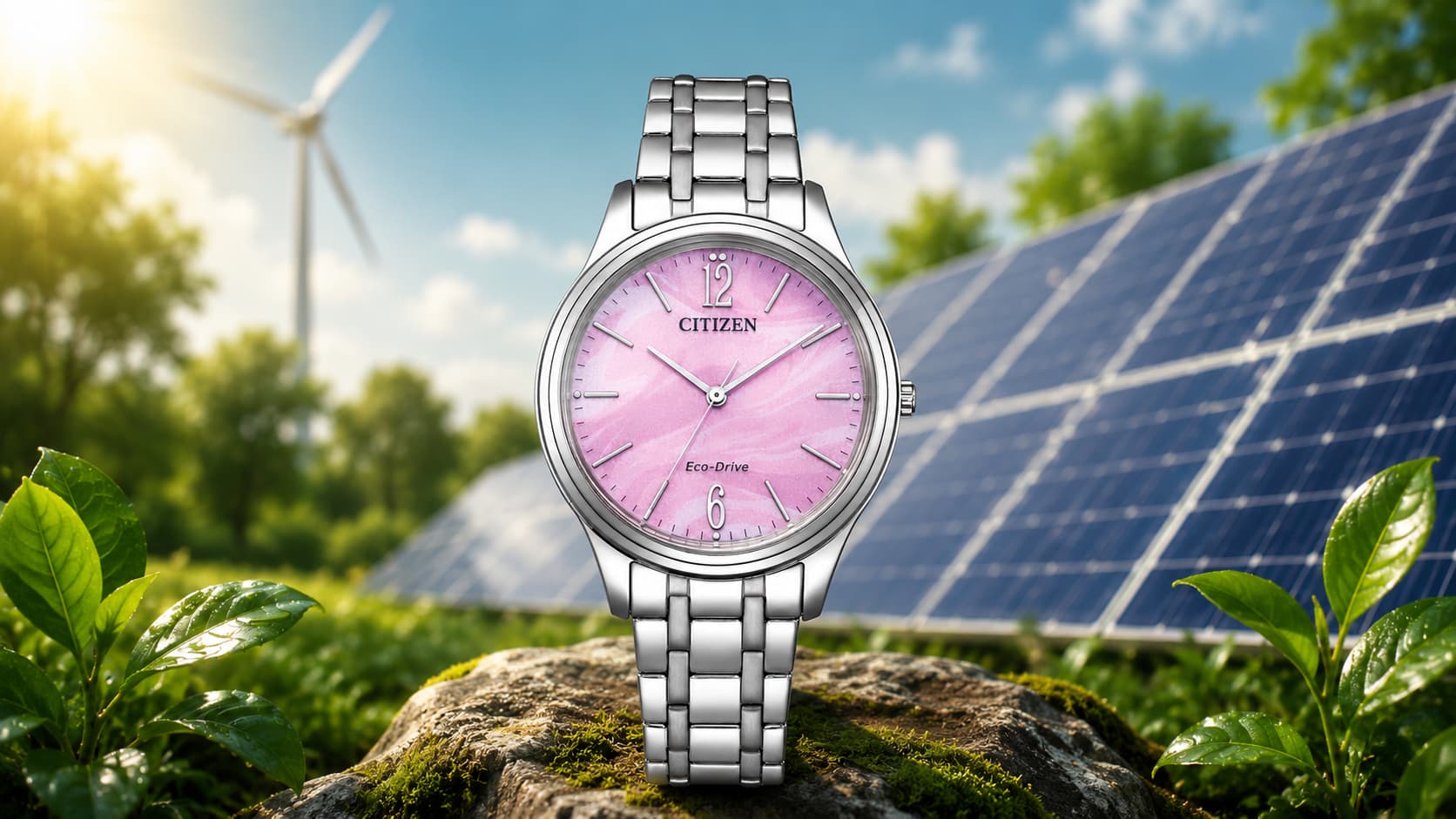
Eco-Drive is Citizen’s own brand name for its light-powered watch technology, and it works on the same solar principle described above. So every Eco-Drive watch is solar-powered, but not every solar-powered watch is an Eco-Drive, since other brands use their own versions of the same idea under different names.
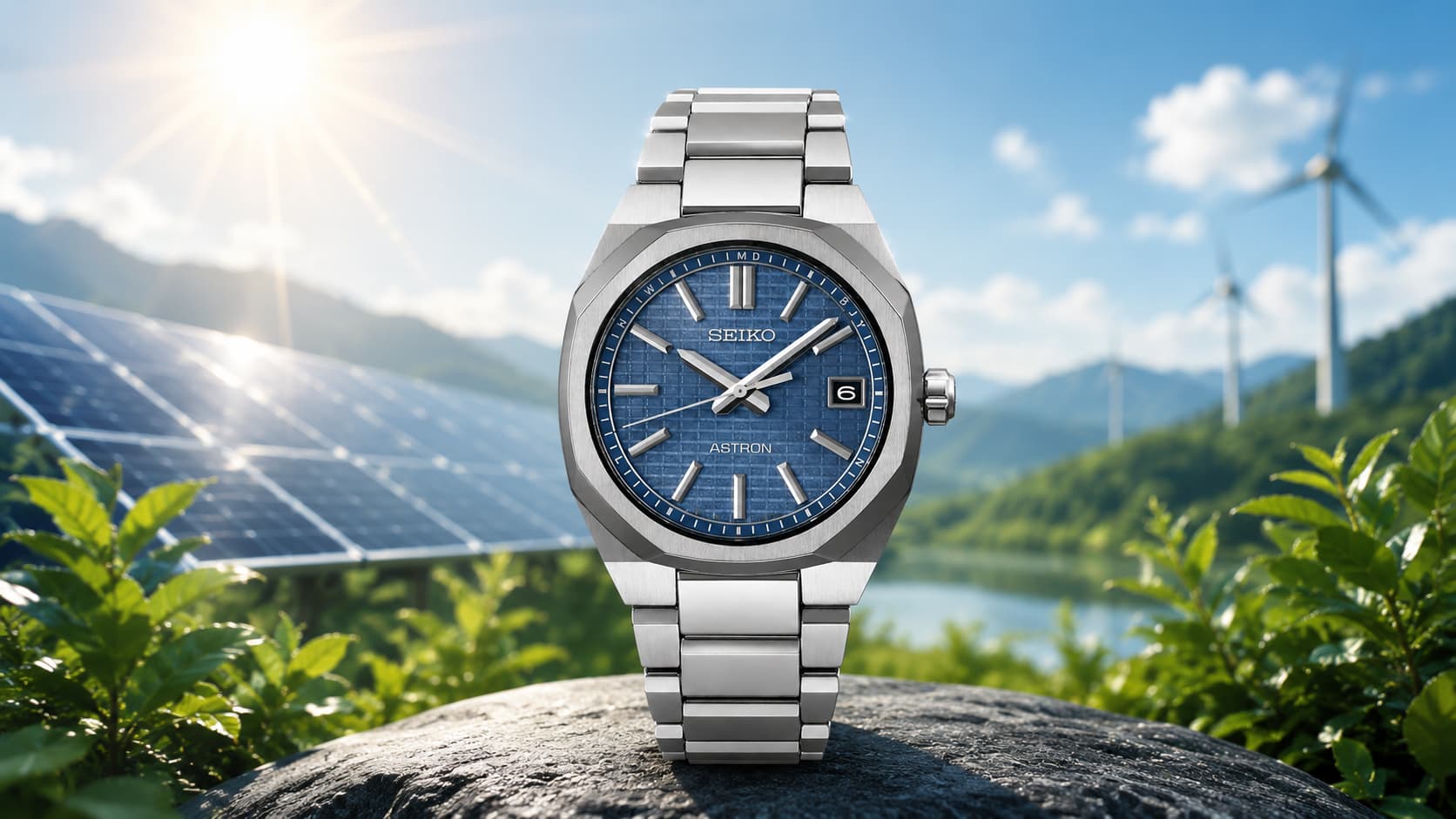
Citizen positions Eco-Drive as a technology that can draw usable energy from nearly any light a wearer encounters during a normal day, not just direct sun, and the brand states that a fully charged watch can keep running for more than six months without any further light exposure. The company also promotes the system’s environmental angle, framing it as a way to cut down on the disposable batteries that would otherwise end up in landfills. Seiko makes its own equivalent, usually just labeled “Solar” on the dial or caseback, and Casio has its “Tough Solar” line, most familiar to people through certain G-Shock models. All three brands are chasing the same goal: a quartz watch that never needs a fresh battery.
It functions less like a special watch feature and more like a tiny, permanent power plant built into an ordinary quartz watch, one that runs on daylight instead of a disposable cell.
Some Eco-Drive models take this a step further by pairing the light-powered movement with radio time syncing, so the watch periodically checks itself against an atomic clock signal and corrects its own time automatically. Citizen combined radio-controlled timing with Eco-Drive for the first time in 1996, building on a concept the German brand Junghans had pioneered with its Mega 1 wristwatch in 1990, and the system works by regularly syncing the watch’s electronic movement with a transmitter linked to one of the world’s atomic clocks. A watch built this way, in theory, never needs a battery change and never needs to be manually reset, as long as it gets occasional light and stays within range of a radio signal.
How Does Solar Watch Technology Work?
Light enters through the watch crystal, passes through a translucent dial, and lands on a solar cell that converts it into electricity, which then charges a rechargeable battery that powers the watch’s circuit board and motor. It’s a short chain of events, but each part matters.
The process moves through five layers, from the outside of the watch inward:
- The crystal — usually mineral glass or sapphire — lets light pass through to the dial underneath.
- The dial is made with a slight see-through quality so light doesn’t stop there.
- The solar cell, a thin panel typically made from amorphous silicon, sits right beneath the dial and absorbs that light, converting it to an electrical current.
- The rechargeable cell, almost always a lithium-ion or lithium secondary battery, stores the electricity for later use.
- The circuit and stepping motor draw a tiny trickle of that stored power to keep the watch’s quartz oscillator ticking and the hands moving.
Citizen sums up its version of this process as a four-step chain: light passes through the crystal and dial to reach a solar panel, the panel converts that light into electrical energy, and the watch stores and manages that power to keep accurate time. On many current Eco-Drive models specifically, the light passes through a translucent dial to reach an amorphous silicon photocell mounted directly under it, which then feeds the lithium-ion battery sitting below the movement.
Why Can’t You See the Solar Cell?
The solar cell is hidden underneath the dial instead of sitting on top of it, so the watch looks like any other timepiece with no visible panels or grids. Early solar watches from the 1970s didn’t have this luxury — their cells often sat right on the dial’s surface, which limited how they could be designed and made them instantly recognizable as “solar watches” from a glance.
That changed in 1995, when Citizen introduced its 7878 caliber, the first solar movement to place the solar cell under the dial rather than on it, which allowed for a cleaner, more conventional-looking watch face. This under-dial placement is now standard across most solar watches on the market, which is part of why so many people own one without ever realizing it isn’t a normal battery watch.
Casio takes a slightly different approach with its Tough Solar watches, which are common on digital and G-Shock models. Casio’s system spreads a solar panel around the watch face itself, positioned to work alongside the LCD display and dial printing so it can collect light even from weaker sources like lamps or fluorescent lighting. Because digital watches often run backlights, alarms, stopwatches, and other power-hungry functions, this layout is built to handle a heavier electrical load than a typical analog solar watch needs to.
What Kind of Light Charges a Solar Watch?
No, direct sunlight isn’t required, though it charges the watch fastest. Ordinary indoor lighting, cloudy daylight, and even the glow from a desk lamp will all put some charge into the cell, just more slowly than the sun would.
Cloudy days, dim light, and exposure to artificial light all work to charge the cell, though a clear, sunny day will charge it fastest and most completely. This is genuinely one of the more practical parts of the design. A watch sitting on a windowsill, on a desk near an office light, or simply being worn outdoors during a normal day is picking up small amounts of charge basically all the time, even if the wearer never thinks about it.
That said, a watch that’s stored in a dark drawer for a long stretch will eventually run its stored charge down and stop. It isn’t broken — it just needs a few hours of decent light to wake back up and start running again.
How Long Does a Solar Watch Charge Last?
A fully charged solar or Eco-Drive watch can typically run for several months to over half a year without seeing any more light, depending on the specific model and its features. Citizen states its Eco-Drive watches run for over six months off a single full charge. Once fully charged, these watches can commonly sit in darkness for more than 180 days before stopping.
Some models push that number even further using a power-saving mode, which shuts off the second hand and other functions during long dark stretches to conserve whatever charge remains, then resumes normal function the moment it detects light again. This is a deliberate design choice, not a malfunction — a solar watch with a stalled second hand isn’t necessarily broken, since the more common explanation is that it has simply been sitting somewhere dark for too long.
The exact numbers vary quite a bit by brand and model. Casio, for example, states that its GAB2100-1A model runs for about 7 months on a full charge under normal conditions with no further light exposure, and can stretch to 18 months in total darkness once its power-save function kicks in. As a rough rule, models built for rugged or outdoor use, and models with fewer power-hungry features like alarms and backlights, tend to hold a charge the longest.
How Long Do the Rechargeable Cells Last?
The rechargeable cell inside a solar watch is built to last for many years, often outliving the useful battery life of a phone or laptop many times over by comparison, because it’s charged and discharged so gently. Citizen states its Eco-Drive movements are designed to function without issues for at least ten years, and there are documented cases of these watches still running well after two decades.
That doesn’t mean the cell lasts forever with zero maintenance. Like any rechargeable battery, it can degrade over time, especially if the watch is regularly left to fully discharge in the dark rather than getting consistent light exposure. Watchmakers generally recommend giving these watches a few hours of daylight every week or two, even when they aren’t being worn, just to keep the cell in good working condition over the long run.
How Do You Know a Solar Watch Is Low on Power?
The clearest sign is the second hand itself: instead of moving once per second like normal, it starts jumping forward two seconds at a time. This is a built-in low-power warning rather than a fault, designed to signal that the watch needs light before it stops altogether.
This two-second jump is an intentional low-power indicator, and it’s the watch’s way of conserving remaining energy while still keeping reasonably accurate time. Citizen Eco-Drive watches and most Seiko solar watches both use this same two-second jumping pattern as their low-battery signal. Some models take it a step further with a dedicated power-save mode. On certain Seiko calibers, if the watch goes 72 hours without enough light, it enters a power-save mode where the second hand parks at the 15-second mark and the hour and minute hands stop moving entirely, though the watch will spring back to the correct time on its own after five seconds or more of decent light.
When either sign appears, the fix is straightforward: placing the watch somewhere bright for several hours is usually enough to resolve it. A recharge by a sunlit window for five to six hours typically brings the watch back to normal, though it should never be left somewhere that gets too hot while charging. If a watch still won’t hold a charge after a solid stretch in good light, that’s usually a sign the rechargeable cell itself has worn out and needs replacing by a watch technician, rather than something a longer charge can fix.
Solar vs. Eco-Drive vs. Tough Solar
The underlying science is nearly identical across brands — light in, electricity out, stored in a rechargeable cell — so the real differences come down to each brand’s engineering choices, efficiency, and how the technology is packaged into their watch lines. Both Eco-Drive and Seiko Solar are light-powered quartz systems with strong accuracy; Eco-Drive tends to emphasize long power reserve and appears across a wide share of Citizen’s catalog, while Seiko Solar delivers similar core benefits within Seiko’s own lineup.
| Brand | Technology Name | First Introduced | Notable Trait |
|---|---|---|---|
| Citizen | Eco-Drive | 1976 | First to move the solar cell fully underneath the dial (1995), enabling more conventional dial designs |
| Seiko | Solar | 1977 | Available across a narrower slice of Seiko’s overall lineup, which is mostly mechanical and Kinetic watches |
| Casio | Tough Solar | Introduced later, expanded widely through G-Shock | Solar panel built around the LCD and dial printing, sized to power heavier digital functions like backlights and alarms |
Both Citizen and Seiko introduced their first solar watches in the 1970s, with Citizen launching in 1976 and Seiko following roughly a year later, and both companies have continued refining the technology for decades since. Citizen’s road to today’s version wasn’t instant, either — the brand spent years making incremental improvements before releasing a model in 1986 that could run 200 hours, over eight days, on a full charge, which was itself considered a breakthrough at the time. Neither brand’s approach is objectively “better” in a way that applies to every buyer — it mostly comes down to which brand’s design, accuracy features, and price point best match a wearer’s priorities.
Frequently Asked Questions
Do solar watches need direct sunlight to work?
No. While direct sunlight charges a solar watch fastest, ordinary indoor lighting, overcast daylight, and lamp light will all charge the cell too, just more gradually.
Can a solar watch’s battery be replaced?
Yes, though it happens rarely since these cells are built to last many years. When a rechargeable cell in a solar watch does eventually wear out, a qualified watch technician can replace it, similar to a standard battery service on any quartz watch.
Is Eco-Drive only found on Citizen watches?
Yes. Eco-Drive is a trademarked name that belongs specifically to Citizen. Other brands making light-powered watches use their own names for the same general technology, such as Seiko’s “Solar” or Casio’s “Tough Solar.”
Will a solar watch stop working if it’s stored in a dark drawer?
It can, but only temporarily. Once the stored charge runs out from lack of light, the watch will stop until it’s exposed to light again, at which point it recharges and starts running on its own.
Are solar-powered watches accurate?
Yes. Most solar and Eco-Drive watches use the same quartz timekeeping technology as a standard battery-powered quartz watch, so their accuracy is comparable — typically accurate to within a few seconds per month, and even tighter on models with radio or GPS time syncing.
Conclusion
Solar and Eco-Drive technology solves one of the most annoying parts of owning a quartz watch: the slow countdown to a dead battery. By hiding a light-converting cell just beneath the dial and pairing it with a rechargeable power cell, these watches keep themselves running for months on a single charge and, in many documented cases, for decades of regular use. The brand name on the dial changes the marketing, not the underlying science — Citizen’s Eco-Drive, Seiko’s Solar, and Casio’s Tough Solar are all variations on the same principle of turning ordinary light into a quiet, self-renewing source of power.