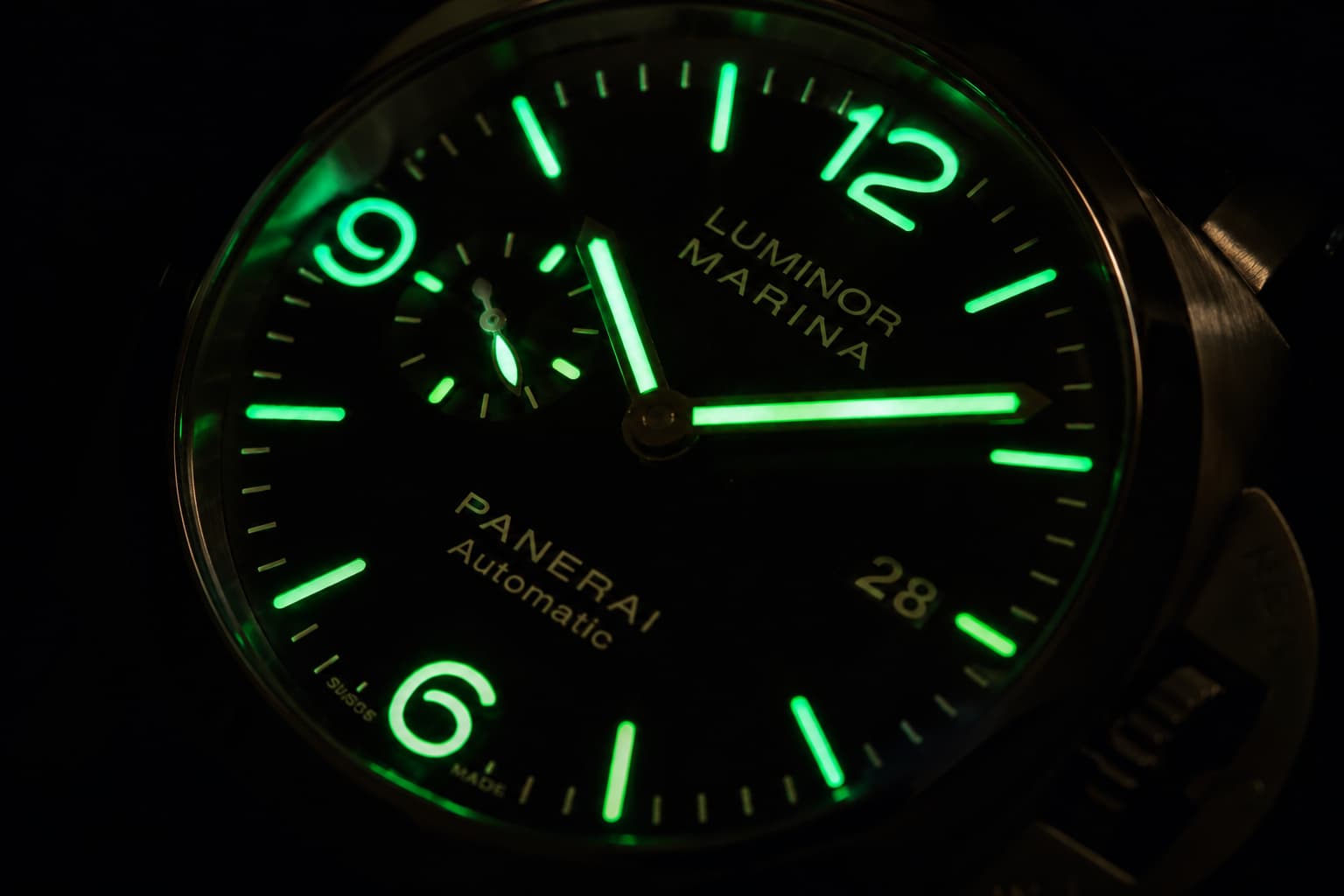
Glance down at a watch in a dark room and, on the right model, the hands and hour markers seem to float in the air on their own soft light. That glow is called lume, short for luminescence, and it has been solving the same simple problem for more than a hundred years: how does anyone read the time when there’s nothing else to see by? The story behind that little glow involves radioactive paint, factory workers who got sick from it, and a chemistry breakthrough that finally made glowing watches safe. It’s a much bigger story than most people expect from something so small on a wrist.
What Is Watch Lume?
Watch lume is a light-storing material painted or applied onto a watch’s hands, hour markers, or numbers so they remain visible after the lights go out. It works a bit like a glow-in-the-dark sticker on a kid’s ceiling: it soaks up light while it’s bright out, then slowly releases that stored light once things go dark.
Lume isn’t just decoration. It started as a practical tool for soldiers and workers who needed to check the time without a flashlight, and it’s still essential today for divers, pilots, and anyone checking a watch in the middle of the night. Not every watch has it, and not every lume job performs the same way, which is why some watches glow for eight hours and others barely last thirty minutes.
How Does Watch Lume Work?
Most modern lume works through a process called photoluminescence, meaning it needs to “charge up” under a light source before it can glow. A smaller group of watches use a completely different trick that never needs charging at all. Understanding the difference explains why two lumed watches can behave in totally opposite ways.
Photoluminescence: How Charged Lume Works
This is the lume found on the vast majority of watches sold today, including nearly every dive watch and pilot watch on the market. The material is made of tiny crystals that absorb photons, which is just a science word for particles of light, and hold onto that energy for a while before letting it go again as a visible glow.
The surprising part is that the material isn’t producing its own light. It’s storing borrowed light, the same way a rechargeable battery stores electricity. A lumed watch left in a dark drawer for a day will have already faded to nothing by the time it’s checked again, since there was nothing left to recharge it. That same watch held under a bright lamp or sunlight for a minute or two, though, will glow clearly for hours once the lights go off.
Two things determine how good a lume job is: how bright it gets right after charging, and how long it keeps glowing before fading below what the human eye can detect. A cheap lume job might fizzle out in under an hour, while a well-applied premium lume can still be faintly readable eight to ten hours later.
Radioluminescence: Lume That Never Needs Charging
A much smaller category of watches uses radioluminescence instead, which produces light through a slow, ongoing radioactive process rather than absorbed light. These watches glow at a steady, constant brightness all night, every night, without ever being held under a lamp.
This sounds alarming, but the amount of radioactive material involved in a modern watch is extremely small and considered safe by regulators, unlike the dangerous versions used a century ago (more on that below). Watches using this method are less common and tend to show up in tool watches built for the military, professional divers, and outdoor use, since a constant glow with zero charging is genuinely useful when checking a lamp or a window isn’t an option.
The trade-off is brightness. A freshly charged photoluminescent dial is usually more intense in the first hour than a radioluminescent one, but it fades steadily from that point on. A radioluminescent watch never reaches that early peak, but it also never goes fully dark, which is why it’s often described as dimmer but more dependable rather than brighter overall.
How Watch Lume Has Changed Over Time
The glowing watch dial has a much darker origin story than most people realize, and understanding it helps explain why the watch industry cares so much about lume safety today.
Radium: The First Watch Lume
Glow-in-the-dark watches first appeared around the 1910s, when a paint made from radium mixed with zinc sulfide let soldiers read their watches in the trenches during World War I without lighting a match that could give away their position. The paint, sold under names like “Undark,” was seen as almost magical at the time, since radium had just been discovered by Marie Curie and was widely, and wrongly, believed to be healthy.
The paint was applied by hand, mostly by young women working in factories in places like New Jersey, Illinois, and Connecticut. To keep their tiny brushes sharp enough to paint fine numbers, workers were taught to shape the bristles between their lips, meaning they swallowed small amounts of radium with every stroke. Within a decade, many of these women, later remembered as the “Radium Girls,” developed severe bone damage, jaw disease, and cancer after years of exposure, and their court cases became a turning point for workplace safety laws in the United States.
Radium itself doesn’t fade quickly. It has a half-life of around 1,600 years, meaning the radioactivity in an old radium dial is still there today, decades after the watch was made. What actually dims on an old radium dial over time isn’t the radium, it’s the zinc sulfide phosphor around it, which slowly gets damaged by the very radiation exciting it and eventually stops glowing even though the radium underneath is still active. It’s also worth knowing that the greatest danger was always to the workers handling raw radium paint, not to someone simply wearing a finished watch, since the radiation involved struggles to pass through a sealed case and crystal.
Tritium and Promethium: Safer Lume Options
After the dangers of radium became impossible to ignore, watchmakers began phasing it out through the 1960s and experimented with other radioactive elements considered less harmful. Promethium was one early substitute, but its half-life of only about two and a half years meant a promethium dial’s glow faded dramatically within just a handful of years, so relatively few brands adopted it before moving on again.
Tritium turned out to be the more practical replacement and became the industry standard from the 1960s through the 1990s. It has a much longer half-life of roughly 12.3 years, and unlike radium, its radiation is weak enough to be blocked by something as thin as a sheet of paper. Vintage watches from this era often carry a small “T” or “T Swiss T” printed near the six o’clock marker, or “H3” inside a circle on military pieces, both of which signal tritium lume rather than radium. Rolex, along with much of the wider industry, used tritium-based lume on its dials until switching away from it at the end of the 1990s, once a safer non-radioactive alternative had matured enough to take over. Tritium hasn’t disappeared, though; it’s still used today, just sealed safely inside tiny glass tubes rather than painted directly onto the dial, which prevents any of the material from being touched or swallowed.
How Super-LumiNova Changed Watch Lume
In 1993, a Japanese company called Nemoto & Co., which had spent years researching safer glow materials, developed a non-radioactive luminescent pigment made from strontium aluminate. This pigment, sold as LumiNova, charges from ordinary light instead of radioactivity and contains no radioactive material at all.
A Swiss company called RC Tritec AG later partnered with Nemoto to produce and distribute a version of this pigment specifically for the watch industry, marketed as Super-LumiNova. It quickly became the standard lume material used across the vast majority of watch brands worldwide, from budget dive watches to some of the most expensive timepieces made, because it offered strong brightness with zero radiation risk.
Types of Watch Lume Today
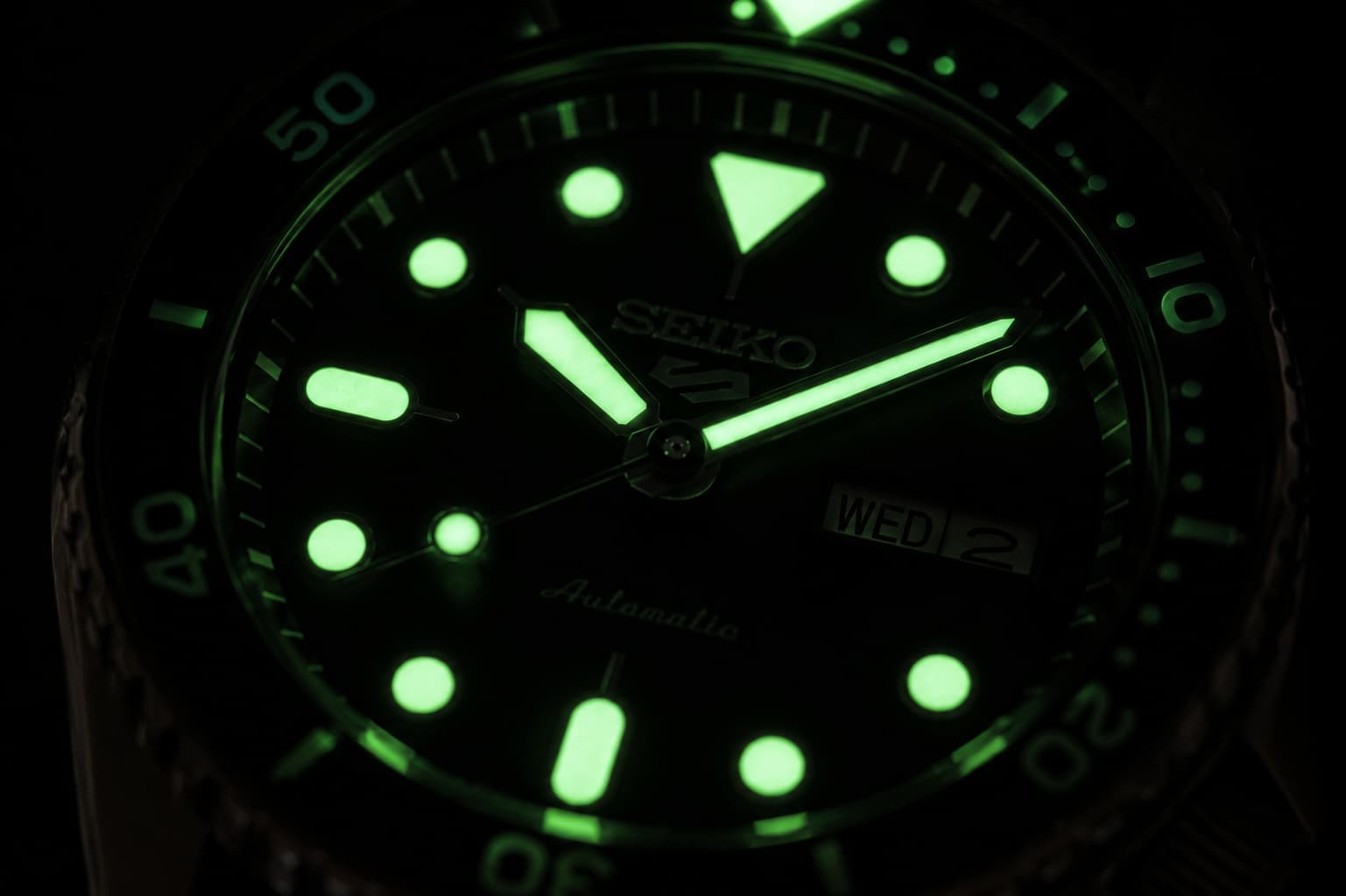
Not all glowing watches use the same technology, and the type used often depends on the brand, the watch’s purpose, and its price point.
Most watches marketed as “diver’s” or “pilot’s” watches specify their lume type somewhere in the product description or on the case back, which is worth checking for anyone who cares about brightness and glow duration.
Super-LumiNova and LumiNova
This is the pigment used on the overwhelming majority of lumed watches today, applied as a paint over the dial markers, hands, and sometimes the bezel. It comes in several color options, including the classic green and the increasingly popular light blue, and in different performance grades, typically labeled Standard, Grade A, and the newer Grade X1, with each step up producing a noticeably brighter glow in the first couple of hours after charging.
Brands don’t always advertise which grade they use, so two watches with identical-looking green lume can perform quite differently in practice. This is one reason enthusiasts often test a new watch under a bright light and compare it against another piece before deciding how good the lume actually is.
Brand-Specific Watch Lume
Some major watch brands use their own branded version of a similar photoluminescent pigment, tuned to their own preferred color or performance. Rolex uses a proprietary formula called Chromalight, recognizable by its long-lasting blue glow, while Seiko has long used a version called LumiBrite, licensed from the same Nemoto research that created the original LumiNova. These are built on the same basic strontium aluminate science as Super-LumiNova but are mixed, tinted, and licensed differently by each brand.
Most other watch brands, including a large share of Swiss luxury names, simply use standard or grade-specific Super-LumiNova sourced directly from its Swiss manufacturer rather than developing their own version, since the base material already performs well and doesn’t need reinventing.
Tritium Gas Tubes
Instead of paint, these use tiny sealed borosilicate glass tubes filled with tritium gas and coated inside with a phosphor layer, glowing continuously through radioactive decay rather than absorbed light. The tubes are manufactured almost exclusively by the Swiss company mb-microtec, which sells them under the name Trigalight, even though different watch brands market the same underlying technology under their own names.
Brands like Ball Watch, Luminox, Traser, and Marathon are known for building this technology into their tool watches, often marking the dial with “T25” or “T100” to indicate the radiation level inside the tubes, with T100 tubes containing roughly four times the tritium of a T25 tube and glowing correspondingly brighter. Because tritium naturally decays over time, the glow slowly dims over roughly a 12-year half-life, though most tritium tubes remain usefully bright for around 25 years before eventually needing replacement.
Photoluminescent pigment and tritium tubes solve the same problem in opposite ways, and the practical differences between them are significant enough to matter when choosing a watch.
| Super-LumiNova / LumiNova | Tritium Gas Tubes | |
|---|---|---|
| How it’s charged | Absorbs sunlight or artificial light | Never needs charging; glows from radioactive decay |
| Radioactive? | No | Yes, in small, sealed, regulated amounts |
| Typical glow duration | Brightest for 1-2 hours, fading over 8-10 hours | Steady, dimmer glow for years, with no dark period |
| Long-term lifespan | Doesn’t wear out; performance stays consistent for decades | Gradually dims over a roughly 12-year half-life |
| Common on | Most dive, pilot, and everyday watches | Military, tactical, and dedicated dive-tool watches |
| Known brands | Rolex, Omega, Seiko, Panerai, most Swiss brands | Ball Watch, Luminox, Traser, Marathon |
What Makes Lume Bright and Long-Lasting?
A few practical factors decide whether a lumed watch will actually be useful in the dark, and they have nothing to do with the watch’s price tag alone. Two watches using the exact same Super-LumiNova pigment can still perform very differently once differences in application and use are factored in.
- Layer thickness: a thicker application of lume pigment holds more charge and glows longer, which is why premium dive watches often apply lume more generously than dressier pieces.
- Pigment grade: higher-grade Super-LumiNova formulas, like Grade X1, absorb and release light more efficiently than standard grades.
- Color: green lume pigments tend to appear brighter to the human eye, while blue lume is often prized for a softer, longer visual glow.
- Charging light: natural sunlight generally charges photoluminescent pigment more effectively than indoor lamps, since it’s both stronger and richer in the wavelengths lume absorbs best.
- Surface area: larger hands and thicker markers simply hold more pigment, and therefore glow longer, than thin or narrow lume applications.
- Application quality: even good pigment applied unevenly or too thinly by hand can underperform a cheaper pigment applied carefully and consistently.
Unlike a light bulb that eventually burns out, quality Super-LumiNova pigment doesn’t wear out with age or repeated charging. A dial lumed decades ago can, in most cases, still charge and glow the same way it did when new, as long as it hasn’t been damaged, which is very different from tritium tubes, which are always slowly losing brightness the moment they’re manufactured.
Tips to Make Watch Lume Glow Brighter
The short answer: direct, bright light for a minute or two produces the strongest glow, and natural sunlight beats any indoor lamp by a wide margin. A quick charge under a bright window or outdoors noticeably outperforms the same watch charged under a dim ceiling light.
For a watch charging under artificial light indoors, a full minute or two under a strong LED or daylight-bulb lamp held close to the dial produces reasonable results, though it still falls short of direct sun. Lume also charges through the crystal, so anything blocking that light matters: a watch sitting face-down on a nightstand, tucked under a sleeve, or behind tinted sunglasses picks up no charge at all, no matter how bright the room is. Before a night dive, a flight, or a night’s sleep, a short blast of direct sunlight produces a far stronger glow than a watch left sitting under ordinary room lighting all day.
Frequently Asked Questions
Is watch lume radioactive?
Modern Super-LumiNova and similar pigments used on the vast majority of today’s watches are not radioactive at all; they charge from ordinary light rather than any radioactive decay. Tritium tube watches do contain a small amount of radioactive gas, but it’s sealed inside glass tubes at levels considered safe by international regulators.
Why does watch lume stop glowing?
Standard photoluminescent lume always fades within a matter of hours after it’s no longer being charged by light, which is completely normal. If a watch’s lume looks far dimmer than it used to even right after a good charge, the pigment may be old or low grade, or the watch may need servicing to check the dial’s condition.
How long does watch lume glow in total darkness?
A well-applied photoluminescent lume, like a higher grade of Super-LumiNova, can remain visible for roughly eight to ten hours after a strong charge, though it’s brightest in the first hour or two and gradually dims after that. Tritium tube lume glows at a steady, lower brightness continuously, without needing to be recharged, for years at a time.
Can old radium watches still be worn safely?
Vintage watches with original radium dials do still emit radiation, and while the risk from occasional handling is generally considered low, direct or prolonged skin contact and any damage to the dial that could release radium dust are best avoided. Many collectors choose to have such dials professionally assessed, and some vintage radium watches have had their dials relumed with modern, safe materials.
What’s the best color for watch lume?
There isn’t a single “best” color, since it comes down to personal preference and use case. Green lume is generally considered the brightest to the human eye, making it popular for tool and dive watches, while blue lume tends to have a softer look that many wearers still find perfectly readable in the dark.
Conclusion
Watch lume looks like a small design detail, but it carries a surprisingly deep history, from a dangerous radium mistake that cost workers their health to the safe, glowing pigments used on watches today. Whether a watch charges its glow from sunlight through Super-LumiNova or produces a constant glow from sealed tritium tubes, the goal has stayed exactly the same since the 1910s: letting someone check the time without needing any other light source. The next time a watch’s dial glows softly on a nightstand, it’s worth remembering that the quiet green or blue light took over a century of trial, error, and hard lessons to get right.