Most people who love watches have heard of Rolex, Omega, or Seiko. Far fewer have heard of Fears, and that’s a shame, because Fears has one of the strangest and most interesting stories in the whole watch world. It’s a British company that started in 1846, grew into one of the largest watchmakers in the west of England, disappeared for forty years, and then came back from the dead because one family member refused to let the name die. Today, Fears builds small batches of hand-finished watches in Bristol, and its lineup has grown into something genuinely worth exploring if you care about watches with real history behind them rather than a marketing story invented last year.
What Is Fears Watches?
Fears is a British watch company founded in Bristol, England, in 1846, and it is still owned and run by the same family today. The brand went quiet for about forty years in the late 20th century before being relaunched in 2016 by a descendant of the original founder. It now makes mechanical watches that are designed in Britain, built with Swiss-sourced movements and cases, and hand-assembled by a small team at the company’s own workshop in Bristol.
What makes Fears stand out from most “new” independent watch brands is that it isn’t actually new. It has an archive of real historical pieces, old advertisements, and even company directors buried in the same Bristol cemetery that the newest collection is named after. The current team leans on that archive constantly when designing new watches, rather than inventing a backstory from scratch.
The 180-Year Story Behind the Name
Fears was founded by a watchmaker named Edwin Fear, who opened his first workshop and showroom on Redcliff Street in Bristol in 1846, when he was just 21 years old. The business grew quickly, and within twenty years the company had added a second premises on Bristol Bridge, which served as its headquarters for most of the next century.
How Fears Grew Into a Major Watchmaker
The company kept expanding through the late 1800s and early 1900s, eventually registering as a formal corporation — Fears Limited — in 1908. Wristwatches took over from pocket watches on the production floor during the 1920s, a period when the business tried out several unusual case shapes, among them the cushion silhouette that modern Fears watches still wear today. By the time the 1930s arrived, roughly 100 watchmakers were working under the Fears name in Bristol, and the company’s products were reaching buyers in around 95 countries, enough to make it the largest watch manufacturer in the west of England at the time. A separate export office, trading as Fears (Export) Limited, operated out of Brunswick Square in Bristol to handle that overseas trade.
The company made it through the Great Depression, but World War II proved far more damaging: Bristol was heavily bombed during the war, and the Fears headquarters was among the buildings lost, forcing a rebuild in a new location. The business carried on for several more decades after that, but like most traditional mechanical watchmakers, it couldn’t compete once cheap, highly accurate quartz watches from Japan took over the global market in the 1970s. By 1976, Fears had shut down entirely.
The Doors Close, Then Reopen
For almost forty years, Fears existed only as a family memory and a handful of old watches passed down through generations. That changed because of Nicholas Bowman-Scargill, Edwin Fear’s great-great-great-grandson, who had grown up with barely any awareness of his family’s watchmaking past. It was only during an otherwise ordinary family meal that his mother filled in the details, and that conversation ended up reshaping his entire career.
Instead of chasing a career in finance as he had originally planned, Bowman-Scargill trained as a watchmaker, spending nearly five years at Rolex’s London workshop to learn the craft properly. Years of digging through the family archive followed, and the research culminated in a public relaunch at London’s SalonQP exhibition on November 3, 2016. The watch chosen to carry that moment was the Redcliff, its name borrowed from the street where Edwin Fear had opened his first workshop 170 years earlier.
A second collection, the Brunswick, arrived the following year, in 2017. Its name is a nod to Brunswick Square, the Bristol address that had housed the company’s export office generations earlier. The brand’s physical return to Bristol took a little longer: for its first several years back in business, Fears operated without a dedicated base in the city, and it wasn’t until 2022 that it opened a proper showroom and workshop on home turf again — something it hadn’t had in over fifty years. That site has since grown into a single headquarters at Paintworks on Bath Road, where the design, sales, and watchmaking teams all now sit together, including a workshop built specifically for assembling the watches by hand. The company marked its 175th birthday in 2021 with a 176-page history book, Elegantly Understated: 175 Years of the Fears Watch Company, penned by Bristol writer Jane Duffus with a foreword contributed by master watchmaker Roger Smith OBE. Five years later, in 2026, the brand turned 180.
Fears is one of the few British watch brands that can point to physical proof of its past — real watches, real advertisements, a published history book, and even the graves of its founder and his successor — rather than an origin story written for marketing purposes.
How Fears Builds Its Watches Today
Fears designs its watches in Britain but still relies on Switzerland for the technical heart of each piece. Cases are typically machined in Switzerland, and the movements come from established Swiss suppliers such as Sellita and La Joux-Perret, sometimes combined with specialist modules built by other makers for more complicated pieces.
Once the components arrive in Bristol, Fears’ own team handles final assembly, quality control, water-resistance testing, timing regulation, and finishing by hand at the Paintworks workshop. This hybrid approach — Swiss-made components finished and assembled in England — is fairly common among small independent brands, because it lets Fears offer well-finished mechanical watches without the enormous cost of building a movement entirely from scratch in-house. Most Brunswick models also give buyers a choice between a solid steel caseback or a sapphire crystal exhibition caseback, so the finished movement and its engraved rotor can be seen on the ones where that detail matters most to the owner.
Several design details repeat across the lineup and act as the brand’s visual signature, tying every modern Fears watch back to the same family identity:
- The cushion-shaped case, borrowed directly from Fears watches made in the 1920s.
- The Fears Cypher, a monogram engraved into the crown on most models.
- “Pipette” hands, a distinctive, slightly bulbous hand shape used across most of the range.
- The Flower of Bristol motif, often engraved or cast into the rotor visible through the caseback.
- The “Edwin” typeface, a bespoke lettering style the brand created for dial numerals and text.
The Best Fears Watches to Know
Fears keeps its lineup fairly small and focused compared to big commercial brands, which makes the collection easy to take in as a whole. The following models represent where the brand stands today, from its most practical watch to its most ambitious one.
Fears Redcliff 39.5 Date — The All-Rounder
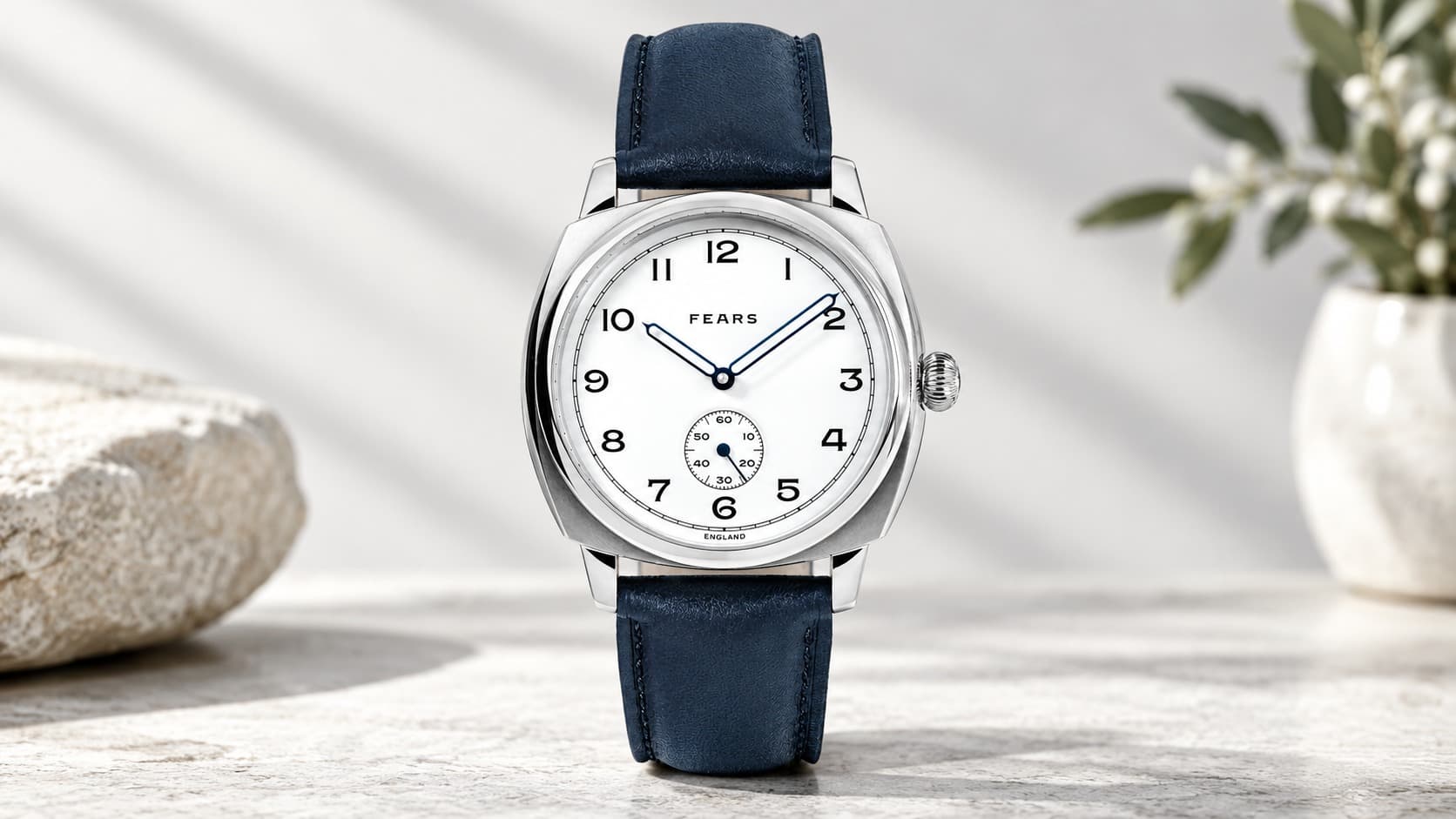
The Redcliff is the collection that relaunched the brand in 2016, and it remains the most practical, everyday option in the current range. The case is 39.5mm across, made of stainless steel, and kept deliberately thin, with buyers able to choose between a three-link steel bracelet or a leather strap. Dial options run from deeper, classic tones like Pewter Grey and Cherry Red through to softer, newer pastel shades including Pale Lilac, Sherbert Yellow, and Soft Peach.
It runs on an automatic movement with a date window, and depending on the specific edition, water resistance sits somewhere between 100 and 150 meters, making it genuinely wearable day to day rather than just for display. A hardened, frosted-steel “ES” (Endurance Specification) edition takes this further, with a tougher case finish built for rougher daily use. Because of its slim proportions and simple dial layout, the Redcliff works equally well under a shirt cuff at the office or on a weekend.
A lesser-known detail from the brand’s early years: the very first Redcliff watches sold in 2016 used quartz movements rather than mechanical ones. That lower-cost launch helped fund the company’s move into full Swiss mechanical watchmaking soon after, and every Redcliff sold today is automatic. The shift illustrates how a relaunched heritage brand actually gets off the ground financially before investing in costlier movements.
Fears Brunswick — The Signature Dress Watch
If the Redcliff is Fears’ everyday watch, the Brunswick is its signature design. Its cushion-shaped case is directly inspired by Fears watches from the 1920s, and most versions use a hand-wound movement rather than an automatic one, which keeps the case slim and gives the watch a more old-fashioned, deliberate feel on the wrist. The owner has to wind it by hand each day, a small daily ritual that’s part of the appeal for people who enjoy a more hands-on relationship with their watch.
Newer Brunswick editions, like the Brunswick 38 “Charcoal Rose,” use the La Joux-Perret D100 hand-wound caliber and feature exhibition casebacks that show off the finished movement underneath. The 38mm case size keeps the whole watch compact, so it tends to suit smaller or slimmer wrists as well as anyone who prefers a more restrained, formal piece. This is the model most people picture when they think of Fears, and it’s the clearest expression of the brand’s own description of itself: “elegantly understated.”
Fears Brunswick 40.5 Jump Hour — A Unique Mechanical Watch
This is the most technically interesting watch in the current lineup. Instead of traditional hour and minute hands, the dial displays the current hour through a large circular window at 12 o’clock that jumps forward every sixty minutes, while the minutes are shown separately below it.
The jumping-hour function is made possible by a module built in partnership with the British brand Christopher Ward, originally developed for its own Bel Canto watch, and mounted on top of a Swiss Sellita SW200 automatic base movement. It runs at 4Hz with a 38-hour power reserve, and it’s housed in the brand’s classic 40.5mm cushion case, available in dial finishes like a textured silver-and-plum “Barleycorn” pattern or a softer, pottery-inspired “China Blue.” It’s a genuinely fun mechanical party trick built on a dependable, well-tested base movement.
Fears Brunswick 40 Filton — The New Pilot’s Watch
Released in 2026 for the brand’s 180th anniversary, the Filton is Fears’ first-ever pilot’s watch, which is a notable milestone for a company that has otherwise stuck closely to dress and everyday designs. Its name comes from Filton, a district just outside Bristol with a long aviation pedigree: the Bristol Aeroplane Company was based there, and British-built parts for Concorde later came out of the same area. Naming the watch after a real piece of local industrial history, rather than reaching for generic military styling cues, keeps it tied to the same hometown story the rest of the brand draws on.
It keeps the familiar 40mm Brunswick cushion case, but the dial borrows cues straight from older aviation watches: a bold triangle sits at 12 o’clock to mark true north on the bezel, and the numerals are set in the brand’s own “Edwin” lettering. A small date window tucked in at six o’clock is new too — the first time a date has appeared anywhere on the 40mm Brunswick — and the whole watch runs on the automatic La Joux-Perret G100 movement, good for roughly 68 hours between windings. Two dial finishes were available at launch: a textured green called Squadron Green, which fades vertically and reads closer to a rugged field watch, and a glossier black option called Raven Black that leans more toward a traditional pilot’s watch look.
Fears Brunswick 39 Perpetual Calendar — The High-End Showpiece
Sitting near the top of the Brunswick family is the Perpetual Calendar, a far more complicated watch built for collectors who want to see traditional watchmaking on full display. Its movement combines two parts: a Sellita SW300 as the base, finished by hand, with a perpetual-calendar module from specialist supplier Dubois Depraz layered on top. Fears has given the combined result its own in-house caliber number, 55115, rather than selling it under the supplier names alone, and it carries a 47-hour power reserve with 50 meters of water resistance.
That movement gets real decorative attention: its bridges are frosted and hand-beveled, and the rotor is solid 18 carat gold, cast with the brand’s own Flower of Bristol emblem and visible through a sapphire window in the caseback. A perpetual calendar is considered one of watchmaking’s harder complications to pull off, since it tracks varying month lengths and leap years on its own, without needing to be reset by hand. Seeing one come out of a small independent British name, rather than only from the large Swiss manufacturers that usually build them, is a meaningful part of what makes this particular Fears watch stand out.
Fears Arnos — The Smallest and Most Personal
The Arnos is the newest collection in the Fears lineup, and it’s also the most compact. Its name points to Arnos Vale, the part of Bristol where the company’s current headquarters sits — and, in a coincidence the brand clearly enjoys, the same area where both founder Edwin Fear and his successor, Amos Daniel Fear, were laid to rest.
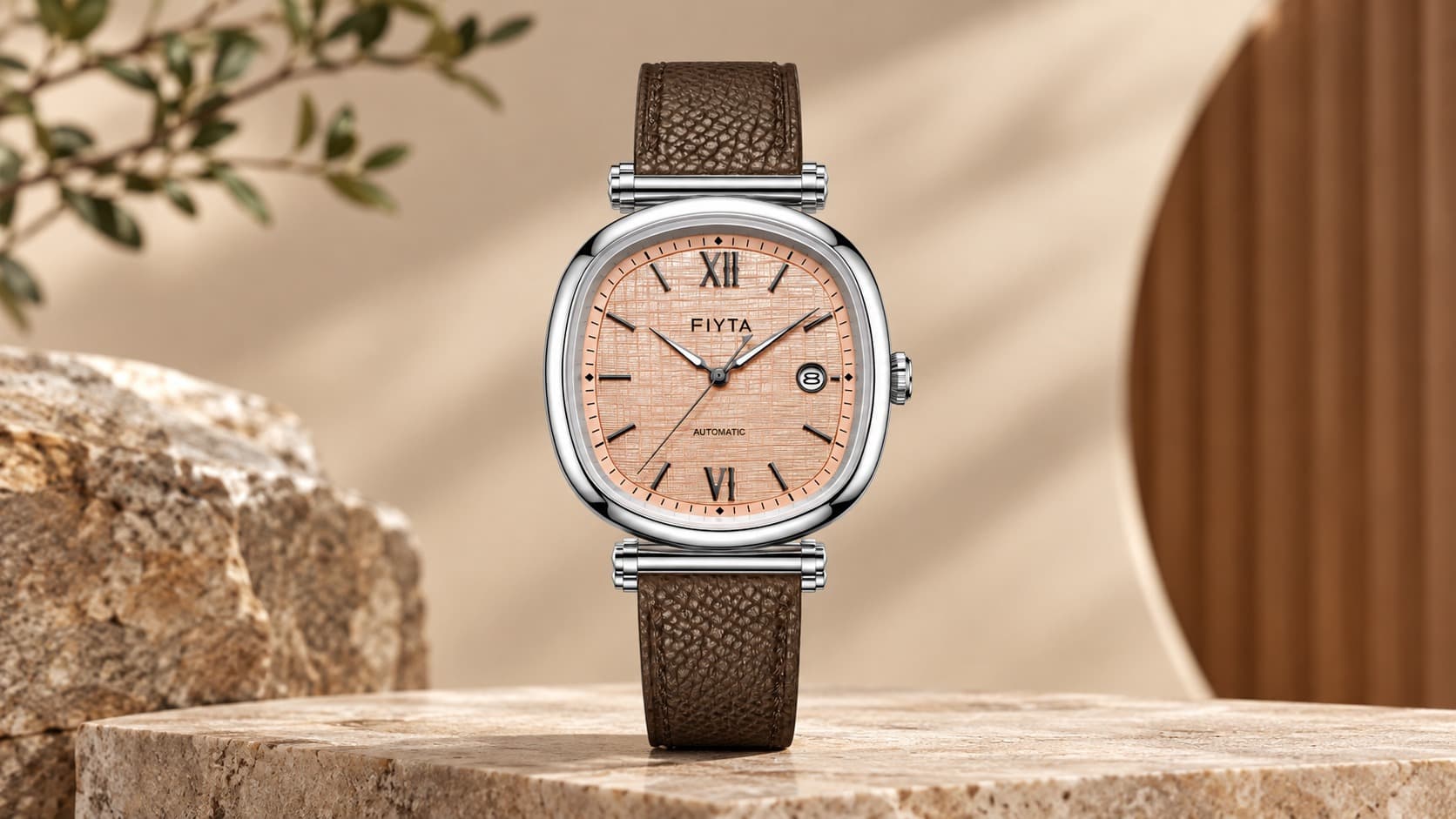
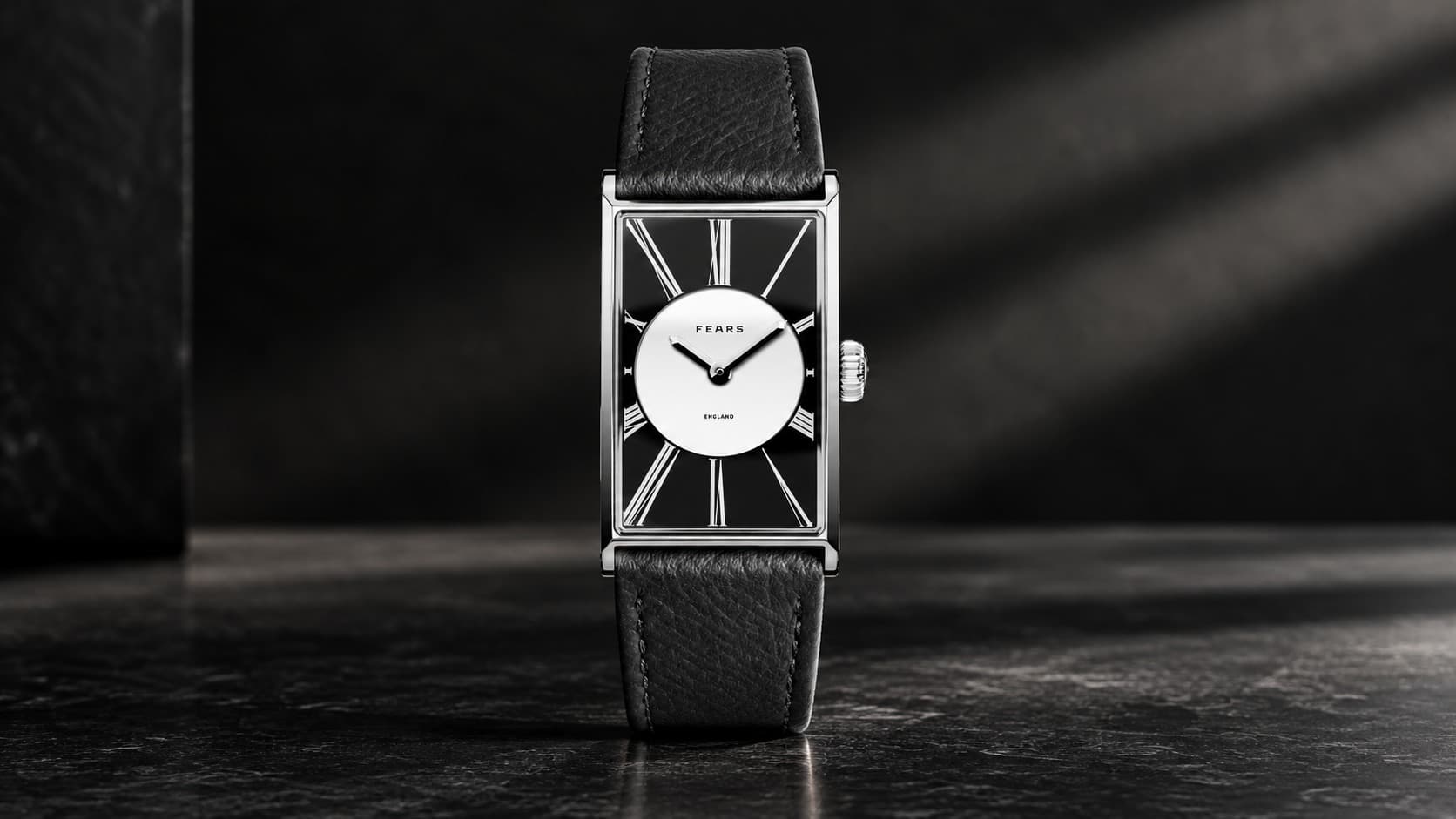
At just 33.5mm by 22.6mm, with a case machined in Switzerland, this is a genuinely small watch by modern standards — only 8.4mm thick and spanning 40mm from lug to lug, so it tucks in close against the wrist rather than sitting proud of it. The dial breaks from the rest of the Fears catalog by using Roman numerals for the first time on a modern piece, alongside the brand’s familiar pipette-shaped hands, here finished in rhodium. The crown pulls and pushes rather than screwing down, and carries the Fears Cypher engraving found on other models. Inside, the automatic movement runs at 4Hz with a 46-hour power reserve and 30 meters of water resistance, though the caseback is solid rather than an exhibition window, so the gold-toned rotor and its Flower of Bristol detailing stay out of sight. The launch version, called Arnos Pewter Blue, uses a blue dial with a textured, concentric machined pattern that gives it a more tactile finish than most of the brand’s other watches.
Fears Archival 1930 — The History Lesson on Your Wrist
Made to mark the brand’s 175th anniversary, the Archival 1930 is exactly what it sounds like: a proportionally faithful recreation of an actual Art Deco watch that Fears produced in 1930. Rather than loosely referencing the past the way many “heritage” watches do, this model is built directly from an original piece held in the company’s own archive.
The commitment to authenticity goes further than the design: the movement inside is genuine new-old-stock, a Swiss ETA caliber dating to around 1968 that Fears sourced, serviced, and fitted with an upgraded mainspring rather than building a modern equivalent. The 40 x 22mm steel case is manufactured in Germany, as is the copper, gold-plated dial, while the lance-shaped hands are laser-cut, hand-beveled, and heat-blued by hand. It launched in 2021 alongside Elegantly Understated, the company’s own 175-year history book, so the watch and the book were effectively telling the same story at the same time — one in print, one on the wrist. At 30 meters of water resistance, it’s built for wear rather than for swimming, which suits a piece best understood as a genuine time capsule of the brand’s real history rather than a modern reinterpretation of it.
Fears x Garrick — The Collector’s Piece
At the top of the Fears range sits a collaboration with Garrick, another independent British watchmaker known for building its movements almost entirely by hand. The Fears x Garrick watch uses a 42mm case in 904L steel, a grade of stainless steel prized for its corrosion resistance and used by very few watch brands, paired with Garrick’s own manually wound UT-G04 movement, which runs at a slower, more traditional 2.5Hz and shows roughly 45 hours of power reserve through a dial-side indicator. The balance wheel sits exposed and oversized rather than tucked under a bridge, letting the hand-finishing on it be seen rather than hidden.
This piece sits well above the rest of the Fears catalog in both price and complexity, and it’s aimed squarely at serious collectors who want to see traditional British hand-finishing up close rather than buy a daily-wear watch.
Fears Watch Models Compared
| Collection | Case Size | Movement Type | Water Resistance | Best For |
|---|---|---|---|---|
| Redcliff | 39.5mm | Automatic, date | 100–150m | Everyday wear |
| Brunswick | 38–40.5mm | Hand-wound or automatic | 100m | Dress occasions |
| Brunswick Jump Hour | 40.5mm | Automatic with jump-hour module | 100m | Collectors who like mechanics |
| Brunswick 40 Filton | 40mm | Automatic, date | 150m | Casual and travel wear |
| Brunswick 39 Perpetual Calendar | 39mm | Automatic, perpetual calendar module | 50m | Collectors wanting a complication |
| Arnos | 33.5 x 22.6mm | Automatic | 30m | Smaller wrists, formal looks |
| Archival 1930 | 40 x 22mm | Hand-wound (vintage ETA stock) | 30m | Collectors interested in history |
| Fears x Garrick | 42mm | Hand-built, manual | 100m | Serious collectors |
Water resistance figures can vary slightly by edition, so the specific watch’s own rating is the one that matters before swimming or diving.
How Much Do Fears Watches Cost?
Fears sits in the “affordable independent luxury” price bracket rather than competing with mass-market quartz brands or the very top end of Swiss horology. Most current models, including the Redcliff, Brunswick, and Brunswick 40 Filton, land somewhere in the region of $3,000 to $4,500 depending on the exact dial, strap, and movement chosen.
Pricing climbs from there based mainly on case material, movement complexity, and how much hand-finishing is involved. The Brunswick 39 Perpetual Calendar, with its modified perpetual-calendar module and solid 18ct gold rotor, sits well above the entry-level models because of that extra complication and the hand-finishing it requires. At the very top, the Fears x Garrick collaboration, with its hand-built movement and exposed balance wheel, is priced around $23,000, reflecting the amount of traditional hand craftsmanship that goes into each one.
Frequently Asked Questions
Is Fears a real British watch brand?
Yes. Fears was founded in Bristol, England, in 1846 by watchmaker Edwin Fear, and it is still owned and run by his descendants today. It isn’t a brand-new company borrowing a vintage-sounding name; it has an unbroken family connection and a documented 180-year history, including a period of closure between 1976 and 2016.
Are Fears watches made in Switzerland or England?
Both. The cases are typically machined in Switzerland, and the movements come from established Swiss suppliers such as Sellita and La Joux-Perret. Final assembly, quality control, and finishing happen by hand at Fears’ own workshop in Bristol, England.
What is the most popular Fears watch?
The Brunswick, with its distinctive cushion-shaped case, is generally considered the brand’s signature design and its most recognizable model. The Redcliff is the more practical, everyday option and was the watch that relaunched the brand in 2016.
Why did Fears Watches close in 1976?
Fears closed in 1976 largely because of the “quartz crisis,” a period when cheap, highly accurate quartz watches from Japan flooded the global market and put enormous pressure on traditional mechanical watchmakers, especially smaller family-run companies that couldn’t compete on price.
Is Fears Watches a good investment?
Nobody can guarantee that any watch will increase in value, and Fears is still a small, young brand in its current form despite its old name, so its watches don’t have the decades of resale data that bigger luxury brands do. It’s better thought of as a well-made mechanical watch with genuine history behind it rather than a guaranteed financial investment.
The Bottom Line
Fears isn’t trying to be the biggest watch brand in the world, and that’s really the point. It’s a small British company rebuilding a 180-year-old family name one hand-finished watch at a time, using real archive pieces like the 1930s Art Deco original behind the Archival 1930 and real local history like Filton’s aviation heritage to shape new designs, rather than inventing a story for marketing. For an everyday watch with a slim, versatile case, the Redcliff is the obvious starting point. For the brand’s defining look, it’s the Brunswick. And for traditional hand-finishing taken to its furthest point, the Garrick collaboration is where that story currently ends. What ties all of it together is a family that could have let a 180-year-old name disappear for good, and chose instead to rebuild it by hand.