Daniel Wellington is one of the most recognized watch names of the last fifteen years, and it got there in a way almost no watch brand had tried before: through Instagram, not through watch shops. The brand built its whole identity around one simple idea — a thin, round watch with a swappable fabric strap — and turned that idea into hundreds of millions of dollars in sales. Because the brand grew so fast and so publicly, it also attracts a lot of questions and a fair share of skepticism from people used to traditional watchmaking. Where the watches actually come from, what they’re made of, which collections stand out, and what the price tag really reflects all tell a more complete story than the marketing alone.
How Daniel Wellington Got Its Name
Daniel Wellington was founded in 2011 by Swedish entrepreneur Filip Tysander, and the name comes from a real person he says he met, not a made-up brand story. Tysander was backpacking through Australia in 2006 when he crossed paths with a British traveler wearing a Rolex Submariner on a plain, worn-looking NATO strap. That contrast between an expensive watch and a simple fabric band is what stuck with him.
The man’s name, as the story goes, was Daniel Wellington. That understated look eventually became the inspiration for Tysander’s own brand, which he named directly after him. No independent evidence has ever confirmed the meeting actually happened, so the origin story is best treated as brand folklore rather than a documented fact. What is documented is that Tysander launched the company after finishing university, put in $15,000 of his own money, and sold his first watch in 2011. Within three years, the young brand had already sold more than a million watches and pulled in around $70 million in revenue.
A cheap fabric strap on someone else’s watch became the spark for a company worth hundreds of millions. That’s the whole origin story in one sentence.
The brand’s logo carries a small nod to that founding story too. Daniel Wellington trademarked its “DW” mark with the letter D printed in reverse, a stylized detail that’s shown up on case backs, buckles, and packaging since the company’s earliest days. From that $15,000 start, the brand scaled fast: it has sold more than six million watches worldwide since 2011, and it still keeps its headquarters in central Stockholm even as the product lineup has grown well beyond the original NATO-strap design into full watch collections and, more recently, jewelry.
Where Are Daniel Wellington Watches Made?
Daniel Wellington watches are designed in Sweden but manufactured in China, which is standard practice for fashion watch brands at this price point. The company keeps its headquarters in Stockholm and sells its products in more than 25 countries around the world. Inside each watch, the movement itself comes from Miyota, a large Japanese manufacturer that supplies both the quartz movements used in most models and the automatic, self-winding movements used in a smaller number of pieces.
This split — Swedish design, Japanese movement parts, Chinese assembly — is common across the affordable fashion watch category, and it’s not a red flag on its own. Brands like Fossil, Skagen, and MVMT follow a similar setup. The value in a watch like this comes from design, branding, and keeping the price within reach, not from decades of in-house mechanical engineering.
What Materials Does Daniel Wellington Use?
Every Daniel Wellington metal watch case is built from 316L stainless steel, often called surgical steel because of how well it resists corrosion and skin reactions. The brand states this grade of steel was chosen specifically for its purity and durability. Gold and rose gold versions aren’t solid gold underneath; they’re coated using a technique called ion-plating, which the brand describes as more sustainable than older, traditional plating methods, even though the gold layer itself stays thin.
The glass on top of the dial is another detail that shapes how a watch holds up over time. Daniel Wellington uses hardened mineral glass on most models, a material the brand says holds up fine under everyday wear but still needs a bit of care. Mineral glass sits a step above cheap plastic crystal but a step below sapphire crystal, which resists scratches far better but costs much more to produce. One independent reviewer who examined the watches directly confirmed this middle-ground quality, noting the crystal offers only modest scratch protection compared with the sapphire glass found on pricier watches.
Straps vary depending on the collection. The classic NATO-style bands are woven polyester with a stitched construction, while the leather options use genuine leather rather than a synthetic substitute.
Daniel Wellington’s Interchangeable Strap System Explained
Daniel Wellington’s straps attach and detach using spring-loaded pins called quick-release spring bars, so no tools are needed to swap one strap for another. Turning the watch over reveals a small lever or slider built into the spring bar itself. Pressing it releases one end of the pin, letting the whole strap slide off the case in a few seconds, and the replacement strap slides on the same way.
This system is a big part of why the brand became so popular in the first place. A single watch case can wear a casual fabric NATO strap for daily use and a leather band for a dressier occasion, without needing a jeweler or a watch tool kit. Lug width is the one variable that matters when sourcing a replacement strap, and it varies by collection: Classic watches use 18mm or 20mm straps, Iconic Link models scale from 14mm up to 20mm depending on case size, and the smaller Petite and Quadro cases take narrower straps, often between 10mm and 16mm. A strap even a couple of millimeters off the correct width will not sit securely in the case.
The NATO-style strap deserves a quick mention on its own, since it’s a specific design with military roots rather than just a generic fabric band. A true NATO strap passes underneath the watch case and back out the other side in one continuous loop, so even if one spring bar were to fail, the watch stays looped onto the wrist instead of falling off. That built-in redundancy, combined with the tool-free swap system, is what turned Daniel Wellington’s straps into the brand’s calling card rather than just an accessory afterthought.
What Is the Price Range for Daniel Wellington Watches?
Most Daniel Wellington watches sell somewhere between $100 and $250, with a smaller group of automatic models priced higher. A 2023 interview with the brand’s leadership put the full lineup’s price range at roughly $150 to $400, depending on the collection, case material, and whether the watch runs on a battery-powered quartz movement or a self-winding automatic one.
Typical pricing by collection breaks down as follows:
| Collection | Typical Price Range | Movement |
|---|---|---|
| Classic | Lower end | Quartz |
| Petite | Lower to mid | Quartz |
| Iconic Link (quartz) | Mid | Quartz |
| Quadro | Mid | Quartz |
| Iconic Link Automatic | Higher | Automatic |
Automatic watches cost more because their movement is mechanically more complex, relying on dozens of small moving parts instead of a battery and a quartz crystal.
In practical terms, entry-level Classic and Petite models with leather or NATO straps commonly list in the $100 to $160 range, mesh-strap Petite watches like the Evergold or Ashfield tend to sit a little higher, and metal-bracelet Iconic Link pieces often land in the $150 to $220 range. The Iconic Link Automatic, with its sapphire crystal and exposed movement, is the priciest regular-production piece in the catalog and typically pushes past $300.
Best Daniel Wellington Watch Collections
Classic Collection
The Classic is the watch that built the brand, and it remains the simplest option in the current lineup. It pairs a thin, round case with an interchangeable strap system, so the same watch face can wear a fabric NATO band during the day and switch to leather for the evening. Case sizes run small to medium, and swapping straps takes seconds with no tools required.
This collection suits someone who wants one clean, versatile watch rather than a piece built for a specific activity like diving or sport. The best-known names in the Classic line include the Sheffield, Cornwall, Bristol, and St. Mawes, each offering the same core design in slightly different dial colors, case tones, and strap pairings.
Iconic Link Collection
The Iconic Link trades the fabric strap for a metal bracelet, giving it a more polished, dressier look than the Classic line. The standout piece here is the Iconic Link Automatic, which the brand describes as its first true mechanical watch, wound entirely by the natural motion of the wearer’s wrist. It runs on a Miyota 8215 automatic movement, uses a scratch-resistant sapphire crystal instead of mineral glass, shows off the moving parts through a transparent case back, and holds up to 10 ATM of water resistance, equal to about 100 meters.
That sapphire crystal and visible movement make the Iconic Link Automatic the closest thing Daniel Wellington offers to a genuine entry-level mechanical watch, giving it appeal as an accessible way into automatic watches without Swiss-brand pricing.
Petite Collection
The Petite line is built around smaller case sizes, generally between 28mm and 32mm, aimed at slimmer wrists or a more delicate look overall. It uses the same 316L steel construction and quartz movements as the rest of the lineup, just scaled down to a smaller dial. Strap choices include mesh metal bands and leather, and the smaller size keeps the design understated rather than feeling like a shrunken men’s watch. Names like the Petite Bondi, Ashfield, and Evergold represent this line well, each swapping in a different strap material and metal tone while keeping the same compact case.
Quadro Collection
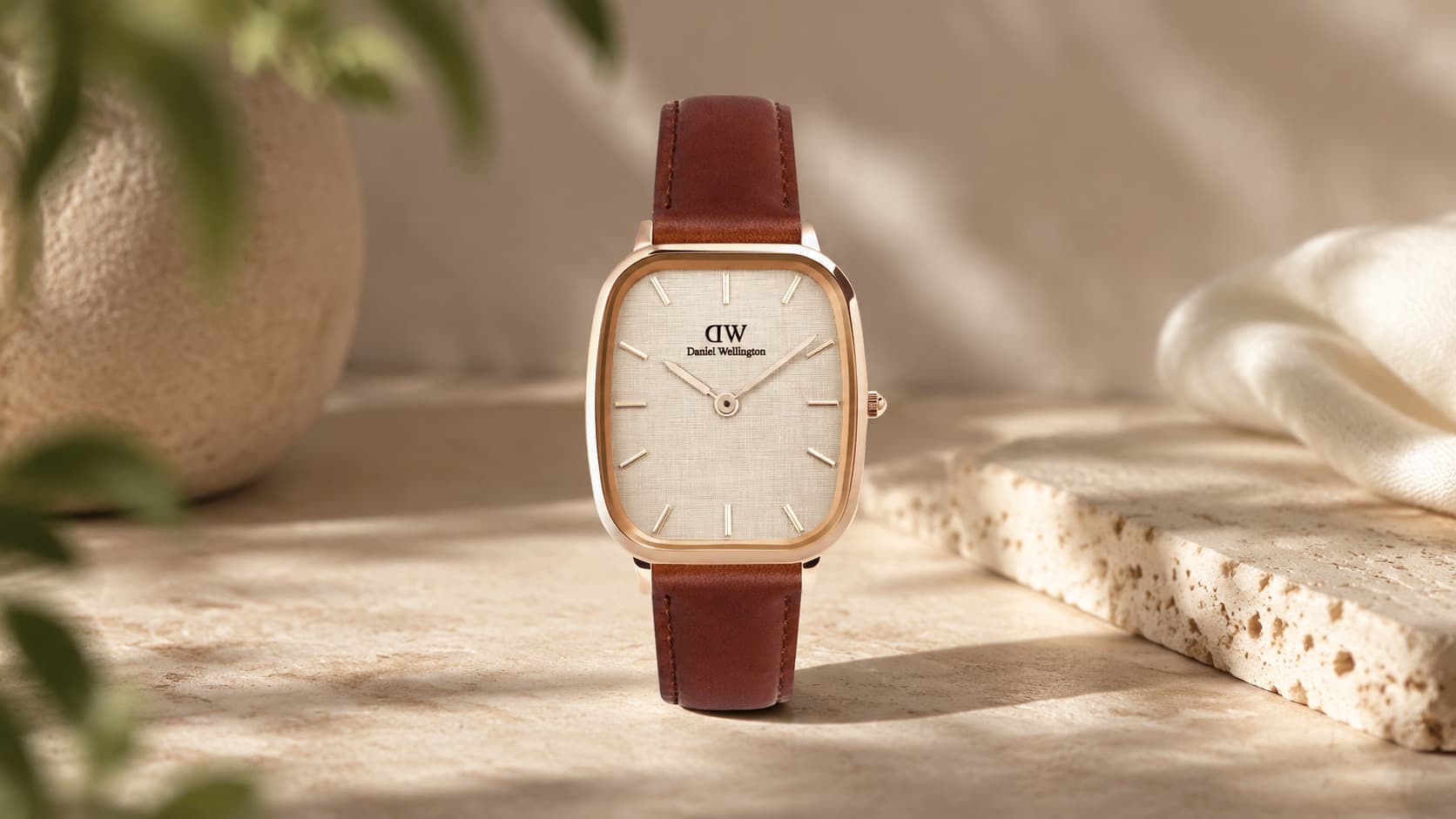
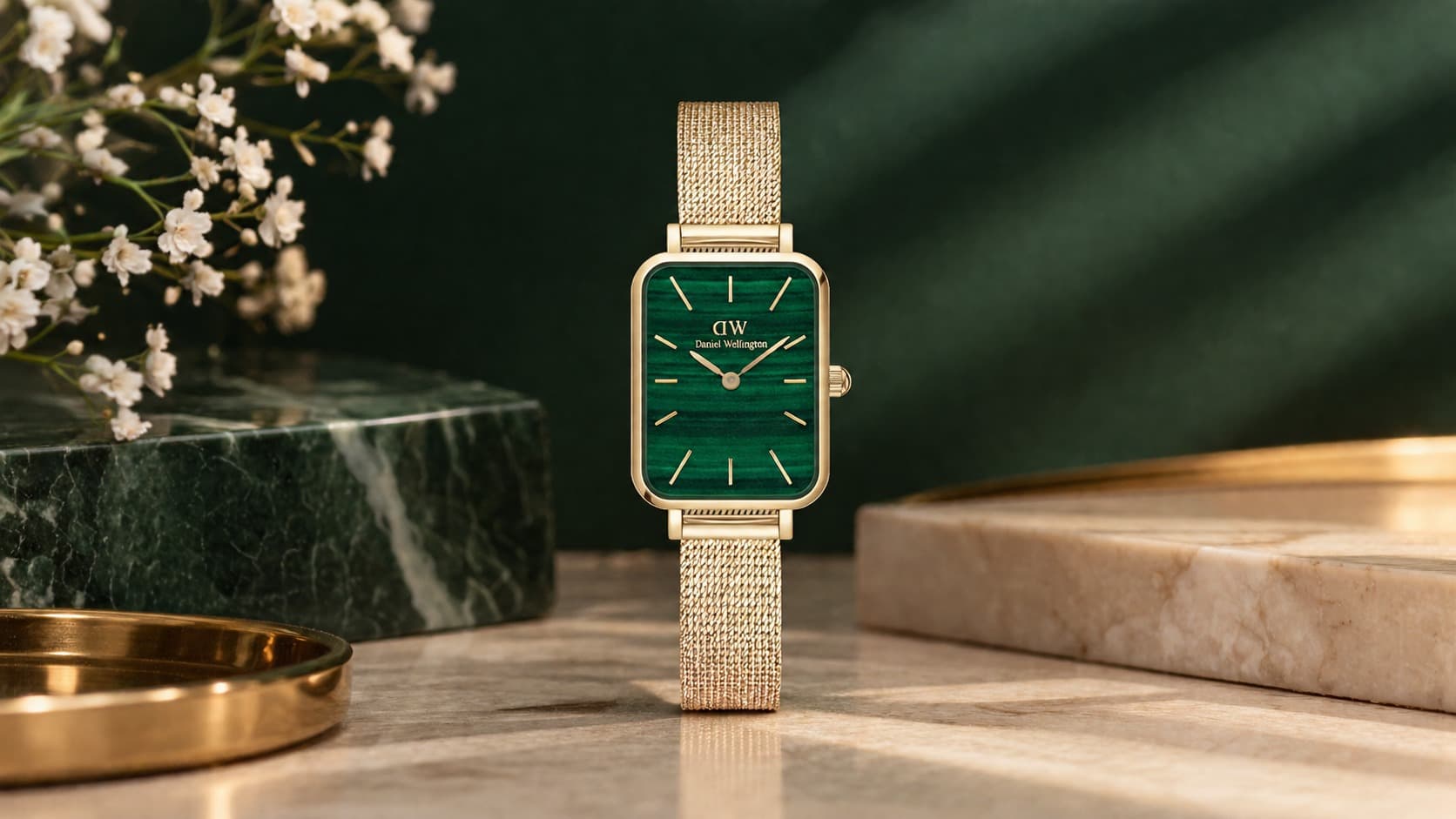
The Quadro breaks away from Daniel Wellington’s usual round shape and offers square and rectangular cases instead, including versions finished with mother-of-pearl dials. It’s the most fashion-forward line in the catalog, better suited to someone who already owns a round everyday watch and wants something visually different for variety. The Quadro Pressed Melrose and Quadro Studio are two of the more recognizable pieces in this range, along with the smaller-cased Quadro Mini for anyone who wants the square silhouette in a more compact size.
Iconic Motion Collection
The Iconic Motion is built specifically with activity in mind, pairing a 316L stainless steel case with a flexible FKM rubber strap and water resistance rated up to 10 ATM. FKM rubber holds up well against sweat and repeated stretching, making this the practical pick for the gym or casual sports rather than an office desk.
Is Every Daniel Wellington Watch Water Resistant?
No, water resistance varies by model, and the rating stamped on a given watch determines how it can safely be worn around water. Daniel Wellington watches carry either a 3 ATM or a 10 ATM rating, stamped directly on the case back and listed on the product page.
The two ratings behave very differently in real life:
- 3 ATM: Handles rain and light splashes but shouldn’t go in the shower, bath, or pool.
- 10 ATM: Can handle showering and casual surface swimming, though diving and high-impact water sports still aren’t recommended.
The brand also advises rinsing the watch in plain tap water after any contact with salt water or chlorine. Water damage from exceeding a watch’s rated pressure is not covered under the standard 24-month warranty.
Is Daniel Wellington a Serious Watch Company?
It’s fair to call Daniel Wellington a fashion watch brand rather than a horology-first one, and that’s not an insult — it’s simply a different category. Traditional watchmakers like Rolex or Omega spend decades developing their own movements and mechanical complications in-house. Daniel Wellington’s approach looks more like a fashion accessory business: reliable, mass-produced Japanese movements, a heavy focus on design and branding, and pricing built for everyday buyers rather than collectors.
The brand’s growth reflects that strategy clearly. Sales reportedly reached $230 million by 2016, driven almost entirely by social media rather than traditional watch retail or advertising, and the company’s website and Instagram following still pull in massive numbers today. That kind of reach came from marketing savvy, not decades of mechanical innovation, a distinction that explains what the price tag is actually paying for.
The brand’s business history hasn’t been a straight line up, either. Around 2018, Daniel Wellington moved away from selling through outside retailers and tried to build its own network of boutiques instead, a shift that left the company overextended right before COVID-19 hit global retail hard. The brand has said it spent roughly four years operating at a loss afterward, before turning things around under CEO Tianhao Liu by returning to multi-brand retail partnerships and forming new ones, including a notable tie-up with fellow watchmaker Timex.
That Timex relationship has since become the company’s new chapter. Timex Group first invested in Daniel Wellington in 2023, taking a 25 percent stake, and in July 2026 it completed a full acquisition, bringing Daniel Wellington entirely into the Timex Group portfolio while founder Filip Tysander remains connected to the brand he started. For anyone buying a watch today, that ownership change doesn’t alter what’s already on shelves, but it does mean future collections will be shaped with more backing from an established, century-old watch manufacturer behind the scenes.
Frequently Asked Questions
Is Daniel Wellington considered a luxury watch brand?
No, Daniel Wellington sits in the affordable fashion watch category rather than luxury. Prices typically fall between $150 and $400, far below where entry-level luxury brands usually start. The appeal here is minimalist design and interchangeable straps, not mechanical prestige or in-house engineering.
Does Daniel Wellington use real gold?
Daniel Wellington’s gold and rose gold watches aren’t solid gold. They use an ion-plating process to apply a gold coating over a 316L stainless steel base, a method the brand says is more environmentally sustainable than older plating techniques, though the gold layer itself remains thin.
Can a Daniel Wellington watch be worn in the shower or while swimming?
It depends on the specific model’s water resistance rating. Watches rated at 3 ATM should come off before showering or swimming, while models rated at 10 ATM can handle showering and casual surface swimming. Checking the case back or product listing for the specific model before it gets wet is the safest approach.
Why are Daniel Wellington watches so cheap compared to Swiss brands?
The lower price reflects the materials and movement rather than poor build quality. The watches use mass-produced Japanese quartz and automatic movements instead of expensive in-house Swiss calibers, and manufacturing takes place in China rather than Switzerland. That combination keeps production costs down, and the savings get passed along in the retail price.
What movement does the Iconic Link Automatic use?
The Iconic Link Automatic runs on a Miyota 8215 automatic movement, a well-regarded, reliable Japanese caliber used across many affordable mechanical watches. It’s paired here with a sapphire crystal and an exhibition case back that reveals the movement in motion.
Conclusion
Daniel Wellington earned its place in modern watch culture through smart branding and a genuinely simple, wearable design rather than mechanical innovation, and that’s exactly what it delivers today: dependable 316L stainless steel construction, reliable Miyota movements, and a range of collections running from the original Classic NATO-strap watches to the more advanced Iconic Link Automatic with its sapphire crystal and visible movement. The brand’s rocky stretch through the late 2010s and its recent full acquisition by Timex Group show that the business side hasn’t always been as smooth as the minimalist dials suggest, but the product itself has stayed consistent throughout. For a good-looking, dependable everyday watch without luxury-brand pricing, this lineup delivers on that promise — the value sits squarely in design and reliability, not decades of fine watchmaking heritage.