Most watch brands try to make the dial easier to read at a glance. Hautlence does the opposite on purpose. Since 2004, this small Swiss company has built its whole identity around telling time in strange, mechanical, almost theatrical ways, wrapped inside a case shaped like an old television screen. It is not a brand many casual shoppers know by name, but among people who follow independent watchmaking closely, Hautlence has earned a reputation as one of the most inventive workshops in Switzerland. Understanding what the brand actually makes, why it looks the way it does, and how it survived some genuinely rocky years explains why collectors keep paying close attention.
The Hautlence Design Philosophy Explained
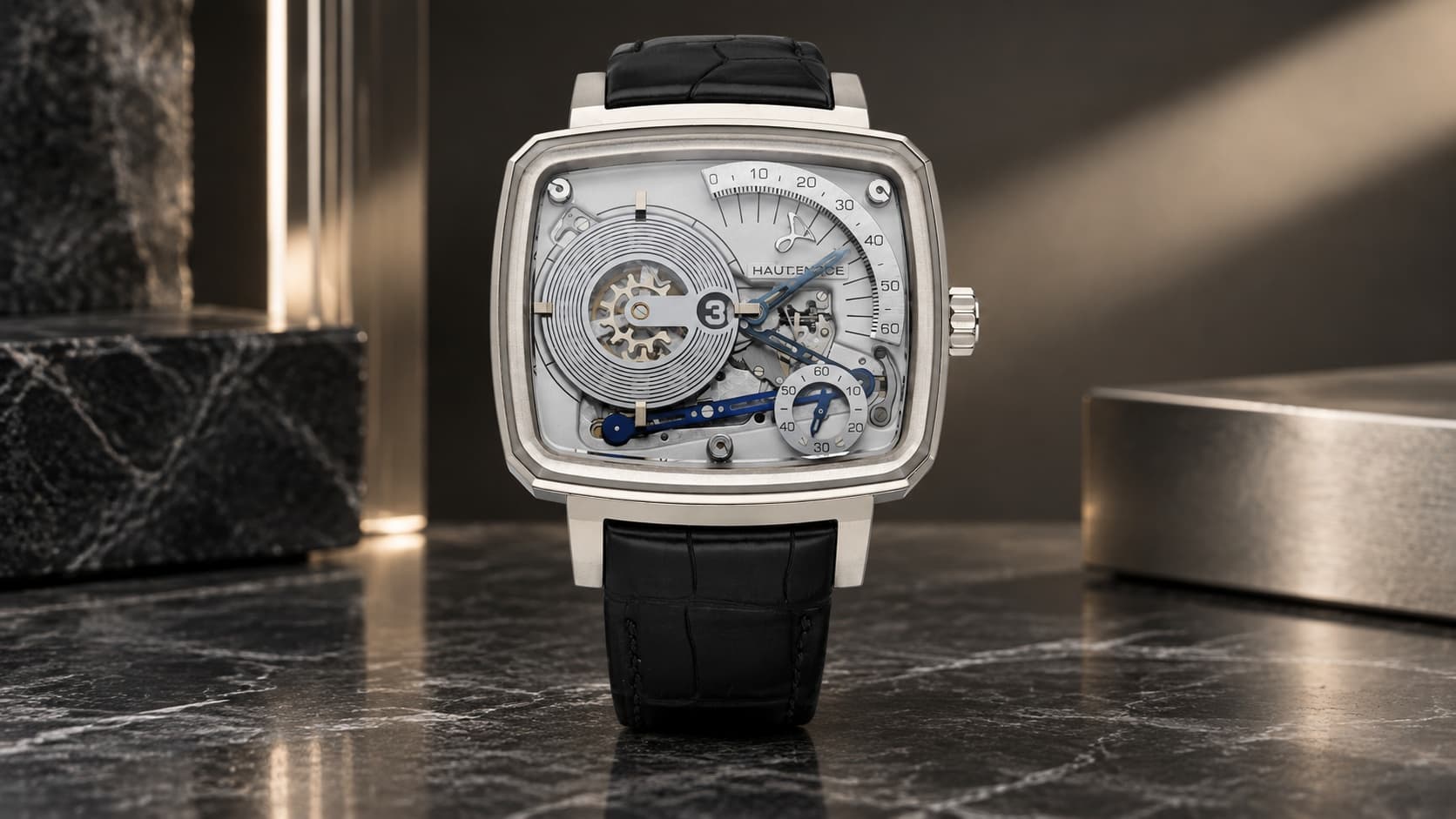
A Hautlence watch stands out because it almost never uses regular hands to show the hours and minutes. Instead, it relies on jumping numbers, retrograde scales that snap back to zero, spherical dials that rotate in place, or “wandering hours” that drift slowly around the dial in a loop. That single choice shapes everything else about the watch, from the movement inside to the shape of the case around it.
The name itself is a clue to where this idea came from. Hautlence is an anagram of Neuchâtel, the Swiss city where the company was founded, and Neuchâtel has been tied to fine watchmaking for centuries. The founders wanted a name that paid tribute to that history while still sounding like nothing else on a watch dial.
The other unmistakable signature is the case. Most Hautlence models are built in a wide, rectangular shape with rounded corners, styled after an old-school television set from the 1970s. It is a polarizing look. Some people find it striking and architectural, and others think it is too bulky for daily wear. Either way, it is one of the few watch cases that can be identified from across a room without seeing the logo.
Beyond the mechanics, Hautlence also leans into a playful, almost theatrical side that few luxury brands are willing to show. It has built watches shaped like vintage radios, dials inspired by arcade pinball machines, and a case that physically transforms into a small tabletop robot. That sense of humor sits right alongside serious, in-house engineering, which is an unusual combination in high-end Swiss watchmaking.
Hautlence rarely makes more than a few dozen of any single watch. Most collections are limited to 28 pieces or fewer, a number the brand now uses almost like a signature.
Hautlence’s Story: From 2004 to Today
Hautlence was founded in 2004 by watch-industry veterans Renaud de Retz and Guillaume Tetu, along with a small team of collaborators who had cut their teeth at established houses like Longines, Jaeger-LeCoultre, and TAG Heuer. The founders had already spent close to three years developing ideas and sketches for their first timepieces before the company was formally established.
That prototype, called the HL04, arrived in 2004 and set the template the brand still follows today: a jumping hour display, a retrograde minute hand, and a case built around the 16:9 ratio of a television screen. The full HL Collection reached the public in 2005, and it quickly caught the attention of watch journalists who had never seen anything display time quite that way. Over the next decade the brand kept expanding on that formula, adding the Invictus collection in 2012 and, two years later, its first-ever chronograph, the Invictus Morphus, which was designed in collaboration with football legend Eric Cantona. That same year, 2014, Hautlence also introduced a more affordable Destination line built to bring the brand’s design language to a wider audience.
The launch timing was not ideal, though. Hautlence appeared right as an entire wave of experimental “hyperwatch” brands showed up in the mid-2000s, and many of them collapsed when the 2008 financial crisis hit. Hautlence survived, but only barely, and by the early 2010s it needed a stronger financial backer to keep going.
That backer arrived in 2012, when Georges-Henri Meylan, the former CEO of Audemars Piguet, brought Hautlence into MELB Holding, the same family group that owns H. Moser & Cie. The move gave Hautlence access to real manufacturing resources and, eventually, a shared home with Moser in Schaffhausen. The brand kept experimenting through this period too, launching the geometric Vortex collection in 2015 and the game-inspired Playground line in 2016, which included watches styled after pinball machines. Production slowed to a trickle for a few years in the late 2010s, but the brand never fully disappeared, and it introduced its first wandering hours watch, the HL Vagabondage 01, in 2018.
In September 2022, Hautlence relaunched with new leadership under brand manager Samuel Hoffmann and a fresh set of collections, the Linear Series and the Vagabonde Series, both built on movements developed with Moser’s technical team. That relaunch is the version of Hautlence most people are discovering today, and it has kept up a steady stream of new pieces every year since.
Best Hautlence Watch Collections
Hautlence does not release watches the way big brands do, with dozens of steady, ongoing models. Instead, it puts out small batches, often 28 pieces at a time, under a handful of collection names, each built around its own version of the brand’s unconventional time displays.
Linear Series
The Linear Series is the collection that marked Hautlence’s 2022 comeback, and it remains the clearest example of the brand’s current direction. It uses a jumping hour display that moves along a straight line rather than around a circle, paired with a flying tourbillon visible at six o’clock.
The movement, called Caliber D50, was built with Geneva-based movement specialist Agenhor on top of a base developed with H. Moser & Cie. It runs at 3 hertz, holds a 72-hour power reserve, and is made from close to 240 parts. Hautlence prices all its watches in Swiss francs, but converted to dollars at current exchange rates, pricing for Linear Series pieces has generally sat between roughly $72,000 and $81,000 depending on the specific edition, with each version limited to 28 watches. By 2025, Hautlence had already released a third colorway in the line, the Linear Series 3 in red, showing the collection has staying power rather than being a one-off comeback piece.
Vagabonde Series
The Vagabonde line uses “wandering hours,” a much older complication first developed in the 1600s for a silent clock built for a pope. Instead of hands, a single number for the current hour appears inside a rotating disc and lines up with a printed minute scale as time passes.
Hautlence’s modern take pairs this display with an automatic Caliber B30 movement and, in the higher-end Vagabonde Tourbillon versions, adds a flying tourbillon with a double hairspring built by sister company Precision Engineering AG. Standard Vagabonde Series 4 pieces launched around $37,000, while the tourbillon versions have landed closer to $72,000 to $80,000. A collaboration edition with lume artist James Thompson, known as Black Badger, used glow-in-the-dark 3D-printed elements on the dial and sold for around $41,000. The line has kept evolving too, with newer Vagabonde Tourbillon Series 4 and 5 pieces using 3D-printed cubic and organic dial patterns instead of the earlier geometric designs.
Sphere Series
The Sphere Series trades the flat, layered dial of the other collections for a rounded, orb-like jumping hour display paired with a retrograde minute hand on a 180-degree arc. It runs on the manual-winding Caliber A80, an in-house movement built from over 200 components with a 72-hour power reserve, and the Sphere Series 1 won the Innovation Prize at the 2023 Grand Prix d’Horlogerie de Genève, one of the watch industry’s most respected awards. A darker, monochrome follow-up, the Sphere Series 2, arrived shortly after in anthracite tones for collectors who wanted the same mechanism without the brighter blue accents. Secondary-market listings put pricing for the Sphere Series in roughly the $75,000 to $98,000 range, though Hautlence has not published an official dollar or franc retail figure for this collection the way it has for its other current lines.
Retrovision
Retrovision is where Hautlence gets the most playful with its own history, reimagining what its watches might have looked like in earlier decades. The first entry, the Retrovision ‘47, was shaped like a 1940s tabletop radio, right down to a hand-painted case meant to look like marbled Bakelite and a small offset dial styled after a radio frequency dial. Limited to just 10 pieces, it used an automatic movement borrowed from Moser with a flying tourbillon and sold for around $74,000.
The follow-up, the Retrovision ‘85, pushed the idea even further by making the entire case detachable from its strap so it can stand on a table as a small robot, a nod to 1980s toy design. It runs on the self-winding Caliber D31 with a double-hairspring tourbillon and wandering hours display, and only 8 pieces were made, priced around $104,000 before tax. A third piece, the Retrovision ‘64, followed that theme into the 1960s, shaped like a science-fiction communicator with a flip-top cover, built around the same Linear Series jumping hour movement, and limited to just 3 examples at roughly $160,000 before tax. These concept pieces sit at the very top of Hautlence’s lineup, both in price and in how far the brand is willing to push a single idea.
How Hautlence Watches Fit on the Wrist
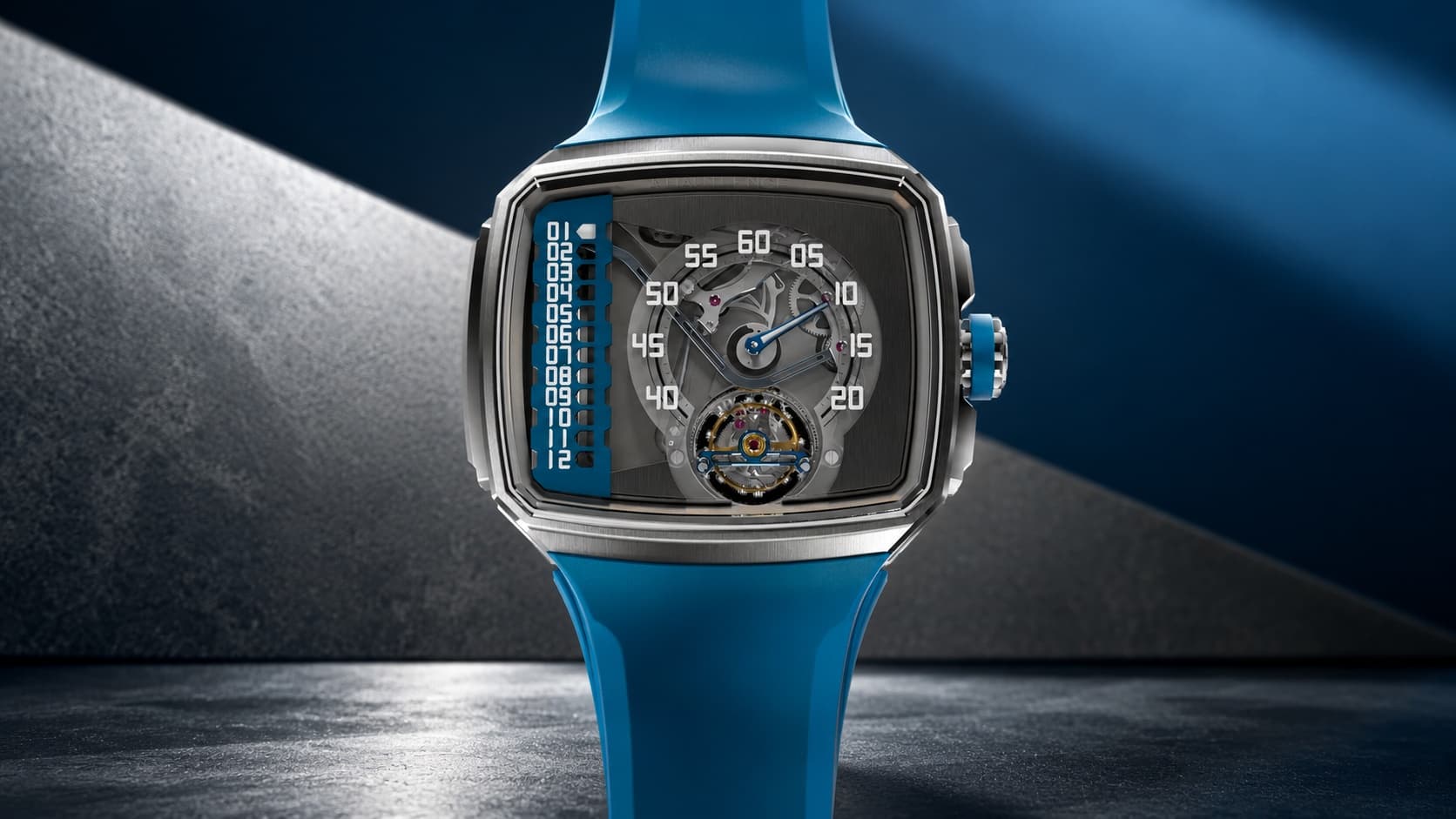
Hautlence cases are measured differently from most watches, and that trips people up the first time they look at the specs. A standard men’s watch is usually described by one number, its diameter, and most round watches run somewhere between 38mm and 42mm across, with larger sport or dive watches reaching 44mm to 46mm. A Hautlence, because it is rectangular and worn sideways like a small TV screen, needs two numbers instead: length and width. Most current models measure around 43mm long by 50.8mm wide, which means the case actually stretches wider across the wrist than even a large round sport watch would.
That width is the figure that matters most for fit. On a wrist under about 6.5 inches, a case that wide can overhang the edges, since it behaves more like lug-to-lug length on a round watch than diameter does. The height also runs a bit taller than average, typically 11.9mm to 15.6mm depending on the collection, mostly because of the domed sapphire crystal needed to cover jumping or spherical hour displays. The Concept pieces in the Retrovision line push this even further, with the robot-transforming Retrovision ‘85 measuring a substantial 64mm by 60mm.
None of this makes Hautlence uncomfortable to wear. Reviewers who have tried the watches on consistently note that the integrated rubber straps and lugless designs help the case sit closer to the wrist than the raw measurements suggest, similar to how a curved case can wear smaller than its stated size. Even so, the width sits well outside what most people are used to from a conventional round watch, which makes trying one on in person the safest way to judge fit on a smaller wrist.
How Much Do Hautlence Watches Cost
A new Hautlence watch typically costs somewhere between $37,000 and $160,000, depending on the collection and complications involved. That places the brand solidly in the independent luxury segment, alongside names like H. Moser & Cie. and MB&F, rather than in mainstream luxury territory occupied by larger Swiss houses.
The main reason prices sit this high is scarcity combined with mechanical complexity. Most Hautlence collections cap production at 28 pieces or fewer, and many use in-house or co-developed movements rather than off-the-shelf calibers. A tourbillon model with a wandering hours display, for example, costs more to engineer than a simple three-hand watch, and small production runs mean the brand cannot spread that cost across thousands of units the way a larger manufacturer can. The rare Concept pieces in the Retrovision line push this even further, since some are limited to single-digit production numbers.
| Collection | Typical Price Range (USD) | Signature Feature |
|---|---|---|
| Vagabonde Series | $37,000 – $44,000 | Wandering hours display |
| Linear Series | $72,000 – $81,000 | Straight-line jumping hours with tourbillon |
| Vagabonde Tourbillon | $72,000 – $80,000 | Wandering hours plus flying tourbillon |
| Sphere Series | $75,000 – $98,000 (estimate) | Rounded, orb-style jumping hour display |
| Retrovision | $74,000 – $160,000 | Retro-inspired concept pieces, limited to 3–10 pieces |
Who Should Consider a Hautlence Watch
Hautlence is built for people who already own several watches and want something their friends have never seen before. It is not usually a first serious watch purchase, since the display takes some getting used to and the price sits well above entry-level luxury.
The typical buyer tends to follow independent watchmaking closely, often owning pieces from brands like MB&F, De Bethune, or H. Moser & Cie. already. These collectors care less about brand recognition among the general public and more about mechanical creativity, low production numbers, and a design that reads as art as much as it does a timepiece. Winning the GPHG Innovation Prize with the Sphere Series 1 also gave the brand a fresh wave of credibility among people who take horological awards seriously.
Frequently Asked Questions
Is Hautlence a good brand?
Hautlence is well respected within independent watchmaking circles for its creative time displays and small-batch production, though it is not widely known outside that community. The brand’s connection to H. Moser & Cie. through shared ownership gives it real technical credibility, since many current movements are built with Moser’s help, and the Sphere Series 1’s 2023 GPHG award backs that reputation up with industry recognition.
Who owns Hautlence?
Hautlence is owned by MELB Holding, a family group led by Georges-Henri Meylan that also owns H. Moser & Cie. The two brands share facilities in Schaffhausen and collaborate closely on movement development.
Why do Hautlence watches look like a TV screen?
The rectangular, rounded-corner case was designed to echo the look of a 1970s television set, giving the brand an instantly recognizable silhouette. This shape has been part of Hautlence’s identity since its first prototype in 2004 and remains central to nearly every collection today, though newer Concept pieces like the Retrovision series have started experimenting with other retro shapes too.
How many Hautlence watches are made each year?
Hautlence limits most collections to around 28 pieces per edition, and some Concept pieces are limited to as few as 3 to 10 watches. Following its 2022 relaunch, the brand set a target of around 150 watches a year across all collections, and this intentional scarcity is part of what keeps resale interest and collector demand high.
Are Hautlence watches a good investment?
Independent watches with low production numbers can hold or gain value if collector interest in the brand grows, but Hautlence’s smaller size and history of financial struggles make this less predictable than with more established manufacturers. Most buyers treat the design and mechanical creativity as the main draw, with resale potential as a secondary consideration rather than the primary reason to buy one.
Conclusion
Hautlence built its entire reputation on refusing to show time the ordinary way, and that choice has both helped and hurt the brand across two decades. The TV-shaped case, the wandering and jumping hour displays, the award-winning Sphere Series, and the genuinely playful Retrovision concept pieces all point to a company that prioritizes mechanical creativity over mass appeal. For collectors who already own the predictable stuff and want something genuinely different on the wrist, Hautlence remains one of the more interesting names in independent Swiss watchmaking today.