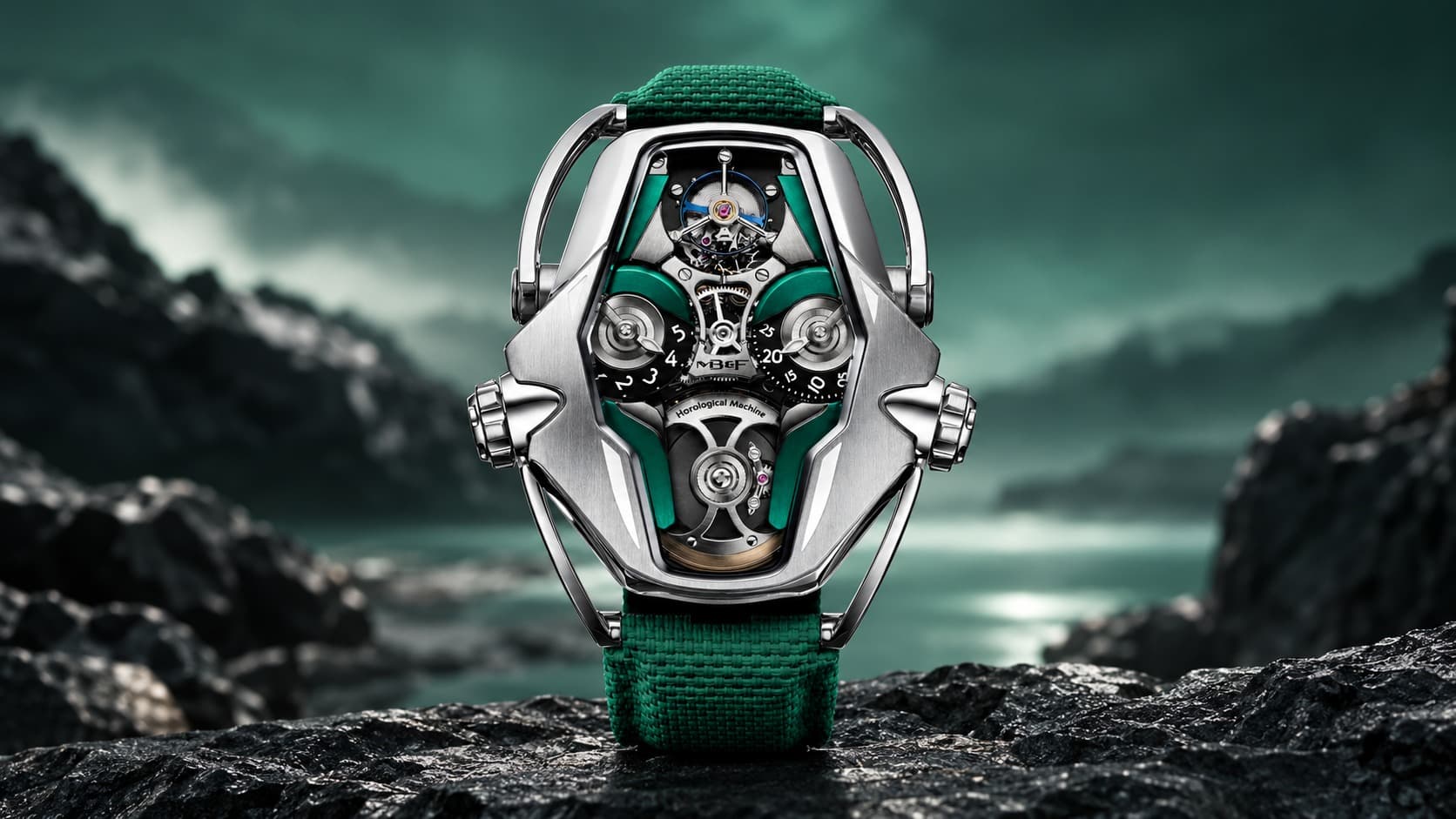
Most watch brands try to make a wrist look sharp and traditional. MB&F does the opposite. It builds tiny mechanical sculptures that happen to tell the time, shaped like spaceships, jet engines, and even little houses. The brand has only existed since 2005, which is very young compared to names like Rolex or Patek Philippe, yet it has already changed how people think about what a watch is allowed to look like. Collectors tend to talk about MB&F pieces like art rather than accessories, and the brand’s key models make clear why, from the shapes that inspired them to roughly what each one costs.
MB&F Watch Brand: History and Philosophy
MB&F stands for Maximilian Büsser & Friends, and it is less of a normal watch company and more of a small workshop that builds concept watches with the help of outside specialists. Maximilian Büsser started the company in Geneva in July 2005 after working at Jaeger-LeCoultre for seven years and then running Harry Winston’s rare timepieces division, a job he took on at just 31 years old.
Büsser calls his creations “Machines that tell the time, rather than Machines to tell the time.” That sentence explains a lot about the brand. Instead of designing a watch case and then hiding a movement inside it, MB&F often builds the movement first, like an engine, and shapes the case around it so the mechanics stay on display. Every watch is a collaboration between Büsser, a designer (usually Eric Giroud, who has shaped nearly every MB&F case since HM1), and a small circle of watchmakers and engineers he calls his “friends,” which is where the second half of the brand name comes from.
The company stays small on purpose. It made around 350 watches in 2022 with a team of fewer than 50 people, and it now has more than 20 in-house calibres to its name across two main families: the futuristic Horological Machines and the more classically shaped Legacy Machines. MB&F usually alternates between launching one of each per year. In 2024, the fashion house Chanel bought a 25 percent stake in the company, giving MB&F extra financial backing while Büsser kept creative control.
Best MB&F Horological Machines
The Horological Machines, shortened to HM, are the strangest and most sculptural watches MB&F makes. Each one usually takes years to design and is built around a single bold idea, whether that is a spacecraft, a fighter jet, or a building.
HM1: MB&F’s First Watch
HM1 mattered because it proved a brand new watchmaker could do something nobody had tried before. Released in 2007, it had a long, horizontal case with two separate dials for hours and minutes on either side of a raised central tourbillon, a small rotating cage that holds the balance wheel and is normally seen as a sign of serious watchmaking skill. The design came from a sketch by Büsser that designer Eric Giroud turned into a three-dimensional case, while watchmaker Peter Speake-Marin and engineer Laurent Besse built the movement after the original supplier MB&F had lined up dropped out partway through development.
The finished watch ran on four mainspring barrels, giving it a generous seven-day power reserve, and could be wound either by hand or automatically. Both Speake-Marin and Besse’s names appear on the movement alongside “Max Büsser and Friends,” a small detail that says a lot about how MB&F credits its collaborators. When the model was retired, MB&F closed it out with two ten-piece final editions, HM1-Black and HM1-RS, underlining just how limited these early runs really were.
HM4 Thunderbolt: MB&F’s Aviation Watch
The HM4 Thunderbolt took its shape from the twin jet engines of the A-10 Warthog attack aircraft, a plane Maximilian Büsser loved building as model kits when he was a child. Launched in 2010 after three years of development, it used two tube-shaped dials, one for the time and one for the power reserve, milled from titanium with clear sapphire crystal sections so the movement stayed visible. It went on to win the Best Concept and Design prize at the 2010 Grand Prix d’Horlogerie de Genève, one of watchmaking’s most respected award ceremonies.
The HM4 line was never officially limited by name, but MB&F only ever made a set number of examples per year, which quietly made every version a rare find.
At launch, the HM4 Thunderbolt was priced at $158,000. Special versions followed over the next few years, including the hand-painted “Razzle Dazzle” and “Double Trouble” editions with riveted fuselage-style cases, an 18-karat red gold “HM4 RT” limited to 18 pieces, and the blacked-out “HM4 Final Edition,” nicknamed the Stealth Fighter, which closed out the entire 100-piece series in 2013 at around CHF 198,000 (about $212,000).
HM6 Space Pirate: MB&F’s Boldest Design
Büsser has said the HM6’s design was sparked by memories of a spaceship from a Japanese cartoon he watched as a kid. The result is a rounded, four-cornered case with a central dome hiding a flying tourbillon behind a retractable shield, plus two spinning turbines linked to the automatic winding rotor that spin as the watch is worn. Ten separate pieces of sapphire crystal are used just for the case, and the movement, co-developed with watchmaker David Candaux, took more than three years to finish and packs 475 components into 68 jewels.
Released in 2014 in a limited run of 50 titanium pieces, the HM6 Space Pirate launched at around CHF 215,000, or roughly $230,000. A later version made from a mix of titanium and a special fade-resistant red gold alloy, called the HM6 RT, was limited to 18 pieces at close to CHF 220,000 (about $233,000), with only 100 HM6 movements ever produced across both versions combined.
HM11 Architect: MB&F’s Newest Machine
Released in 2023 as MB&F’s 21st in-house calibre, the HM11 Architect takes its inspiration from experimental 1960s architecture and a quote from the architect Le Corbusier describing a house as “a machine to live in.” The 42mm by 23mm titanium case is built like four small rooms arranged around a central flying tourbillon, and the whole structure can be rotated by hand, clicking 45 degrees at a time, so the wearer can peek inside each one. It is also the rare MB&F watch that reports the temperature, thanks to a built-in thermometer function borrowed from a horological principle dating back to 18th-century marine chronometers.
Only 50 pieces were made, split evenly between a blue dial version and a red gold dial version, priced at CHF 198,000 (about $230,000 USD) before tax.
More MB&F Horological Machines Worth Knowing
MB&F’s Horological Machine numbering runs well past HM11, and HM2 through HM10 cover just as much ground. HM2 and HM3 explored a more modular, animal-inspired look, with the HM3 nicknamed “Frog” for its bulging, rotating time-display domes. HM5 borrowed styling cues from 1970s supercars, while HM7 “Aquapod” turned the format into a dive watch shaped like a jellyfish, with a floating outer bezel and a flying tourbillon. HM8 “Can-Am” paid tribute to 1960s Can-Am motor racing, HM9 leaned further into biomorphic, flowing shapes, and HM10 “Bulldog” gave the time-display domes a pair of cartoonish dog eyes with a hinged jaw that doubles as the power reserve indicator. Each machine follows the same underlying rule: a bold visual idea comes first, with the movement engineered to fit that shape rather than the other way around.
Best MB&F Legacy Machines
While the Horological Machines look toward the future, the Legacy Machines look backward, reimagining 19th-century watchmaking ideas inside modern, three-dimensional cases. Büsser has described the collection as an answer to the question of what watches he might have designed if he had been born in 1867 instead of 1967.
LM1: MB&F’s First Round Watch
Introduced in 2011, LM1 was MB&F’s first attempt at a rounder, more classically shaped watch, even though it was still unmistakably an MB&F design underneath, complete with a large dial-side balance wheel and twin subdials for two independent time zones. It won two awards at the 2012 Grand Prix d’Horlogerie de Genève, including Best Men’s Watch, which helped convince skeptics that MB&F could do more than just build sci-fi shapes.
LM101: MB&F’s Simplest Watch
Launched in 2014, the LM101 strips things back to the basics that make a mechanical watch tick, quite literally: the time, the power reserve, and a large, floating 14mm balance wheel placed right on the dial. At 40mm wide, it is one of the smallest and most wearable Legacy Machines, and it carries a bit of engineering history too, since it uses the first movement MB&F designed entirely in-house rather than with an outside movement maker, developed with design input from independent watchmaker Kari Voutilainen.
Pricing has shifted with different materials over the years, generally landing somewhere around CHF 53,000 to 55,000 (roughly $59,000) for stainless steel versions and up to CHF 64,000 or more for solid gold editions. In 2025, to mark the brand’s 20th anniversary, MB&F released an updated LM101 EVO with a sportier integrated case built for daily wear, alongside a special New York boutique edition in rose gold and black.
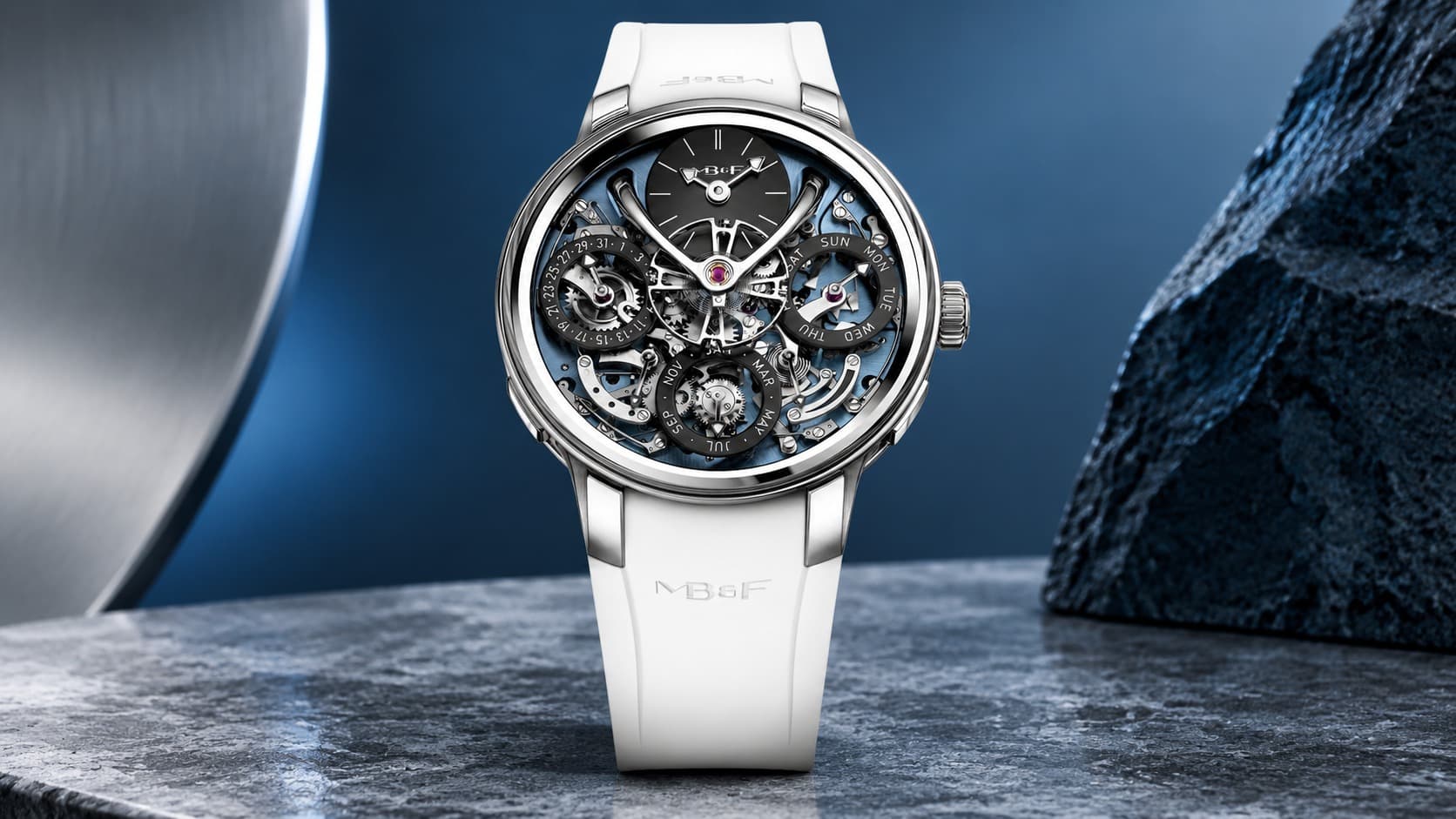
LM Perpetual: MB&F’s Most Complex Watch
A perpetual calendar is a watch complication that automatically knows how many days are in each month, including February in leap years, without needing to be manually adjusted. Most traditional versions use a fragile central lever that can jam or break if the date is set at the wrong moment. For the LM Perpetual, released in 2015 after four years of work, Irish watchmaker Stephen McDonnell (the same person who helped rescue the original HM1 project when its movement supplier fell through) threw out that approach entirely and built a 581-component “mechanical processor” that treats every month as 28 days by default and simply adds extra days as needed, so it can be adjusted safely at any time without breaking.
The result won the Best Calendar Watch prize at the 2016 Grand Prix d’Horlogerie de Genève, and in 2018 MB&F was granted a patent covering the mechanism. It launched in editions of 25 pieces each in red gold (CHF 138,000) and platinum (CHF 168,000), with later versions offered in materials including titanium, palladium, and stainless steel.
LM FlyingT: MB&F’s First Women’s Watch
Released in 2019 after four years of development, the LM FlyingT was MB&F’s first watch designed specifically for women rather than a men’s design simply set with stones. It features a 60-second flying tourbillon rising through a highly domed sapphire crystal, while the time itself sits on a small subdial tilted at 50 degrees near 7 o’clock, angled so that mainly the wearer can read it. An automatic winding rotor shaped like a sun powers a 100-hour reserve, and the watch went on to win Best Ladies’ Complication at the 2019 Grand Prix d’Horlogerie de Genève.
The LM FlyingT launched in three 18-karat white gold versions: a black lacquer dial with about 1.7 carats of diamonds around $115,000, a fully diamond-paved dial and case around $145,000, and a baguette-diamond version near $315,000. MB&F has since added colored-dial editions in materials like onyx, lapis lazuli, and tiger’s eye, generally starting around CHF 114,000 and running up toward $150,000 for special editions like the yellow gold and titanium Tiger’s Eye.
M.A.D.Editions: MB&F’s More Affordable Watch Line
Not everyone can spend six figures on a watch, and Maximilian Büsser knew this bothered a lot of people close to the brand, including many of the suppliers and collaborators who helped build MB&F in the first place. He had thought about launching a lower-priced sister brand for almost two decades before finally releasing M.A.D.Editions between 2020 and 2021.
The first model, the M.A.D.1, uses a modified Miyota 821A automatic movement and an unconventional stacked-disc time display viewed through the side of the case, all inside a 42mm steel case that still looks unmistakably like something from the MB&F universe. It runs on a roughly 42 to 60-hour power reserve depending on the edition, and retail prices have generally sat under CHF 3,000, or around $3,000 to $3,500. The follow-up M.A.D.2, designed by longtime MB&F collaborator Eric Giroud, upgraded to a higher-spec La Joux-Perret G101 movement with a bidirectional jumping hour display that can be set both forward and backward, something most jump-hour watches cannot do, and it kept the same CHF 2,900 price point.
Buyers usually have to enter a random lottery just for the chance to purchase one, since demand runs far ahead of the roughly 1,500 pieces made per release. Because of that gap, M.A.D. pieces are frequently resold well above retail, with some editions settling into a stable secondary market range of roughly $5,000 to $9,000 and rarer colorways occasionally reaching $12,000 or more.
How and Where to Buy an MB&F Watch
Buying an MB&F is a different experience than walking into a typical mall jeweler, mainly because the brand deliberately keeps its retail footprint small. Most Horological Machines and Legacy Machines are sold through MB&F’s own M.A.D.Gallery boutiques, a concept the brand launched in Geneva in 2011 that mixes watch retail with a showcase for other kinetic art. Three more galleries followed in Taipei (2014), Dubai (2016), and Hong Kong (2018), and MB&F later added smaller “MB&F Lab” spaces in cities like Beverly Hills and Singapore for markets too small for a full gallery. Beyond these, a short list of authorized retailers around the world, such as The Hour Glass in Singapore and Bangkok, carry select pieces as shop-in-shops.
Because production numbers are so low, some models sell out before they are even publicly released, and popular references can carry a waiting list through the boutique or retailer rather than being available off the shelf. M.A.D.Editions works differently: instead of a waitlist, MB&F opens a short registration window online, then randomly selects buyers from everyone who enters, so getting one comes down to a lottery rather than being first in line or having an existing relationship with the brand.
MB&F Watch Prices Explained
MB&F pricing depends heavily on the collection, and the gap between the cheapest and most expensive pieces is enormous:
| Collection | Typical Price Range |
|---|---|
| M.A.D.Editions (M.A.D.1, M.A.D.2) | $3,000 – $6,000 (retail) |
| Legacy Machine 101 | $59,000 – $75,000 |
| Legacy Machine 1 / FlyingT / Perpetual | $115,000 – $175,000 |
| Horological Machines (HM4, HM6, HM11, etc.) | $150,000 – $230,000+ |
Because most Horological Machines and Legacy Machines are made in such small numbers, sometimes fewer than 50 pieces, availability often matters as much as price when it comes to actually tracking one down.
Do MB&F Watches Hold Their Value?
MB&F watches can hold or grow in value, but that is not the same as saying every model will. Limited pieces with a strong story, like the early Horological Machines or sought-after M.A.D.Editions, have sold on the secondhand market for more than their original retail price, and pieces with their original box and papers tend to hold value better than those without. However, MB&F itself does not build or market these watches as investments, and value on the resale market always depends on collector demand at that specific moment, which can rise or fall.
Anyone drawn to MB&F for financial reasons alone is probably approaching it the wrong way. These watches are built for people who want a piece of moving, sculptural engineering on their wrist and find that idea genuinely exciting, with any resale value treated as a bonus rather than the point.
Frequently Asked Questions
What does MB&F stand for?
MB&F stands for Maximilian Büsser & Friends. Maximilian Büsser is the founder, and “Friends” refers to the small group of outside watchmakers, engineers, and designers who collaborate with him on each new watch.
When was MB&F founded?
MB&F was founded in July 2005 in Geneva, Switzerland. The brand’s first actual watch, the HM1, was not released until 2007, since it took roughly two years to design and build.
Are MB&F watches handmade?
MB&F does not run its own giant factory. Instead, it works with a network of specialist workshops and independent watchmakers across Switzerland to produce each component, then assembles and finishes the watches by hand in very small batches, often fewer than 50 pieces per edition.
What is the cheapest way to own an MB&F design?
The M.A.D.Editions line, launched between 2020 and 2021, is by far the most affordable way in, with retail prices generally under $3,500. Getting one usually requires entering a lottery, since demand consistently outpaces the small number of pieces made in each release.
Why are MB&F watches so expensive?
Most MB&F watches involve custom-built movements, complex three-dimensional cases, and hundreds of hours of hand finishing, all produced in extremely limited numbers, sometimes fewer than 50 pieces. That combination of low volume and high engineering complexity is what pushes prices for the Horological Machines and Legacy Machines well into six figures.
The Bottom Line
MB&F has spent twenty years proving that a watch can be a piece of moving art without giving up mechanical seriousness underneath. The Horological Machines lean into science-fiction shapes and bold storytelling, from spaceship-inspired dive watches to a fighter jet on the wrist, while the Legacy Machines reinterpret classic 19th-century watchmaking in a more grounded but still unmistakably MB&F way, right down to a perpetual calendar that fixes its own oldest design flaw. M.A.D.Editions finally opened the door for people without six-figure budgets to own a piece of that world. Across every collection, the common thread is a brand that would rather build something nobody has seen before than play it safe.