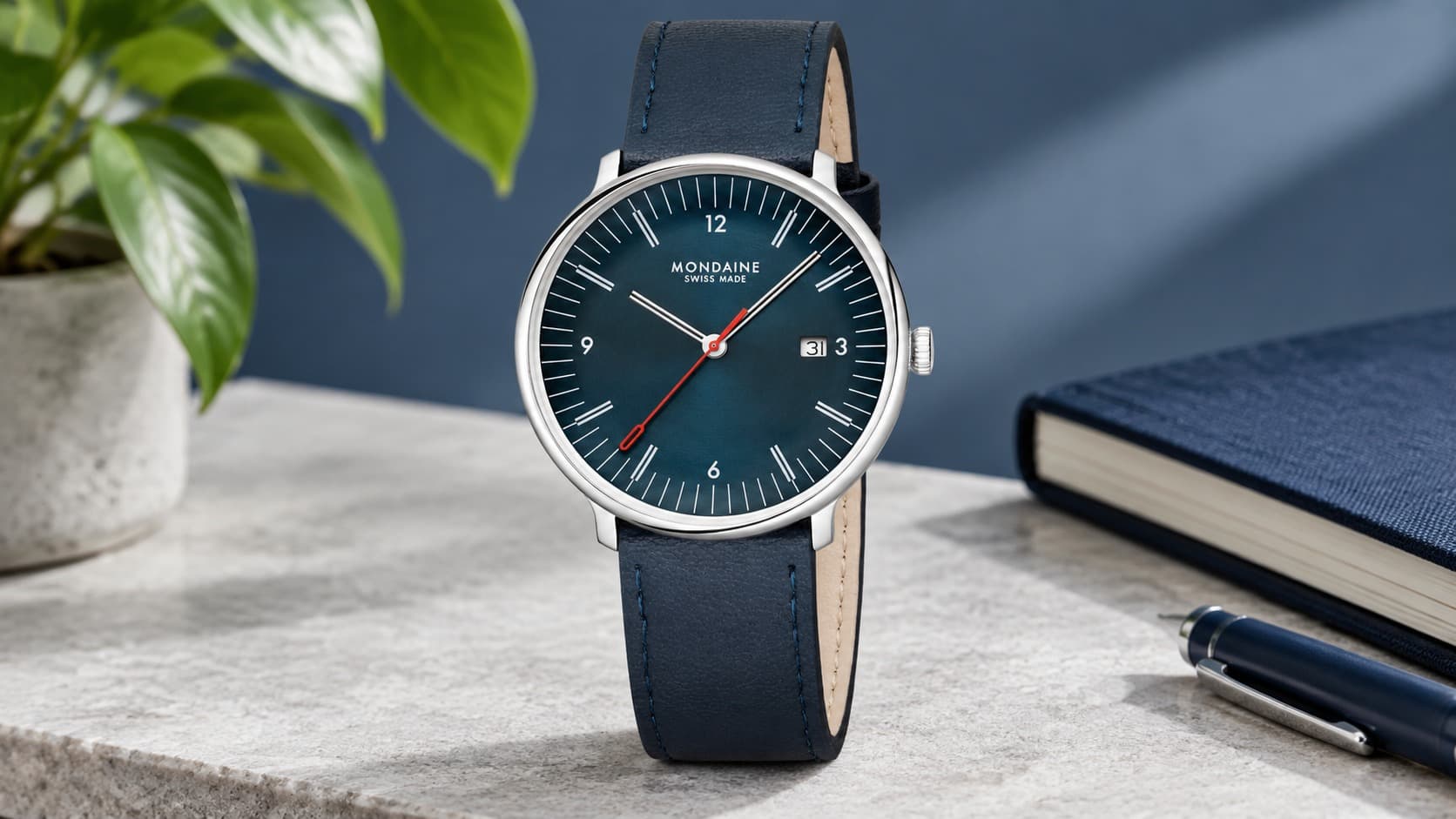
Mondaine is the watch brand behind one of the most copied clock faces on the planet, the plain white dial with black markers and a bright red second hand seen in train stations, airports, and even on an old iPhone screen. It started as a way to keep Swiss trains running on time, and it slowly turned into a full watch collection loved by people who want something clean, honest, and easy to read. Because the design has barely changed in decades, the “best” Mondaine watch is less about chasing trends and more about matching the size, movement, and finish to how someone actually lives.
Why People Love Mondaine Watches
Mondaine watches are known for one thing above all else: readability. The dial has no clutter, no extra text, and no tiny numbers to squint at, so the time reads in half a second. Every Mondaine watch traces its look back to a single clock face, which gives the whole brand a sense of consistency that most watchmakers do not have.
The most famous detail is the red second hand, shaped like a train conductor’s signal paddle. That paddle was once used by real station staff in Switzerland to signal that a train was clear to leave. Because the design was originally built for function, not fashion, it has held up for decades without looking dated. Combined with genuine Swiss manufacturing and fair pricing, it is easy to see why the brand has built such a loyal following among people who simply want a watch that works.
The Story Behind the Mondaine Watch Design
The story starts in 1944, when Swiss engineer Hans Hilfiker designed a clock for the Swiss Federal Railways, known as SBB. The goal was simple: build a clock that could be read from far away on a busy platform, while making sure every station clock in the country showed the exact same time.
Hilfiker’s clock had a clever trick built into it. The red second hand moves a little faster than normal, sweeping around the full dial in 58 seconds instead of 60, then pausing at the top for two extra seconds. That short pause let the clock reset itself the moment it received an electrical signal from a master clock, keeping every station clock in Switzerland perfectly in sync. It is also why trains could leave right on the minute, since the pause built in a tiny buffer before departure.
Mondaine itself was founded in 1951 by Swiss businessman Erwin Bernheim, built on the foundation of an existing Neuchâtel watchmaker that Bernheim took over as part of establishing the new company. For its first few decades, Mondaine made its own watch designs and had nothing to do with the railway clock. That changed in 1986, when Mondaine secured an official license from SBB to put the famous clock face on a wristwatch. That licensing deal is still active today, and Mondaine remains the only company licensed to sell watches carrying the real Official Swiss Railways design.
The company has stayed in the Bernheim family ever since, and it is now run by second-generation brothers André and Ronnie Bernheim. Its watches are still assembled in Biberist, Switzerland, at a factory that Mondaine says now runs largely on its own solar power, and the brand has stated it has been carbon neutral across manufacturing, sourcing, and shipping since 2020. That mix of family ownership and hands-on Swiss production is part of why the brand has kept such a consistent identity for over 70 years.
Fun fact: the design became so recognizable that Apple used a near-identical clock face in an iOS update in 2012. SBB objected, and Apple reportedly agreed to pay around 20 million Swiss francs (about $21 million) to license it, a sign of just how protected and valuable this simple clock face really is. Mondaine’s own license with SBB is separate from that Apple deal, and it remains the only watch license SBB has ever granted.
Best Mondaine Watch Collections
Mondaine sells dozens of individual models, but almost all of them fall into a handful of collections, each built around a different case shape, movement, or take on the original railway dial.
Evo2
Evo2 is Mondaine’s modern, everyday collection, built around a softly rounded case that sits comfortably on the wrist. It keeps the classic railway dial but wraps it in a case shape that feels more current than the original design.
Evo2 comes in a wide range of sizes, from small 26mm versions for slim wrists up to bold 43mm cases, with a choice between a battery-powered quartz movement or a mechanical automatic movement. Automatic versions usually have a see-through case back, showing off the movement as it runs, something the simpler quartz models do not offer. Because it spans so many sizes, movement types, and price points, Evo2 is generally the entry point for new Mondaine buyers.
Classic (The Original)
The Classic line, sometimes called The Original, is the closest thing to Hilfiker’s 1944 design in its purest form. The case is simple and round, the dial is uncluttered, and the strap choices lean toward genuine leather or stainless steel mesh.
This collection represents the design in its most historically accurate shape, without extra styling layered on top. Case sizes here tend to run smaller and more traditional, which makes Classic a common recommendation for wearers who find modern watches too bulky.
stop2go
The stop2go collection is the only Mondaine line that actually recreates the original clock’s start-stop motion inside a watch. The second hand sweeps around in 58 seconds, then pauses briefly at 12 o’clock before the minute hand ticks forward, just like the real station clocks.
Because that mechanism takes extra engineering to build into a small wristwatch case, stop2go models usually sit near the top of Mondaine’s price range. It delivers the full railway experience rather than just the look of it.
Essence
Essence is Mondaine’s vegan-friendly line, built with a plant-based strap in place of animal leather. The case and dial keep the same minimal railway look, so the sustainable material does not come at the cost of style.
It suits buyers who care about where their strap comes from but still want the classic Swiss dial.
Simply Elegant
Simply Elegant trims the case down to a slim, dressy profile, better suited to formal outfits than the sportier Evo2 or stop2go lines. The dial stays true to the railway design, but the overall watch feels quieter on the wrist.
Helvetica
Helvetica was Mondaine’s first major collection built around a different idea entirely: the famous Helvetica typeface instead of the railway clock face. Launched in 2014, it swaps the red second hand and dashes for clean typographic hour markers.
For anyone drawn to Mondaine’s Swiss design philosophy but not the train station look itself, Helvetica offers the same minimalism without the railway theme.
Doppio
Doppio is Mondaine’s newest collection, built around the idea of duality, which is what the Italian word “doppio” means. Instead of the classic flat dial, Doppio uses a slightly concave dial under a double-domed sapphire crystal, plus thinner, double-lined hands that still end in the familiar red dot.
Some Doppio models run on standard quartz batteries, while others use a solar cell hidden under the dial that recharges the watch from ordinary light. Mondaine states that a full charge can run the solar version for around eight months in total darkness, and that just two minutes in daylight is enough to power a full day if the battery ever drains completely. The straps lean into sustainability as well, using vegan grape leather and cases made with a high share of recycled stainless steel, making Doppio a natural extension of the Essence collection with a newer case shape.
NEO
NEO is Mondaine’s chronograph line, built around a “panda dial” look, meaning a light dial paired with darker sub-dials, or the reverse, for extra contrast. It uses a 41mm stainless steel case in a shape unique to this collection, with a date window and full chronograph function for timing things like a workout or a parking meter.
The straps are made from vegan grape leather rather than animal hide, and the dial uses Super-LumiNova on the hands for visibility in the dark. NEO brings the railway dial into a busier, more feature-driven format than a plain three-hand watch.
Numeri
Numeri swaps Mondaine’s usual plain bezel for a bold 12-sided fixed bezel with the numbers 1 through 12 engraved directly into it, giving the watch a sportier, more geometric look than the rest of the lineup. The 42mm stainless steel case is rated up to 10 ATM (100 meters) of water resistance, handling swimming and everyday knocks better than most other Mondaine collections.
Straps come in either a sporty silicone option or a dual-finished steel bracelet, and Mondaine has released seasonal dial colors within the line, making it easy to build a small rotation of watches around one case design.
Cushion
Cushion is Mondaine’s take on a rounded-square case shape, nicknamed for its resemblance to an actual cushion, and it comes in two sizes: the smaller Petite Cushion around 31mm and the larger Grand Cushion around 41mm. The Grand Cushion adds a chronograph and date window, while the Petite Cushion keeps things to a simple three-hand dial aimed at smaller wrists.
Some Cushion models use a quartz movement, but there is also a 39mm automatic version with a Swiss mechanical movement, roughly 38 hours of power reserve, and a see-through case back, putting it closer to a proper mechanical watch than most of Mondaine’s other lines. It offers a genuine alternative for anyone who finds the round cases across the rest of the collection start to blur together.
Pocket Watch
The Pocket Watch collection takes Mondaine’s railway dial out of the wristwatch format entirely and puts it inside a traditional pocket watch, complete with a polished stainless steel case, a matching chain, and a quartz movement. It is a niche pick rather than an everyday accessory, but it connects directly back to the era before wristwatches were common, when a pocket watch was how most people carried the time with them.
It works well as a distinctive gift or a collector’s piece for anyone already drawn to the railway design who wants something less conventional than a wristwatch.
| Collection | Best For | Design Style |
|---|---|---|
| Evo2 | Everyday wear, most sizes | Rounded, modern case |
| Classic | Historical accuracy | Simple, historic railway dial |
| stop2go | The real start-stop mechanism | Classic dial with moving second-hand pause |
| Essence | Vegan and sustainability-minded buyers | Railway dial, plant-based strap |
| Simply Elegant | Dressy, formal occasions | Slim, low-profile case |
| Helvetica | A non-railway look | Typography-based dial |
| Doppio | A newer take on sustainability | Concave dial, double-domed crystal |
| NEO | Chronograph function | Panda-style dial, sub-dials |
| Numeri | Active, everyday sport wear | 12-sided numbered bezel |
| Cushion | A different case shape | Rounded-square case |
| Pocket Watch | Collectors and gift buyers | Traditional pocket watch with chain |
What to Expect to Pay for a Mondaine Watch
Most Mondaine watches sit somewhere between about $150 and $600, placing them in the affordable end of Swiss-made watches. Simpler quartz models in the Classic and Evo2 lines tend to land on the lower end of that range, while automatic movements and the mechanical stop2go models push toward the higher end.
Some limited or premium pieces, especially automatics with steel mesh bracelets or special dial finishes, can run past $800. As a rough guide based on current retail listings, a basic Classic quartz model on a textile strap often starts around $200 to $250, a mid-size Evo2 in stainless steel typically lands between $300 and $450, and stop2go or automatic pieces tend to sit closer to $500 to $900 depending on the case and bracelet; these figures move with exchange rates and retailer promotions, so exact current pricing is worth confirming against a live listing. Even so, Mondaine stays well below the price of true luxury Swiss brands, which is part of why it appeals to first-time watch buyers and design fans who are not looking to spend thousands.
Is Mondaine a Good Watch Brand?
Mondaine watches are genuinely Swiss-made and use real components like sapphire crystal glass and stainless steel cases on most models. Sapphire crystal resists scratches far better than the plastic or mineral glass used on cheaper watches, keeping the dial clear for years of normal wear.
Watch collectors sometimes overlook Mondaine because it is not a “prestige” brand with a long history of complicated mechanical watchmaking. That said, the brand is respected for exactly what it set out to do: build a reliable, accurate, easy-to-read watch based on a design that museums like MoMA in New York have recognized as a genuine design classic. For daily wear and dependable timekeeping, it holds up well against other brands in the same price range.
Most of the quartz models run on movements from Ronda, a well-known Swiss movement maker that supplies plenty of respected brands, not just budget ones. That is a normal setup for a Swiss watch in this price range, since building an entire movement in-house would add a cost that pushes a watch well past this price point. The automatic Evo2 and stop2go models use mechanical movements instead of a battery, which matters for buyers who value that kind of engineering over quartz precision.
How to Pick the Best Mondaine Watch
Picking a Mondaine watch comes down to a few simple questions: how large the case should be, whether a battery or a mechanical movement matters, and how closely the design should follow the original railway look.
- Evo2 suits everyday wear in almost any size, with the widest range of movements and finishes.
- Classic suits anyone after the design exactly as it looked in 1944.
- stop2go suits fans of the moving, pausing second hand as the defining feature.
- Essence suits buyers who want a vegan strap without changing the classic look.
- Simply Elegant suits anything slim enough for a suit or dress.
- Helvetica suits Swiss design fans who want to skip the railway theme altogether.
- Doppio suits buyers drawn to a newer case design along with solar power or recycled materials.
- NEO suits anyone who wants a chronograph with a bolder, layered dial.
- Numeri suits a sportier lifestyle, with better water resistance for swimming.
- Cushion suits buyers after a rounded-square case instead of Mondaine’s usual round shape.
- Pocket Watch suits collectors or gift buyers after the railway design in a non-wrist format.
How to Take Care of a Mondaine Watch
Water resistance is measured in ATM, and figures vary by model rather than by collection as a whole. As a general pattern in this segment, simpler dress-oriented quartz watches often sit around 3 ATM (30 meters), enough for rain, sweat, and hand-washing but not swimming, while sportier models are more likely to carry a higher rating; Mondaine’s Numeri collection, for example, is rated up to 10 ATM (100 meters), suitable for swimming and light water sports. The exact rating printed on a given model’s case back is worth checking before it gets wet, since it can vary even within the same collection.
Wiping the case and strap after wear in humid weather helps prevent moisture buildup, and the crown or buttons should never be pressed while the watch is wet, since that is when water is most likely to get inside. Leather straps in particular should be dried gently and kept away from direct heat, since fast drying can crack the material over time.
Automatic models, like some Evo2 and stop2go pieces, need regular wear to stay wound and accurate. An automatic that sits unworn for long stretches benefits from an occasional hand wind or a spell on a watch winder to keep the movement running smoothly.
Frequently Asked Questions
Is Mondaine a luxury watch brand?
No, Mondaine is considered an affordable Swiss brand rather than a luxury one. It focuses on clean design and solid Swiss manufacturing at prices most people can reasonably afford, rather than competing with luxury names on price or complex mechanical craftsmanship.
What is special about the Mondaine second hand?
The red second hand is based on the paddle a Swiss train conductor once used to signal that a train was ready to leave the station. On the original clock design, and on the stop2go watch collection, that hand also pauses briefly at the top of the dial to help keep timing perfectly synced.
Are Mondaine watches made in Switzerland?
Yes, Mondaine is a Swiss company headquartered in Pfäffikon, and its watches are made to Swiss manufacturing standards. The brand also holds the official license from the Swiss Federal Railways to use the real station clock design.
Which Mondaine collection is the most popular?
Evo2 is generally the most popular collection because it comes in the widest range of sizes and offers both quartz and automatic versions. It also keeps the classic railway dial most closely associated with the Mondaine name.
Do Mondaine watches hold their value?
Mondaine watches are not typically bought as investment pieces the way some luxury Swiss watches are. They tend to lose resale value like most quartz and entry-level automatic watches, making them better suited to everyday wear and enjoyment rather than resale potential.
The Bottom Line
Mondaine’s whole appeal comes down to one idea: a clock face built for a Swiss train platform in 1944 turned out to be so well designed that it still works perfectly on a wrist today. From the modern comfort of Evo2 to the historical accuracy of Classic, the mechanical charm of stop2go, and the sustainable strap on Essence, every collection carries the same honest, no-clutter design philosophy that made the original clock a design icon in the first place. For most buyers, that combination of legible design, real Swiss manufacturing, and a fair price is exactly what makes a Mondaine watch worth wearing.