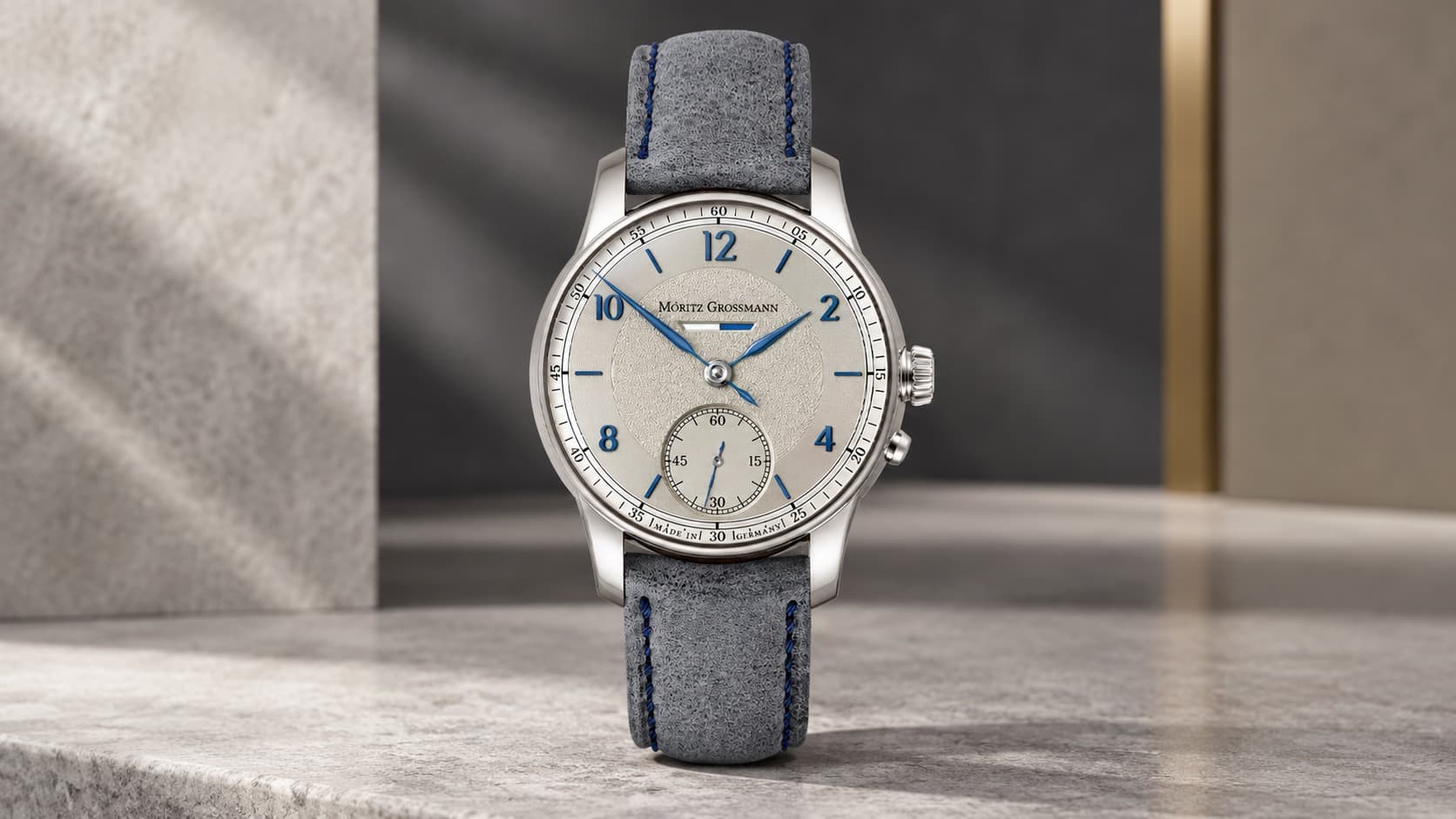
Most people who love watches have heard of Rolex, Omega, or Patek Philippe. Far fewer have heard of Moritz Grossmann, and that is exactly how this tiny German manufacturer seems to like it. Based in the small Saxon town of Glashütte, the brand builds only a few hundred watches a year, almost entirely by hand, using techniques that most of the watch industry gave up decades ago. For anyone curious about serious, old-school watchmaking that doesn’t shout about itself, Moritz Grossmann is one of the most interesting names working today.
Why Moritz Grossmann Watches Are Unique
Moritz Grossmann stands out because it makes almost every part of its watches by hand, inside its own workshop, including parts that most brands buy ready-made. Jewels and mainsprings come from outside suppliers, as they do for nearly every watchmaker, but beyond that, essentially everything in a movement is cut, shaped, and finished on site, down to the tiny screws and wheels. Even the hands are made in-house, individually formed and heated until they turn a deep blue-violet color.
This matters because a lot of “luxury” watch brands buy finished parts from outside suppliers and simply assemble and decorate them. Moritz Grossmann does the opposite, producing more than 85% of each caliber in-house, well above the 50% threshold Glashütte watchmakers need to reach before they are even allowed to print “Glashütte” on the dial. Output stays deliberately small to match that level of hand labor: the workshop employs around 40 watchmakers and turns out well under 500 watches in a typical year, a tiny number compared to brands producing hundreds of thousands.
The balance spring, the hair-thin coil that governs a watch’s accuracy, is normally bought pre-formed from a specialist supplier. Moritz Grossmann’s watchmakers instead bend and finish each one by hand under a microscope, a step only a handful of manufacturers anywhere still take on themselves.
The Story Behind Moritz Grossmann
Moritz Grossmann is named after a real 19th-century watchmaker, and the brand only exists today because one woman brought his name back from history. Karl Moritz Grossmann was born in Dresden in 1826, and in 1854 he moved to Glashütte at the urging of his friend and fellow watchmaker Ferdinand Adolph Lange, who had already set up his own workshop there. Grossmann founded his own company the following year, and he was known for more than just watches. Beyond watchmaking, Grossmann served as a Glashütte councilman from 1866 to 1878, sat in the Royal Saxon parliament, and even helped organize a local fire brigade.
His biggest lasting contribution to the watch world was education rather than watches themselves. That interest led him, on 1 May 1878, to establish a dedicated watchmaking school in Glashütte under the Central Association of German Watchmakers, training craftsmen directly instead of leaving the skill to pass down informally within workshops. The region’s reputation for precision owes a real debt to that school. A couple of years later, in 1880, he published a technical essay on building a simple yet mechanically flawless watch, a text that helped define the construction style the world now calls Glashütte watchmaking.
Grossmann’s death in 1885 ended the company along with him, since there was no successor ready to take it over, and the workshop’s assets were eventually sold off. For well over a century afterward, his name survived mainly in local records and on a Glashütte town square renamed in his honor, but no watch carried it. That changed when Christine Hutter, a watchmaker who had trained and worked in the region, came across the forgotten name, acquired the rights to it, and used them to launch Grossmann Uhren GmbH in Glashütte in 2008. Two years later the young company released its debut wristwatch collection, and 2026, marking 200 years since Grossmann’s birth, has brought a commemorative exhibition and a limited-edition watch honoring the anniversary.
Best Moritz Grossmann Watch Collections
Moritz Grossmann’s catalog is small compared to most watch brands, which makes it easy to get to know the whole lineup rather than just a few highlights. Seven collections currently make up the range, spanning from the simplest dress watch to the brand’s most complicated grand complication.
Benu
The Benu is the watch that put Moritz Grossmann on the map, and it was the brand’s first modern wristwatch, launched in 2010. It is a classic, round, hand-wound dress watch with a simple dial, but flip it over and the movement underneath is where all the real work shows. The case shape, with its stepped, three-part design, was created specifically to showcase traditional Glashütte finishing on a modern watch.
Inside sits the manufacture’s caliber 100.0, built around a layout most other brands abandoned long ago. Rather than one solid bridge covering the gear train, the movement uses a two-thirds plate raised above the main plate on small pillars, with a half-moon cutout in that upper plate that has become something of a visual signature for the brand, and every visible surface is finished and engraved by hand. A micrometer screw built into the balance cock lets a watchmaker fine-tune the rate in tiny increments, and before leaving the workshop, each movement is regulated in five separate positions rather than the one or two more common elsewhere, so it keeps similar time whether it’s lying flat overnight or standing upright in a drawer.
Benu Tourbillon
The Benu Tourbillon is the most complicated and expensive watch Moritz Grossmann regularly makes, built around a tourbillon the brand engineered entirely in-house and first introduced in 2013. Its flying, three-minute tourbillon cage draws on a construction style pioneered decades earlier by Glashütte watchmaker Alfred Helwig, and a signature pusher-activated manual winder separates hand-setting from restarting the movement so the watch never loses time while it’s being set.
Few complications are harder to pull off than a flying tourbillon that also has to stop precisely on command, which is why this model sits above everything else in the Benu range. Two windows let an owner watch caliber 103.0 at work: a cutout in the dial directly over the rotating cage, and a sapphire case back that exposes the full movement behind it. These watches are made in very limited numbers, with a past rose gold edition capped at 25 pieces and priced around €175,000 at launch, while the newest titanium and white gold “Tremblage” versions sell for well over €160,000.
Atum
The Atum is Moritz Grossmann’s answer to an everyday watch, with a cleaner, slightly more modern look than the Benu. It keeps the same hand-wound caliber 100.0 and the same hand-engraved balance cock, but drops some of the Benu’s dressier case details in favor of simpler lines that work equally well under a shirt cuff or a casual jacket. It’s offered in white or rose gold, with the 37mm “Atum 37” giving the collection a noticeably smaller option alongside the standard 41mm case, and the “Atum Date” adding a simple date display to the classic layout.
This is also where the brand’s first automatic movement eventually appeared, in a sub-line called the Atum Hamatic, which is explained in more detail below. For buyers who want the full Moritz Grossmann experience, meaning an in-house hand-wound movement with visible, old-world finishing, at a slightly gentler price than the Benu, the Atum is usually the recommended starting point.
Atum Pure
The Atum Pure strips the dial down to the basics, removing extra text and decoration so that nothing distracts from the hands and hour markers. It is aimed at buyers who want the mechanical substance of a Moritz Grossmann watch without a busy-looking face, and it is typically the most affordable way into the brand. At the top of this sub-line sits the Atum Pure High Art, which adds hand engraving across the dial and movement for collectors who want the minimalist look paired with extra decoration.
Tefnut
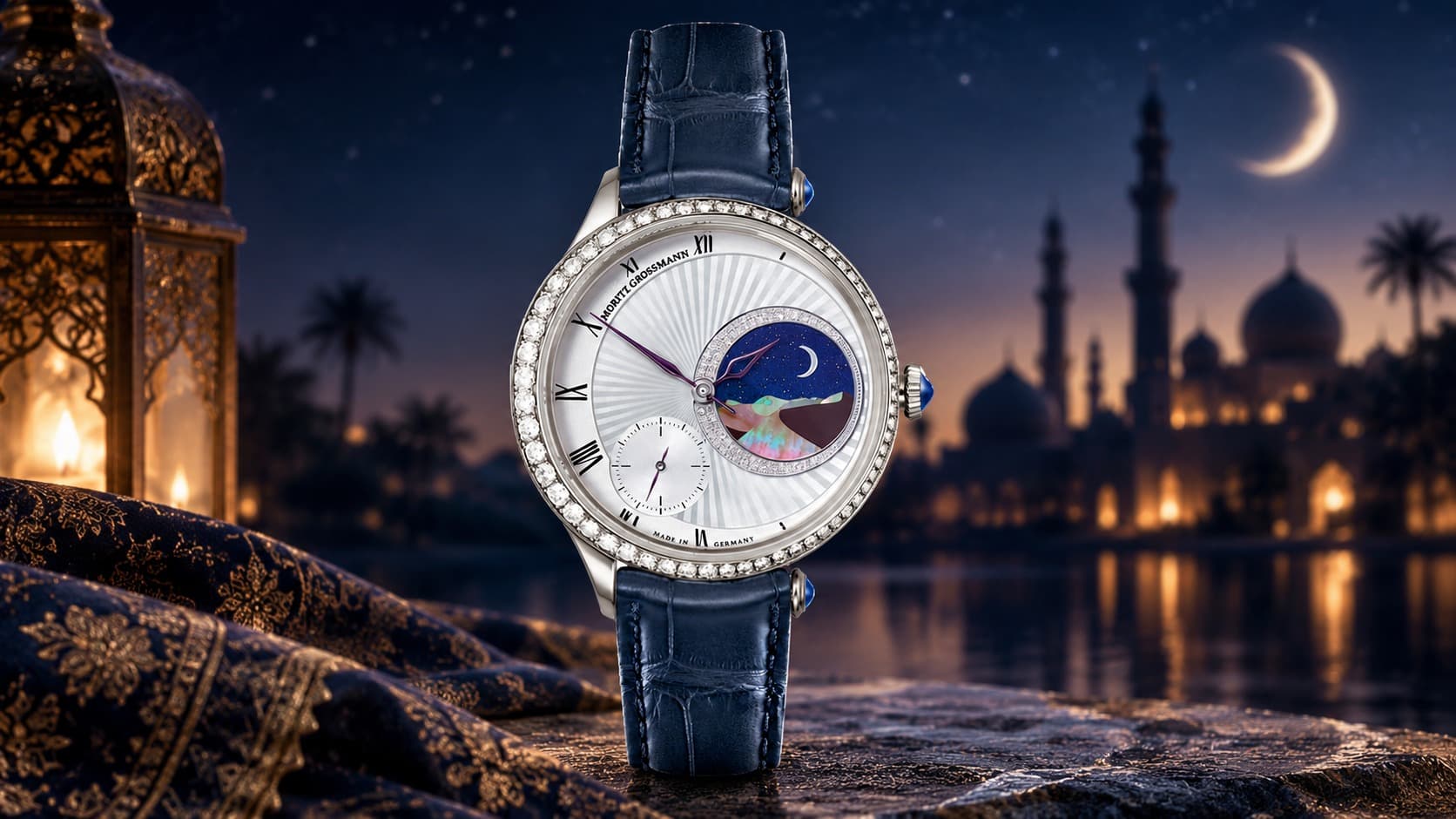
The Tefnut shrinks Moritz Grossmann’s case down for smaller wrists, aimed at anyone who wants the brand’s craftsmanship without the larger diameter typical of a dress watch. It follows the same basic design vocabulary as the Atum, thin cases in steel, rose gold, or white gold paired with anthracite or silver dials, just scaled to a more compact size.
The collection also gets its own hand design: slim, polished steel or warm brown-finished hands made in-house rather than sourced from an outside supplier, giving Tefnut watches a slightly different personality despite sharing the Atum’s movement architecture. A “Tefnut Lady” variant is sized specifically for smaller wrists, and a “Tefnut Twist” version plays with case finishing and dial color for a more playful look while keeping the same serious movement underneath.
Hamatic
For its first decade, Moritz Grossmann only made hand-wound watches. That changed with the Hamatic, the brand’s first self-winding model, which appeared as a prototype in 2018 and reached dealers roughly a year later priced at about €44,800. Instead of the spinning rotor found in most automatic watches, the Hamatic winds itself with a weighted arm that swings back and forth like a pendulum, a system the brand calls its hammer mechanism and one that traces back to winding devices used in much older pocket watches.
That swinging motion, rather than a full rotation, is both a nod to that older technology and a genuinely unusual engineering choice for a brand this size. In 2026, the brand marked Grossmann’s 200th birthday with the Hamatic Silver-Plated by Friction, an 18-piece limited edition priced at €73,500 that keeps the same hammer-winding movement but introduces a new dial for the occasion. Moritz Grossmann is based in Glashütte, the cradle of German watchmaking tradition, alongside brands such as A. Lange & Söhne, Lang & Heyne, and Glashütte Original, and the Hamatic is one of the clearest examples of the brand trying to do something genuinely its own rather than copying its famous neighbors.
Backpage
The Backpage is Moritz Grossmann’s most unusual watch, because it puts the decorated, mechanical side of the movement on the dial side, instead of hiding it on the back like almost every other watch in the world. Parts normally reserved for a case-back view, the Grossmann balance, the floral engraving on the balance cock, the snailed ratchet wheel, sit facing outward instead, in plain view every time the wearer checks the time.
Making this work meant redesigning how the watch winds and sets. Large parts of the engineering had to be flipped: the escapement and the direction the balance spring coils both needed mirroring, and the plate itself was rebuilt around a new three-quarter layout so the usually hidden hand-setting train could run openly across what’s now the back of the movement. It is a watch built for people who already understand and love mechanical watches, since its entire reason for existing is to show off engineering most brands keep hidden.
GMT
The GMT, launched in 2019, was Moritz Grossmann’s first attempt at a second time zone, and it solves the problem in a very deliberate, old-fashioned way. Rather than adding a quick-set 24-hour hand to an existing caliber, the brand built a dedicated movement for it, the caliber 100.8, derived from the standard 100.0 but with a second-time-zone mechanism built into the front of the movement rather than bolted onto the back.
The watch uses two crowns instead of one: the crown at 3 o’clock winds the watch and sets the home time, while a second crown at 10 o’clock adjusts a rotating arrow around the outer edge of the dial to show the second time zone on a 24-hour scale. It is a classic 41mm case, and like the rest of the catalog, setting the time still goes through the brand’s pusher-activated mechanism rather than a simple pull-out crown.
Perpetual Calendar
The Perpetual Calendar is the newest and most complex watch in the current lineup, released in 2025 to mark 17 years since Christine Hutter revived the brand. It’s one of the hardest complications to build well, since the mechanism has to track months of different lengths and leap years entirely on its own. Moritz Grossmann’s version needs no attention on that front until the year 2100, the one point every century when the usual four-year leap pattern breaks and most perpetual calendars briefly fall out of step.
The watch is built around a new caliber, the 101.13, which adds a 211-part calendar module on top of a 190-part base movement derived from the caliber 100.1. The dial shows the date, day of the week, month, and a moon phase rendered in mother-of-pearl against a goldstone sky. A single pusher, nicknamed the sum corrector, handles catching up after the watch sits unworn: one press advances the date, and the day, month, and moon phase then fall into place behind it automatically. It comes in rose gold or platinum, in a 41mm case, starting at roughly €98,800.
Moritz Grossmann Watch Prices
Prices vary considerably depending on the collection, case metal, and how limited an edition is.
| Collection | Approximate Starting Price | What the Price Reflects |
|---|---|---|
| Atum Pure | €17,000–€20,000 | Entry point into the brand, simplified dial |
| Benu | €27,000–€35,000 | The classic flagship, full hand-finishing |
| Atum / Tefnut | €28,000–€55,000 | Everyday wear, smaller Tefnut cases available |
| Hamatic (automatic) | €40,000–€75,000 | First and only automatic line, hammer-winding |
| GMT | €55,000–€68,000 | Dual time zone, two-crown construction |
| Perpetual Calendar | €98,800+ | The brand’s first grand complication |
| Benu Tourbillon | €165,000+ | In-house flying tourbillon, very limited runs |
Limited editions, gold cases, and special dial finishes push these numbers up quickly. A standard Benu in steel sits at the low end, while a platinum or gold Tourbillon can cost ten times as much.
Owning a Moritz Grossmann Watch
Beyond the price tag, owning a Moritz Grossmann watch comes with a handful of day-to-day realities that apply across almost the entire catalog.
- Water resistance is minimal. Most models, including the steel ones, are rated to around 30 meters, enough for rain or an accidental splash, but these watches are not built for swimming, showering, or diving.
- Nearly everything is hand-wound. Apart from the Hamatic, every current collection uses a manual-winding movement, so each watch needs to be wound and set by hand regularly, or stored on a watch winder when it isn’t worn daily.
- Case sizes stay fairly consistent. Most collections run between 37mm and 41mm, with the Benu Tourbillon stepping up to 44.5mm to accommodate its larger movement and tourbillon cage.
- New watches carry a two-year manufacturer warranty, honored through the brand’s authorized dealer network regardless of which country the watch was purchased in.
Why These Watches Cost What They Do
A Moritz Grossmann watch costs more than most people expect for a brand they have never heard of, and the reason comes down to how little of it is made by machine. Unlike many watch companies that buy a base movement and decorate it, Moritz Grossmann designs and builds its calibers from scratch, including the balance wheel and balance spring that most brands outsource entirely. The movement plates are made from untreated German silver rather than the rhodium-plated brass most brands use, which means the metal slowly develops a warm patina over the years instead of staying artificially shiny forever.
One small but clever detail sums up the brand’s whole approach: how the time is set. Instead of a normal crown pulled out to set the hands, most Moritz Grossmann watches rely on a small pusher near the 4 o’clock position. Pressing it disengages the going train and freezes the balance wheel in place, so the hands can be repositioned precisely without the watch quietly continuing to run underneath, a small flaw that ordinary pull-out crowns never fully fix. It is the kind of problem-solving the brand applies throughout its entire catalog.
Frequently Asked Questions
Is Moritz Grossmann a good watch brand?
Yes, it has a strong reputation among serious watch collectors and industry experts, even though it is not a household name. The brand makes its own movements almost entirely in-house, including parts that most companies buy pre-made, and its finishing is considered on par with far more famous German names like A. Lange & Söhne.
Is Moritz Grossmann related to A. Lange & Söhne?
Not as a company, but the two names are tied together historically. Ferdinand Adolph Lange arrived in Glashütte first, in 1845, and the watchmaking industry he built there is part of what drew Grossmann to the town nine years later; Lange reportedly encouraged the move himself. Beyond that personal connection, though, Moritz Grossmann has always operated as its own independent company, both in the 1800s and in its current form.
Does Moritz Grossmann make automatic watches?
Yes, but only recently and only in one line. The brand spent its first decade making only hand-wound watches, then introduced the Hamatic as its first automatic model, using an unusual swinging “hammer” winding mass instead of the spinning rotor found in most automatic watches.
How many Moritz Grossmann watches are made each year?
Very few compared to most watch brands. The manufacture keeps a staff of roughly 40 watchmakers and caps yearly output below 500 pieces by choice rather than necessity, which helps explain why the brand stays relatively unknown outside collector circles despite the quality of its work.
Who founded the modern Moritz Grossmann company?
Christine Hutter, a trained watchmaker, founded the current company in 2008 after coming across the dormant Grossmann name during her career in Glashütte. She holds a fairly unusual position in the industry: no other German watch manufacturer is currently led by a woman on her own, and by most accounts, no woman in the history of watchmaking has founded and run an independent brand quite the way Hutter has built Moritz Grossmann.
The Bottom Line
Moritz Grossmann is a brand built for people who care about how a watch is made, not just how it looks on a wrist. Every collection, from the classic Benu to the automatic Hamatic and the showpiece Tourbillon, shares the same core idea: build it by hand, in Glashütte, the way it used to be done before most of the industry switched to machines and outside suppliers. It is not a brand for someone who wants instant recognition, but for anyone who wants a genuinely rare, hand-built mechanical watch with a real story behind its name, it is one of the most rewarding corners of German watchmaking to explore.