Most people have never heard of Cyma, and that is a little strange, because Cyma has been making watches since 1862, longer than many of the brands that get all the attention today. It survived two world wars, a rocky decline in the 1960s and 1970s, and the quartz crisis that wiped out dozens of other Swiss names. Along the way, it built alarm watches that ticked like tiny clocks, dive watches trusted by navies, and one of the most collected military watches in history.
Who Made Cyma Watches?
Cyma was founded in 1862 in La Chaux-de-Fonds, Switzerland, by brothers Joseph and Théodore Schwob. The name comes from the French word “cime,” meaning summit, which itself traces back to a Latin word for a young shoot or sprout. It is a fitting name for a company that spent its first decades growing quickly through the Jura Mountains, the historic heart of Swiss watchmaking.
The brand’s real turning point came in 1892, when the Schwob brothers partnered with Frédéric-Henri Sandoz, a watch wholesaler who ran his own company, Henri Sandoz & Cie. That partnership led to the creation of the Tavannes Watch Company, and the Cyma brand name was created to sell its products. For decades, Cyma and Tavannes were so closely linked that some vintage watches even carry both names on the same dial, or hybrid names like “Ta-Cy” and “Tacy.”
In its earliest days, Cyma was a small operation, with about 40 workers and 55 machines producing roughly 40 watches a day. That changed fast. By the 1920s and 1930s, Cyma had grown so large that the company claimed, at least for a time, to be the biggest watch manufacturer in Switzerland. It kept its own factories and made most of its own movements well into the 1950s, which was unusual even then, since many watch brands simply bought movements from outside suppliers.
The brand’s ownership has shifted several times since then. After production dropped off in the 1960s and the company went through a difficult stretch, businessman Claude Guilgot bought Cyma in the 1970s. His daughter, Françoise Schürch-Guilgot, took over as company president in 2007, and Cyma remains based in Le Locle to this day, still described as one of the last family-owned Swiss watchmakers.
Cyma Watches: Built for Durability
Cyma built its reputation on tough, reliable watches rather than flashy or expensive ones. That focus on durability shows up again and again across the brand’s history.
As early as 1915, Cyma was already making waterproof watches, a full decade before “waterproof” became a marketing word other brands leaned on. In 1921, the company managed to make its watch parts fully interchangeable, an early step toward standardized manufacturing that most factories only adopted later. In 1943, Cyma released its first automatic watch, and it kept refining that rotor system through the 1950s. The brand also became known for its shock-resistant “Cymaflex” system, which protected the delicate balance wheel inside the movement from knocks and drops.
Cyma’s philosophy, from its earliest days, centered on function rather than flash: a watch that still worked after everything else stopped.
That reputation also shows up in where Cyma watches ended up being used. Governments and armed forces did not choose Cyma because it looked nice. It was chosen because it survived, and Cyma leaned into that reputation in its own advertising. As early as 1908, the brand was already marketing its watches as resistant to electricity, magnetism, and temperature swings, all things that could throw off a mechanical movement’s accuracy. That early focus on function is part of why Cyma watches from the 1940s and 1950s still run well today, when properly serviced, decades after they were made.
Top Cyma Watch Models
Cyma made thousands of references over 160-plus years, but four models explain most of what the brand is known for today.
The Cyma WWW “Dirty Dozen” (1944–1945)
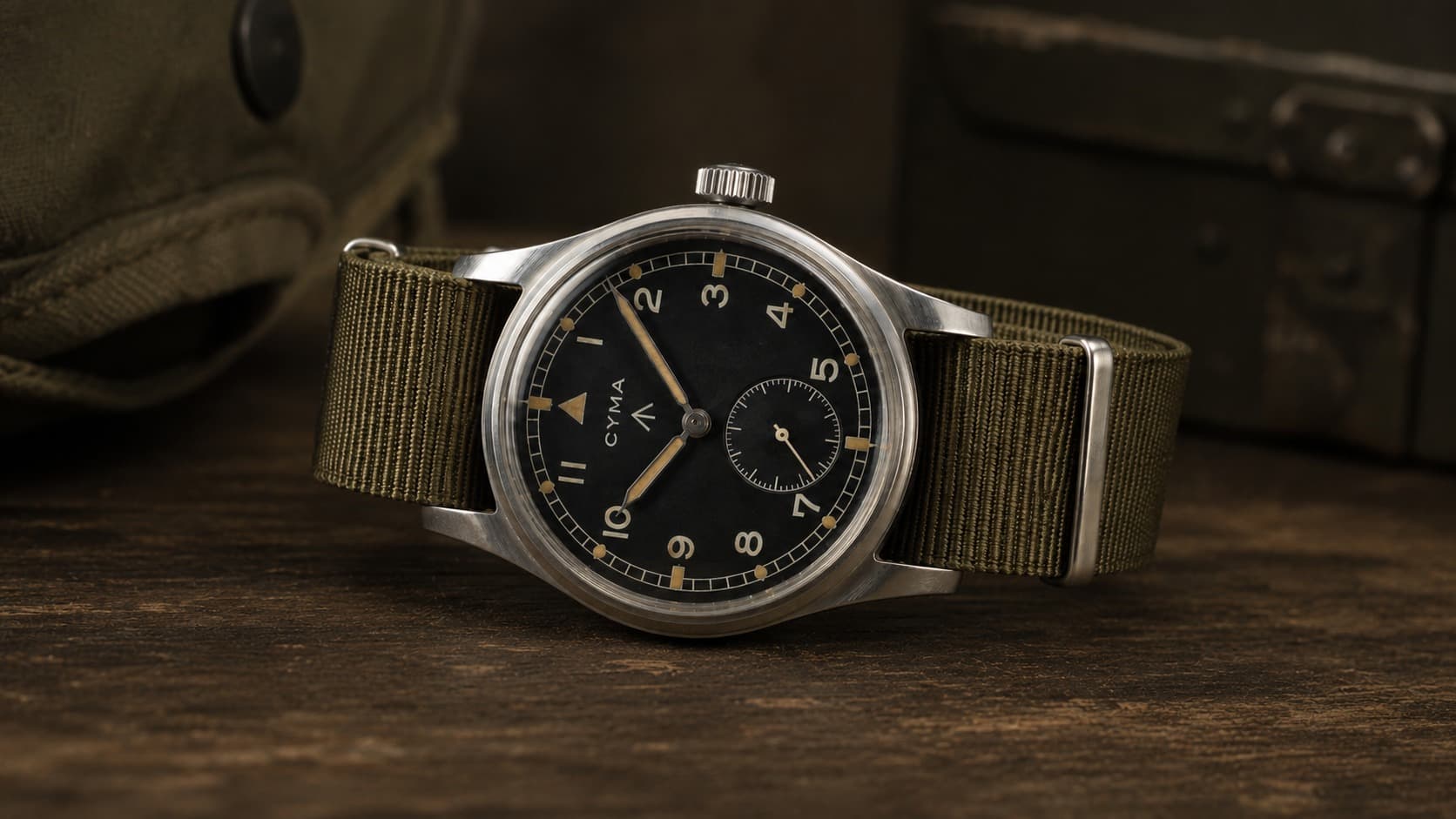
Cyma’s most famous watch is a genuine military artifact, built to a wartime government specification rather than designed for style.
During World War II, the British Ministry of Defence needed a rugged, standardized watch for its soldiers. It set strict requirements under the code “W.W.W.,” which stood for Watch, Wristlet, Waterproof. The specification called for a black dial, clear Arabic numerals, luminous hands, a shatterproof crystal, and a small seconds sub-dial, all housed in a stainless steel case. Twelve Swiss manufacturers were chosen to build it, including Omega, Longines, IWC, and Jaeger-LeCoultre. Because of that group of twelve, collectors nicknamed the set “the Dirty Dozen,” after the 1967 war film about a squad of twelve soldiers.
Cyma delivered around 20,000 of these watches to the British military in 1944 and 1945. Its version, at 38mm, was the largest case of all twelve brands in the set. Many were later destroyed by the Ministry of Defence in the 1970s because their luminous paint contained radioactive radium, which shrank the surviving population and made the watches more desirable to collectors today.
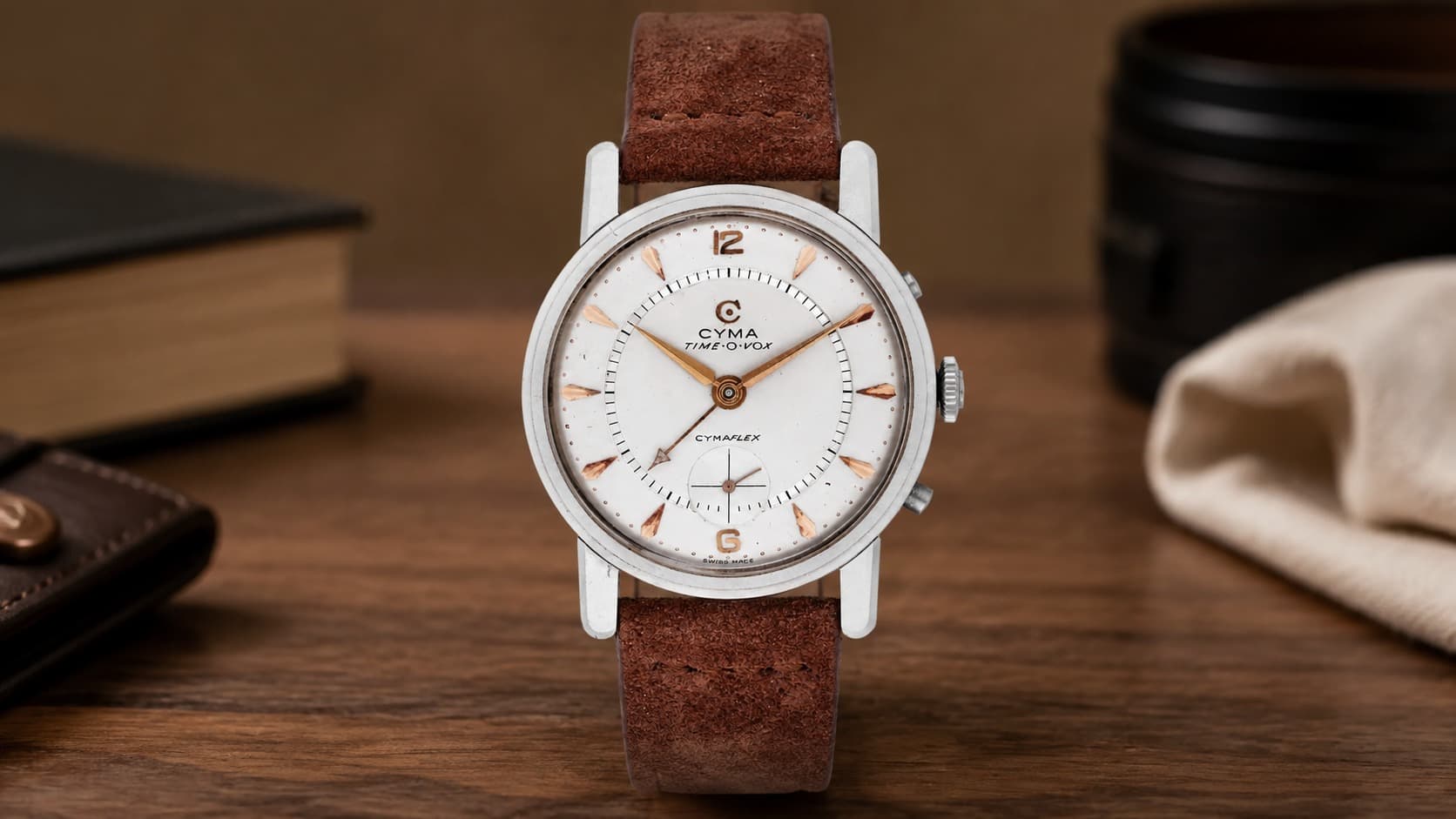
The Cyma Time-O-Vox (1950s)
If the Dirty Dozen shows Cyma’s toughness, the Time-O-Vox shows its cleverness. It was a mechanical wristwatch with a built-in alarm, using a single mainspring to power both the timekeeping and the alarm function, a genuinely difficult engineering trick to pull off in a case small enough to wear on a wrist.
Cyma had been building toward this since 1945, when it released an eight-day alarm clock wound with a single key. By 1956, a gold version of the Time-O-Vox, running on the caliber R.464 movement, earned official chronometer certification from Swiss testing authorities, meaning it passed strict accuracy standards normally reserved for high-precision watches. Cyma followed it in 1957 with the Sonomatic, another alarm watch aimed at a wider audience.
The Time-O-Vox used pushers on the case, rather than a second crown, to set and release its alarm, which made it simpler to operate than some rival alarm watches of the same decade. Because the movement is more complex than a standard hand-wound caliber, surviving examples need careful, specialist servicing, and collectors generally pay a premium for one that still chimes reliably.
The Cyma Navystar (1960s onward)
The Navystar is Cyma’s answer to the dive watch boom of the 1960s. Built around the brand’s Cymaflex shock-protection system, it was rated water-resistant to 200 meters, a serious depth rating for the era, and came with a unidirectional rotating bezel and luminous markers designed for underwater visibility. More than 20 patents protected the technology packed into the case.
The Navystar’s design barely changed for decades, which is a compliment in watchmaking circles. Cyma relaunched the model in 2000 using close to its original 1960s design, and modern Navystar watches, including quartz chronograph versions, are still sold under the Cyma name today. Another 1950s and 1960s Cyma design worth noting is the Cymaflex bracelet, a patented flexible metal band made of spring-connected links that stretched to fit different wrist sizes, a feature that was unusual for its time and remains a detail collectors look for on original pieces.
The Cyma Autorotor and Automatic Calibers
Cyma introduced its first automatic, self-winding watch in 1943, using a caliber built around a unidirectional rotor, a weighted piece that spins with wrist movement to wind the mainspring automatically. That system evolved into the “Autorotor” caliber 485 in 1957. These movements are less famous than the Dirty Dozen or the Time-O-Vox, but they matter historically because they show Cyma experimenting with automatic winding technology at roughly the same time as the biggest names in Switzerland.
What Do Cyma Watches Cost Today?
Vintage Cyma watches are generally affordable compared to other brands with similar history. The ranges below are rough estimates pieced together from auction results and marketplace listings, not a formal price guide, but they give a realistic sense of where different types of Cyma watches tend to land.
| Type of Cyma Watch | Typical Price Range | Why |
|---|---|---|
| Common vintage dress or manual-wind models | $300–$800 | Plentiful supply, simple movements |
| Dirty Dozen WWW military watches | $800–$3,000+ | Military history, radium dial rarity, collector demand |
| Time-O-Vox alarm watches | $1,000–$4,000+ | Complex movement, condition-sensitive |
| Rare gold or exceptional-condition pieces | Can exceed $10,000 at auction | Precious metal case plus rarity |
At the very top end, Cyma auction records show that a rare “Clamshell” model sold for $18,750 at a 2017 auction, one of the highest publicly recorded prices for the brand. That is still modest next to what a rare vintage Rolex or Patek Philippe fetches, which underlines the appeal collectors find in Cyma: real history at a fraction of the price.
Case material changes the math too. Cyma made watches in solid gold, gold-plated steel, and plain stainless steel across its history, and a solid 18k gold Cyma dress watch from the 1930s or 1950s will usually sell for more than a steel model of the same age simply because of the metal content, even before factoring in rarity or condition.
New Cyma watches sit in a separate market from vintage ones. Today’s Cyma lineup is mostly quartz-powered, stainless steel, and aimed at the everyday watch buyer rather than the collector, which puts new pieces like a current Navystar chronograph in roughly the $500 to $1,200 range based on current retail listings, though that estimate rests on a small number of available listings rather than a full market survey. That is a much smaller, simpler catalog than the brand’s mechanical peak, which explains why most of the interest in Cyma today centers on its vintage models rather than its current ones.
Do Cyma Watches Hold Their Value?
Cyma watches are better understood as collectible history pieces than as financial investments, and that distinction matters because the two questions get answered very differently.
Unlike Rolex or Patek Philippe, Cyma does not carry the same brand recognition or resale demand that drives steady price growth. Its value comes from specific stories, like the Dirty Dozen connection to WWII, or the engineering behind the Time-O-Vox, not from broad brand prestige. That means prices can be unpredictable and depend heavily on a specific watch’s documentation, originality, and condition.
By the late 1990s, Cyma’s own leadership had already leaned into this reality rather than fight it. Longtime director Claude Guilgot described the brand’s market position as “the cheapest of the expensive,” and the company built a strategy around affordable, ultra-thin quartz watches sold mainly in the United States, Spain, and the Middle East, rather than competing directly with luxury Swiss names on price. That strategy still frames the brand today: a name with real Swiss history, priced well below the watches it shares that history with.
How to Spot an Authentic Cyma Watch
A few checks before buying protect against paying collector prices for a watch that has been altered or mismatched, which is common with older military and alarm watches.
- Check the dial signature and case markings. Genuine Cyma dials are marked clearly, and military WWW models should show the broad arrow “pheon” mark along with a W.W.W. engraving on the case back.
- Look at the movement, not just the dial. Because Cyma and Tavannes shared movements for decades, some watches are honestly marked “Cyma-Tavannes,” and that is normal. What matters is that the movement style and serial numbers match the expected era.
- Check for servicing history. Alarm watches like the Time-O-Vox have more moving parts and fail more easily if neglected, so a documented service history adds real value.
- Compare case size and shape to known references. The Dirty Dozen Cyma, for example, is consistently documented at 38mm, the largest of the twelve military brands, so a supposed original in a very different size is worth questioning.
A watch with a good story but no paperwork can still be worth owning. The risk is paying rare-collectible prices for a piece that cannot be verified.
Frequently Asked Questions
Is Cyma still making watches today?
Yes. Cyma is still an active Swiss brand, based in Le Locle, and it continues to sell watches including updated versions of the Navystar line, though it operates on a much smaller scale than it did during its peak in the early-to-mid 20th century.
Was Cyma part of the “Dirty Dozen” watches?
Yes. Cyma was one of twelve Swiss manufacturers commissioned by the British Ministry of Defence to build the W.W.W. military watch during World War II, alongside brands like Omega, Longines, and IWC.
What is special about the Cyma Time-O-Vox?
The Time-O-Vox is a mechanical wristwatch with a built-in alarm function powered by a single mainspring. A gold version earned official chronometer certification in 1956, a rare achievement for an alarm watch at the time.
Are Cyma watches waterproof?
Many are. Cyma began producing waterproof watches as early as 1915, and later models like the Navystar were built with dive-ready water resistance rated to 200 meters, backed by the brand’s Cymaflex shock-protection system.
Did Cyma ever go bankrupt?
That specific detail is disputed in collector accounts, so it should be treated as unconfirmed. What is well documented is that Cyma and its sister brand Tavannes went through a serious decline in the 1960s, production ceased for a period, and the brand changed ownership more than once before settling under its current management in Le Locle.
Conclusion
Cyma’s story is really a story about staying power rather than fame. It built its name on watches that soldiers trusted in combat, alarms that could wake someone on time in 1956, and dive watches that held up at depths most brands never tested. None of that made Cyma a household name the way Rolex or Omega became, but it left behind a genuinely interesting catalog of Swiss watches that remain accessible to collectors today, from a battered WWW dating to the 1940s to a current quartz Navystar on a store shelf.