Carl F. Bucherer spent more than a century building a quiet reputation among watch collectors, known less for flash and more for genuinely clever engineering hidden inside classic-looking cases. The Lucerne-based brand invented a winding system that no one else had managed to mass-produce, built its own movements from scratch, and stayed in the hands of one Swiss family for three generations. In 2025, Rolex, which had bought the brand’s parent company two years earlier, announced it was shutting Carl F. Bucherer down for good, closing out one of Switzerland’s more inventive independent names at an unexpected moment in its long history.
Who Was Carl F. Bucherer?
Carl F. Bucherer was a Swiss watch and jewelry brand founded in Lucerne, Switzerland, and owned for generations by the same family before Rolex bought it. Carl Friedrich Bucherer opened his first shop selling watches and jewelry in Lucerne in 1888, and the company stayed under family control for the next 135 years. It became known for building its own movements in-house rather than buying them from outside suppliers, which is unusual even among expensive Swiss watchmakers.
The name on the dial changed over time. For most of the company’s history it simply traded as “Bucherer.” The founder’s grandson, Jörg G. Bucherer, took over the business in the 1970s and, in 2001, renamed the watch brand Carl F. Bucherer in honor of his grandfather, then took the newly renamed brand international. That relaunch is why most of the watches people associate with the company today, such as the Manero and Patravi lines, only date back a couple of decades, even though the business itself is much older.
Family involvement ran deep from the start. The founder’s two sons joined the company after training in complementary crafts, one as a watchmaker and one as a goldsmith, and that pairing of jewelry-making and watchmaking skill shaped the brand’s identity for generations. The company’s connection to Rolex also goes back much further than its eventual sale. In the 1920s, one of the founder’s sons struck a distribution deal with Hans Wilsdorf, the founder of Rolex, bringing Rolex watches into Bucherer’s stores decades before Rolex ever owned the company itself.
The brand’s own watchmaking story started earlier than most people assume. In 1919, encouraged by his sons, Carl Friedrich Bucherer released his first collection under his own name: a line of small, ornately decorated Art Deco women’s watches. That timing mattered, because wristwatches were still considered a passing fad at the time, worn mostly by women and dismissed by much of the watch industry as a novelty next to the pocket watch. Bucherer was one of the first watchmakers to commit to the wristwatch anyway, later expanding into men’s and unisex models by the 1930s, and that early bet on the wrist strap is a big part of why the brand is remembered as ahead of its time.
Is Carl F. Bucherer Still in Business?
Carl F. Bucherer is being wound down after Rolex, which bought the brand’s parent company in 2023, decided in 2025 to discontinue it entirely. Rolex publicly announced its purchase of Bucherer AG, the retail chain and its associated watch brand, in August 2023, framing the deal as a way to protect a century-long partnership after the Bucherer family had no direct heirs ready to take over the business. At the time, Rolex said Bucherer would keep operating independently, with its existing management staying in place.
That changed roughly eighteen months later. Swiss business outlets reported in early 2025 that Rolex was shutting down the Carl F. Bucherer watch brand for good, with remaining boutiques set to close and the watch counters inside Bucherer’s retail stores cleared to make room for other brands. By most accounts, the decision came down to money rather than the quality of the watches. Reporting suggests the brand never turned a profit even in its strongest years, when it brought in annual sales of roughly $100 million to $125 million and ranked as the second-best-selling brand in Bucherer’s own stores behind Rolex itself, with total losses over its lifetime estimated at around $310 million.
This closure does not affect the separate Bucherer retail chain, the multi-brand jewelry and watch stores, which is still open and still owned by Rolex. It’s specifically the in-house watch brand, Carl F. Bucherer, that is closing.
The shutdown has real consequences beyond the watches themselves. Around 100 employees are reportedly affected by the closure, and roughly 70 of them worked at Carl F. Bucherer’s production facility in Lengnau, near Biel, which the brand had opened in 2016 specifically to bring most of its watchmaking under one roof. Rolex is said to be trying to place many of those workers at its own new manufacturing site in Bulle rather than let the expertise disappear entirely, though no formal statement has confirmed the details.
Owners of existing Carl F. Bucherer watches don’t need to worry that the pieces will stop working or lose their value overnight. That said, the secondary market has reacted quickly: some reports describe pre-owned Carl F. Bucherer watches selling at steep discounts, in some cases as much as 90 percent off original retail on resale platforms, a sign that collector demand hasn’t caught up with the brand’s engineering reputation yet. Discontinued brands with genuine in-house movements sometimes gain appreciation over time rather than losing it, but that outcome isn’t guaranteed, and servicing is expected to shift gradually from brand boutiques to independent watchmakers.
Carl F. Bucherer’s Signature Technology
Carl F. Bucherer’s watches stood out because of a movement part called a peripheral rotor, and the brand was the first to build one successfully for mass production. Every automatic, or self-winding, watch needs a weighted rotor that swings as you move your wrist, winding the mainspring for you. Normally that rotor sits directly on top of the movement, right in the middle, blocking your view of the gears and bridges underneath.
Carl F. Bucherer flipped that idea around. Instead of placing the rotor in the center, its engineers built one that spins around the outer edge of the movement instead, more like a ring than a wheel. The brand introduced its first peripheral-rotor movement, the caliber CFB A1000, in 2008, and followed it with an improved version, the CFB A2000 family, in 2016, which added independent Swiss chronometer certification known as COSC. That certification means an outside testing body confirmed the watch keeps time within a strict tolerance, which is a real mark of quality rather than a marketing phrase.
The benefit is easy to picture: with nothing sitting on top of the gears, the movement remains almost entirely visible through the back of the watch, while automatic winding still works exactly as it should. It’s a smart piece of problem-solving, and several other major watch brands have since adopted similar peripheral systems in their own ultra-thin watches.
Who Made Carl F. Bucherer’s Movements
Carl F. Bucherer’s movements weren’t outsourced complications bolted onto a generic base caliber. The brand ran its own manufacturing operation, including a dedicated facility built specifically for complicated movements. That manufacturing arm began life as an independent, standalone specialist in high complications, founded in the late 1980s by a small group of respected Swiss watchmakers, before it eventually became part of the Bucherer family of companies and, later, part of Rolex. That heritage is why Carl F. Bucherer was able to offer features like minute repeaters and tourbillons, complications usually reserved for far pricier independent watchmakers.
The Best Carl F. Bucherer Watch Collections
Carl F. Bucherer organized its watches into a handful of clear collections, each built around a different purpose, with distinct designs and price points depending on what a given buyer valued most.
Manero: Carl F. Bucherer’s Dress Watch Line
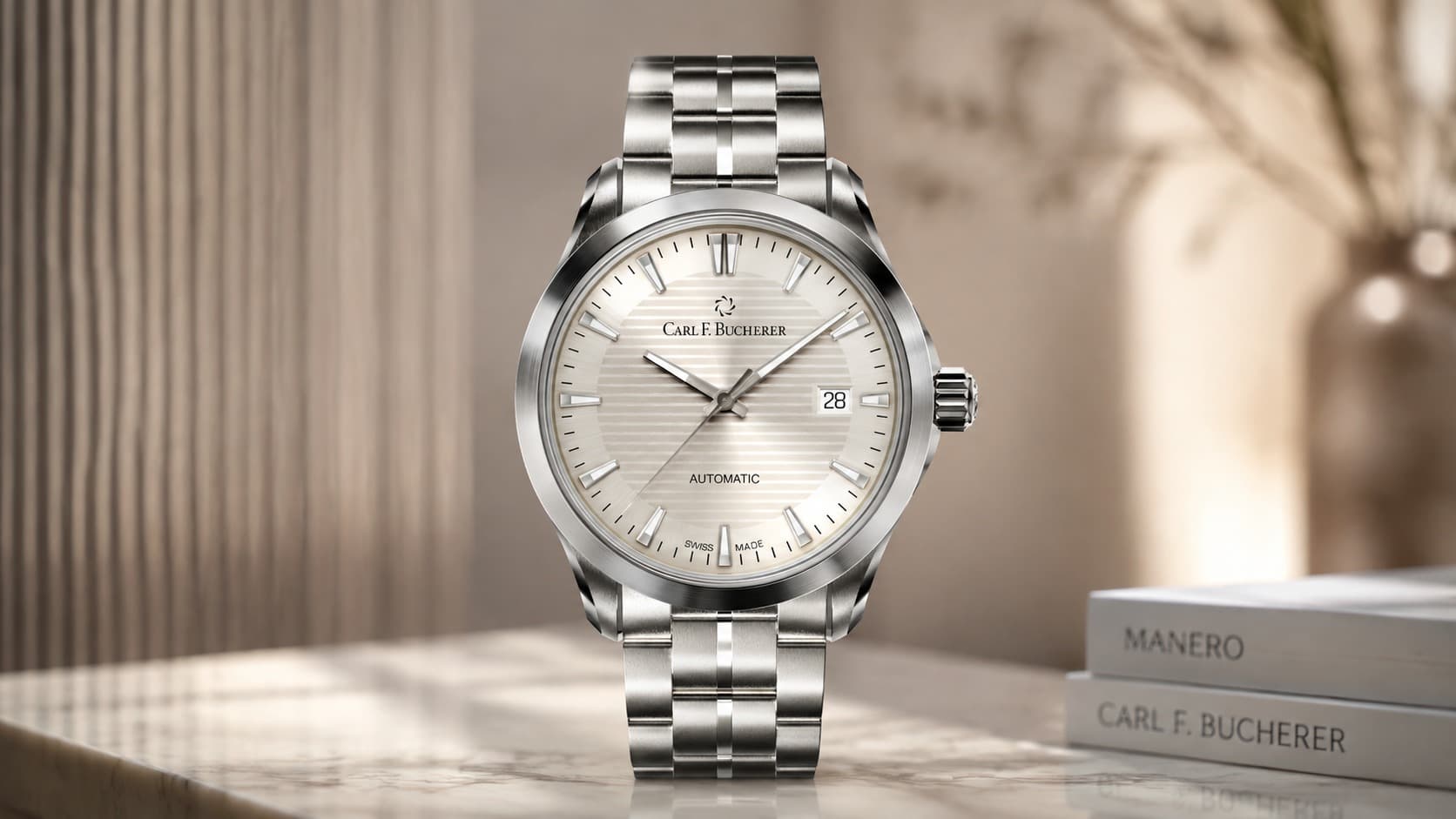
The Manero was Carl F. Bucherer’s core dress-watch line and the best place to see the peripheral rotor in action. The simplest three-hand version, the Manero Peripheral, has been part of the lineup since 2016 and runs on the COSC-certified calibre CFB A2050. Pricing for the steel model has generally sat around $9,300 as part of the brand’s permanent collection, with gold versions climbing well past $18,000.
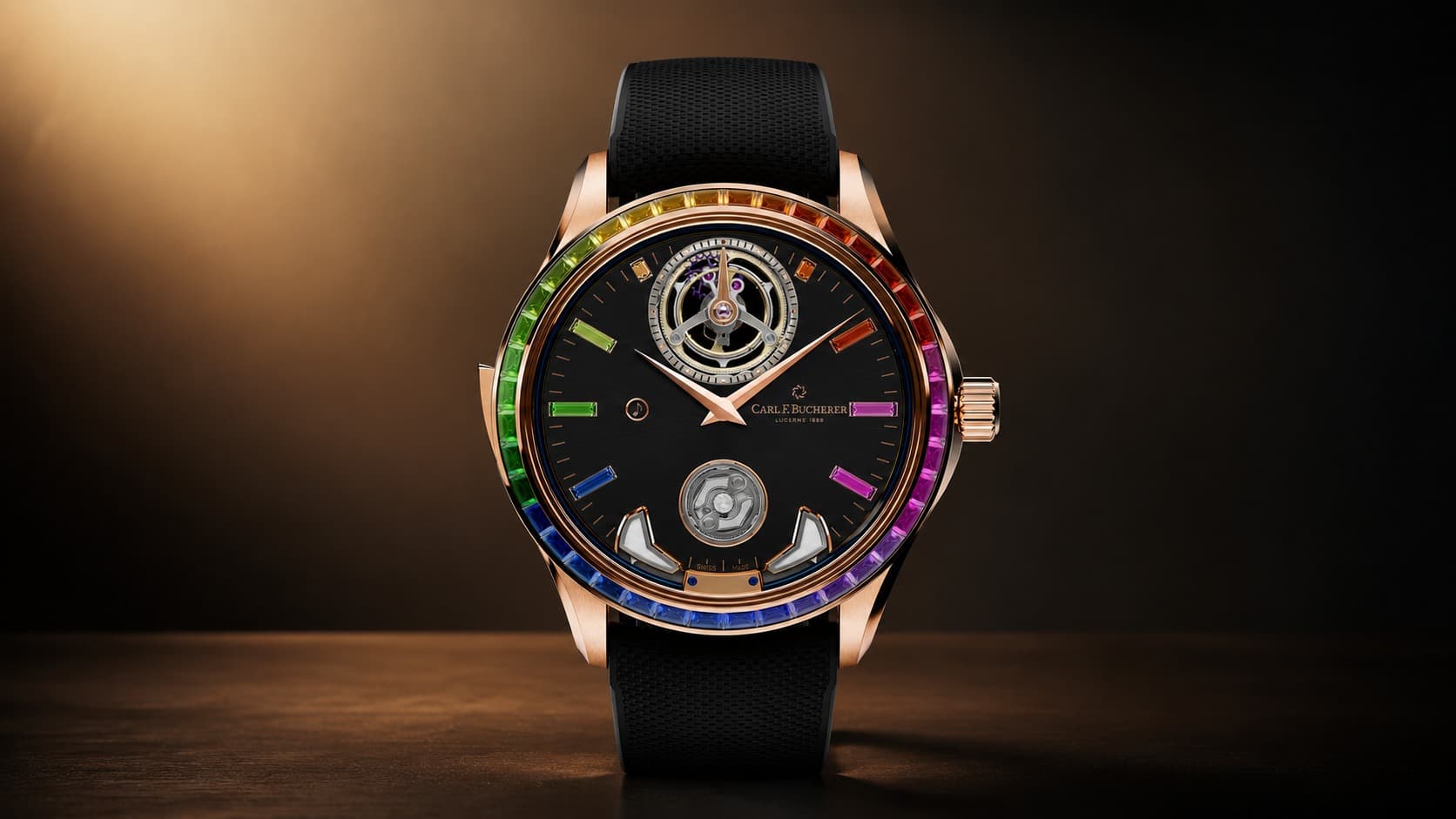
The wider Manero family also covered more specialized needs. Some versions added a power reserve indicator to show how much charge the watch had left, others were built as flyback chronographs for precise stopwatch timing, and the range topped out with one of the most ambitious watches the brand ever made: the Manero Tourbillon Double Peripheral, which combined the signature peripheral rotor with a peripherally mounted tourbillon. That flagship piece has been priced around $180,000.
Patravi: Carl F. Bucherer’s Travel Watches
The Patravi collection was Carl F. Bucherer’s tool-watch and travel-watch family, and its most famous piece, the Patravi TravelTec, was designed for people who actually cross time zones for a living. It runs on a specially developed chronometer-certified chronograph movement that can display three different time zones at once. A push-button on the side of the case advances or sets back one of the time-zone rings without disturbing the rest of the watch, a genuinely useful feature rather than a gimmick.
It also wears big. The TravelTec measures roughly 46.6mm across and about 15.5mm thick, with water resistance to 50 meters, so it’s built for the boardroom and the airport lounge rather than the pool. Steel versions have generally landed somewhere between $11,000 and $16,000 depending on the strap, dial finish, and whether the case has a black diamond-like-carbon coating.
For actual water sports, the Patravi name also covered a proper dive watch, the Patravi ScubaTec, launched in 2013. It’s built to a much tougher standard than the TravelTec, with water resistance rated to 200 meters in most versions and up to 500 meters in the toughest titanium editions, plus a helium relief valve that lets trapped gas escape safely after deep saturation dives. Carl F. Bucherer also used the ScubaTec to support ocean conservation, sponsoring the Manta Trust and engraving manta rays on some casebacks, and offered a smaller 36.5mm version built specifically for women. Between the TravelTec and the ScubaTec, the Patravi collection genuinely covered both ends of the travel-and-adventure spectrum rather than just looking the part.
Heritage: Carl F. Bucherer’s Vintage-Inspired Line
The Heritage collection leaned directly into the company’s 1888 founding date and its early chronograph designs. The standout piece is the Heritage BiCompax Annual, whose design is based on a specific vintage chronograph the brand introduced around 1956. The watch revives that shape in a modern case while adding an annual calendar, meaning the date mechanism only needs manual adjustment once a year instead of at the end of every short month, a genuinely clever engineering shortcut for anyone who wants a big, easy-to-read date display without resetting it every few weeks.
Many Heritage pieces were also released as limited editions tied to the brand’s history. One BiCompax Annual release, for example, came in two versions limited to just 888 pieces each, a direct nod to the company’s founding year of 1888. Pricing for Heritage models has generally sat between $6,800 and $15,000 depending on the metal and complication.
Adamavi: Carl F. Bucherer’s Affordable Line
Adamavi was Carl F. Bucherer’s simplest and most affordable collection, aimed at buyers who wanted the brand’s design language and Swiss manufacturing without the price tag of an in-house peripheral movement. Recent retail pricing for Adamavi models has generally sat around $3,200 to $3,350, making it the most accessible door into the brand for first-time buyers.
Carl F. Bucherer Collections Compared
| Collection | Best For | Typical Price Range (Steel) |
|---|---|---|
| Adamavi | First-time buyers, simple daily wear | ~$3,200–3,350 |
| Manero | Dress watches, showing off the peripheral rotor | $8,700–21,000+ |
| Heritage | Vintage-inspired design, annual calendars | $6,800–15,000 |
| Patravi | Travel, chronographs, sports watches | $8,700–20,000 |
Buying Carl F. Bucherer Watches Today
Since the brand is being wound down, buying a Carl F. Bucherer watch today means buying into a defined, finite history rather than an ongoing collection. That isn’t automatically a downside, but it shifts what matters most in the decision.
- Movement type matters most. Peripheral-rotor models, mostly found in the Manero line, are the brand’s real technical signature and the ones most likely to hold long-term collector interest.
- Sourcing gets harder over time. Authorized dealers and reputable retailers remain the safest route while boutiques are still open; afterward, trusted secondary-market platforms become the main option, and genuine parts and documentation only get scarcer with time.
- Servicing will change. With the brand shutting down, a local independent watchmaker familiar with in-house Swiss calibers is likely to become the long-term maintenance option rather than a brand boutique.
- Documentation carries extra weight. For a discontinued brand, a complete box-and-papers set matters even more for resale value and insurance purposes down the road.
- Price movement will likely be slow. Discontinued brands can take years to build serious collector demand, and Carl F. Bucherer never had the household-name recognition of a brand like Rolex, even at its peak.
Frequently Asked Questions
Is Carl F. Bucherer still in business?
No. Swiss business outlets reported in early 2025 that Rolex, which had owned the brand since 2023, was shutting Carl F. Bucherer down and closing its boutiques, bringing an end to 137 years of watchmaking under that name.
Who owned Carl F. Bucherer before Rolex bought it?
The Bucherer family owned the company for three generations, starting with founder Carl Friedrich Bucherer in 1888 and continuing through his descendants, including longtime chairman Jörg G. Bucherer, right up until the 2023 sale to Rolex.
What is a peripheral rotor, and why did Carl F. Bucherer use it?
A peripheral rotor is a self-winding weight that spins around the outer edge of a watch movement instead of sitting on top of it in the center. Carl F. Bucherer pioneered this for mass production so owners could see nearly the entire movement through the caseback without a rotor blocking the view.
Are Carl F. Bucherer watches a good investment now that the brand is closing?
It’s genuinely hard to say for certain. Discontinued brands with real in-house engineering, like this one, sometimes gain collector interest over time, but that outcome isn’t guaranteed, and Carl F. Bucherer never had strong name recognition outside watch-enthusiast circles. The design and the mechanics inside a given piece are a better reason to buy one than any expectation of a financial return.
What was Carl F. Bucherer’s most technically impressive watch?
The Manero Tourbillon Double Peripheral is generally considered the brand’s engineering flagship, combining a peripheral rotor with a peripherally mounted tourbillon, a pairing almost no other watchmaker has attempted.
Conclusion
Carl F. Bucherer’s story ends up being about a small, family-run Swiss watchmaker that solved a genuinely difficult engineering problem years before its bigger rivals, then got folded into the world’s most famous watch company and switched off anyway. The peripheral-rotor movements, especially in the Manero line, are the clearest evidence of what the brand actually contributed to watchmaking, while the Heritage and Patravi lines show how it balanced that innovation with more familiar, wearable designs. For anyone considering one of these watches now, the movement and the paperwork matter far more than resale hype, because the real value here was always in the mechanics, not the name on the dial.