The word “chronometer” shows up constantly in watch listings, often without much explanation of what it actually means or whether it’s just marketing language. COSC certification is one of the most respected accuracy stamps in the entire watch world, and it’s the reason certain Swiss watches can legally use the word “chronometer” on their dial at all. Understanding what this label really tests for, and what it doesn’t, separates the fancy word from what a buyer is actually paying for.
What Is a COSC Certified Watch?
COSC certification is an official Swiss test that proves a watch movement keeps time within a very tight, government-recognized accuracy range. The name stands for Contrôle Officiel Suisse des Chronomètres, which translates to the Official Swiss Chronometer Testing Institute, the body responsible for certifying the precision and accuracy of high-precision wristwatches made in Switzerland.
COSC has been testing individual timepieces with strict care to certify their precision since 1973. It isn’t run by a single watch brand. Instead, it was established by a nonprofit group representing five Swiss watchmaking regions: Bern, Geneva, Neuchâtel, Solothurn, and Vaud. That independence is the whole point. A brand can’t just print “chronometer” on a dial because it sounds impressive. In Switzerland, the word is legally protected, and only movements that pass COSC’s testing (or an equivalent recognized standard) are allowed to wear it.
The idea of a “chronometer” is actually much older than COSC itself. Sailors needed extremely accurate timekeepers centuries ago to figure out their exact location at sea, since even a few seconds of drift could throw off a longitude calculation by miles. COSC picked up that same obsession with precision and turned it into a modern, standardized test that any Swiss brand can submit a movement to. Today the organization runs three laboratories, in Biel/Bienne, Saint-Imier, and Le Locle, staffed by dozens of technicians who inspect more than two million movements and watches every year.
How Does a Watch Get COSC Certified?
A watch movement earns COSC certification by running for 15 days straight while machines track how many seconds it gains or loses every single day. The movement is tested in five different positions and at three different temperatures, roughly 8, 23, and 38 degrees Celsius, to mimic the different ways a watch actually sits on a wrist and moves through daily life.
COSC almost always tests the bare movement rather than the finished watch, a detail that surprises many first-time buyers. That means the case, crystal, strap, and dial aren’t part of the exam. The effects of the case, dial, hands, and any magnetic shielding are left out of the test entirely. Two independent atomic clocks act as the reference point, so there’s no room for a brand to fudge the numbers.
Each day of testing produces a rate reading, and with five positions tested daily over the accuracy portion of testing, that adds up to around 50 separate readings per movement. Every one of those numbers has to land inside the accepted range for the movement to pass.
A COSC certificate doesn’t just check if a watch is accurate once. It checks whether it stays accurate no matter which way it’s tilted or how hot or cold the room gets.
What Accuracy Does a COSC Movement Need?
A COSC-certified mechanical movement must average between -4 and +6 seconds of drift per day, and that’s just one of seven separate checks a movement has to pass. COSC doesn’t round numbers up or down in anyone’s favor either. If a movement misses even one of the seven limits, no matter how close, it’s rejected, and the brand has to send it back for re-regulation before trying again.
That -4/+6 range might sound generous compared to a smartphone, which never loses a second, but for a purely mechanical device powered by a coiled spring and a tiny oscillating wheel, it’s remarkably tight. For comparison, an everyday mechanical watch that hasn’t been chronometer-tested often drifts by something closer to -20 to +40 seconds a day. COSC narrows that window down to a fraction of the size, and all seven criteria have to be met at the same time, not just the headline number:
| Criterion | What It Measures | Limit (seconds/day) |
|---|---|---|
| Average daily rate | Overall speed of the watch across the whole test | -4 to +6 |
| Mean variation in rates | How much the daily rate wobbles day to day | 2 max |
| Greatest variation in rates | Biggest swing between any two testing days | 5 max |
| Difference in horizontal vs. vertical rates | Consistency between lying flat and standing up | -6 to +8 |
| Largest variation in rates | Biggest single gap from the average daily rate | 10 max |
| Thermal variation | Rate change per degree of temperature swing | ±0.6 |
| Rate resumption | How closely the watch returns to its starting rate afterward | ±5 |
A movement that averages perfect timekeeping but swings wildly from one position to another can still fail, because consistency matters just as much as raw accuracy here. This is also why COSC testing takes a full two weeks rather than a single afternoon on a timing machine: it’s built to catch a watch that only behaves well under ideal, still conditions and falls apart everywhere else.
Which Brands Use COSC Certification?
Brands including Rolex, Breitling, Tudor, Omega, Tissot, and Mido regularly send movements through COSC testing. These brands frequently rely on COSC testing to confirm their watches meet high accuracy standards before they leave the factory.
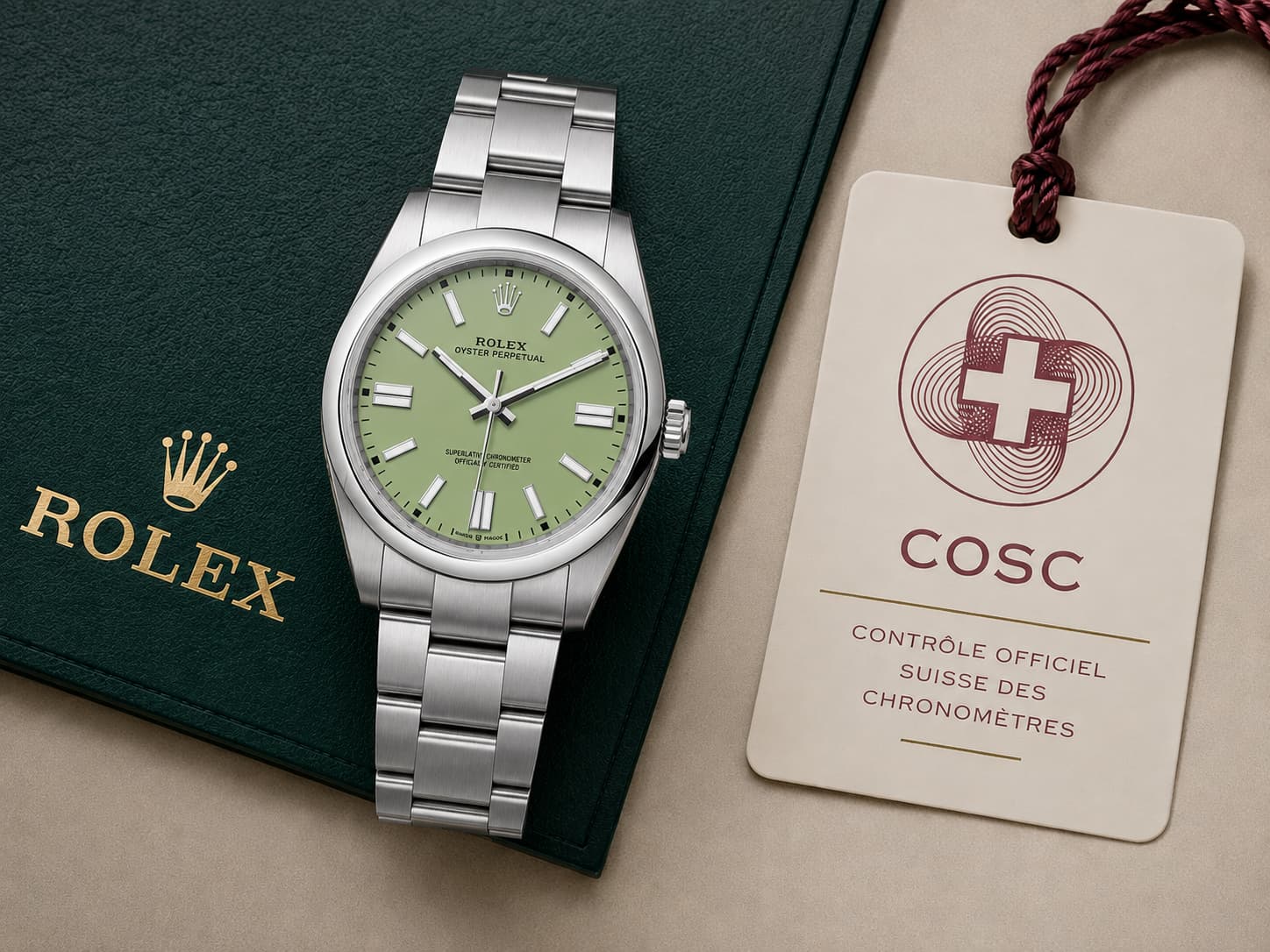
Rolex and Breitling take it further than most; both certify essentially every mechanical watch they sell as a chronometer, making the label a core part of how they market themselves. Rolex even built its own extra layer on top: after a movement earns its COSC certificate, Rolex tests the fully cased watch again under its “Superlative Chronometer” standard, which demands an even tighter window of a maximum daily deviation of -2 to +2 seconds.
Not every brand needs COSC to prove its watches are accurate, though. High-end Japanese brands such as Seiko and Citizen typically skip COSC altogether, even though some of their premium movements perform just as well or better than the COSC standard requires. Because COSC is a Swiss institution testing Swiss-made movements, it was never really built to certify watches from outside that industry, so this isn’t a knock against those brands. It’s simply a different system.
Several brands have also built their own, even stricter certification on top of a COSC pass, using it as a foundation rather than a finish line. The best-known of these in-house standards compare as follows:
| Certification | Who Uses It | Tested Against | Accuracy Window |
|---|---|---|---|
| COSC (base standard) | Rolex, Breitling, Tudor, Omega, Tissot, Mido | Bare movement only | -4 to +6 sec/day |
| Rolex Superlative Chronometer | Rolex | Fully cased, finished watch | -2 to +2 sec/day |
| Tudor MT5612 Chronometer | Tudor | Fully cased, finished watch | -2 to +4 sec/day |
| METAS Master Chronometer | Omega, some Tudor models | Fully cased watch, plus magnetism up to 15,000 gauss | 0 to +5 sec/day |
This comparison is why COSC is often described as the entry point rather than the finish line. Passing COSC is the prerequisite that unlocks these in-house programs, but brands like Rolex and Omega then run the finished, cased watch through an entirely separate round of testing before it ever reaches a store.
Is a Chronometer the Same as COSC Certified?
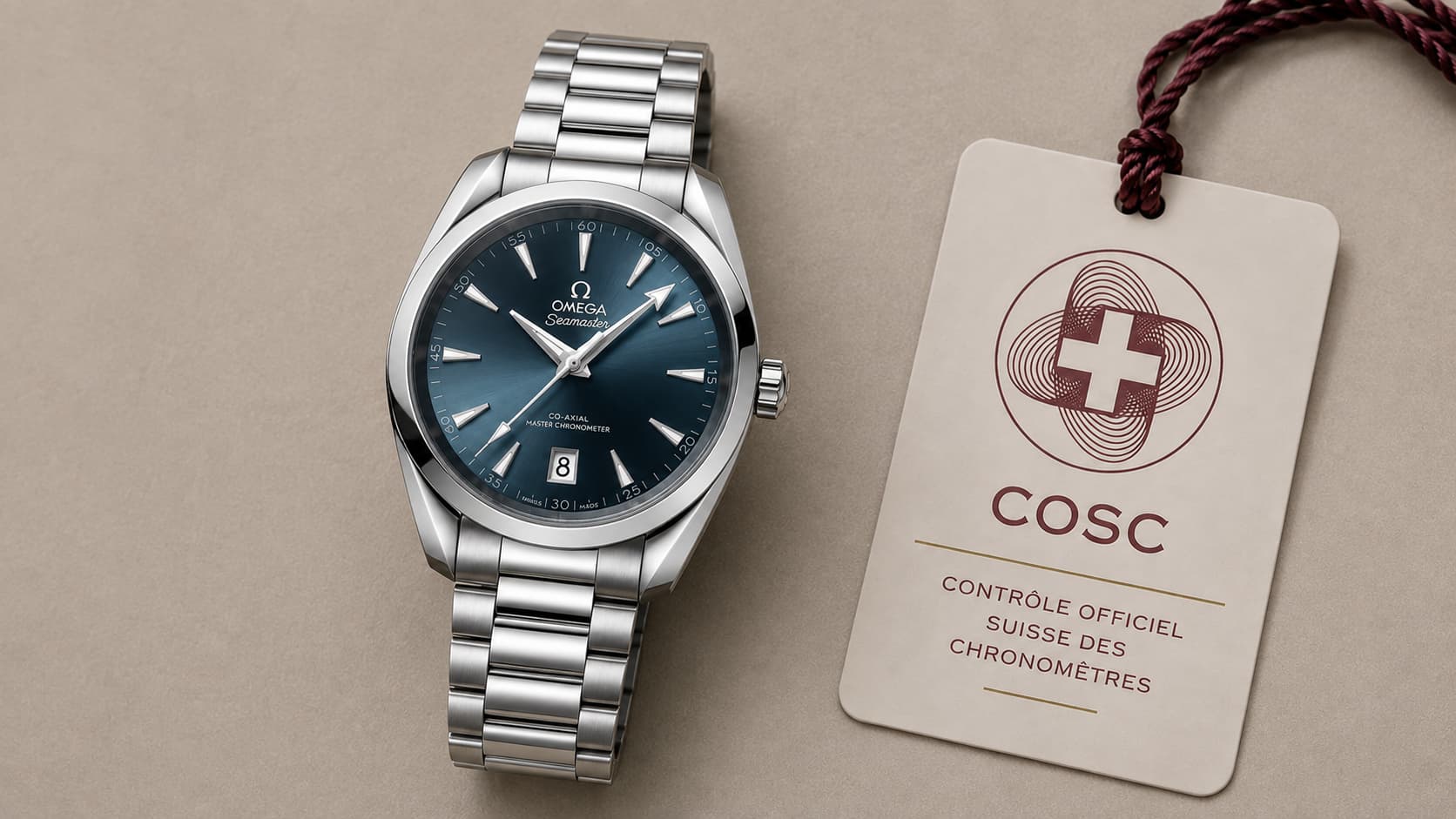
Not exactly, though the two terms get used interchangeably. A chronometer is any watch that has been officially tested and proven to meet a recognized accuracy standard, and COSC is the specific body responsible for granting that title to watches made in Switzerland. Outside of Switzerland, other organizations have historically certified watches to similar standards, though those labels haven’t always been policed as strictly.
So every COSC-certified watch is a chronometer, but the reverse isn’t automatically true everywhere in the world, since a handful of other testing bodies use their own criteria. Within Switzerland, though, COSC is effectively the gatekeeper. If a Swiss-made watch says “chronometer” on the dial, it earned that word through COSC or a stricter successor standard.
It’s also worth separating “chronometer” from “chronograph,” since the two words look almost identical but mean completely different things. A chronograph is simply a stopwatch function built into a watch, using extra pushers and sub-dials to time an event. A chronometer has nothing to do with stopwatch functions at all; it’s purely a statement about how accurately the watch keeps ordinary time. A watch can be a chronograph, a chronometer, both, or neither.
Is COSC Certification Worth It?
COSC certification is worth paying attention to for anyone who genuinely cares about daily accuracy, but it isn’t the only sign of a well-made watch. A COSC-certified movement carries a documented guarantee that the watch was, at the moment of testing, keeping remarkably tight time across a range of real-world conditions. That’s a meaningful promise, not just a sticker.
That said, it comes with a few honest caveats worth knowing before placing too much weight on the label:
- It tests a snapshot, not a lifetime. A freshly regulated movement performs beautifully on day one. Years of wear, dust, and lack of servicing can push any watch outside its original tolerances, chronometer or not.
- It only costs the brand money, not the customer directly, but that cost gets baked into pricing. COSC testing costs a meaningful amount of money, which is part of why larger brands with bigger budgets, like Rolex, Tudor, and Omega, are among its biggest clients.
- It’s not the ceiling of what’s possible. Standards like METAS (used by Omega and some Tudor models) test the fully assembled watch and add checks for magnetism resistance and power reserve, going a step beyond what COSC alone measures.
- Plenty of accurate watches skip it entirely. A watch without a chronometer certificate isn’t automatically less precise. It just means nobody paid to have that precision independently documented.
Roughly 15 percent of all watches produced in Switzerland, including quartz models, carry chronometer certification, while that figure climbs to nearly 40 percent among mechanical wristwatches specifically. Either way, COSC-certified pieces remain a genuine minority, though not quite as rare as some marketing might suggest.
What Is the New COSC Excellence Chronometer?
COSC Excellence Chronometer is a stricter, optional second tier of certification that COSC announced in February 2026, sitting on top of the standard chronometer test rather than replacing it. The announcement landed on the 50th anniversary of the ISO 3159 standard, and it directly answers the biggest criticism of ordinary COSC certification: that it only ever tests the bare movement, never the finished watch a customer actually wears.
To earn the Excellence label, a watch first has to pass the regular 15-day COSC test just like any other chronometer. Once it’s cased up by the manufacturer, the complete, finished watch goes back to COSC for a second round of testing that simulates real wrist wear using robotic winding systems. That second phase demands a tighter average daily rate of -2 to +4 seconds, and it adds checks for magnetic resistance and verifies that the watch actually delivers the power reserve the brand advertises. Full rollout begins in October 2026, so the first Excellence-certified watches should start reaching stores shortly after that. It won’t replace the standard -4/+6 chronometer certificate, but it gives COSC its own answer to in-house programs like Rolex’s Superlative Chronometer and Omega’s METAS Master Chronometer.
Frequently Asked Questions
How long does COSC testing take?
COSC testing typically runs for 15 consecutive days, though depending on the type of movement being tested, the full process can take anywhere from 12 to 20 days. During that window, the movement is checked daily in different positions and temperatures.
Can a quartz watch be COSC certified?
Yes. COSC primarily certifies mechanical wristwatches, but it also certifies pocket watches, fixed-time devices, and quartz wristwatches. Quartz movements are held to different in-house criteria than mechanical ones since they work on entirely different technology.
Does COSC certification cover the whole watch or just the movement?
In most cases, COSC certifies the bare movement before it’s cased. The case, crystal, strap, and any magnetic shielding aren’t part of the standard test, which is why some brands add their own additional testing on the fully assembled watch afterward.
How Can Someone Tell if a Watch Is COSC Certified?
The word “chronometer” printed on the dial is the first sign, along with a unique certification number engraved on the movement itself. Many brands also provide a certificate, though whether that paperwork gets handed to the customer varies by brand. When a certificate exists, it’s worth checking that the number printed on it matches the number engraved on the movement, since a mismatch usually means the paperwork and the watch got separated somewhere along the way, not necessarily that either one is fake.
Is COSC certification the highest watch accuracy standard available?
No. Standards like METAS Master Chronometer and various in-house programs from brands like Rolex and Tudor build on top of COSC’s baseline with tighter tolerances and extra tests, such as resistance to magnetism. COSC is best understood as the recognized entry point into chronometer-grade accuracy rather than the absolute peak of it.
Conclusion
COSC certification ultimately confirms one specific, verifiable thing: a movement was independently tested across a range of positions and temperatures and proved it could keep time within roughly -4 to +6 seconds a day. That’s a genuinely impressive feat for a mechanical device with no battery, and it’s why brands like Rolex, Breitling, and Tudor treat the label as central to their identity. It isn’t a guarantee of lifetime perfection, and it isn’t the only path to an accurate watch, but a “chronometer” marking on a Swiss dial represents a watch that earned the word through 15 days of genuinely rigorous testing, not just a name someone picked because it sounded nice. And with Excellence Chronometer certification rolling out later in 2026, that baseline is about to get an even more demanding sibling for anyone chasing the tightest possible accuracy on a finished, cased watch.