Jaquet Droz is one of the strangest and most wonderful names in Swiss watchmaking, because it does not just tell time. It builds tiny mechanical birds that sing, dials shaped like figure eights, and watches that feel closer to museum pieces than everyday accessories. The brand traces its roots back to 1738, long before most modern watch companies existed, and it has spent the centuries since perfecting a very specific kind of magic: turning small metal parts into something that looks and feels alive. Anyone curious about where watchmaking meets art will find Jaquet Droz one of the best places to look.
The One Thing That Makes Jaquet Droz Different
Jaquet Droz stands out because it builds automatons, tiny mechanical figures that move and make sounds, directly into wristwatches. Most watch brands focus purely on keeping accurate time. Jaquet Droz does that too, but it also builds little mechanical performances into the watch itself, like a bird that flaps its wings and whistles a real tune.
This tradition did not start with wristwatches at all. Records place the founding in 1738, when a young Pierre Jaquet-Droz set up his own workshop in La Chaux-de-Fonds. He had trained in physics and mathematics first, and only later turned that background toward the craft of horology. By the mid-1700s, he was not just building clocks anymore. He was also building animated dolls and mechanical birds driven by clockwork, and these creations went on to amaze royal courts stretching from Europe all the way to China, India, and Japan. That reputation for mechanical theater never left the brand, and it still shapes almost every decision Jaquet Droz makes today, from dial design down to how a movement is finished.
The History of Jaquet Droz
Jaquet Droz was founded by a real person, and his life story is almost as dramatic as his inventions. Pierre Jaquet-Droz was born in 1721 on a small farm near La Chaux-de-Fonds, and he picked up the fundamentals of precision mechanics from older relatives while still young. He fell in love with the craft early and never let it go.
His breakthrough came on a gamble that paid off spectacularly. In 1758 he traveled to Spain carrying a small selection of his finest clocks, and the trip earned him more than admiration: King Ferdinand VI liked the pieces enough to purchase every single one for the royal residences of Madrid and Villaviciosa. That windfall gave Pierre both the money and the reputation to chase his real passion project, building automata.
That project reached its peak with three astonishing figures that are still famous today. It took Pierre, his son Henri-Louis, and a business partner named Jean-Frédéric Leschot roughly six years, from 1768 to 1774, to complete three humanoid automata known as The Writer, The Musician, and The Draughtsman. Each figure ran on its own dedicated internal mechanism, and The Writer alone needed close to 6,000 individual metal parts, while the Musician and Draughtsman used around 2,500 and 2,000 respectively. The Writer’s real trick was that it could genuinely compose short phrases up to 40 characters long, dipping an actual quill into actual ink, with a small built-in wrist motion added purely so the ink would not drip mid-sentence. Some historians consider these figures early ancestors of the modern computer, since the programmable memory system behind The Writer relied on principles that would later influence real computing machines. All three automata still perform for the public today and can be seen in person at the Museum of Art and History in Neuchâtel, Switzerland.
Word of these creations spread far beyond Europe, and the family business grew into a genuine international trading operation. Over roughly a decade, the workshop shipped upward of 600 pieces into China, where the Qianlong Emperor and members of his Imperial Court developed a strong appetite for them, making Jaquet-Droz the first clockmaking house to ever get its products into the country. That success did not last forever, though. The Napoleonic Wars drained the wealthy clientele the business depended on, and once Napoleon’s 1806 blockade choked off trade with England, there was no market left to sustain the original company. The name sat quiet for nearly two centuries after that.
The brand did not simply fade away. It went dormant, like a seed waiting for the right season to grow again.
That season arrived at the turn of the millennium, when the Swatch Group purchased the rights to the name in 2000 and rebuilt it as a maker of artistic, fine watches once again. Since then, Jaquet Droz has operated almost like an independent watchmaker inside a much larger company, quietly building some of the most technically ambitious watches in the world.
Jaquet Droz Collections Compared
Jaquet Droz organizes most of its output into five clear collections, and each one carries its own personality, defining feature, and price point. The figures below reflect current retail listings and secondary market prices, which vary depending on materials, complications, and how limited a piece is.
| Collection | Signature Feature | Typical Price Range (USD) |
|---|---|---|
| Grande Seconde | Off-center figure-eight dial layout | $6,600 to $48,000+ |
| Petite Heure Minute | Off-center dial with room for hand-painted or engraved scenes | $8,000 to $70,000+ |
| Astrale | Complications like chronographs, perpetual calendars, and second time zones | $5,000 to $15,000+ |
| Lady 8 | Figure-eight case shape, often set with a pearl or gemstone; women’s collection | Varies by materials and gem setting |
| Charming Bird / Bird Repeater | Singing mechanical bird automaton, sometimes paired with a minute repeater | Six figures, into the hundreds of thousands |
Grande Seconde: Jaquet Droz’s Most Famous Watch
The Grande Seconde is the watch most people picture when they think of Jaquet Droz. It features two circles on the dial, one for the hours and minutes near the top and one much larger for the seconds near the bottom, which together form a shape that looks like the number eight.
That layout is not a modern design trick. It traces directly back to Pierre Jaquet-Droz’s own 18th-century pocket watches, where a compact hours-and-minutes display sat near the top while an oversized seconds dial dominated the lower half. Modern versions keep that classic look but add contemporary touches. Case sizes generally measure 41 to 44mm across today, and the lineup has expanded to include more advanced versions with monopusher chronographs, a GMT function for tracking a second time zone, and moon phase displays.
One clever example is a chronograph model that had to solve a real design puzzle. Adding a standard chronograph normally means squeezing two or three extra sub-dials onto the face, which would have crowded out the figure-eight shape the Grande Seconde is known for. Jaquet Droz worked around this by engineering an entirely new chronograph layout built specifically to protect that signature look. It is a good example of how the brand treats its heritage design as something worth protecting, not something to compromise for the sake of adding features.
How Much Does a Grande Seconde Cost
A basic stainless steel Grande Seconde typically starts around $6,000 to $6,600, while gold and complicated versions can climb well past $20,000. Models with a second time zone, moon phase display, or an oversized date generally start closer to $12,000. Limited editions in precious metals climb higher still, with pieces like the deadbeat seconds and power reserve limited editions retailing in the $25,000 to $30,000 range, and the rarest 39mm Circled limited editions reaching close to $48,000. Enamel dials and other rare decorative techniques push individual pieces even further past those numbers.
Petite Heure Minute: Jaquet Droz’s Understated Collection
The Petite Heure Minute is Jaquet Droz’s more understated line, and it works well for anyone who wants the brand’s craftsmanship without the boldest visual statement. Instead of the dramatic figure-eight layout, it uses a smaller off-centered dial for hours and minutes, leaving more open space on the watch face for decoration.
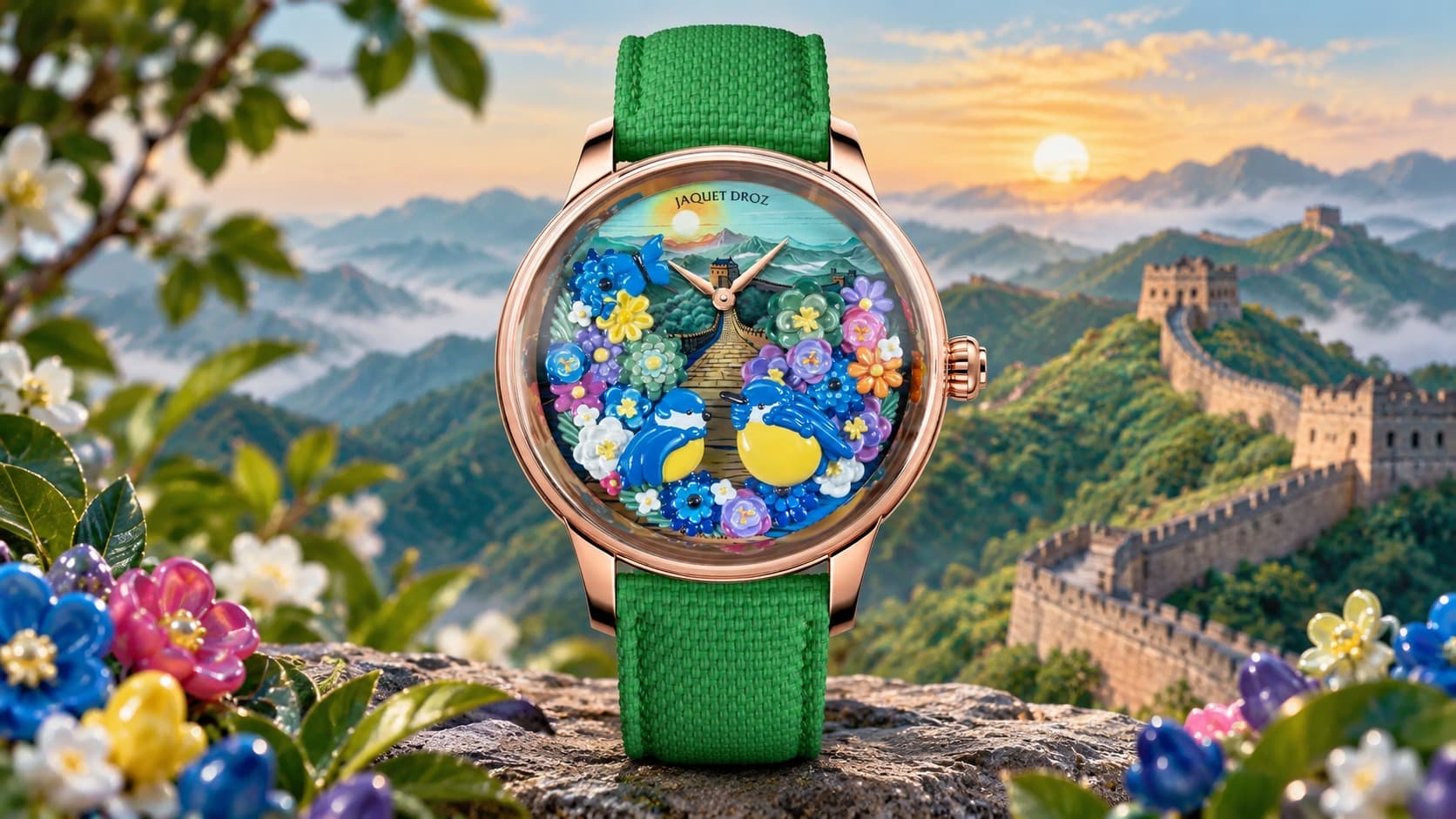
That open space becomes a canvas, and the brand uses it in genuinely striking ways. Many models pair a self-winding movement, often the in-house JD2653 caliber with a silicon balance spring and roughly 68 hours of power reserve, with dials built around mother-of-pearl, hand engraving, or three-dimensional relief work. The Relief Seasons series shows just how far this can go: craftsmen engrave and hand-paint a mother-of-pearl base first, then add a pair of gold birds that are individually carved, engraved, and painted with enough precision to look almost alive. Pieces like this are produced in very small numbers, sometimes as few as 88 examples per version, and their prices reflect that level of handwork, often landing anywhere from roughly $60,000 to $70,000 or more depending on the metal and dial theme.
Simpler versions of the Petite Heure Minute stay far more accessible. Steel or gold models without the elaborate relief dials typically start in the $8,000 to $25,000 range, which still buys a genuinely artisanal watch with a hand-finished movement, just without the museum-piece level dial work of the Relief series. This makes the collection one of the more flexible entry points into the brand, since a buyer can choose exactly how much decorative ambition they want to pay for.
Other Jaquet Droz Collections Worth Knowing
Beyond the two collections most people know, Jaquet Droz also runs a line built around complications and astronomy called Astrale. It was built as a nod to Pierre Jaquet-Droz’s own reputation for pairing refined looks with genuinely difficult mechanics. Case sizes span roughly 39 to 45mm, and the lineup covers heavier complications too, including chronographs, perpetual calendars, and models built to track a second time zone. Several pieces lean into a stargazing look, with moons, stars, and dials angled to echo astrological charts, and resale values for Astrale pieces generally fall somewhere between $5,000 and $15,000 depending on the complication and metal.
Lady 8 is the brand’s collection built specifically with women in mind, and it plays with the figure-eight shape in a different way than the Grande Seconde does. Here, the case itself forms the number eight: the larger bottom loop houses the time display, while the smaller loop up top usually frames a pearl or a cut gemstone. One version, the Lady 8 Flower, swaps that gemstone for a tiny mechanical flower sealed under a sapphire dome, with petals that genuinely open and close when triggered. It is a smaller, quieter cousin of the Charming Bird’s mechanical showmanship, built into a case designed to be worn every day.
Charming Bird and Bird Repeater: Watches That Sing
This is where Jaquet Droz becomes genuinely unlike anything else in watchmaking. The Charming Bird is a wristwatch with a real, tiny mechanical bird built into the dial that moves and whistles an actual melody on command.
In practice, the bird runs on its own hand-wound mechanism with a push-button trigger and a built-in sapphire whistle system, entirely separate from the self-winding movement that handles timekeeping and carries a 38-hour power reserve. Once triggered, the little figure turns, flaps its wings, and opens its beak in sync with a chirp that sounds far too realistic for something built from gears and springs, and none of it borrows power from the timekeeping side of the watch.
The technology behind the birdsong itself is genuinely clever. Rather than relying on the vibrating parts older singing-bird mechanisms used, this version pushes air through a set of miniature sapphire tubes to produce the sound, drawing air in through one tube before the melody begins. It sounds like something from a fantasy novel, but it is real, working mechanical engineering shrunk down to fit inside a wristwatch case.
The achievement did not go unnoticed by the watch industry either. The Charming Bird picked up the Mechanical Exception award at the Grand Prix d’Horlogerie de Genève in 2015, one of the most respected honors in fine watchmaking. Even the production numbers are part of the story, with only 8 pieces made in white gold and 28 in red gold. A decade after that award, in 2025, Jaquet Droz rebuilt the Charming Bird in Grade 5 titanium, a first for any wristwatch carrying a musical automaton.
The Bird Repeater takes things a step further by combining the singing bird with a minute repeater, a complication that chimes out the time in sound. It fuses the singing-bird mechanism with a minute repeater, regarded as one of the hardest complications to build in all of watchmaking, striking two hammers against two gongs to sound out hours, quarters, and minutes on demand. Special editions like the 300th anniversary Bird Repeater were made in extremely small numbers, with that particular release capped at just eight examples to mark the milestone.
These watches are less about checking the time and more about owning a small piece of moving art that happens to sit on the wrist.
Why Are Automaton Watches So Expensive
Automaton watches like the Charming Bird and Bird Repeater cost far more than standard watches because they pack two entirely separate mechanisms into one small case. One mechanism tells the time, while a completely different one powers the moving bird, its wing flaps, its sound, and the trigger mechanism that starts the whole sequence. Building two independent, miniaturized mechanical systems that fit together without interfering with each other takes an enormous amount of engineering time, and that complexity is reflected directly in the price, which typically starts in six figures and can run into the hundreds of thousands of dollars for the rarest pieces.
Jaquet Droz Materials and Craftsmanship
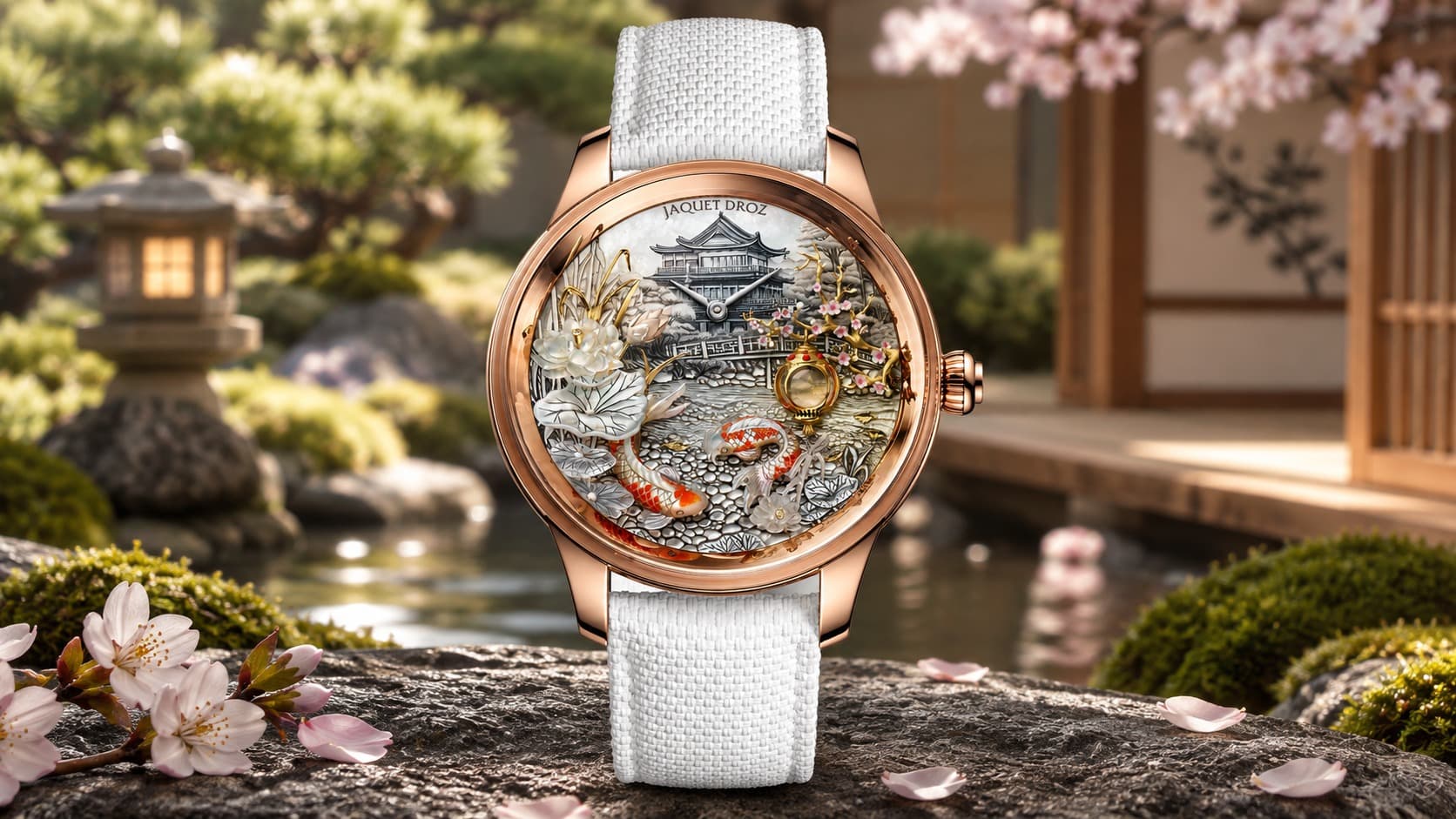
Jaquet Droz blends traditional and modern materials depending on the collection and the effect it wants to create. Traditional choices like stainless steel and gold sit alongside newer options including titanium, sapphire crystal, and ceramic, depending on the piece. Most calibers are developed in-house, though for certain models the brand turns to movements built to its specifications by other Swatch Group companies, including Blancpain and the movement specialist Frédérique Piguet.
The dials themselves often showcase traditional decorative arts that most modern brands have largely abandoned. Techniques like hand engraving, miniature painting, and enamel work appear across the collections, especially on Petite Heure Minute and limited-edition Grande Seconde models. That tradition is not new. Pierre Jaquet-Droz’s original workshop already relied on a mix of specialists, including chasers, jewelers, enamellers, and painters, working alongside the clockmakers themselves, and a similar division of skilled trades still exists inside the modern workshop today.
Who Should Buy a Jaquet Droz Watch
Jaquet Droz fits a very specific kind of collector, one who values storytelling and mechanical creativity as much as accurate timekeeping. Someone shopping purely for a reliable, everyday watch with minimal fuss will likely find better value elsewhere. Someone who wants a piece with genuine historical roots, unusual mechanical features, and a design language unlike anything else on the market tends to be drawn to a few things in particular:
- An appreciation for watches as functional art rather than purely functional tools.
- A pull toward the Grande Seconde’s distinctive figure-eight dial layout.
- An interest in genuinely unusual mechanics, such as a singing bird automaton.
- A fondness for brand history and a direct link to 18th-century watchmaking traditions.
- A willingness to pay a premium for hand-finishing, in-house complications, and small production numbers.
Frequently Asked Questions
Is Jaquet Droz considered a luxury watch brand?
Yes. Jaquet Droz sits firmly in the luxury and fine watchmaking category, with entry prices starting around $6,000 and rising into six figures for rare automaton pieces. It is owned by the Swatch Group but operates with the independence and craftsmanship level typically associated with much smaller, independent watchmakers.
Who owns Jaquet Droz today?
What is the difference between the Grande Seconde and the Petite Heure Minute?
The main difference is the dial layout and what it is used for. The Grande Seconde is built around a large, dominant seconds sub-dial that creates the brand’s signature figure-eight look, while the Petite Heure Minute uses a smaller time display that leaves more open space on the dial for decorative work like engraving, painting, or relief sculpture.
What is the most famous Jaquet Droz watch?
The Grande Seconde is the brand’s best-known and most widely produced watch, recognized for its figure-eight dial layout inspired by Pierre Jaquet-Droz’s original 18th-century pocket watch designs. For sheer novelty, the Charming Bird automaton watch is often the piece people remember most, thanks to its genuinely singing mechanical bird.
Are Jaquet Droz watches a good investment?
Jaquet Droz watches are best purchased for their craftsmanship and artistic value rather than as a financial investment. Limited-edition automaton pieces, especially those made in very small numbers like eight or twenty-eight units, can hold or grow in value among serious collectors, but standard production models are best bought for the enjoyment of wearing them, not for resale potential.
How does the singing bird mechanism actually work?
The bird’s song is created using compressed air pushed through tiny sapphire crystal tubes rather than a traditional speaker or bell. A separate hand-wound mechanism powers the bird’s movements and sound entirely independently from the mechanism that keeps time, and a push-button trigger starts the roughly thirty-second performance on demand.
The Bottom Line
Jaquet Droz proves that a watch can be far more than a timekeeping tool strapped to a wrist. From the elegant simplicity of the Grande Seconde’s figure-eight dial, to the hand-painted storytelling of the Petite Heure Minute, to the almost theatrical spectacle of a mechanical bird singing on command, this brand has spent nearly three centuries treating watchmaking as a form of storytelling. Anyone drawn to horology as an art form, rather than just a function, will find few brands that commit to that idea as fully as Jaquet Droz does.