Laco is one of the last watch brands still making the exact style of pilot watch that German aviators wore during World War II. Most “aviator” watches today just borrow the look. Laco actually built the originals, and the company never stopped. That makes it a rare case in the watch world: a brand whose history isn’t a marketing story, but a documented fact tracing back nearly a century. For anyone curious about pilot watches, German manufacturing, or where that oversized dial and giant crown style came from, Laco is the name that defines the category.
The Story of Laco, Germany’s Pilot Watch Maker
Laco started in 1925 as a small company called Lacher & Co. Two people founded it: Frieda Lacher and Ludwig Hummel. They set up shop in Pforzheim, a city in southwestern Germany, and the brand name “Laco” is simply a shortened version of “Lacher & Co.”
Pforzheim wasn’t a random choice. The city had been known for jewelry making since the 1700s, and by the early 1900s it had grown into a hub for watchmaking too. People even nicknamed it the “Golden City.” Laco is still headquartered there today, in the same region where German watchmaking built its name over a hundred years ago.
A few years after founding the company, Lacher and Hummel went separate ways. Hummel stayed on the watch production side and kept building the business. That decision mattered a lot for what came next, because Hummel didn’t want Laco to depend on outside suppliers forever.
How Laco Started Making Pilot Watches
In 1933, Hummel started a second company called Durowe, short for Deutsche Uhren-Rohwerke. Durowe made watch movements, the mechanical parts that make a watch actually run. This mattered a lot, because most German brands at the time bought their movements from Switzerland. Laco, through Durowe, could build its own instead.
That independence paid off. Production scaled fast enough that Durowe was turning out roughly 30,000 movements a month by the time the war broke out, supplying other German brands alongside Laco itself. This gave Laco something few competitors had: full control over its own supply chain at a moment when demand for reliable timekeeping was about to explode.
In the late 1930s, the German aviation ministry needed pilot watches for its air force. It picked only five companies to make them: Laco, A. Lange & Söhne, Stowa, Wempe, and IWC. These watches were called Beobachtungsuhren, or B-Uhr for short, which means “observation watch” in German. The person strapping one on wasn’t actually the pilot at the controls, but the navigator, responsible for calculating position and timing mid-flight.
The B-Uhr watches had a case that measured 55mm across. That’s huge by today’s standards, but the size existed for a real reason: navigators needed to read the time instantly, even wearing thick gloves in a shaking, cold cockpit.
Laco Through War and the Quartz Crisis
Laco kept working through some of the hardest years in German history, continuing to build watches for the Luftwaffe even as the war dragged on. After 1945, like most German industry, the company had to rebuild almost from scratch, shifting back toward everyday civilian watches instead of military contracts.
Like most of the German watch industry, Laco also came through the “quartz crisis” of the 1970s and 1980s, a period when cheap, accurate quartz watches from Japan nearly wiped out traditional mechanical watchmaking worldwide. Many historic European brands didn’t survive it. Laco kept producing, though it took time before the brand found its modern identity again.
The real turning point came around the start of the 2000s, when Laco relaunched its historical pilot watches onto the market. This is when the brand leaned fully into its wartime B-Uhr heritage, reviving details like Geneva stripes on movements and blued steel screws, and building the modern collection structure that still exists today.
Laco’s 100th Anniversary
Laco turned 100 years old in 2025, a milestone very few independent watch companies ever reach. To mark it, the brand released a limited run of 100 special watches named “Frieda,” after co-founder Frieda Lacher, whose role tends to receive less attention than Hummel’s in most accounts of the company’s history.
Laco also teamed up with fellow Pforzheim watchmaker Circula, which turned 70 in the same year, on a joint project called ProLab. The collaboration produced two watches sold only as a matched set, limited to 170 pairs total, a number chosen to reflect the combined 170 years of history between the two companies. It’s a rare example of two independent German watchmakers based streets apart from each other publicly working together instead of competing.
The Design of a Laco Pilot Watch
A real Laco pilot watch is built to be read at a glance, because that was the entire design goal from the start. Every B-Uhr had to be readable instantly, in poor light, under stress. That requirement shaped features that still define Laco watches today.
Type A and Type B Dials
There were two approved dial layouts. Type A dials keep things simple: large numbers from 1 to 12, with a small triangle at the top to mark 12 o’clock. Type B dials flip that idea. The main dial ring shows minutes in big numbers, while a smaller inner circle shows the hours.
Both styles still appear on Laco watches sold today, and collectors often have a strong preference for one over the other. Type A tends to look cleaner and more minimal, while Type B feels busier but shows more information at once. Neither is “better” in a technical sense, it really comes down to personal taste.
The Oversized Crown
Laco pilot watches use a crown, the knob that sets the time, that’s much larger than on a normal watch. Original navigators needed to adjust their watch while wearing thick flight gloves, so a tiny crown would have been useless.
Modern Laco watches keep this oversized crown even though nobody wears flight gloves to the office anymore. It has become part of the brand’s visual identity, and removing it would make a Laco pilot watch look like every other generic aviator-style watch on the market.
The FL 23883 Engraving
The side of a Laco Original Pilot Watch case usually carries “FL 23883” stamped into the metal. This isn’t decoration. It was the official Luftwaffe designation number for these watches back in the 1940s, and Laco still engraves it on its modern historical reissues as a direct link to that documented past.
Laco Watch Collections Explained
Laco doesn’t make just one type of watch. The lineup splits into five distinct collections, each built around a different purpose.
- Pilot Watch Original – the closest thing to the wartime B-Uhr, with 42–45mm cases, straight lugs, and historically accurate dials
- Erbstück – hand-aged, one-of-a-kind versions of the Original line, built to look like inherited vintage pieces
- Pilot Watches Basic – smaller, budget-friendly pilot watches like the Genf and Zürich models, built around Swiss quartz movements
- Squad – rugged tool watches like the Atacama, built for outdoor, tactical, and diving use rather than aviation history
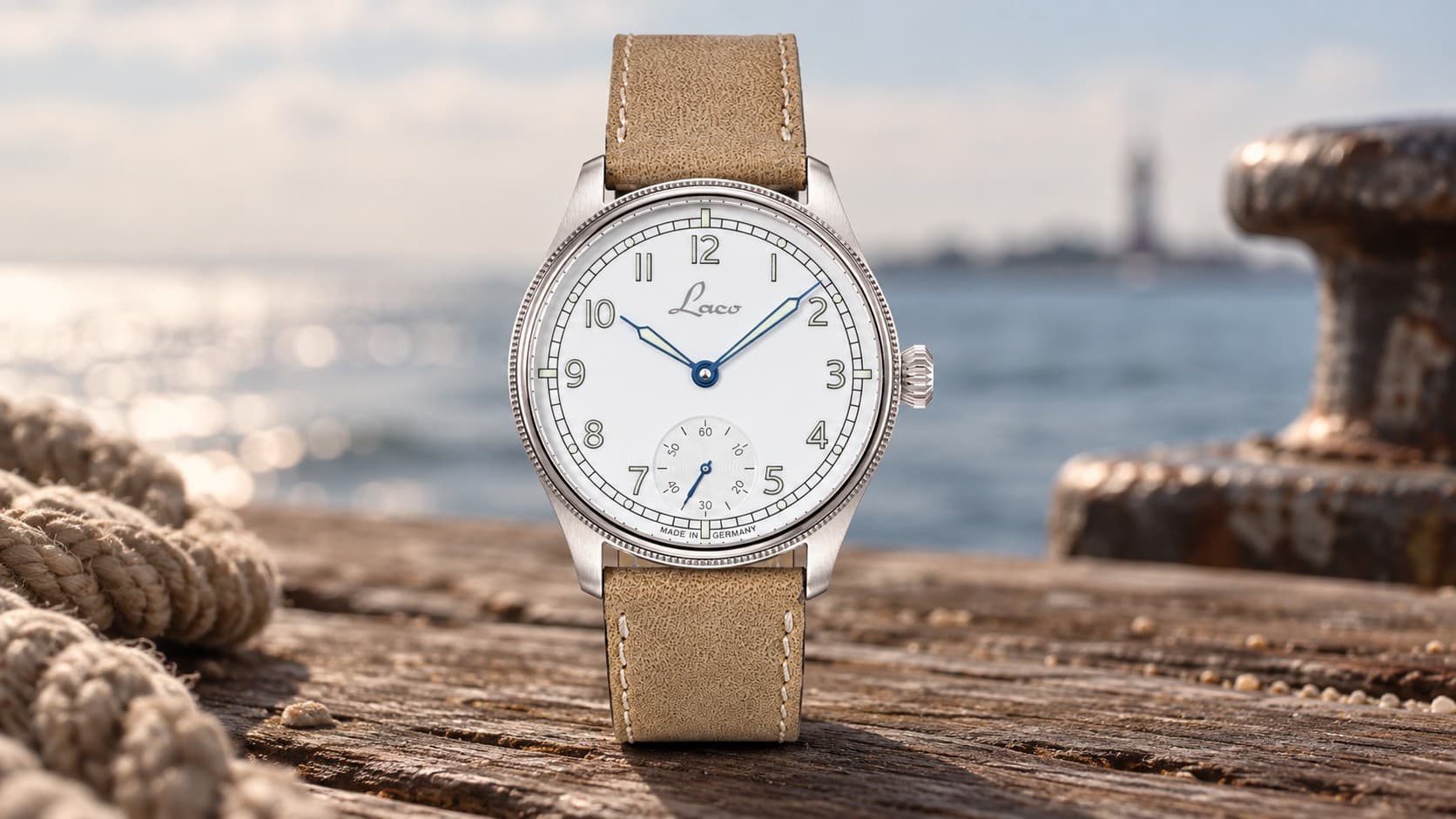
- Navy – watches inspired by 1940s marine observation pieces, aimed at everyday wear rather than aviation
Pilot Watch Original
This is the historical core of the brand. These watches are built to 42 to 45mm case sizes, close to the original 55mm B-Uhr but sized for modern wrists. They use straight, uncurved lugs, an oversized crown, and a highly domed crystal, the clear cover over the dial, to mimic the shape of the 1940s originals. If someone wants the most authentic version of a Laco pilot watch, this is the collection to look at.
The Erbstück Line
Erbstück means “heirloom” in German, and that’s exactly the idea. Laco hand-ages these watches so they look like they’ve been passed down for generations, with scratches, discoloration, and worn edges added by hand rather than by time. No two pieces come out identical, since the aging process is done individually on each case, dial, and strap, using a slow, work-intensive method without machine shortcuts.
Pilot Watches Basic
This is Laco’s entry point, and it’s genuinely different from the Original line rather than just a cheaper copy of it. Models like the Genf and Zürich run smaller, 40 to 42mm cases with quartz movements from the Swiss maker Ronda, which keeps the price low without giving up on Swiss-made mechanics inside. The Type A or Type B dial layout and the riveted leather strap still tie the watch back to the historical design, just without the size and hand-wound complexity of the Original collection.
This makes the Basic line a sensible starting point for someone drawn to the Laco look and story without committing four figures to a first pilot watch.
The Squad Collection
The Squad line moves away from aviation entirely and into tool-watch territory. The Atacama model, for example, was originally developed with input from German army and special-unit personnel, and it shows: a 46mm conical case, a unidirectional rotating bezel, and water resistance that ranges from 200 meters on quartz versions up to 500 meters on some automatic models. Squad watches also include GMT versions with a second time-zone hand, aimed at frequent travelers as much as outdoor use.
These watches are built for rougher conditions than a dress pilot watch would handle, and they carry a noticeably different look, with black PVD-coated cases and rubber straps instead of leather.
The Navy Collection
Laco’s Navy watches trace back to a separate but related piece of wartime history. In the 1940s, the German Marine Observatory in Hamburg needed accurate timekeeping instruments of its own, and Laco was one of the manufacturers trusted to build them, alongside its work on aviation watches.
Modern Navy models, like the Cuxhaven and Bremerhaven, borrow their design from those 1940s marine pocket watches rather than the B-Uhr. They typically feature smaller seconds sub-dials, railway-style minute tracks, and hand-wound movements based on the classic ETA Unitas 6498.2 caliber. The result reads as more restrained and dressier than the pilot watches, making the line a fit for someone drawn to Laco’s German engineering without the oversized aviation look.
Laco vs the Other Original Five Brands
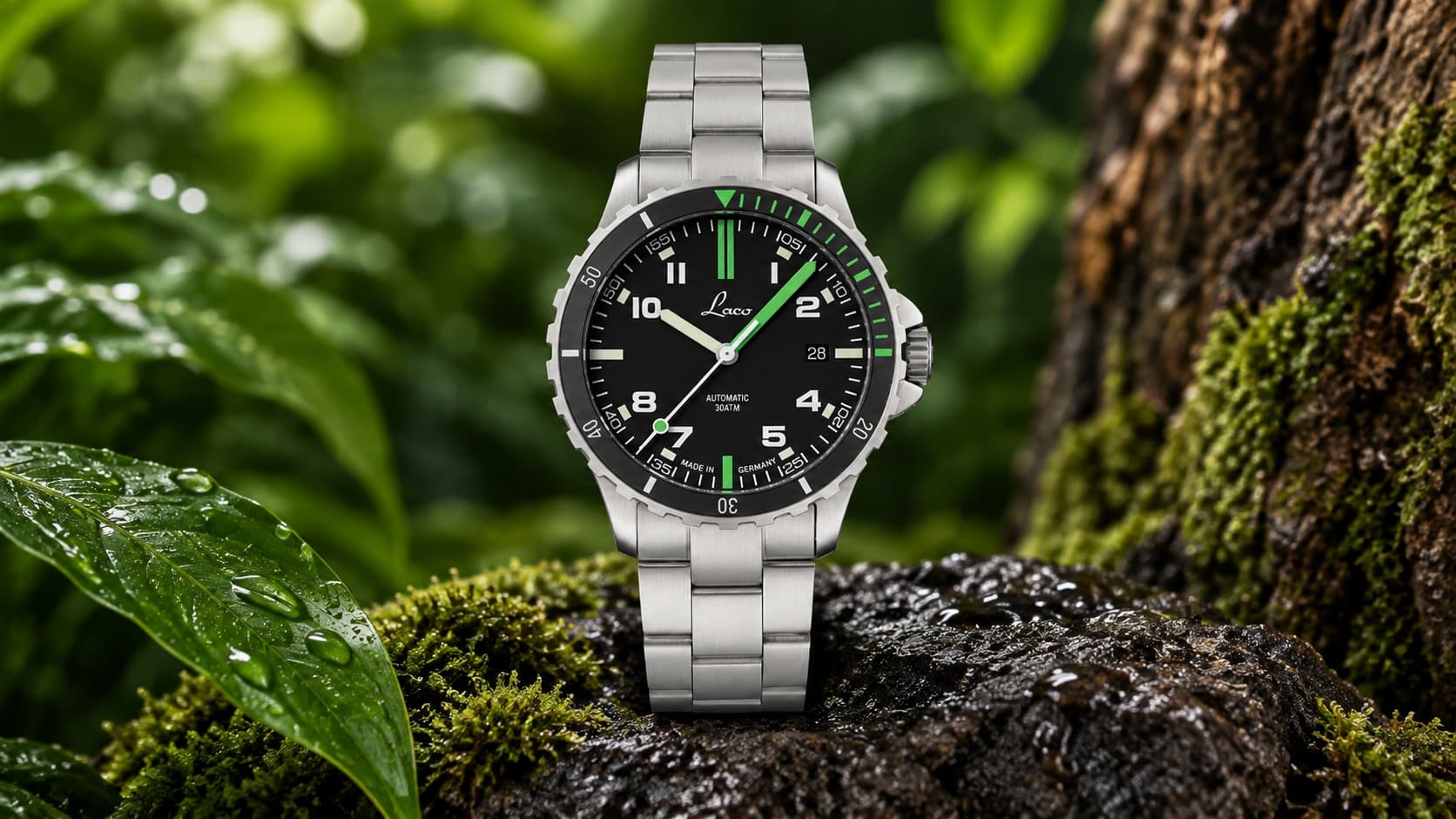
Laco was never alone in building B-Uhr pilot watches. Understanding where the other four manufacturers ended up helps explain what makes Laco’s position in the market unusual today.
| Brand | Country / City | Status Today | General Price Range |
|---|---|---|---|
| Laco | Pforzheim, Germany | Independent, still family-linked | €400 – €2,500 |
| Stowa | Pforzheim / Engelsbrand, Germany | Independent, part of Tempus Arte group since 2021 | €1,000 – €1,500 |
| Wempe | Hamburg, Germany | Independent, still family-owned | Several hundred to several thousand euros |
| A. Lange & Söhne | Glashütte, Germany | Owned by Richemont (Swiss luxury group) | Tens of thousands of euros and up |
| IWC | Schaffhausen, Switzerland | Owned by Richemont (Swiss luxury group) | Several thousand to tens of thousands of euros |
Laco and Stowa both stayed independent and accessible, and both are still based in or near Pforzheim, the same city where they were founded. Wempe also remains family-run, though it operates more as a retailer with its own watch division based in Hamburg and Glashütte. A. Lange & Söhne and IWC took the opposite path, becoming part of the Swiss luxury conglomerate Richemont and moving into a much higher price bracket. That split explains why Laco can trace its lineage back to the exact same wartime specification as IWC, yet sell for a fraction of the price.
What Movements Does Laco Use
A watch movement is the mechanism inside that actually keeps time. Laco uses a mix of sources depending on the model and price point.
| Movement Type | Common Use | What It Means |
|---|---|---|
| Swiss ETA / Sellita | Mid-to-high-end automatics | Reliable, widely serviced mechanical movements |
| Swiss Ronda (quartz) | GMT and tool watches | Battery-powered, low-maintenance, precise |
| Miyota (Japan) | Entry-level models | Affordable, dependable, easier on the wallet |
| Laco in-house calibers | Special editions | Built and finished by Laco itself for premium pieces |
Higher-end Laco watches often use Swiss automatic movements such as the ETA 2824-2, sold under Laco’s own caliber names like the Laco 24 or Laco 200, which wind themselves through the natural motion of the wrist. Hand-wound models, common in the Original Pilot Watch line, use calibers like the Laco 01, based on the ETA/Peseux 2801.2, which needs manual winding since it has no automatic rotor.
Entry-level and travel-focused pieces, including several Squad GMT models, run on Swiss Ronda quartz movements instead. These trade the mechanical craftsmanship of an automatic for near-perfect accuracy and years of battery life without servicing. Neither option is “wrong.” It comes down to how much hand-finishing and mechanical complexity a given price point is meant to buy.
How Much Does a Laco Watch Cost
Laco sits in an unusual spot in the watch market. It isn’t a budget brand, but it isn’t priced like Swiss luxury houses either.
The Original Pilot Watch collection generally runs from around €1,000 to €2,000, depending on the case material, movement, and finishing. Bronze cases and hand-aged Erbstück pieces sit at the higher end of that range, sometimes reaching €2,000 to €2,500. Squad tool watches, like the Atacama GMT, typically land between roughly $600 and $1,100 depending on the retailer and whether it’s a quartz or automatic version. Navy watches sit in a similar mid-range, generally €1,100 to €2,500 depending on the model and finish.
The Pilot Watches Basic line is where the real savings show up, with quartz models like the Genf and Zürich often priced under €400. That makes it the most realistic entry point into the brand for someone who wants the name and the look before deciding whether to invest in the full Original collection later.
Picking the Right Laco Collection
The right Laco collection depends on the reason behind the purchase, not just on budget. Two buyers with the same amount of money to spend can land on completely different models, since each collection was built with a different priority in mind.
For Historical Accuracy
The Pilot Watch Original collection sticks closest to the 1940s design, carries the FL 23883 engraving, and comes in both Type A and Type B dial styles. This is the version collectors point to when discussing Laco’s real heritage.
For an Everyday or Budget-Friendly Option
The Pilot Watches Basic line, including the Genf and Zürich, offers a smaller, lighter, quartz-powered option that costs a fraction of the Original collection. It functions as the easiest way to try Laco before committing to a more serious piece.
For Toughness Over Aviation Styling
The Squad Atacama is built for real durability, with higher water resistance and, on GMT versions, a second time-zone hand for travel. For a dressier, non-aviation look with the same German engineering, the Navy collection offers an alternative.
For a One-of-a-Kind Piece
The Erbstück line justifies its extra cost through individuality. Because each watch is aged by hand, no two pieces look exactly alike, which appeals to buyers seeking something that feels personal rather than mass-produced.
A design tribute to history and an actual reissue built to the original specs are not the same thing. Laco makes both, and confusing the two is the most common buying mistake.
Frequently Asked Questions
Is Laco a good watch brand?
Yes. Laco has been making watches since 1925 and was one of only five companies authorized to build official pilot watches for the German Luftwaffe. It still manufactures in Pforzheim, Germany today, and its reputation is built on documented history rather than marketing claims.
Are Laco watches made in Germany?
Laco’s headquarters and much of its production remain in Pforzheim, Germany, the same city where the company started in 1925. Some components, like certain movements, come from Switzerland or Japan depending on the model, but assembly and finishing happen at Laco’s home base.
What does B-Uhr mean?
B-Uhr is short for Beobachtungsuhr, a German word meaning “observation watch.” These were the large pilot watches built for German aviation navigators in the late 1930s and 1940s, and Laco was one of the five original manufacturers approved to make them.
What’s the difference between Laco’s pilot watches and its Squad watches?
The Pilot Watch Original collection is built to honor the historical B-Uhr design, with dress-watch proportions and leather straps. The Squad collection is a completely different, modern tool-watch line, built for outdoor and tactical use with higher water resistance, rubber straps, and rugged PVD-coated cases.
How does Laco compare to IWC?
Both brands were among the original five B-Uhr manufacturers, but they’ve taken very different paths since. IWC became a high-end Swiss luxury brand with prices often in the thousands to tens of thousands of dollars. Laco stayed closer to its roots as an accessible German manufacturer, with most watches priced well under €2,500.
Do Laco watches hold their value?
Laco watches are generally bought to wear and enjoy rather than as investment pieces. Special editions and hand-aged Erbstück models can hold interest among collectors, but the brand doesn’t have the same resale market as ultra-luxury Swiss houses like IWC or Rolex.
What’s the cheapest way to get a real Laco watch?
The Pilot Watches Basic line, including models like the Genf and Zürich, is Laco’s most affordable entry point. These use Swiss quartz movements in smaller cases, often priced under €400, while still carrying the Type A or Type B dial design that defines the brand.
The Bottom Line
Laco earned its place in watch history the hard way, through nearly a century of actually building the watches other brands only imitate, including surviving both a world war and the quartz crisis that ended many of its rivals. Whether the choice is the historically faithful Pilot Watch Original, a rugged Squad Atacama, or a hand-aged Erbstück piece, each one connects back to a lineage that runs directly to 1925 Pforzheim and the original B-Uhr specification. That direct link, more than any marketing story, is what separates Laco from the countless “pilot-style” watches that only borrow the look.