Most watch brands spend their energy trying to cram more information onto a dial: a date, a second hand, a moon phase, sometimes all three at once. MeisterSinger did the opposite. The German brand builds every watch around a single hand, stripping the dial down to something closer to an old church clock or a sundial than a modern instrument. It sounds like a gimmick on paper, but owners who wear one for a week or two commonly report checking the time less often and worrying about it less than they expected.
Why MeisterSinger Watches Only Have One Hand
MeisterSinger builds every model around one hour hand because that’s how nearly all clocks worked before the 1700s. Long before minute and second hands became standard, tower clocks, table clocks, and early pocket watches all told time with a single hand sweeping around the dial once every twelve hours. Some of the brand’s earliest design cues actually trace back to specific historical pieces, including old church tower clocks like the one on Westminster Abbey and the “Souscription” pocket watch made by Abraham-Louis Breguet, both of which relied on a single hand long before anyone thought to add a second one. Founder Manfred Brassler built the entire company around bringing that old idea back, treating a watch less like a status symbol and more like the measuring instrument it originally was.
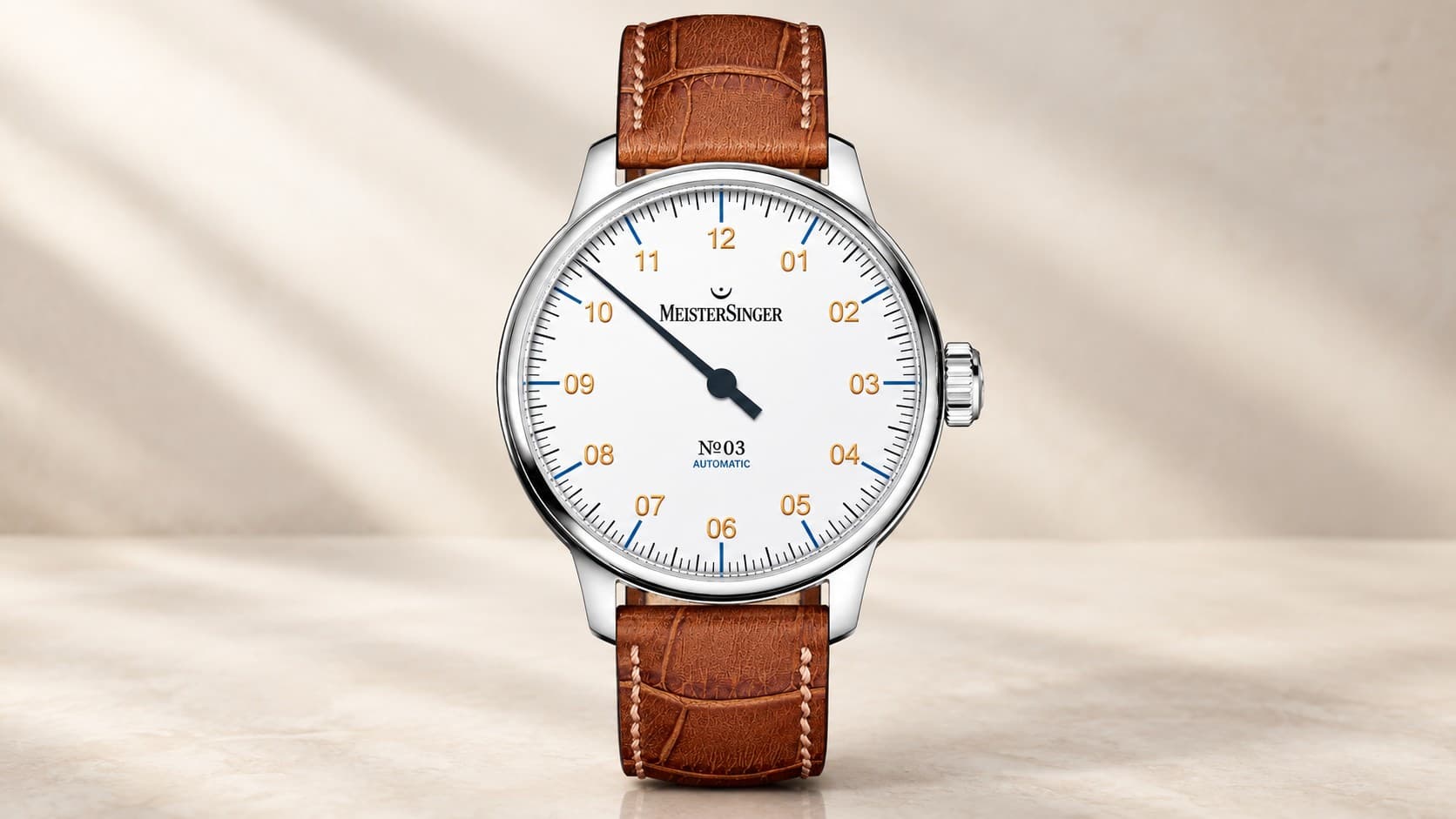
That history matters because it explains the whole brand. MeisterSinger isn’t trying to make a “quirky” watch for the sake of it. It’s recreating the feeling of an old timekeeping device, back when knowing the exact minute wasn’t really the point. To make that older format easy to read at a glance, the outer edge of every dial is divided into fine lines: each line marks five minutes, and a slightly longer line marks each quarter and half hour, so the eye naturally lands on useful reference points instead of having to count every single line. Once someone understands that layout, reading one is genuinely easy, and plenty of owners say it becomes their favorite part of wearing the watch rather than an obstacle.
The Story Behind MeisterSinger Watches
MeisterSinger was started in Münster, Germany, in 2001, by a watchmaker who wanted to do something no one else was doing. Manfred Brassler had just sold his previous company, Watch People, two years earlier, and set out on his own as a self-taught jeweler with a plan to build serious mechanical watches with an unusually simple look. The company’s name looks back to the Meistersinger tradition of medieval Germany, where a small circle of skilled singers earned the title by composing an original melody of their own. That connection to craftsmanship carries through to the logo, a small curved mark borrowed from sheet music called a fermata, which tells a musician to hold a note and let it breathe rather than rushing through it.
The very first model set the template for everything that followed. The debut N°01 established the dial style still used across the range today: bold, evenly spaced numerals with five-minute divisions read by that single hand. It took over a decade before MeisterSinger started building its own movements instead of relying entirely on outside suppliers. That changed in 2014 with the hand-wound MSH01 caliber, developed with a Swiss manufacturing partner and built with two mainsprings, giving it an unusually long five-day power reserve. It went on to win the German Design Award, the first MeisterSinger movement to do so, and the brand’s design work has since picked up additional honors, including the Red Dot Design Award and the iF Design Award for some of its later models. The company has kept expanding since, adding automatic and power-reserve variants of its own calibers, and in 2025 it exhibited for the first time at Watches and Wonders, one of the industry’s largest trade shows, launching a new sports-watch line alongside its usual dress-focused pieces.
Best MeisterSinger Watches to Know
MeisterSinger N°01 — The One That Started It All
The N°01 is the watch that made MeisterSinger a real brand, and it still looks close to the original 2001 version. Its dial pairs bold Arabic numerals with a domed sapphire crystal and a curved, “onion” style crown that has become one of the brand’s visual trademarks. Most versions sit in a 43mm by 11.5mm stainless steel case with a solid caseback, and the standard model runs a hand-wound Sellita SW210 movement good for about 42 hours of power reserve once fully wound. Current pricing on MeisterSinger’s own US store runs from roughly $2,300 to about $2,600 depending on dial color and strap.
The N°01 is the right starting point for anyone new to single-hand watches who wants the “classic” version before trying anything sportier or more complicated. It’s simple, well proportioned, and it wears like a dress watch without being fussy about it. Because it’s hand-wound rather than automatic, it also asks for a small daily ritual: giving the crown a few turns each morning, which some owners genuinely enjoy as part of the brand’s slower approach to time.
MeisterSinger N°03 — A Bigger, Date-Equipped N°01
The N°03 takes the same dial language as the N°01 and swaps the hand-wound movement for an automatic Sellita SW200, which winds itself through normal wrist motion and holds around 38 hours of power reserve. It comes in both 38mm and 43mm cases, giving it a bit more flexibility for smaller or larger wrists than the standard N°01 offers, and its dial adds a small date window that stays out of the way near the edge. Retail prices sit a step above the N°01, generally landing in the high-$2,000s and running a little past $3,000 for certain special versions. The model has earned recognition of its own too, having been singled out with a Good Design Award for the strength of its overall styling.
If the only thing holding someone back from a MeisterSinger is not wanting to lose date tracking, or not wanting to wind a watch by hand every day, the N°03 solves both of those without changing the overall look of the collection.
MeisterSinger Neo — The Vintage-Inspired Entry Point
The Neo leans hard into a 1960s look: a slim 36mm or 40mm case with almost no visible bezel, a slightly domed crystal, and an overall height of under 10mm that makes it sit close to the wrist. That thin, bezel-free profile is part of the design trick that makes such a small case feel roomier than its size suggests. It runs the same reliable Sellita SW200 automatic movement found in several other MeisterSinger models, with a date window at six o’clock, and comes in dial colors ranging from sunburst blue and green to ivory and gray, with newer versions offered on either hardened acrylic or upgraded sapphire crystal. Current US pricing ranges from around $1,000 on sale models up to about $2,500 for special editions with the sapphire upgrade.
The Neo tends to be the model people point to as the best-value way into the brand, since it keeps the core single-hand idea intact in a smaller, more affordable, and notably slim package.
MeisterSinger Pangaea — The Signature All-Rounder
The Pangaea is arguably the brand’s most recognized shape, thanks to its rounded 40mm case, dramatically domed crystal, and oversized onion crown. Inside, most versions use an automatic Sellita SW200 movement, though some special editions swap in a slightly slimmer or small-seconds variant of the same family, and the exhibition caseback is usually secured with six screws so the decorated rotor stays visible. A Pangaea Day Date variant adds day and date rings that circle the dial without a hand pointing to them, keeping the layout balanced instead of adding a busy display, and some limited editions have used genuine aventurine glass for a dial that visibly sparkles under light. Pricing on the official US store runs from about $2,700 for simple steel and white-dial versions up to around $4,150 for aventurine dials or gold-bezel editions.
This is the model most people picture when they think “MeisterSinger,” and it works equally well with a suit or with jeans thanks to that rounded, understated case shape.
MeisterSinger Perigraph — For Anyone Who Wants an Open Date Ring
The Perigraph swaps a small date window for an open date ring that circles the dial just inside the hour markers, giving it a slightly more technical, layered look than the Pangaea or N°01. It’s built around a 43mm automatic case, with a smaller 38mm version also available, and comes in dial colors including ivory, white, sunburst blue, and a sportier black-and-petrol combination, with a black DLC-coated “Black Line” edition adding a tougher, more casual finish to the same layout. On the official US site, prices land in the $3,000 to $3,400 range across most versions.
Anyone who likes the single-hand idea but wants a bit more visual detail than the plain N°01 dial should look here first.
MeisterSinger Unomat — The Toughest Watch in the Lineup
The Unomat is MeisterSinger’s answer to “what if a single-hand watch could also survive a hike or a swim.” It first launched in 2021 as a bigger, sportier sibling of the N°03, and it runs a larger Sellita SW400 automatic movement with the date pushed farther toward the dial’s edge for extra legibility, wrapped in layers of soft iron that shield it against everyday magnetic interference from phones, laptops, and other electronics. The oversized double-digit numerals and a broad, luminous hand make it easy to read in poor light, and it sits in a 43mm steel case on an integrated bracelet, rated water resistant to around 300 meters with a screw-down crown and crown guards. Retail pricing on the official US store runs from roughly $2,900 to $3,300.
This is the pick for anyone who wants a genuinely rugged watch without giving up the single-hand concept, since most of the collection leans dressier by comparison.
MeisterSinger Kaenos — The Newest Integrated-Bracelet Sports Watch
The Kaenos is MeisterSinger’s most recent departure from its usual dress-watch shapes, built with a steel sports-watch silhouette and an integrated bracelet rather than a lugs-and-strap design. It debuted in 2025 as part of the brand’s first appearance at Watches and Wonders, built around a 40mm barrel-shaped case with a traditional round bezel rather than anything sharp or angular. Its dial is built in two visible layers instead of one: the numerals and markers sit on top and are punched through so a second, glow-in-the-dark surface shows through them, which is why the face looks brighter and more three-dimensional after dark than most older MeisterSinger dials. The base Kaenos runs a Sellita SW400 automatic to fit a larger date window, while the Kaenos Open Date uses the smaller SW200 for its open date ring, and a later run of black DLC-coated versions became the first Kaenos models offered on a leather strap instead of the metal bracelet. Prices for the base steel models start at roughly €2,650.
Anyone who wants the calmness of a single-hand dial paired with a modern steel sports-watch case should put the Kaenos on their shortlist.
MeisterSinger Lunascope — Best for a Moon Phase Without the Hassle
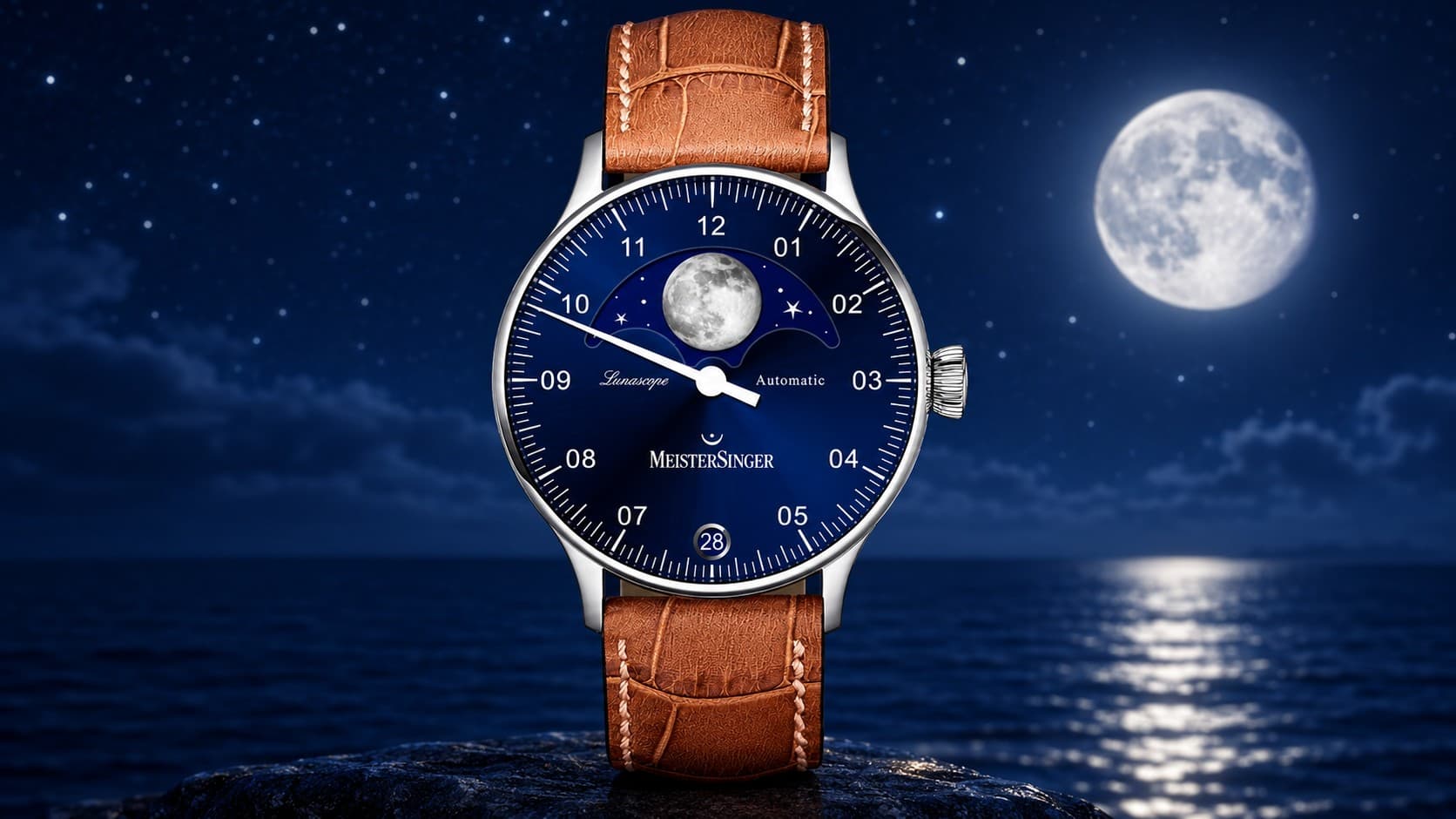
Most moon phase watches need a manual correction every couple of years, because their standard mechanism rounds the moon’s orbit to 29.5 days instead of its true length of a little over 29 days and 12 hours, which causes the display to drift noticeably over time. Launched in 2018 as the brand’s first watch with any astronomical complication, the Lunascope gets around that drift with a custom-built module added to a Swiss automatic base movement, keeping the moon phase accurate to within a single day for roughly 128 years of continuous wear. The oversized moon sits against a starry, sunburst-blue or silver-opaline dial in a 40mm stainless steel case, with a round date window at six o’clock and a screw-down exhibition caseback that shows off the added module. Its design work hasn’t gone unnoticed either, with the Lunascope collecting three separate honors over the years: the German Design Award, the Red Dot Design Award, and the iF Design Award. Pricing on the official US store spans a wide range, generally starting around $4,200 for the base version and climbing toward $6,400 for gold accents or a bracelet fit.
For anyone who genuinely likes tracking the moon’s phase but hates the maintenance that usually comes with it, the Lunascope solves a real, practical problem.
MeisterSinger Archao — The Boldest, Most Rugged Design
The Archao is the newest addition built for people who want MeisterSinger’s philosophy without the traditional dressy look. Its name comes from the Greek word for “primal” or “original,” and it comes in a 43mm case finished in a jet-black coating that makes it feel more rugged and, oddly, appear slightly smaller than its actual size. The three launch dials, in black, blue, and red, use a raised, three-dimensional luminous material on the numerals and hand instead of ordinary painted lume, which adds visible texture even in daylight. Underneath sits a reliable, easy-to-service Swiss automatic movement, visible through a display caseback with a molten, volcanic-style texture and the Archao name etched across it. Each of the three launch colorways carries the same tax-included price of €2,390.
This is the collection to check out if the classic MeisterSinger dress-watch look doesn’t match someone’s personal style, but they still want the single-hand concept.
MeisterSinger Watches Compared
| Collection | Best For | Case Size | Typical Movement | Approx. Starting Price |
|---|---|---|---|---|
| N°01 | First-timers, classic dress look | 43mm | Hand-wound Sellita SW210 | $2,300 |
| N°03 | Classic look with a date | 38mm / 43mm | Automatic Sellita SW200 | $2,700 |
| Neo | Best value, vintage styling | 36mm / 40mm | Automatic Sellita SW200 | $1,000 |
| Pangaea | Everyday all-rounder | 40mm | Automatic Sellita SW200 | $2,700 |
| Perigraph | Extra dial detail, open date ring | 38mm / 43mm | Automatic Sellita SW200 | $3,000 |
| Unomat | Toughest, most sporty | 43mm | Automatic Sellita SW400 | $2,900 |
| Kaenos | Modern integrated bracelet | 40mm | Automatic Sellita SW200/SW400 | ~€2,650 |
| Lunascope | Low-maintenance moon phase | 40mm | Automatic + MeisterSinger moon module | $4,200 |
| Archao | Boldest, most rugged look | 43mm | Automatic Sellita SW200 | ~€2,390 |
Prices shift with dial color, strap material, and currency exchange rates, so treat these as a general starting range rather than a fixed number.
How to Read a Single-Hand Watch
Reading one of these watches takes about a minute to learn and becomes automatic after that. Each hour on the dial is broken into smaller lines, usually representing five-minute increments, and the tip of the hand marks both the hour and how far into that hour it’s pointing by its position along those lines. Instead of stacking a minute hand on top of an hour hand, MeisterSinger just stretches the hour hand’s path so it can point precisely between the markers.
A few reference points make it click faster:
- The numeral the hand has just passed marks the current hour.
- The number of small lines the hand has moved past that numeral, multiplied by five, gives the minutes.
- Muscle memory tends to kick in after a single full day of regular wear.
- Precision to the exact minute isn’t really the goal, since that’s the whole point of the design.
A single-hand watch isn’t built to give the exact second. It’s built to give a moment, leaving the wearer to decide how precise that moment needs to be.
Buying Tips for MeisterSinger Watches
Choosing a MeisterSinger comes down to intended daily use more than which model looks best in photos. A dressier N°01 or Pangaea works well for offices and evenings out, while the Unomat, Kaenos, or Archao make more sense for a watch that needs to survive an active lifestyle. Movement type matters too: automatic versions wind themselves through normal wear, while hand-wound models need a daily wind but tend to feel more traditional on the wrist.
Budget is worth mapping out honestly before shopping, since the range spans from around $1,000 for a Neo on sale to well over $6,000 for a top-spec Lunascope. It’s also worth deciding how important a date window is early on, since some collectors find that any date display interrupts the clean, single-hand look they were originally drawn to.
Frequently Asked Questions
Are MeisterSinger watches hard to read?
Not once the layout is understood. Each hour is divided into small five-minute lines, and the tip of the single hand marks both the hour and roughly how many minutes have passed. Most new owners get comfortable reading it within a day or two of regular wear.
Are MeisterSinger watches Swiss or German?
Both, in different ways. MeisterSinger is a German company, founded and still headquartered in Münster, Germany, but its watch movements are Swiss-made, whether that’s an outside Swiss caliber or the brand’s own in-house movements built with a Swiss manufacturing partner.
Do all MeisterSinger watches have only one hand?
Yes, every current model uses a single hand to display the hour and minute together, which is the defining feature of the brand. Some models add a second, hand-free indicator, like a date ring, a moon phase display, or a power reserve gauge, but none of them add a traditional minute or second hand.
How accurate is a single-hand watch?
The movement inside keeps time exactly the same way any other mechanical or automatic watch does; only the display is different. The hand simply travels around the dial once every twelve hours instead of an hour hand and minute hand moving separately, so accuracy depends on the caliber inside, not the single-hand format itself.
What is the most affordable MeisterSinger watch?
The Neo collection is generally the least expensive way into the brand, with some dial colors selling for around $1,000 during regular promotions and closer to $1,400–$1,500 at standard pricing. It keeps the same core single-hand design as the pricier collections in a smaller, simpler case.
The Bottom Line
MeisterSinger built an entire watch brand around one simple idea: telling time doesn’t need a second hand, a minute hand, and constant precision to actually be useful. From the original N°01 to the rugged Unomat and the newer Kaenos and Archao lines, every model in the lineup commits to that single-hand philosophy while still finding room for date windows, moon phases, and genuinely tough, water-resistant cases. Anyone who wants the classic look should start with the N°01 or Pangaea, anyone who needs something more durable for daily life will get more out of the Unomat or Kaenos, and anyone working with a tighter budget can still join the brand through the Neo without paying for its pricier, manufacture-movement pieces.