Most watch brands people recognize are Swiss, Japanese, or German. Weiss Watch Company is different. It is one of the very few brands actually building mechanical watches by hand in the United States, down to machining its own movement parts instead of buying finished pieces from overseas. That story matters to collectors because American watchmaking nearly disappeared in the last century, and Weiss is one of the small handful of companies trying to bring it back. The brand’s brass-dial field watches have built a loyal following since its early days as a two-person operation, growing into a small but respected name built on hand-finishing and domestic manufacturing.
The Story Behind Weiss Watch Company
Weiss Watch Company is a small, family-owned American watch brand founded by watchmaker Cameron Weiss in 2013. Cameron trained at the Nicolas G. Hayek Watchmaking School in Florida, earned certification through the Swiss WOSTEP program, and worked with Audemars Piguet and Vacheron Constantin before starting his own company. He launched Weiss with just ten field watches, sold at a market in San Francisco alongside his soon-to-be wife, Whitney. Each of those first ten watches took roughly 300 hours to hand-finish and assemble, largely because there were no ready-made American watch parts to buy off a shelf. Cameron had to design and machine almost everything himself, working out of the couple’s dining room.
The company grew steadily from there. By 2015, Weiss had outgrown the apartment workshop and moved into its first dedicated facility in Los Angeles, where it built a small team of certified watchmakers while Cameron stayed personally involved in every design decision. During those years, the brand also teamed up with other American makers, including Allen Edmonds, Birdwell, and Tanner Goods, on limited-edition watches that leaned into shared values around materials and craft.
In 2020, Cameron and Whitney relocated the company and their family to Nashville, Tennessee, where Weiss now runs its studio and workshop. Today, Weiss produces around 1,500 watches a year, a small number compared to major brands, but reportedly enough to make it the largest maker of mechanical watches still building in the United States. The company remains independently and family-owned, with Cameron still hand-finishing and regulating watches at the bench rather than running the business from a distance.
Why Choose a Weiss Watch Over Others
The short answer: Weiss makes its own parts instead of buying complete movements from a supplier, and every watch passes through a single small team of watchmakers rather than a factory line. That’s rare, even among expensive luxury brands, most of which outsource movements to specialists like ETA or Sellita and simply build a case and dial around them.
Weiss started that same way, using Swiss-made movements inside American-made cases. That changed in 2016, when the company introduced its own in-house movement, the Caliber 1003, machined and assembled entirely in its own workshop. It’s based on the architecture of a classic Swiss pocket-watch movement whose patents expired long ago, so building an American version of it was legal, though still difficult and expensive. Very few American mainspring or jewel-bearing manufacturers exist anymore, so Weiss still imports those two components; nearly everything else, including mainplates, bridges, screws, wheels, cases, and dials, is machined domestically.
That hands-on approach shows up in small details buyers notice. Casebacks are secured with visible hex screws rather than hidden clips. Dials are cut from naval brass and hand-painted rather than printed by machine. Each Caliber 1003 movement is assembled twice, once to test the fit of every part and once for final assembly, because tolerances this tight can’t be guaranteed on the first pass. It’s a slower and more expensive way to build a watch, but it’s also the reason enthusiasts describe Weiss as one of the only “real” American watch manufacturers left, rather than a brand that just assembles imported parts under a domestic name.
Best Weiss Watch Models
Standard Issue Field Watch
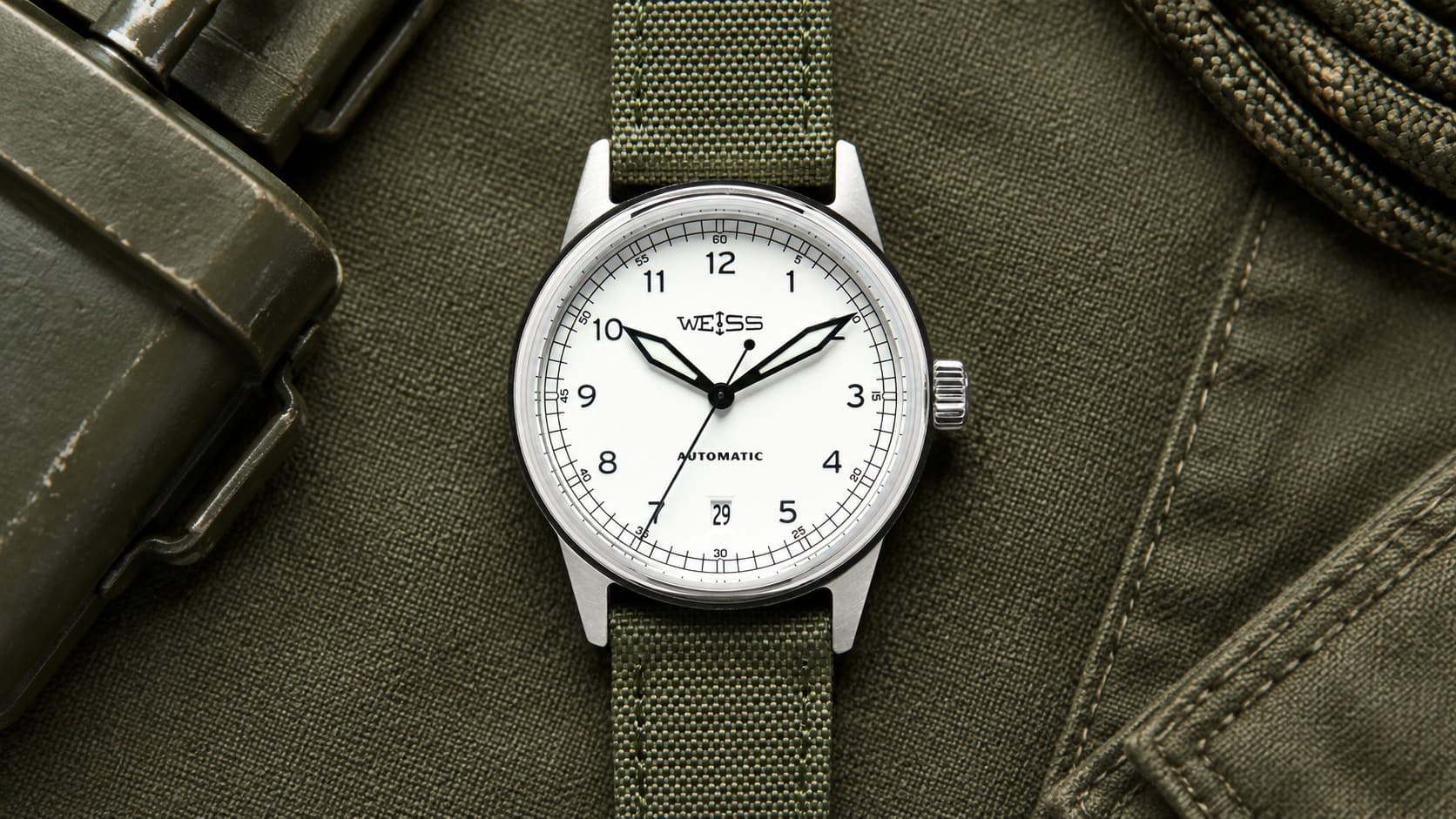
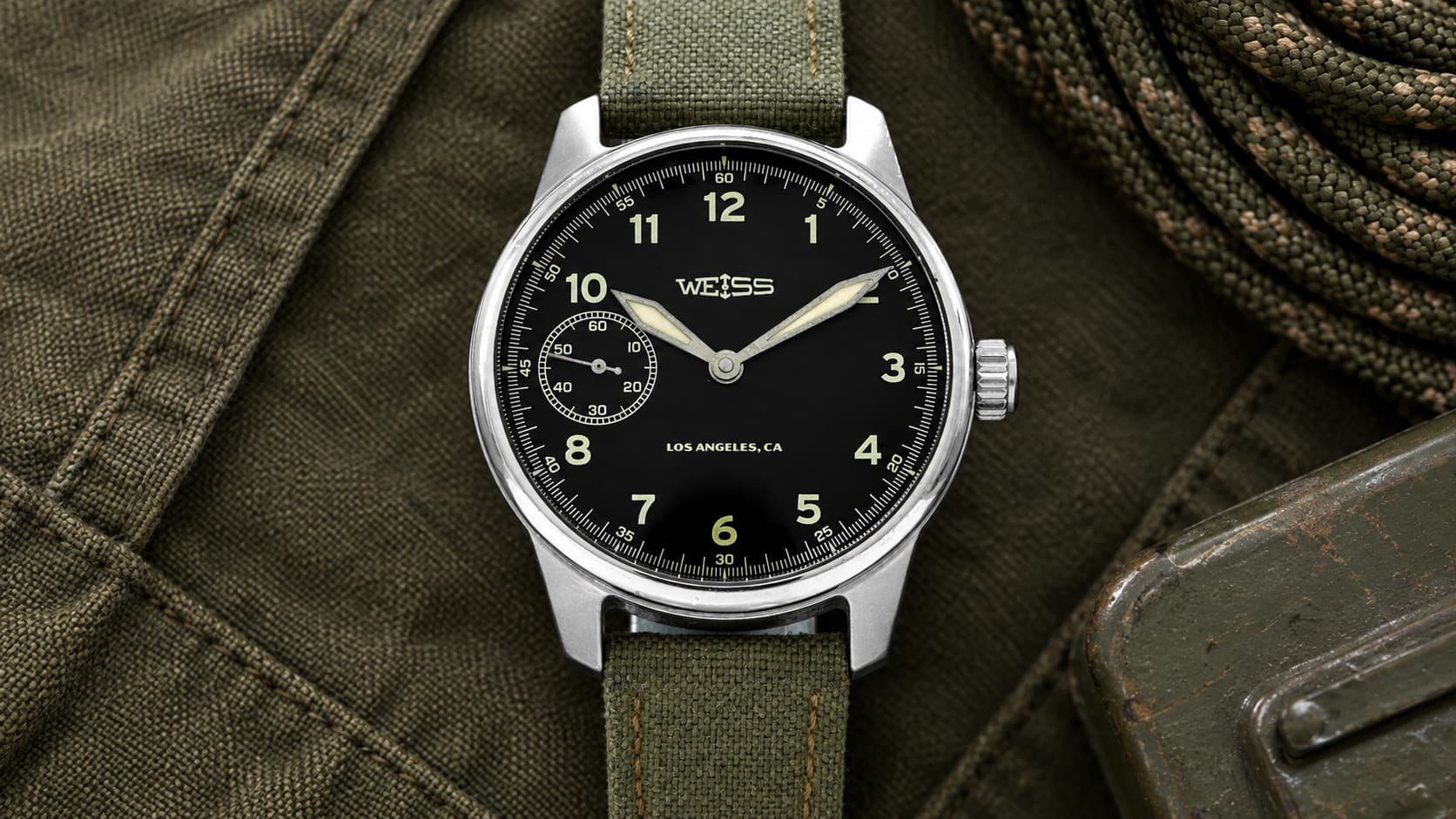
The Standard Issue is Weiss’s flagship and the design the whole brand grew from. It runs on a manually wound Swiss-base movement, finished and assembled by hand, paired with a naval-brass dial and a 316L stainless steel case.
It comes in 38mm and 42mm sizes, so it can fit smaller or larger wrists, with a case thickness around 12 to 13mm and water resistance rated to 100 meters. Beat rates and power reserves vary slightly by version, but most Standard Issue watches run at 18,000 to 21,600 beats per hour with 42 to 46 hours of power reserve once fully wound. The dial layout borrows from old military field watches: big, easy-to-read numbers, a matte finish that won’t glare in sunlight, and a simple display with no unnecessary clutter. It’s the watch most reviewers point to first when they talk about Weiss, since it set the tone for everything the brand makes today, and it typically sits at the lower end of the brand’s current pricing.
American Issue Field Watch
This is the watch that carries the Caliber 1003, Weiss’s own American-made movement, machined and assembled in the company’s workshop rather than sourced from Switzerland. If the Standard Issue proved the brand could build a great case, the American Issue proved it could build the engine inside it too.
The first run was a closed edition of only 50 pieces, individually numbered, and Weiss has released small numbered batches since, sometimes in stainless steel and sometimes in titanium. It shares the same field-watch DNA as the Standard Issue, with a 42mm case, a naval-brass dial, and a manually wound movement running around 21,600 beats per hour with roughly 46 hours of power reserve. It also includes a hacking seconds hand, which stops the second hand when the crown is pulled out, letting the wearer sync it exactly to another clock. For anyone who cares about the “how it’s made” story behind a watch, this model is the clearest example of Weiss’s mission in action, and it commands a noticeable premium over the Standard Issue because of the extra manufacturing involved.
Automatic Issue Field Watch
This model swaps manual winding for a self-winding, or automatic, movement, meaning the watch winds itself through the natural motion of the wrist rather than needing to be wound by hand each morning. It keeps the same field-watch look the brand is known for, in both 38mm and 42mm cases.
It’s aimed at people who want the classic Weiss style without a daily winding routine. Because automatic movements have more moving parts than manual ones, this line sits above the original Standard Issue in price, generally in the mid-to-upper part of the brand’s current range. It’s become one of Weiss’s most popular models since launch, partly because it’s an easier everyday watch for people who aren’t used to wearing a hand-wound piece.
Standard Issue Dive Watch
Weiss’s Dive Watch, launched in October 2022, took the brand outside the field-watch template for the first time, built for use in and around water rather than on land. It runs on the Caliber 2120, an automatic movement built on a Soprod M100 base, jeweled, finished, plated, and reassembled by hand at Weiss, with 25 jewels, a 28,800 beat-per-hour rate, and roughly 42 hours of power reserve.
The 42mm stainless steel case pairs with a 120-click unidirectional bezel for tracking elapsed dive time, a screw-down crown, double-domed sapphire crystal front and back, and water resistance rated to 300 meters, meeting the ISO 6425 standard for dive watches. Buyers can choose the brand’s original leather and canvas straps or its first-ever in-house stainless steel bracelet, also machined in the Nashville workshop. It’s a smaller part of the current lineup compared to the field watches, but it matters because it proves Weiss can design and finish a completely different type of tool watch to the same standard.
Executive Issue Field Watch
The Executive Issue is Weiss’s dressier, most exclusive offering, built with a solid 18k gold case, buckle, crown, and screws rather than steel or titanium. Cameron sources the gold in the United States, primarily mined in California, then has it smelted domestically before machining and hand-finishing each case individually.
Every Executive Issue is a bespoke, made-to-order piece rather than a stocked model. The build process runs more than 60 hours per watch, and buyers should expect a lead time of at least 12 weeks from order to delivery, depending on the current waiting queue. Because of the cost of gold and the extra hand-finishing involved, this is by far the most expensive model Weiss produces, with historical pricing well into five figures for the full gold case. It exists mainly to show what the company’s watchmakers can do when cost isn’t the main constraint, and it remains a niche, special-order piece rather than part of the everyday lineup.
Weiss Watch Models Compared
| Model | Movement Type | Case Material | Water Resistance | Typical Position in Lineup |
|---|---|---|---|---|
| Standard Issue Field Watch | Manual wind (Swiss base) | Stainless steel | 100m | Entry point, flagship design |
| American Issue Field Watch | Manual wind (in-house Cal. 1003) | Stainless steel or titanium | 100m | Limited runs, US-made movement |
| Automatic Issue Field Watch | Automatic (Swiss base) | Stainless steel | 100m | Everyday wear, self-winding |
| Standard Issue Dive Watch | Automatic (Cal. 2120, Soprod base) | Stainless steel | 300m | Water sports, tool watch |
| Executive Issue Field Watch | Manual wind (in-house Cal. 1003) | Solid 18k gold | 100m | Bespoke, most expensive |
How Much Do Weiss Watches Cost?
Prices for Weiss watches typically range from around $2,000 to well over $4,500 for the standard collection, with the bespoke gold Executive Issue priced well beyond that. The Standard Issue field watches sit at the lower end of that range, while models with the in-house Caliber 1003 movement, titanium cases, or limited-edition status cost noticeably more, and the automatic Dive Watch generally falls in the middle.
A field watch with a Swiss-base movement and a steel case will always cost less than one with an American-made movement or a precious-metal case. Materials and labor both drive the price up.
It’s worth knowing that Weiss’s prices have climbed steadily since the brand’s early days, when its first field watches sold for closer to $950 to $1,500. That increase reflects both the added cost of building parts domestically instead of importing them, and the growing demand for the brand as more collectors have discovered it.
How to Order a Weiss Watch
Weiss sells almost entirely direct to the customer through its own website, rather than through department stores or big watch retailers. That’s typical for a small, hand-built brand: keeping sales in-house lets the company match production to actual demand instead of stocking a retail network.
Because each watch is built to order rather than pulled from a warehouse shelf, buyers typically wait roughly six to eight weeks between placing an order and shipment, longer for limited editions or the bespoke Executive Issue. Buyers can usually choose their own strap or bracelet at checkout, including options like leather, canvas, suede, Horween Shell Cordovan, natural rubber for the Dive Watch, or the in-house stainless steel bracelet, and some models offer custom caseback engraving for a personal touch.
For anyone who wants to see the watches in person first, Weiss operates a private studio in Nashville, Tennessee, where visitors can book an appointment to view and compare the current collection before ordering. A small number of outdoor and lifestyle retailers have carried select Weiss models over the years as well, though the brand’s own site remains the primary way to order one.
Is a Weiss Watch Worth the Price?
The answer depends on what a buyer values most in a watch. For someone drawn to a mechanical watch built almost entirely in the United States, with visible hand-finishing and a company small enough that the founder personally trains the watchmakers and often assembles pieces himself, Weiss delivers something few other brands can match at any price.
For a buyer whose main priority is getting the most watchmaking technology per dollar, a Swiss or Japanese brand at a similar price point may offer more complications, a longer track record, or faster delivery. Weiss isn’t trying to compete on spec sheets or add features for their own sake. It’s selling a story about reviving American craftsmanship, and the price reflects the labor and machining time that story genuinely requires, not marketing.
The Weiss Watchmaking Process
Each Weiss watch starts as raw material, usually steel, titanium, brass, or gold, that gets machined into a case, dial, or movement part inside the company’s own workshop. Nothing about the process is automated at scale the way it would be at a large watch factory, and batches are often limited to a specific, individually numbered edition size.
A single watchmaker typically follows a piece through most of its build, from machining and finishing components to assembling the movement and regulating it for accuracy at the bench. Every Caliber 1003 movement is assembled twice: once as a trial fit to check tolerances, and once for the final build that ships inside the watch. That’s very different from how most watches, even expensive ones, are actually built, since large brands usually split labor across many specialized stations rather than having one person see a piece through from start to finish. This hands-on approach is also why Weiss watches typically take several weeks to complete after an order is placed, and why limited editions with the in-house movement can take even longer.
Frequently Asked Questions
Where are Weiss watches made?
Weiss watches are designed and assembled in the company’s own workshop in Nashville, Tennessee. Cases, dials, and the in-house Caliber 1003 movement are machined domestically, though a small number of parts like mainsprings and jewels are still imported.
Who founded Weiss Watch Company?
Cameron Weiss founded the company in 2013 after training as a watchmaker in the United States and Switzerland and working for Audemars Piguet and Vacheron Constantin. He runs the brand together with his wife, Whitney, and remains personally involved in building and regulating watches.
What movement do Weiss watches use?
Weiss uses two main types of movements: Swiss-based mechanical movements finished and assembled in-house, and its own American-made Caliber 1003, which the company machines and assembles itself using a design based on an expired-patent Swiss pocket-watch movement. The Dive Watch uses a third movement, the Caliber 2120, built on an automatic Soprod M100 base.
Are Weiss watches automatic or manual?
Weiss makes both. The Standard Issue, American Issue, and Executive Issue field watches are manually wound, meaning the wearer turns the crown to power them, while the Automatic Issue and the Dive Watch wind themselves through the natural motion of the wrist.
How long does it take to get a Weiss watch?
Because each watch is largely hand-built, orders often take several weeks to complete rather than shipping immediately. Limited editions and models with the in-house movement can take even longer, and a bespoke Executive Issue typically requires at least 12 weeks due to the extra machining and gold-sourcing involved.
The Bottom Line
Weiss Watch Company earns its reputation the hard way: by machining its own parts, training its own watchmakers, and building watches one at a time in Nashville instead of buying finished pieces overseas. The Standard Issue field watch remains the best entry point into the brand, the American Issue is the clearest proof of its in-house engineering, and the Automatic Issue and Dive Watch show the lineup expanding beyond its original field-watch roots, while the Executive Issue sits at the top as a bespoke gold rarity. What a Weiss watch really represents isn’t just materials or a movement spec sheet, it’s the labor of a small American team trying to keep a nearly lost craft alive.