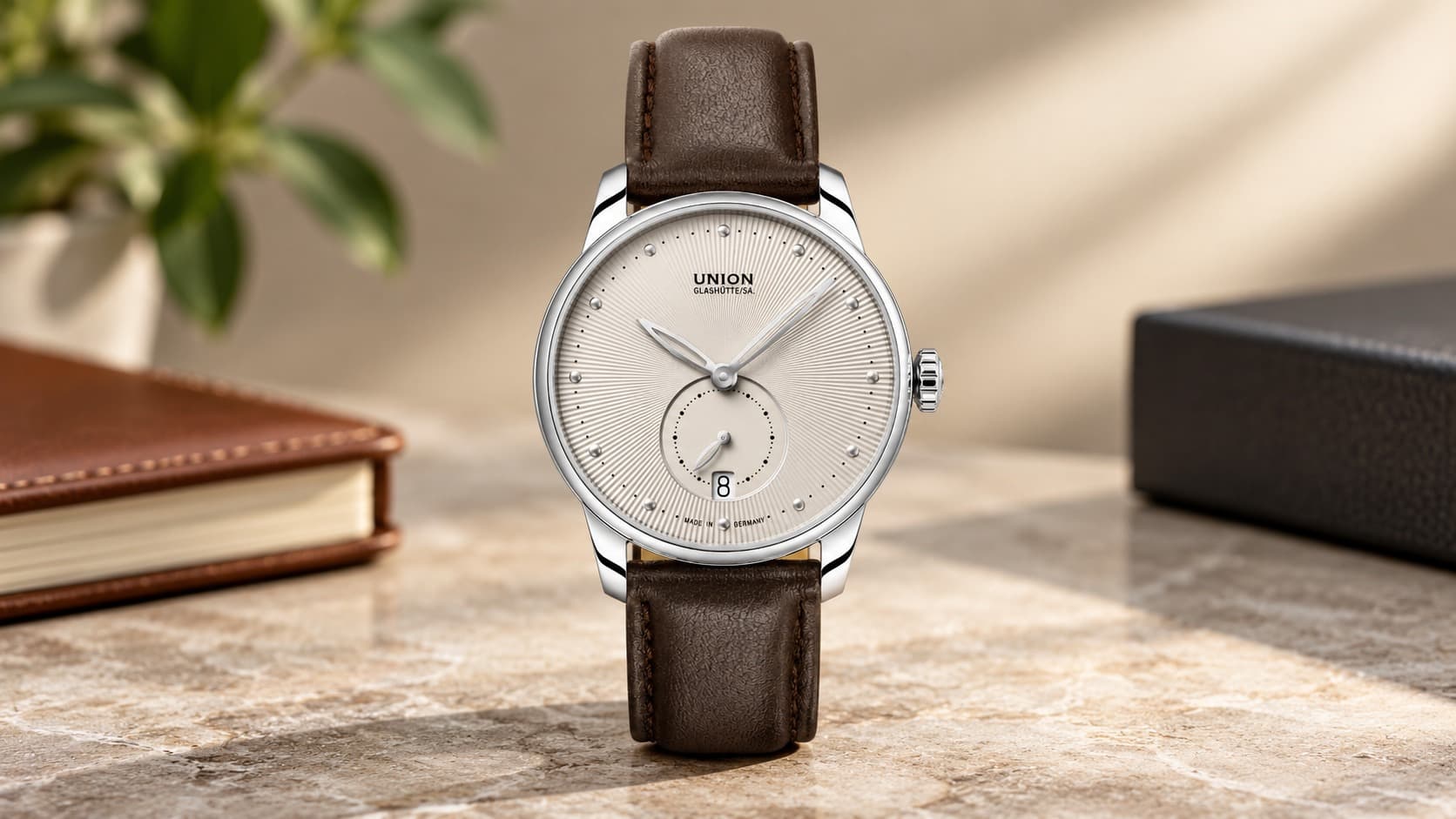
Union Glashütte sits in an unusual spot in German watchmaking. It carries the same hometown as Glashütte Original and A. Lange & Söhne, two of the most respected names in fine horology, yet its watches cost a fraction of what those brands charge. That combination of genuine Saxon pedigree and realistic pricing has made Union Glashütte one of the better entry points into German watchmaking for people who want something more substantial than a mass-market brand, but who aren’t ready to spend five figures. Understanding which collections the brand makes, what powers them, and where the real value sits makes it much easier to pick a model suited to how it will actually be worn.
Union Glashütte vs. Other German Watch Brands
Union Glashütte builds every current watch with a mechanical movement, assembled and finished in the town of Glashütte, Saxony. That single fact separates it from most watch brands in its price range, which rely on quartz movements or outsourced assembly.
German law requires that any watch using the name “Glashütte” must contain components worth at least 50% of its total value that were actually produced in that town. Union Glashütte builds to that standard across its whole catalog, which is part of why the brand can legally and honestly use the Glashütte name on its dials. The company does this while keeping prices between roughly €1,500 and €4,500 for most regular production pieces, which is remarkably accessible next to its sister brand Glashütte Original or neighbors like Nomos.
The brand’s long-time CEO, Franz Linder, has also overseen a push to grow Union Glashütte’s presence outside Germany, especially in China, where it’s often sold as a secondary or complementary brand rather than a customer’s first watch purchase. That international push, combined with a steady run of rally-themed limited editions, has kept the brand active and visible without ever abandoning its affordable-luxury roots.
The History of Union Glashütte
Johannes Dürrstein founded the company in 1893 as “Glashütter Uhrenfabrik Union,” with the goal of making genuinely high-quality Glashütte watches that ordinary customers could actually afford. Before that, in 1880, he had already been selling watches under the Union name as a Dresden-based watch wholesaler, so by the time the Glashütte factory opened, he already understood the market he was building for.
Dürrstein worked closely with master watchmaker Julius Bergter, and the young company produced everything from simple pocket watches to marine chronometers, ultra-thin pocket watch movements, and observation watches added to the range around 1900. The brand registered a stylized temple as its trademark, and its pocket watches carried a distinctive bell-and-five-stars mark on both the case and movement to certify their origin. One especially complex piece, the “Universaluhr” built around 1900 with an alarm function, still stands out as proof of how ambitious the original workshop could be.
The brand didn’t survive the economic chaos between the two World Wars, and it was eventually removed from the German commercial register entirely. For decades, the Union name sat dormant. It came back to life in 1996 as a subsidiary of Glashütte Original, using Glashütte Original’s own movement architecture in its early watches, and in 2000 it became part of the Swatch Group, the same parent company behind brands like Omega, Longines, and Tissot. Union Glashütte opened its own dedicated production facility in the town in 2008, and moved into a larger, more modern workshop at Frühlingsweg 5 in 2012, where its watches are still assembled today.
Dürrstein is often credited with a simple founding philosophy: strip away anything that makes a watch needlessly expensive, while keeping everything that makes it beautiful and precise.
In 2018, the German Watch Museum in Glashütte marked the brand’s 125th anniversary with a dedicated exhibition, a sign that Union’s long and complicated history is taken seriously by the wider watch world, even if the brand itself stays relatively under the radar. Vintage collectors still single out the old Julius Bergter Edition models from the brand’s revival years as some of the most finely finished watches Union has ever produced, closer in quality to full Glashütte Original pieces than to the rest of the modern lineup.
Best Union Glashütte Watch Collections
Union Glashütte currently organizes its watches into a handful of distinct lines. Each one has its own look and purpose, so knowing the difference matters more than knowing individual reference numbers.
Noramis: Union Glashütte’s Vintage Line
The Noramis line pulls its design straight from the 1950s and 1960s, with domed sapphire crystals, mushroom-shaped chronograph pushers, and dial layouts that feel like they belong in a vintage catalog. It comes as a simple three-hand watch, a date model, a Big Date, a Power Reserve, and a chronograph, with case sizes typically around 40mm to 42mm.
The Noramis Chronograph is the line’s standout piece. It runs on the caliber UNG-27.S2, Union’s own regulated version of the Valjoux 7753 architecture, with a silicon balance spring and around 60 hours of power reserve. Regular production versions generally run between €2,950 and €3,600, while limited editions tied to classic car rallies like the Sachsen Classic have pushed closer to €3,900 in recent years. The date position actually changes across the family: it sits at three o’clock on the Date, Big Date, and Power Reserve models, but moves to six o’clock on the Chronograph, a small detail that’s easy to miss when comparing listings online. For buyers who want to move up in materials rather than complications, Union has also released a Noramis in solid rose gold, priced around €4,900 and built on a finished ETA 2892 movement. There’s also a Noramis Chronograph Sport variant for anyone who needs more water resistance: it swaps in a black ceramic rotating bezel and a screw-down crown, pushing water resistance up to 20 bar (200m), well beyond the 10 bar rating on the standard Noramis Chronograph.
Belisar: Union Glashütte’s Sport Watches
Belisar is the line for people who want a chronograph or GMT that can take a bit more abuse. It’s built with screw-down case flanks and a more rugged, masculine look than the Noramis, while still keeping a mechanical movement inside and typically offering 10 bar (100m) of water resistance.
Within Belisar, the Chronograph Moon Phase model is the most expensive regular-production piece in the brand’s lineup, priced at just under €4,500. The standard Belisar Chronograph sits closer to €2,950 to €3,100, using the same family of chronograph calibers found in the Noramis, while the Belisar GMT adds a second time zone for anyone who needs to track time across regions. The screw-down case construction and the range of case finishes and strap combinations available across Belisar are part of why this line tends to appeal to buyers who treat their watch as daily gear rather than an occasional dress accessory.
1893 Watches: Union Glashütte’s Roots
Named after the brand’s founding year, the 1893 collection leans the hardest into Union’s history. Several models use hand-wound movements with small or large seconds subdials, styled after the brand’s original pocket watch layouts from the late 1800s.
This is also where the brand’s most affordable watch lives. A simple 1893 three-hand model with a small seconds dial starts at just under €1,500, making it the cheapest way into genuine Glashütte watchmaking from this brand. One recent anniversary release split this same idea into two sizes: a 34mm Small Second and a 41mm Large Second, each limited to 99 pieces and marking what would have been Dürrstein’s 180th birthday. At the other extreme, the limited-edition 1893 Johannes Dürrstein Edition Double Moon Phase, built on a newly developed hand-wound caliber (UN-58.S2) with a full calendar and a gold central date hand, is currently Union’s most expensive watch at €13,900, limited to 131 pieces.
Viro: Union Glashütte’s Entry-Level Watches
Viro is the brand’s entry-level, no-frills line, available as either a date model or a chronograph. It keeps things simple with a straightforward dial layout and a smaller case, which makes it a sensible pick for someone who wants a Union Glashütte watch purely for daily wear rather than as a statement piece. Date placement differs by model here too: it sits at six o’clock on the Viro Date and moves to three o’clock on the Viro Chronograph, the same kind of small layout shift seen across the Noramis family.
Seris, Sirona, and Averin
Seris and Sirona are Union’s main collections built around women’s sizing, with smaller cases and dial designs aimed at that market, while Averin is a newer, square-cased chronograph line that stands out visually from the rest of the brand’s mostly round watches. First launched in 2008 and resized in its current generation to a 41mm x 41mm case, the Averin Chronograph runs on the UNG-27.S2 caliber with a silicon balance spring, a power reserve of up to 65 hours, and 10 bar of water resistance, while the Averin Chronograph Moon Phase uses the related UNG-25.S1 caliber instead. The line has also appeared in its own rally-themed limited editions, following the same pattern as the Noramis and Belisar lines.
Pricing and positioning vary widely across the six collections:
| Collection | Style | Typical Price Range | Best For |
|---|---|---|---|
| 1893 | Heritage, hand-wound options | €1,500 – €13,900 | Traditional looks, entry pricing |
| Noramis | Retro 1950s–60s inspired | €1,600 – €4,900 | Vintage-style chronographs |
| Belisar | Sporty, rugged | €2,000 – €4,500 | Everyday chronograph wear |
| Viro | Simple, basic | Entry-level | First mechanical watch |
| Averin | Square-cased, modern | Mid-range | A different silhouette |
| Seris / Sirona | Women’s sizing | Varies by model | Women’s dress and casual wear |
Union Glashütte Limited Editions and Rally Partnerships
Union Glashütte has built a steady side-business out of limited editions tied to classic car rallies, mostly across Germany. The Sachsen Classic, Silvretta Classic, and Deutschland Klassik events have each produced their own Noramis or Belisar variants over the years, usually limited to a few hundred pieces, with colorways and dial details inspired by motorsport from the 1960s through the 1980s.
These editions tend to sell in the same €2,900 to €3,900 range as the standard Noramis and Belisar chronographs, so buyers aren’t paying a huge premium just for the limited-run status. What they are paying for is a slightly different look, usually built around racing colors like orange and light blue, or a special dial finish referencing the car grille styling of a particular era. For collectors who like the brand’s regular lineup but want something a little rarer, these rally editions are worth checking before buying the standard version, since the production numbers mean they tend to stay distinctive on the wrist.
Union Glashütte Movements Explained
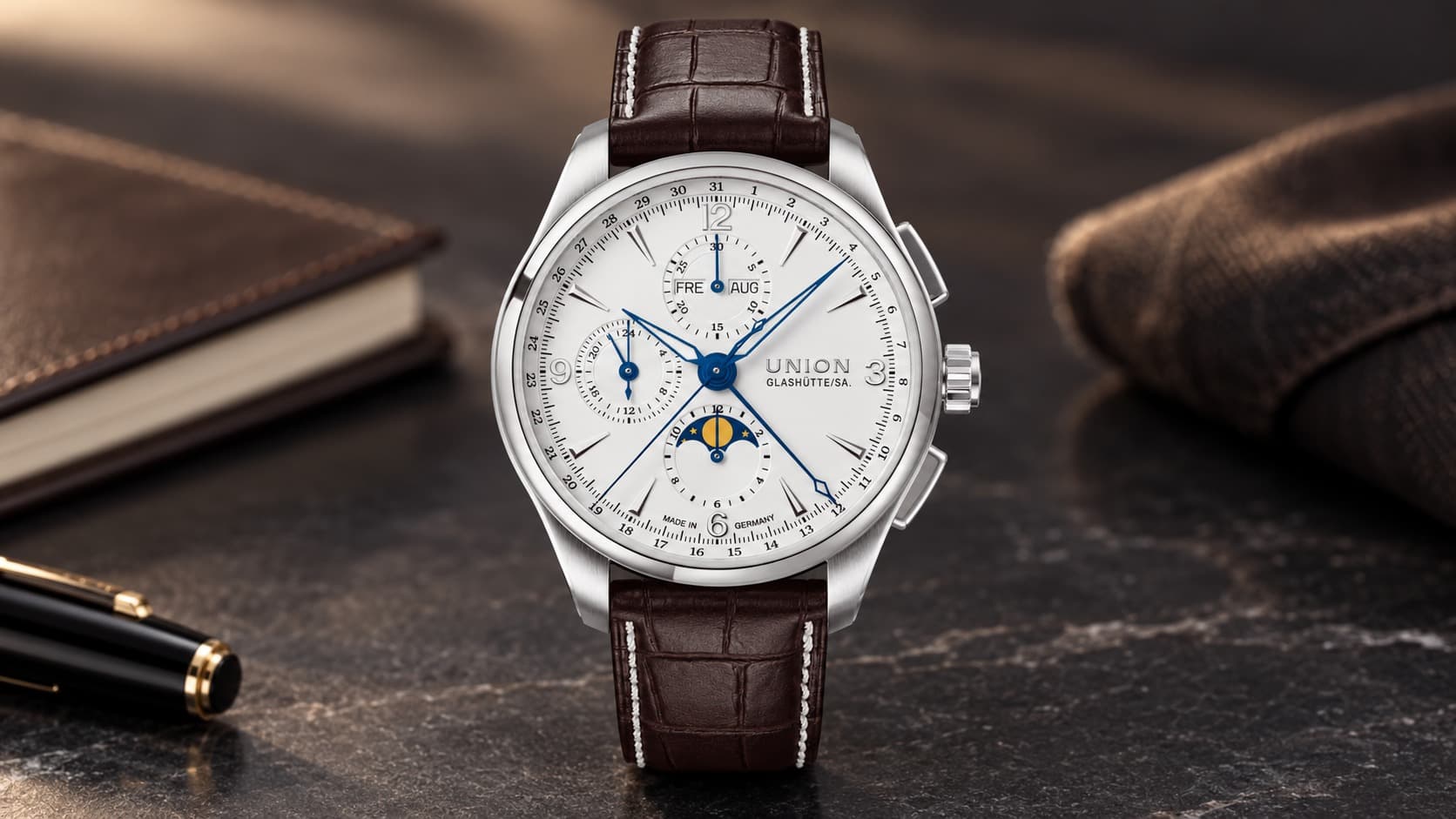
Union Glashütte does not build fully in-house movements the way Glashütte Original or Nomos do. Instead, it takes established Swiss architectures, mostly from ETA, Valjoux, and Sellita, all of which belong to the Swatch Group alongside Union, and then regulates, modifies, and finishes them in its own Glashütte workshop.
The brand’s chronograph movements, labeled things like UNG-27.S1 and UNG-27.S2, are built on the long-running Valjoux 7750/7753 family. Several calibers across the lineup use silicon balance springs, which don’t react to magnetic fields the way traditional metal springs do, so the watch keeps better time if it sits near a phone, laptop, or speaker. The hand-wound UNG-56.S1 used in parts of the 1893 collection is a good example of how far Union pushes these modifications: at just 30mm wide and 5.2mm tall, it carries a small seconds display, a power reserve indicator, and an indexless regulation system, alongside the same silicon hairspring technology. While these movements aren’t COSC-certified chronometers, Union Glashütte regulates them internally to similar accuracy standards, typically within a few seconds a day.
Every movement that qualifies for the Glashütte name gets the traditional decorative touches associated with Saxon watchmaking, including perlage finishing, blued screws, and striped bridges, visible through the sapphire case backs on most models. Older Union watches, made before 2007, used an earlier in-house chronograph design called Caliber 26, which was built on the same architecture as the Glashütte Original Caliber 39. Those pieces now mostly circulate on the secondary market and are worth noting for anyone specifically hunting for a vintage Union chronograph rather than a current model.
How Much Does a Union Glashütte Watch Cost?
Most Union Glashütte watches fall between €1,500 and €4,500 at retail. The cheapest entry point is the 1893 three-hand small seconds model at just under €1,500, while the Belisar Chronograph Moon Phase tops the regular catalog at roughly €4,500. Limited editions, especially those built around the brand’s classic car rally partnerships or anniversary pieces, can run higher, with the most expensive current model, the 1893 Johannes Dürrstein Double Moon Phase, priced at €13,900 for a limited run of 131 watches.
That pricing puts Union Glashütte well below its sister brand Glashütte Original, which often starts well into five figures, while still offering a genuine mechanical movement finished in the same small Saxon town.
Is Union Glashütte a Good Watch Brand?
Union Glashütte makes sense for someone who wants real German watchmaking heritage without paying for a fully in-house movement. Because it shares ownership and some movement architecture with other Swatch Group brands, it benefits from the group’s manufacturing scale while still finishing and regulating watches locally in Glashütte.
It’s a smaller, lesser-known name compared to brands like Omega or Longines, so resale value and brand recognition are more limited by comparison. For buyers who care more about the watch itself, the history behind it, and getting a mechanical movement finished to Glashütte standards at a reasonable price, it’s a genuinely solid option.
Availability is a practical consideration, too: Union Glashütte’s retail footprint is much smaller than Omega’s or Longines’s, so not every city will have a nearby authorized dealer. Checking a dealer locator or trying a model on in person before ordering is worth the extra step, since options for seeing the watch firsthand are more limited than with bigger Swatch Group names.
Frequently Asked Questions
Is Union Glashütte owned by Glashütte Original?
Not directly anymore. Union Glashütte was revived as a subsidiary of Glashütte Original in 1996, but both brands became separate entities under the Swatch Group umbrella after the group acquired Union in 2000. They remain sister brands within the same parent company rather than one owning the other.
Does Union Glashütte make its own movements?
Union Glashütte doesn’t build fully in-house movements from scratch. It takes base architectures from Swatch Group’s movement suppliers, mainly ETA, Valjoux, and Sellita, then modifies, regulates, and finishes them at its own facility in Glashütte, often adding features like silicon balance springs.
What’s the cheapest Union Glashütte watch?
The most affordable model is a three-hand watch from the 1893 collection with a small seconds subdial, priced at just under €1,500. It’s also the simplest watch in the current lineup, which helps keep the cost down.
Are Union Glashütte watches a good investment?
Union Glashütte watches are not known for strong resale value or price appreciation the way brands like Rolex or Patek Philippe are. They’re better suited to buyers who want to wear and enjoy a mechanical German watch rather than treat it as a financial asset.
What does the “Union Glashütte” name on the dial actually guarantee?
German regulation requires that any watch using the Glashütte name must have at least 50% of its component value produced in that town. So the name on the dial is a legal guarantee of real local manufacturing, not just a marketing label.
The Bottom Line
Union Glashütte occupies a genuinely useful niche: real mechanical movements, finished to a legally protected regional standard, at prices that don’t require a five-figure budget. The 1893 line is the place to start if price matters most, the Noramis delivers the strongest retro chronograph design, and the Belisar line is the pick for anyone who wants something sturdier for daily wear. Whichever collection a buyer lands on, they’re buying into a brand that survived two collapses and a 60-year disappearance to still be building watches in the same small Saxon town where it started in 1893.