Most mechanical watches you can buy today were built in Switzerland, Japan, or Germany, which is part of why Weiss Watch Company stands out. It’s one of the very few brands actually building watches by hand in the United States, from the case to the dial to the movement parts inside. Founded by a watchmaker who started fixing watches at age five, Weiss has grown from a dining-room hobby into one of the most talked-about names in American horology, and its watches are worth understanding whether you’re a longtime collector or just curious what all the fuss is about.
An Overview of Weiss Watches
Weiss Watch Company makes mechanical field watches and dive watches by hand in Nashville, Tennessee. Every piece is assembled, finished, and tested in the same workshop, using a mix of American-made and imported Swiss parts, and each watch takes many hours of hand labor before it’s ready to leave the building.
That slow, hands-on approach is unusual in an industry where most watches are mass-produced on assembly lines. Weiss builds in small batches, sometimes just a few dozen pieces at a time, which is a big part of why the brand has built such a loyal following among people who care about how and where their watch was actually made. The company doesn’t just assemble watches from parts bought elsewhere, either. It manufactures many of its own components, including certain movement parts, right there in its own facility.
Weiss Watch Company’s History
Weiss Watch Company was founded in 2013 by Cameron Weiss, a watchmaker trained in Switzerland who started the whole thing at a market stall in San Francisco with just ten watches. Those first ten pieces, all Standard Issue Field Watches, took roughly 300 hours to hand-finish and assemble, and they were literally built in his dining room while his wife, Whitney, and their Labrador, Jules, were nearby.
Cameron’s obsession with watches goes back to childhood. He reportedly tried to fix his own watch at age five, and instead of asking for a car or a trip for his high school graduation, he asked his parents for watchmaking tools and books. He carried that passion through college at the University of Southern California and later trained through the Watchmakers of Switzerland Training and Educational Program (WOSTEP) at the Nicolas G. Hayek Watchmaking School in Florida, earning the kind of formal certification that most American watch brand founders simply don’t have. Some accounts of his background also point to time spent honing his craft with major Swiss maisons before he struck out on his own.
The company started in Torrance and Los Angeles, California, before relocating to Nashville, Tennessee, where it remains today. Weiss opened its Nashville workshop to the public and now offers private in-studio appointments, letting visitors see the watches being built and even sit down with the team that makes them. More than a decade after that market stall in San Francisco, the company is still independently owned and led by Cameron Weiss himself, and it has grown into arguably the largest producer of mechanical watches manufactured on American soil.
Why Weiss Watches Stand Out
Weiss watches stand out because they’re built almost entirely by hand in an American workshop, at a time when nearly every other mechanical watch brand outsources production overseas. That single fact shapes everything else about the brand, from its prices to its production numbers to the way it talks about its watches, and it separates Weiss from other independent watch brands in a few concrete ways:
- American manufacturing. Weiss makes select movement components, cases, and dials domestically, and discloses which parts are American-made versus imported on a model-by-model basis, rather than hiding behind a vague “Swiss Made” style label.
- True hand-assembly. Every watch is put together, regulated, and tested by hand rather than on an automated line, which is part of why production numbers stay relatively low.
- In-house movement work. While some components are based on Swiss ébauches (unfinished movement blanks) like the Unitas 6497 or Soprod M100, Weiss re-finishes, decorates, and assembles these movements itself, and brands them with its own caliber names.
- Design rooted in American history. The watches borrow heavily from vintage American field gear, military instruments, and aviation gauges, giving them a utilitarian, no-nonsense look rather than a dressy or flashy one.
- Small, family-owned operation. Unlike watch brands owned by giant conglomerates, Weiss is still privately run by its founder, which means design decisions come from one consistent point of view rather than a committee.
Weiss is one of the only companies in the world building both the case components and certain movement parts of its watches domestically, a combination almost no other American brand attempts at this scale.
Plenty of brands use quality Swiss movement blanks, and plenty of small companies are family-run, but few combine both traits at once inside a single small workshop, on watches still priced well below most Swiss competitors offering comparable hand-finishing.
Top 10 Best Weiss Watches
Weiss keeps its lineup fairly focused rather than releasing dozens of unrelated collections, so the best watches from the brand tend to be the standout versions within its core Field Watch and Dive Watch families.
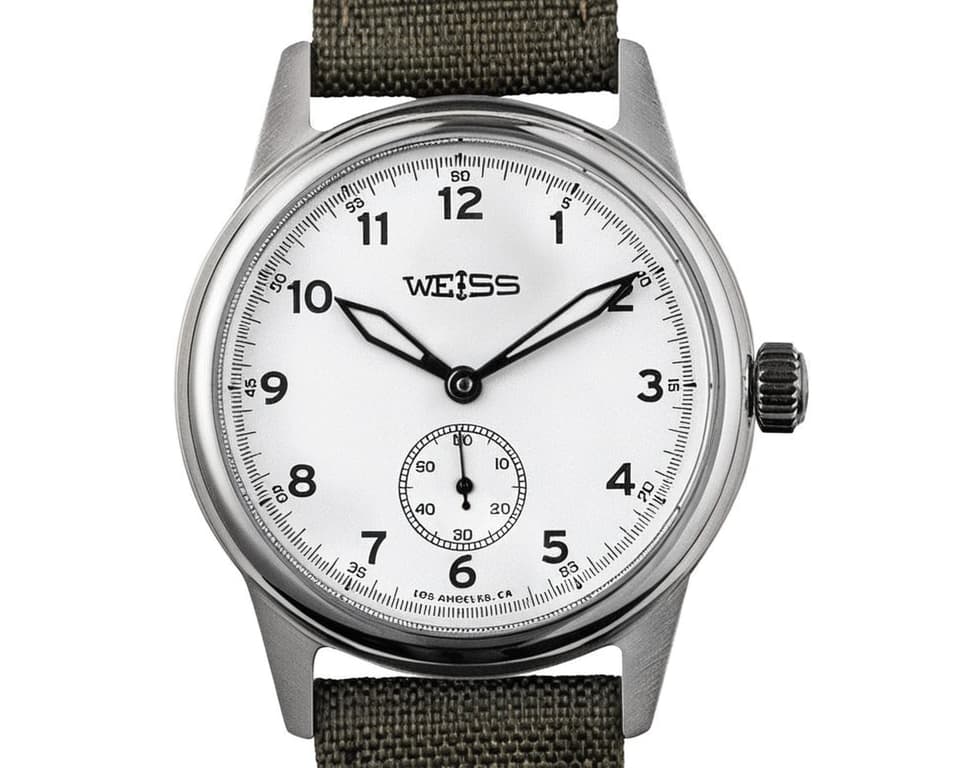
1. 38mm Standard Issue Field Watch (Manual Wind)
This is the original watch that started the company, and it’s still one of the best entry points into the brand. It runs on the hand-wound Weiss Caliber 1005, built on an ETA/Peseux 7001 base, with a small seconds subdial at 6 o’clock and a clean, legible field-watch dial.
| Spec | Detail |
|---|---|
| Case size | 38mm diameter, 9.7mm thick |
| Case material | 316L stainless steel |
| Movement | Weiss Caliber 1005 (ETA/Peseux 7001 base), manual wind |
| Power reserve | 42 hours |
| Water resistance | 100m / 330ft |
| Crystal | Double-domed sapphire, front and exhibition caseback |
2. 42mm Standard Issue Field Watch (Manual Wind)
The larger sibling of the 38mm model, this version uses the Weiss Caliber 1001, based on an ETA/Unitas 6497 movement, with the small seconds dial positioned at 9 o’clock instead of 6. It’s the same core concept scaled up for wrists that prefer a bigger case.
| Spec | Detail |
|---|---|
| Case size | 42mm diameter, 12.9mm thick |
| Case material | 316L stainless steel |
| Movement | Weiss Caliber 1001 (ETA/Unitas 6497 base), manual wind |
| Power reserve | 46 hours |
| Water resistance | 100m / 330ft |
| Crystal | Double-domed sapphire, front and exhibition caseback |
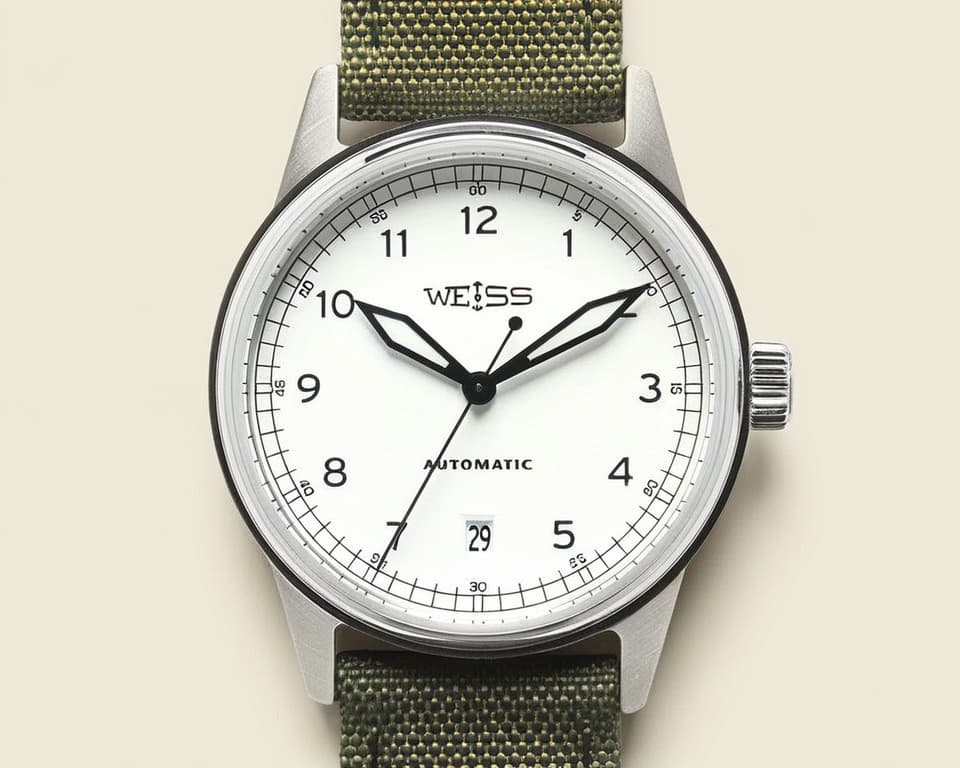
3. 38mm Automatic Standard Issue Field Watch
For people who don’t want to hand-wind their watch every day, Weiss offers an automatic version using its Caliber 2130, a Swiss-based automatic movement. It adds a date window and a three-hand layout while keeping the same rugged field-watch styling.
| Spec | Detail |
|---|---|
| Case size | 38mm diameter |
| Case material | 316L stainless steel |
| Movement | Weiss Caliber 2130, automatic |
| Power reserve | 42 hours |
| Water resistance | 100m / 330ft |
| Complications | Date window, sweep seconds |
4. 42mm Automatic Standard Issue Field Watch
This is the larger automatic option, also built around the Weiss Caliber 2130. It’s one of the most popular sizes in the current lineup, striking a balance between comfortable daily wear and old-school military watch proportions.
| Spec | Detail |
|---|---|
| Case size | 42mm diameter |
| Case material | 316L stainless steel |
| Movement | Weiss Caliber 2130, automatic |
| Power reserve | 42 hours |
| Water resistance | 300ft (~91m) |
| Complications | Date window, sweep seconds |
5. 42mm Standard Issue Dive Watch
Released in October 2022, this was Weiss’s first true dive watch, and it meets ISO 6425 dive watch standards, meaning it has to pass real depth, legibility, and magnetic resistance testing to earn that badge. It’s water resistant to 300 meters and available in several dial colors, including white, black, blue, and yellow.
| Spec | Detail |
|---|---|
| Case size | 42mm diameter |
| Case material | 316L stainless steel |
| Movement | Weiss Caliber 2120, automatic |
| Water resistance | 300m, ISO 6425 rated |
| Dial colors | White, black, blue, yellow |
| Strap options | Natural rubber or stainless steel bracelet |
6. Standard Issue Dive Watch, Agave Dial (Limited Edition)
A limited-run version of the dive watch featuring a distinctive textured green “agave” dial, this piece shows how Weiss occasionally uses special dial finishes to create smaller, more collectible editions without changing the underlying watch or movement.
| Spec | Detail |
|---|---|
| Case size | 42mm diameter |
| Case material | 316L stainless steel |
| Movement | Weiss Caliber 2120, automatic |
| Water resistance | 300m, ISO 6425 rated |
| Dial | Textured green “agave” finish |
| Availability | Limited production run |
7. 38mm Titanium Field Watch, Blue Ocean (Limited Edition)
Limited to just 30 pieces, this titanium-cased version of the manual field watch weighs under 50 grams, making it remarkably light on the wrist. Its light blue dial with high-contrast lume is one of the most legible dials the brand has produced.
| Spec | Detail |
|---|---|
| Case size | 38mm diameter, 46.2mm lug-to-lug |
| Case material | Titanium |
| Movement | Weiss Caliber 1005 (7001 base), manual wind |
| Weight | ~46g with strap |
| Water resistance | 100m / 330ft |
| Edition size | 30 pieces |
8. 38mm Titanium Field Watch, Pink Sand (Limited Edition)
Released alongside the Blue Ocean as a companion limited edition, also capped at 30 pieces, this version swaps in a warm, sandy-toned dial while keeping the same lightweight titanium case and manual movement.
| Spec | Detail |
|---|---|
| Case size | 38mm diameter, 46.2mm lug-to-lug |
| Case material | Titanium |
| Movement | Weiss Caliber 1005 (7001 base), manual wind |
| Weight | ~46g with strap |
| Water resistance | 100m / 330ft |
| Edition size | 30 pieces |
9. 42mm Titanium Field Watch (Carbon or Agave Dial)
Beyond the small limited runs, Weiss also offers a full-size 42mm titanium field watch with either a carbon-fiber-style or agave dial option, giving buyers a lighter-weight alternative to the standard steel case in the larger size.
| Spec | Detail |
|---|---|
| Case size | 42mm diameter |
| Case material | Titanium |
| Movement | Weiss Caliber 1001 (6497 base), manual wind |
| Water resistance | 100m / 330ft, consistent with the steel 42mm model |
| Dial options | Carbon-fiber-style or agave finish |
10. 42mm Field Watch, Chase Rice Edition
A collaboration edition built on the standard 42mm field watch platform, this model shows how Weiss occasionally partners on special-edition releases while keeping the core case and movement construction consistent with the rest of the lineup.
| Spec | Detail |
|---|---|
| Case size | 42mm diameter, 12.9mm thick |
| Case material | 316L stainless steel |
| Movement | Weiss Caliber 1001-2 (6497 base), manual wind |
| Power reserve | 46 hours |
| Water resistance | 100m / 330ft |
| Availability | Collaboration limited edition |
Tips for Choosing the Right Weiss Watch
The most important thing to figure out before buying a Weiss watch is which case size and winding style actually fits how you live, since the brand’s lineup is built around a fairly narrow set of core options rather than dozens of styles. A few factors decide which model makes sense:
- Manual wind vs. automatic. A manual watch needs to be wound by hand roughly once a day, which some people genuinely enjoy as a small daily ritual. An automatic winds itself as you move your wrist, which is more convenient if you don’t want to think about it.
- Case size. Weiss’s core sizes are 38mm and 42mm. The 38mm size wears smaller and more vintage-inspired, while the 42mm size feels closer to a modern field or tool watch.
- Case material. Standard models use 316L stainless steel, which is tough and affordable to service. Titanium versions are noticeably lighter and more resistant to corrosion, but they typically cost more.
- Water resistance needs. The Field Watch line is built for everyday wear but isn’t a dedicated dive watch. If you actually plan to swim or dive, the Standard Issue Dive Watch, rated to 300 meters and built to ISO 6425 standards, is the more appropriate choice.
- Limited edition vs. standard production. Limited runs, like the titanium Blue Ocean or Pink Sand editions, can sell out and become harder to find later. Standard catalog pieces are easier to order and, in most cases, easier to get serviced long-term since parts stay in regular production.
- Lead time. Because these watches are hand-built in small batches, some models are made to order or have a waiting list rather than sitting in stock ready to ship immediately.
Weighing these factors together usually points toward one of two paths: a standard 38mm or 42mm steel Field Watch for buyers who want a dependable everyday piece with straightforward long-term servicing, or a titanium or dive-focused model for buyers prioritizing weight, water resistance, or exclusivity. Either way, matching the watch to actual daily habits matters more than chasing whichever model looks best in photos.
Where to Buy a Weiss Watch
Weiss watches are sold directly through the brand’s own website and through private appointments at its Nashville, Tennessee studio, where visitors can view the current collection and try pieces on in person before buying. The company has also stated that its timepieces are available through a very limited number of hand-selected authorized retailers, so a small piece can turn up outside the brand’s own channels, but the studio and website remain the primary way most buyers interact with the brand.
Buying direct, whether online or in the Nashville studio, is the most reliable way to make sure a watch is genuine and fully covered under the manufacturer’s warranty. Weiss maintains a dedicated counterfeit warning page on its own site, which is a sign that fakes of a small independent brand exist too, not just of the big Swiss names. If you’re shopping secondhand through a private seller or a general watch marketplace, it’s worth asking for the original box, papers, and purchase receipt, and checking that the serial or reference details on the watch match what the seller describes, since resale listings don’t come with the same guarantees as buying new.
What Weiss Watches Are Worth Later
Weiss watches are not designed primarily as investment vehicles. Like most independent microbrands, they don’t have the decades of auction history or brand recognition that drive strong resale premiums the way certain vintage Rolex or Patek Philippe models do.
That said, a few factors do support decent resale value within the niche American-watchmaking collector community. Limited-edition pieces, like the 30-piece titanium runs, tend to hold interest better than standard catalog models simply because there are fewer of them. Secondhand listings for the standard Field Watch have shown up on watch forums and resale marketplaces starting in the neighborhood of $1,500, which suggests the brand does retain meaningful value on the used market rather than dropping off sharply the way many fashion-watch brands do. The brand’s growing reputation as one of the only companies actually manufacturing mechanical watch components in the United States has also built a loyal, engaged fanbase that keeps demand relatively steady on the secondhand market. Still, buyers should think of a Weiss watch primarily as a well-made object to own and wear for years, not as a financial asset expected to appreciate.
Keeping Your Weiss Watch in Top Shape
A Weiss watch needs the same basic care as any quality mechanical watch: keep it away from strong magnets, avoid extreme temperature swings, and get it serviced on a regular schedule rather than waiting until something goes wrong. Mechanical movements have dozens of tiny moving parts that need fresh lubrication over time, so regular servicing isn’t optional if you want the watch to keep accurate time for decades. A handful of specific habits make the biggest difference in how long one of these watches keeps running well:
- Wind manual models gently. Manual-wind Weiss watches should be wound at roughly the same time each day, and you should stop as soon as you feel resistance at the end of the winding range rather than forcing it further.
- Mind the water resistance rating. The Field Watch line isn’t built for swimming or diving, even though it can handle rain or hand-washing. Save water exposure for the dedicated Dive Watch model, and even then, avoid adjusting the crown while the watch is wet.
- Store it properly. When not being worn, keep the watch somewhere dry and away from direct sunlight, which can fade certain dial finishes over time.
- Service on a schedule. Most mechanical watches, Weiss included, benefit from a full service roughly every three to five years, depending on how often the watch is worn.
- Use genuine parts. Because Weiss manufactures some of its own components, working with the brand’s own service department (rather than a generic local watch repair shop) is usually the safest way to keep a watch running the way it was designed to.
A couple of everyday tools also make ongoing care easier without any real cost or hassle. A soft microfiber cloth is enough to wipe down the case and crystal after wear and keep smudges from building up, and a small dry-storage box or pouch with a silica gel packet helps control humidity around the watch when it’s not being worn. Owners of the automatic models sometimes use a watch winder to keep the movement running during stretches when the watch sits unworn, though it’s entirely optional. A watch that’s worn regularly generally keeps better time and needs a winder far less than one that spends most of its life in a drawer.
A mechanical movement is a genuinely delicate piece of machinery, so this maintenance routine matters more here than it would with a mass-produced quartz watch. Treated well, a Weiss watch is built to keep working for decades and to eventually get passed down rather than replaced.
Frequently Asked Questions
A handful of questions come up again and again from people first learning about Weiss, mostly around what “American made” really means for the brand and how the watches hold up over time.
Are Weiss watches actually made in America?
Yes, Weiss designs, assembles, finishes, and tests its watches by hand in its Nashville, Tennessee workshop, and it manufactures a number of its own components domestically, though it also uses some imported Swiss parts, which the brand discloses model by model.
Who founded Weiss Watch Company?
Cameron Weiss founded the company in 2013 after training as a watchmaker in the United States and Switzerland, including certification through the WOSTEP program. He remains the company’s owner and lead watchmaker today.
What movements do Weiss watches use?
Weiss builds its calibers around Swiss movement blanks, using a 7001 base for its 38mm manual watches, a Unitas 6497 base for its 42mm manual watches, and a Swiss automatic base movement for its automatic watches, then finishes and assembles each movement by hand in-house.
Is the Weiss Dive Watch actually safe for diving?
Yes, the Standard Issue Dive Watch is rated water resistant to 300 meters and is built to meet ISO 6425, the international standard that dive watches must pass in categories like pressure resistance, legibility underwater, and magnetic resistance.
Are Weiss watches a good investment?
Not primarily. Weiss watches are best thought of as well-made, hand-built timepieces meant to be worn and eventually passed down, rather than assets bought to flip for profit. Limited editions can hold collector interest better than standard models, but strong resale appreciation isn’t guaranteed.
Conclusion
Weiss Watch Company has carved out a genuinely rare spot in the watch world by building mechanical timepieces almost entirely by hand on American soil, starting from a dining-room table in 2013 and growing into one of the country’s most respected independent watchmakers. Its strength isn’t a huge, sprawling catalog, it’s a tightly focused lineup of Field and Dive watches built around real in-house craftsmanship, disclosed materials, and a founder who still personally shapes the brand’s direction. If you’re drawn to the idea of owning a mechanical watch with a clear, honest story behind exactly who built it and where, Weiss remains one of the most compelling American names to know.